From Surf Wiki (app.surf) — the open knowledge base
Varsity Stadium
Football stadium at the University of Toronto St. George

Football stadium at the University of Toronto St. George
| Field | Value | |
|---|---|---|
| name | Varsity Stadium | |
| logo_image | Toronto varsityblues wmark.svg | |
| logo_size | 100 | |
| image | Varsity Centre.JPG | |
| image_size | 250 | |
| caption | The stadium as seen in 2009 | |
| type | Stadium | |
| current_use | Football | |
| Soccer | ||
| Rugby union | ||
| address | 299 Bloor Street West | |
| city | Toronto, Ontario | |
| country | Canada | |
| coordinates | ||
| pushpin_map | Canada Toronto#Canada Ontario#Canada | |
| pushpin_relief | yes | |
| pushpin_map_caption | Location in Toronto##Location in Ontario##Location in Canada | |
| public_transit | St. George | |
| opened | 1898 (athletic grounds) | |
| 1911 (first stadium) | ||
| 2007 (present stadium) | ||
| expanded | 1924, 1950 | |
| demolished | 2002 (first stadium) | |
| owner | University of Toronto | |
| operator | University of Toronto Athletics | |
| surface | Grass (1898–2005) | |
| Polytan Ligaturf (2006–2024) | ||
| FieldTurf Vertex CORE (2024–present) | ||
| construction_cost | $61.7 million | |
| architect | Craig and Madill (1929–1930) | |
| Diamond+Schmitt Architects (2007) | ||
| tenants | {{plainlist | |
| seating_capacity | 500 (1898–1910) | |
| 10,500 (1911–23) | ||
| 16,000 (1924–49) | ||
| 21,739 (1950–2001) | ||
| 1,500 (2003–05) | ||
| 5,000 (2007–present) |
the stadium in Toronto
Soccer Rugby union 1911 (first stadium) 2007 (present stadium) Polytan Ligaturf (2006–2024) FieldTurf Vertex CORE (2024–present) Diamond+Schmitt Architects (2007)
- Toronto Varsity Blues (U Sports) teams:
- football, soccer, rugby (1898–present)
- Toronto Rush (UFA) (2013–2017, 2019–present)
- North Toronto Nitros (L1O) (2016–2018)
- Toronto Lynx (USL) (1997–2001)
- Toronto Blizzard (NASL/APSL) (1984, 1993)
- Toronto Metros-Croatia (NASL) (1975–78)
- Toronto Rifles (ConFL) (1966–1967)
- Toronto City (USA) (1967)
- Toronto Falcons (NPSL/NASL) (1967–68)
- Toronto Argonauts (IRFU/CFL) (1898–1907, 1916–1958)
- Vanier Cup (1965–72, 1976–88) 10,500 (1911–23) 16,000 (1924–49) 21,739 (1950–2001) 1,500 (2003–05) 5,000 (2007–present) Varsity Stadium is an outdoor collegiate stadium located in Toronto, Ontario, Canada. It is located at the "Varsity Centre & Arena", a sports complex on the University of Toronto St. George campus. Athletic events have been hosted on the site since 1898; the current stadium was built in 2007 to replace the original permanent stadium built in 1911. Varsity Stadium is also a former home of the Toronto Argonauts, and has previously hosted the Grey Cup, the Vanier Cup, several matches of the 1976 Summer Olympics soccer tournament, and the final game of the North American Soccer League's 1984 Soccer Bowl series (which was also the last game played by the original NASL). It is located next to Varsity Arena.
The stadium is home to the Toronto Varsity Blues football, soccer, and rugby teams.
History
Athletic teams of the University of Toronto have used the site as an athletic ground since 1898. In 1911, the university opened Varsity Stadium.
First stadium
Canadian sprinter Percy Williams set a world record in the 100 metres with a time of 10.3 seconds at Varsity Stadium during the Canadian Track and Field Championships in 1930.
Varsity Stadium has for its entire history been host to the University of Toronto's collegiate Canadian football team, the Varsity Blues. However it was, until the opening of Exhibition Stadium in 1959, the home of the Toronto Argonauts of what would become the Canadian Football League. Although it has not hosted a meaningful CFL game in almost half a century, it still holds the record for the number of times any stadium has hosted the Canadian professional football championship game, the Grey Cup. Capacity of the stadium has varied with time, but peaked at about 22,000 in the 1950s although, with the use of temporary bleachers, a record crowd of 27,425 watched the Edmonton Eskimos defeat the Montreal Alouettes 50–27 in the 1956 Grey Cup final. Perhaps the most famous Canadian football game played in the Stadium was the 1950 Mud Bowl for the Grey Cup championship.
During the 1976 Summer Olympics, Varsity Stadium hosted several soccer matches, and was the site of the semi-final game between Brazil and Poland.
The NASL's Toronto Metros-Croatia used Varsity Stadium through 1978, before moving to Exhibition Stadium. They returned six years later as the Toronto Blizzard and again made it their home for the 1984 season. On October 3, 1984, before 16,842 fans, the last game ever contested in the original North American Soccer League was played at Varsity Stadium when the Chicago Sting defeated the Blizzard 3–2 to win the deciding game of 1984 Soccer Bowl Series. The NASL would fold before the start of the next season.
In mid-1986, Varsity Stadium played host to the World Lacrosse Championships, a tournament featuring the United States, Canada, England, and Australia. The US defeated Canada in the final, 18–9.
The new Toronto Blizzard returned to Varsity in 1987 as part of the Canadian Soccer League but would move to the smaller Centennial Park Stadium as a cost-cutting move. They returned in 1993 as a member of the American Professional Soccer League but again were forced to move, this time to Lamport Stadium, again due to financial difficulties. Varsity Stadium continued to host the Canadian intercollegiate championship, the Vanier Cup (as it had been for most years from 1965 to 1988 [with exception of 1973–75]), but that too moved to larger quarters such as SkyDome (now known as Rogers Centre) as the popularity of the collegiate championship grew.
Canada's national soccer team played several matches at Varsity Stadium, including crucial World Cup qualifying matches versus Costa Rica in 1985 and Mexico in 1993. Friendly matches versus Germany and the Netherlands were also staged in 1994.
Minor league professional soccer team Toronto Lynx moved into the stadium in 1997 but was forced to move to Centennial Park Stadium due to the impending demolition of the historic facility.
The stadium was demolished mid-2002 after the cost of maintaining the large facility was far more than it generated in revenue. At that time, several structural sections of the stadium were being held up by temporary repairs, and the future integrity of the structure was in question. The field and track were retained after the demolition. During the demolition and re-building of the site Toronto Varsity Blues relocated to Birchmount Stadium in Scarborough.
Second stadium
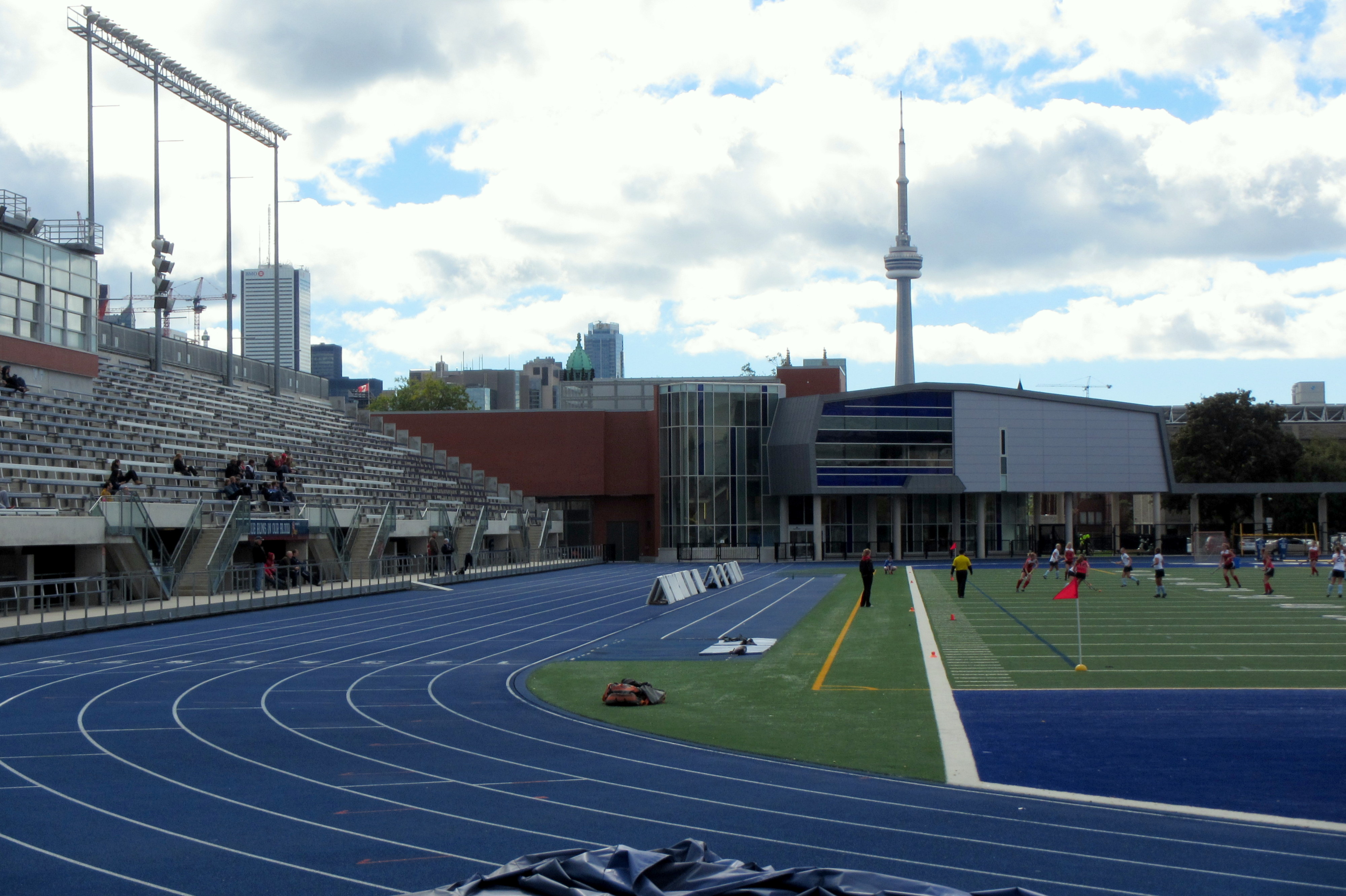
From 2003 through 2005, temporary seating of about 1,500 was installed to permit the use of the field for intercollegiate games. The name Varsity Field was used from 2002 to 2006 during the period when the old stadium was demolished and the new stadium was being built.
A plan to build a new 25,000 seat multi-purpose stadium on the site in 2005 was voted down by the governing council of the University of Toronto due to concerns over its cost. The facility was then planned to be built on the grounds of York University but that too failed. At the time of its demolition, Varsity Stadium was the second largest capacity stadium in Canada with a grass field, after Commonwealth Stadium in Edmonton, Alberta (however, that stadium has since switched to an artificial playing surface). The stadium opened in 2007.
.jpg)
Facilities and features built in the first phase of the stadium's reconstruction include an IAAF Class II 400m eight-lane track, artificial field turf (FIFA 2 Star rated surface by Polytan), and a winter bubble enabling use during inclement weather. The multi-use capability was one of the main reasons that the plan was passed by the governing council, as opposed to the 25,000-seat stadium. Compared to the old Varsity Stadium, the seating is closer to Varsity Arena, almost making the two structures one conjoined complex. Part of the red brick wall along Bloor Street was maintained for historic purposes, but the new facility is much more open and visible from the streets overall. The new facilities are designed by Diamond and Schmitt Architects.
Following the renovation, the Argonauts returned to the stadium, hosting their 2013 preseason game at their former home. Their 2014 and 2015 preseason home games were also scheduled for the stadium.
For the 2015 Pan American Games the facility hosted archery between July 14 and 18. During the games, the facility was configured to hold roughly 2,000 spectators per session. The facility also hosted the archery events of the 2015 Parapan American Games
Major events

In addition to hosting several University of Toronto athletic programs, the stadium has also hosted several events including military, musical, and sporting games.
Music
The stadium has also been host to several concerts, most notably the 1969 Toronto Rock and Roll Revival on September 13, which Rolling Stone once called the second most important event in rock & roll history. This concert led to the production of a documentary, Sweet Toronto, as well as John Lennon's Live Peace In Toronto album. Performers included: The Doors, Plastic Ono Band, Bo Diddley, Chicago Transit Authority (later renamed "Chicago"), Tony Joe White, Alice Cooper, Jerry Lee Lewis, Chuck Berry, Cat Mother & the All Night Newsboys, Gene Vincent, Junior Walker & the All Stars, Little Richard, Doug Kershaw, Screaming Lord Sutch, Nucleus, Milkwood, and Whiskey Howl.
Kiss performed at the stadium during their Destroyer Tour on September 6, 1976. Rush performed at the stadium on September 2, 1979, during their Permanent Waves Warm-up Tour.
Sports

| Game | Date | Winning team | Score | Losing team | Attendance |
|---|---|---|---|---|---|
| University of Toronto Varsity Blues (3) | Toronto Argonauts | 13,687 | |||
| Toronto Argonauts | University of Toronto Varsity Blues | 10,500 | |||
| Hamilton Tigers (2) | Toronto Rowing Association | 2,808 | |||
| University of Toronto Varsity Blues (4) | Toronto Argonauts | 10,088 | |||
| Toronto Argonauts (2) | Edmonton Eskimos | 9,558 | |||
| 11th | Queen's University (2) | Regina Rugby Club | 8,629 | ||
| 12th | Queen's University (3) | Toronto Balmy Beach | 5,978 | ||
| 14th | Ottawa Senators (2) | Toronto Varsity Blues | 8,276 | ||
| 15th | Toronto Balmy Beach | Hamilton Tigers | 13,676 | ||
| 18th | Toronto Balmy Beach (2) | Regina Roughriders | 3,914 | ||
| 22nd | Sarnia Imperials | Regina Roughriders | 8,900 | ||
| 24th | Sarnia Imperials (2) | Ottawa Rough Riders | 5,883 | ||
| 25th | Toronto Argonauts (4) | Winnipeg Blue Bombers | 11,522 | ||
| 26th | Toronto Argonauts (5) | Winnipeg Blue Bombers | 18,778 | ||
| 28th | Ottawa Rough Riders | Toronto Balmy Beach | 4,998 | ||
| 29th | Winnipeg Blue Bombers (3) | Ottawa Rough Riders | 19,065 | ||
| 30th | Toronto RCAF Hurricanes | Winnipeg RCAF Bombers | 12,455 | ||
| 31st | Hamilton Flying Wildcats | Winnipeg RCAF Bombers | 16,423 | ||
| 33rd | Toronto Argonauts (6) | Winnipeg Blue Bombers | 18,660 | ||
| 34th | Toronto Argonauts (7) | Winnipeg Blue Bombers | 18,960 | ||
| 35th | Toronto Argonauts (8) | Winnipeg Blue Bombers | 18,885 | ||
| 36th | Calgary Stampeders | Ottawa Rough Riders | 20,013 | ||
| 37th | Montreal Alouettes | Calgary Stampeders | 20,087 | ||
| 38th | Toronto Argonauts (9) | Winnipeg Blue Bombers | 27,101 | ||
| 39th | Ottawa Rough Riders (4) | Saskatchewan Roughriders | 27,341 | ||
| 40th | Toronto Argonauts (10) | Edmonton Eskimos | 27,391 | ||
| 41st | Hamilton Tiger-Cats | Winnipeg Blue Bombers | 27,313 | ||
| 42nd | Edmonton Eskimos | Montreal Alouettes | 27,328 | ||
| 44th | Edmonton Eskimos (3) | Montreal Alouettes | 39,417 | ||
| 45th | Hamilton Tiger-Cats (2) | Winnipeg Blue Bombers | 27,425 |
| Game | Date | Winning team | Score | Losing team |
|---|---|---|---|---|
| 1st | November 20, 1965 | Toronto | 14–7 | Alberta |
| 2nd | November 19, 1966 | St. F.X. | 40–14 | Waterloo Lutheran |
| 3rd | November 25, 1967 | Alberta | 10–9 | McMaster |
| 4th | November 22, 1968 | Queen's | 42–14 | Waterloo Lutheran |
| 5th | November 21, 1969 | Manitoba | 24–15 | McGill |
| 6th | November 21, 1970 | Manitoba (2) | 38–11 | Ottawa |
| 7th | November 20, 1971 | Western | 15–14 | Alberta |
| 8th | November 25, 1972 | Alberta (2) | 20–7 | Waterloo Lutheran |
| 12th | November 19, 1976 | Western (3) | 29–13 | Acadia |
| 13th | November 19, 1977 | Western (4) | 48–15 | Acadia |
| 14th | November 18, 1978 | Queen's (2) | 16–3 | UBC |
| 15th | November 17, 1979 | Acadia | 34–12 | Western |
| 16th | November 29, 1980 | Alberta (3) | 40–21 | Ottawa |
| 17th | November 28, 1981 | Acadia (2) | 18–12 | Alberta |
| 18th | November 20, 1982 | UBC | 39–14 | Western |
| 19th | November 19, 1983 | Calgary | 31–21 | Queen's |
| 20th | November 24, 1984 | Guelph | 22–13 | Mount Allison |
| 21st | November 30, 1985 | Calgary (2) | 25–6 | Western |
| 22nd | November 22, 1986 | UBC (2) | 25–23 | Western |
| 23rd | November 21, 1987 | McGill | 47–11 | UBC |
| 24th | November 19, 1988 | Calgary (3) | 52–23 | Saint Mary's |
| Date | Team #1 | Result | Team #2 | Round | Attendance |
|---|---|---|---|---|---|
| July 18, 1976 | 0–0 | Group A | 21,643 | ||
| July 19, 1976 | 0–0 | Group B | 9,500 | ||
| July 21, 1976 | 3–1 | Group D | 12,638 | ||
| July 25, 1976 | 4–1 | Quarter-finals | 18,601 | ||
| July 27, 1976 | 2–0 | Semi-finals | 21,743 |
| Game | Date |
|---|---|
| Archery | July 14–18, 2015 |
References
References
- Samuel Hawley. "Percy Williams: World's Fastest Human". samuelhawley.com.
- [http://www.la84foundation.org/6oic/OfficialReports/1976/1976v2.pdf 1976 Summer Olympics official report.] {{Webarchive. link. (May 6, 2010 Volume 2. pp. 226–9.)
- [http://www.la84foundation.org/6oic/OfficialReports/1976/1976v3.pdf 1976 Summer Olympics official report.] {{Webarchive. link. (September 27, 2007 Volume 3. pp. 227–89.)
- Beard, Randy. (April 25, 1979). "Blizzard Hope Revenge Snowballs The Rowdies". Evening Independent.
- Beard, Randy. (May 4, 1984). "Down 3 more teams, but NASL is stronger". Evening Independent.
- (2013-06-20). "Recap:Argos win in return to Varsity Stadium". [[Toronto Argonauts]].
- (2014-02-12). "Toronto Argonauts announce 2014 schedule!". [[Toronto Argonauts]].
- (2015-02-13). "TORONTO ARGONAUTS ANNOUNCE 2015 GAME SCHEDULE". [[Toronto Argonauts]].
- "Varsity Stadium". [[Toronto Organizing Committee for the 2015 Pan and Parapan American Games.
- Aronoff, Herbert. (September 15, 1969). "Mr. & Mrs. John Lennon visit the Toronto Rock and Roll Revival". Montreal Gazette.
- (September 15, 1969). "Rock festival reeks of 'pot'". Calgary Herald.
- Mullen, Pat. (2022-12-15). "Revival69: The Concert that Rocked the World Review - Toronto's Ragtag Revue".
- (2009-08-30). "Whiskey Howl Handbill at Wolfgang's Vault".
- "KISS Concert History Online - Decades on Tour Detailed: 09/06/76".
- "Permanent Waves".
This article was imported from Wikipedia and is available under the Creative Commons Attribution-ShareAlike 4.0 License. Content has been adapted to SurfDoc format. Original contributors can be found on the article history page.
Ask Mako anything about Varsity Stadium — get instant answers, deeper analysis, and related topics.
Research with MakoFree with your Surf account
Create a free account to save articles, ask Mako questions, and organize your research.
Sign up freeThis content may have been generated or modified by AI. CloudSurf Software LLC is not responsible for the accuracy, completeness, or reliability of AI-generated content. Always verify important information from primary sources.
Report