From Surf Wiki (app.surf) — the open knowledge base
Valletta
Capital of Malta
Capital of Malta
| Field | Value |
|---|---|
| name | Valletta |
| native_name | |
| native_name_lang | Maltese |
| other_name | Città Umilissima |
| settlement_type | Capital city and local council |
| image_skyline | {{multiple image |
| border | infobox |
| total_width | 280 |
| image_style | border:1; |
| perrow | 1/2/2 |
| image1 | St Sebastian Curtain (cropped).jpg |
| caption1 | Valletta skyline |
| image2 | Malta 270915 Valletta 06.jpg |
| caption2 | Saluting Battery |
| image3 | Malta - Valletta - Triq il-Lvant - Lower Barrakka Gardens - Alexander Ball 02 ies.jpg |
| caption3 | Lower Barrakka Gardens |
| image4 | St. John's Co-Cathedral - Interior.jpg |
| caption4 | Saint John's Co-Cathedral |
| image5 | Malta - Valletta - St. Michael's Bastion (Manoel Island) 01 ies.jpg |
| caption5 | Fortifications of Valletta |
| image_flag | Flag of Valletta, Malta.svg |
| image_shield | Insigne Valettae coronatum.svg |
| nickname | Il-Belt |
| motto | City Built By Gentlemen For Gentlemen |
| pushpin_map | Malta#Europe |
| pushpin_relief | 1 |
| pushpin_label_position | top |
| map_caption | Map of the Maltese Archipelago with Valletta |
| coordinates | |
| coordinates_footnotes | |
| subdivision_type | Country |
| subdivision_name | Malta |
| subdivision_type1 | Region |
| subdivision_name1 | Port Region |
| subdivision_type2 | District |
| subdivision_name2 | Southern Harbour District |
| established_date | 28 March 1566 |
| established_title2 | Capital city |
| established_date2 | 18 March 1571 |
| founder | Jean de Parisot Valette |
| parts_type | Borders |
| parts_style | para |
| p1 | Floriana |
| leader_title | Mayor |
| leader_name | Olaf McKay |
| leader_party | PL |
| unit_pref | Metric |
| area_total_km2 | 0.61 |
| area_urban_km2 | 256 |
| elevation_m | 56 |
| population_total | 5,157 |
| population_as_of | Jan. 2019 |
| population_density_km2 | auto |
| population_urban | 480134 |
| population_demonym | Belti (m), Beltija (f), Beltin (pl) |
| timezone1 | CET |
| utc_offset1 | +1 |
| timezone1_DST | CEST |
| utc_offset1_DST | +2 |
| postal_code_type | Postal code |
| postal_code | VLT |
| area_code_type | Dialing code |
| area_code | 356 |
| iso_code | MT-60 |
| blank_name_sec1 | Patron saints |
| blank_info_sec1 | St. Paul, the Apostle |
| St. Dominic | |
| Our Lady of Mount Carmel | |
| St. Augustine | |
| blank1_name_sec1 | Day of festa |
| blank1_info_sec1 | 3 August |
| 10 February | |
| website | |
| module | {{Infobox UNESCO World Heritage Site |
| official_name | City of Valletta |
| child | yes |
| ID | 131 |
| Year | 1980 |
| Criteria | Cultural: i, vi |
| Area | 55.5 ha |
St. Dominic Our Lady of Mount Carmel St. Augustine 10 February Valletta (; , ), also known as Città Umilissima (), is the capital city of Malta and one of its 68 council areas. Located between the Grand Harbour to the east and Marsamxett Harbour to the west, its population as of 2021 was 5,157. As Malta’s capital city, it is a commercial centre for shopping, bars, dining, and café life. It is also the southernmost capital of Europe, and, at just 0.61 km2, it is the European Union's smallest capital city.
Valletta's 16th-century buildings were constructed by the Knights Hospitaller. The city was named after the Frenchman Jean Parisot de Valette, who succeeded in defending the island against an Ottoman invasion during the Great Siege of Malta. The city is Baroque in character, with elements of Mannerist, Neo-Classical and Modern architecture, though the Second World War left major scars on the city, particularly the destruction of the Royal Opera House. The city was officially recognised as a World Heritage Site by UNESCO in 1980. The city has 320 monuments, all within an area of 0.55 square kilometres (0.21 sq mi), making it one of the most concentrated historic areas in the world. Sometimes called an "open-air museum", Valletta was chosen as the European Capital of Culture for 2018. Valletta was also listed as the sunniest city in Europe in 2016.
The city is noted for its fortifications, consisting of bastions, curtains and cavaliers, along with the beauty of its Baroque palaces, gardens and churches.
History
The peninsula was previously called Xagħret Mewwija (Mu' awiya – Meuia; named during the Arab period) or Ħal Newwija. Mewwija refers to a sheltered place. Some authors state that the extreme end of the peninsula was known as Xebb ir-Ras (Sheb point), of which name origins from the lighthouse on site. A family which surely owned land became known as Sceberras, now a Maltese surname as Sciberras. At one point the entire peninsula became known as Sceberras.
France French Republic 1798–1800
UK Protectorate of Malta 1800–1813
Malta Crown Colony of Malta 1813–1964
Malta State of Malta 1964–1974
Malta Republic of Malta 1974–present Recent scholarly studies have however shown that the Xeberras phrase is of Punic origin and means 'the headland' and 'the middle peninsula' as it actually is.
Order of Saint John


The building of a city on the Sciberras Peninsula had been proposed by the Order of Saint John as early as 1524. Back then, the only building on the peninsula was a small watchtower dedicated to Erasmus of Formia (Saint Elmo), which had been built in 1488.
In 1552, the Aragonese watchtower was demolished and the larger Fort Saint Elmo was built in its place.
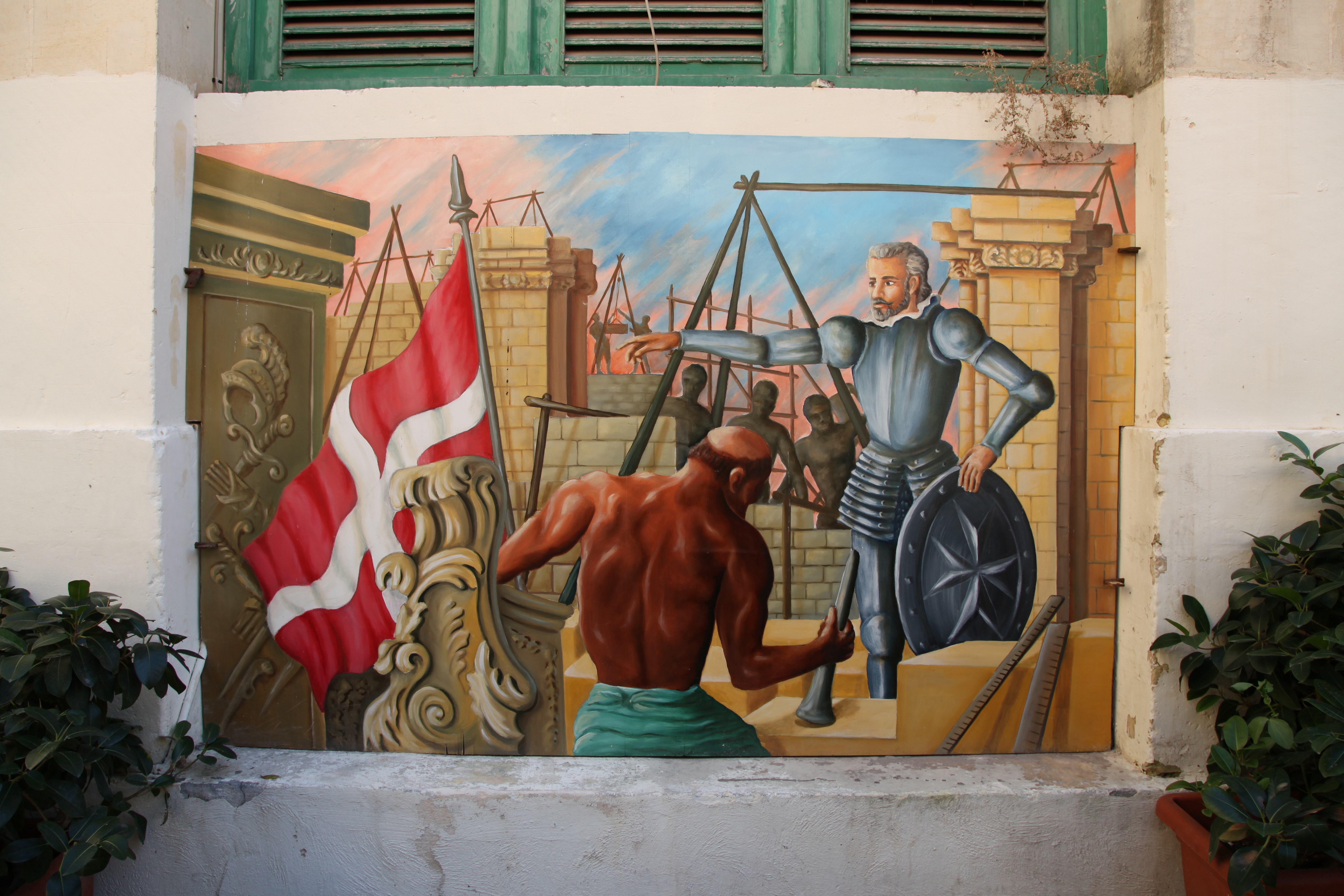
In the Great Siege of 1565, Fort Saint Elmo fell to the Ottomans, but the Order eventually won the siege with the help of Sicilian reinforcements. The victorious Grand Master, Jean de Valette, immediately set out to build a new fortified city on the Sciberras Peninsula to fortify the Order's position in Malta and bind the Knights to the island. The city took his name and was called La Valletta.
The Grand Master asked the European kings and princes for help, receiving a lot of assistance because of the increased fame of the Order after its victory in the Great Siege. Pope Pius V sent his military architect, Francesco Laparelli, to design the new city, while Philip II of Spain sent substantial monetary aid. The foundation stone of the city was laid by Grand Master de Valette on 28 March 1566. He placed the first stone in what later became Our Lady of Victories Church.
In his book Dell'Istoria della Sacra Religione et Illustrissima Militia di San Giovanni Gierosolimitano (), written between 1594 and 1602, Giacomo Bosio writes that, when the cornerstone of Valletta was placed, a group of Maltese elders said: "Iegi zimen en fel wardia col sceber raba iesue uquie" (Which in modern Maltese reads, "Jiġi żmien li fil-Wardija [l-Għolja Sciberras] kull xiber raba' jiswa uqija", and in English, "There will come a time when every piece of land on Sciberras Hill will be worth its weight in gold").
De Valette died from a stroke on 21 August 1568 at age 74 and never saw the completion of his city. Originally interred in the church of Our Lady of the Victories, his remains now rest in St. John's Co-Cathedral among the tombs of other Grand Masters of the Knights of Malta.
Francesco Laparelli was the city's principal designer and his plan departed from medieval Maltese architecture, which exhibited irregular winding streets and alleys. He designed the new city on a rectangular grid plan, and without any collacchio (an area restricted for important buildings). The streets were designed to be wide and straight, beginning centrally from the City Gate and ending at Fort Saint Elmo (which was rebuilt) overlooking the Mediterranean; certain bastions were built 47 m high. His assistant was the Maltese architect Girolamo Cassar, who later oversaw the construction of the city himself after Laparelli's death in 1570.
The Ufficio delle Case regulated the building of the city as a planning authority.
The city of Valletta was mostly completed by the early 1570s, and it became the capital on 18 March 1571 when Grand Master Pierre de Monte moved from his seat at Fort St Angelo in Birgu to the Grandmaster's Palace in Valletta.

Seven Auberges were built for the Order's Langues, and these were complete by the 1580s. An eighth Auberge, Auberge de Bavière, was later added in the 18th century.
In Antoine de Paule's reign, it was decided to build more fortifications to protect Valletta, and these were named the Floriana Lines after the architect who designed them, Pietro Paolo Floriani of Macerata. During António Manoel de Vilhena's reign, a town began to form between the walls of Valletta and the Floriana Lines, and this evolved from a suburb of Valletta to Floriana, a town in its own right.
In 1634, a gunpowder factory explosion killed 22 people in Valletta. In 1749, Muslim slaves plotted to kill Grandmaster Pinto and take over Valletta, but the revolt was suppressed before it even started because their plans leaked out to the Order. Later in his reign, Pinto embellished the city with Baroque architecture, and many important buildings such as Auberge de Castille were remodeled or completely rebuilt in the new architectural style.
In 1775, during the reign of Ximenes, an unsuccessful revolt known as the Rising of the Priests occurred in which Fort Saint Elmo and Saint James Cavalier were captured by rebels, but the revolt was eventually suppressed.
French occupation and British rule
.jpg)
In 1798, the French invaded the island and expelled the Order. After the Maltese rebelled, French troops continued to occupy Valletta and the surrounding harbour area, until they capitulated to the British in September 1800. In the early 19th century, the British Civil Commissioner, Henry Pigot, agreed to demolish the majority of the city's fortifications. The demolition was again proposed in the 1870s and 1880s, but it was never carried out and the fortifications have survived largely intact.
Eventually, building projects in Valletta resumed under British rule. These projects included widening gates, demolishing and rebuilding structures, widening newer houses over the years, and installing civic projects. The Malta Railway, which linked Valletta to Mdina, was officially opened in 1883. It was closed down in 1931 after buses became a popular means of transport.
In 1939, Valletta was abandoned as the headquarters of the Royal Navy Mediterranean Fleet due to its proximity to Italy, and the city became a flash point during the subsequent two-year long Siege of Malta. German and Italian air raids throughout the Second World War caused much destruction in Valletta and the rest of the harbor area. The Royal Opera House, constructed at the city entrance in the 19th century, was one of the buildings lost to the raids.
File:-The Harbor at Valletta, Malta- MET DP115643 (cropped).jpg|Valletta harbour , photo by Calvert Jones File:Goats_at_Port_Real_Wellcome_L0045092_(cropped).jpg|King's Gate 1884–1905 File:Teatru_Rjal,_Malta_1911.jpg|Royal Opera House in 1911 File:Bomb Damage in Valletta, Malta, 1 May 1942. A8701.jpg|Bomb damage in Valletta during the Second World War
Contemporary
In 1980, the 24th Chess Olympiad took place in Valletta.
The entire city of Valletta has been a UNESCO World Heritage Site since 1980, along with Megalithic Temples of Malta and the Hypogeum of Ħal-Saflieni. After that, on 27 November 2015, the city also hosted part of the Commonwealth Heads of Government Meeting 2015.
Valletta was the European Capital of Culture in 2018.
File:City Gate, Valletta 002.jpg|Renzo Piano's Valletta City Gate (2014) File:Parliament Building.jpg|Detail of the Parliament House (2015) File:Sacra Infermeria in 2016.jpg|Mediterranean Conference Centre, former Sacra Infermeria (2016) File:Triton Fountain.jpg|Renovated Tritons' Fountain (2018) File:Drapeaux UE et Malte - La Valette.jpg|Auberge d'Italie, renovated in 2016 to host the new MUŻA (Mużew Nazzjonali tal-Arti) File:The interior after its restoration in 2018.jpg|Renovated covered market Is-Suq tal-Belt, 2018
Government

.jpeg)
Local government
The City of Valletta, Malta’s Capital, was founded in 1566 by Grand Master of the Knights of St. John. During the period of the Knights of Malta, Valletta had its own Municipal Administrative Council, the Università, administered out of what was known the Municipio or the Banca Giuratale. The Administration attracted notable Maltese personalities. The Universitas of Valletta ran from 1577 to 1818 when the British Colonial Governor, Thomas Maithland suppressed it, taking full control of all administrative affairs of Malta. 175 year later, local administration was re-established in Malta.
The Valletta Local Council was established by the Local Councils Act of 1993, along with the other local councils of Malta. The first election was held on 20 November 1993. Other elections were held in 1996, 1999, 2002, 2005, 2008, 2013, 2017. The present local council was elected in 2019. The local council is housed in a building in South Street.
The following people have served as Mayors of Valletta:
- Hector Bruno (1993–1999) (PN)
- Paul Borg Olivier (1999–2008) (PN)
- Alexiei Dingli (2008–2019) (PN)
- Christian Micallef (2019) (PN)
- Alfred Zammit (2019–) (PL)
National government
Valletta is the capital city of Malta, and is the country's administrative and commercial hub. The Parliament of Malta has been housed at the Parliament House near the city's entrance since 2015: it was previously housed at the Grandmaster's Palace in the city centre. The latter palace still houses the Office of the President of Malta, while the Auberge de Castille houses the Office of the Prime Minister of Malta. The courthouse and many government departments are also located in Valletta.
Geography

The Valletta peninsula has two natural harbours, Marsamxett and the Grand Harbour. The Grand Harbour is Malta's major port, with unloading quays at nearby Marsa. A cruise-liner terminal is located along the old seawall of the Valletta Waterfront that Portuguese Grandmaster Manuel Pinto da Fonseca built.
Climate
Main article: Climate of Malta
Valletta features a hot-summer variant Mediterranean climate (Köppen Csa) with very mild, wet winters and long, hot, dry summers, with an average annual temperature above 23 °C during the day and 16 °C at night.
Valletta experiences a lack of precipitation during the summer months with most of the annual precipitation occurring during the winter months, and despite the summer dryness, humidity and dew points remain high because of the city's coastal location. Winter temperatures are moderated by the surrounding sea and as a result, the city has very mild winters and a long seasonal lag.
Air frosts and snowfall are essentially non-existent, with the last measurable snow falling during the winter of 1963.
The official climate recording station in Malta is at Luqa Airport, which is a few miles inland from Valletta. Average high temperatures range from around 16 °C in January to about 32 °C in August, while average low temperatures range from around 10 °C in January to 23 °C in August.
Cityscape

The architecture of Valletta's streets and piazzas ranges from mid-16th century Baroque to Modernism. The city is the island's principal cultural center and has a unique collection of churches, palaces and museums and act as one of the city's main visitor attractions. When Benjamin Disraeli, future British Prime Minister, visited the city in 1830, he described it as "a city of palaces built by gentlemen for gentlemen," and remarked that "Valletta equals in its noble architecture, if it does not excel, any capital in Europe," and in other letters called it "comparable to Venice and Cádiz" and "full of palaces worthy of Palladio."
Buildings of historic importance include St John's Co-Cathedral, formerly the Conventual Church of the Knights of Malta. It has the only signed work and largest painting by Michelangelo Merisi da Caravaggio. The Auberge de Castille et Leon, formerly the official seat of the Knights of Malta of the Langue of Castille, Léon and Portugal, is now the office of the Prime Minister of Malta. The Grandmaster's Palace, built between 1571 and 1574 and formerly the seat of the Grand Master of the Knights of Malta, used to house the Maltese Parliament, now situated in a purpose-built structure at the entrance to the city, and now houses the offices of the President of Malta.
Admiralty House is a Baroque palace dating to the late 1570s. It was the official residence of the Commander-in-Chief of the Mediterranean Fleet during the British era from the 1820s onwards. From 1974 until 2016, it was the site of the National Museum of Fine Arts.
The Manoel Theatre () was constructed in just ten months in 1731, by order of Grand Master António Manoel de Vilhena, and is one of the oldest working theatres in Europe. The Mediterranean Conference Centre was formerly the Sacra Infermeria. Built in 1574, it was one of Europe's most renowned hospitals during the Renaissance. The fortifications of the port, built by the Knights as a magnificent series of bastions, demi-bastions, cavaliers and curtains, approximately 100 m high, all contribute to the unique architectural quality of the city.
Neighbourhoods
.jpg)
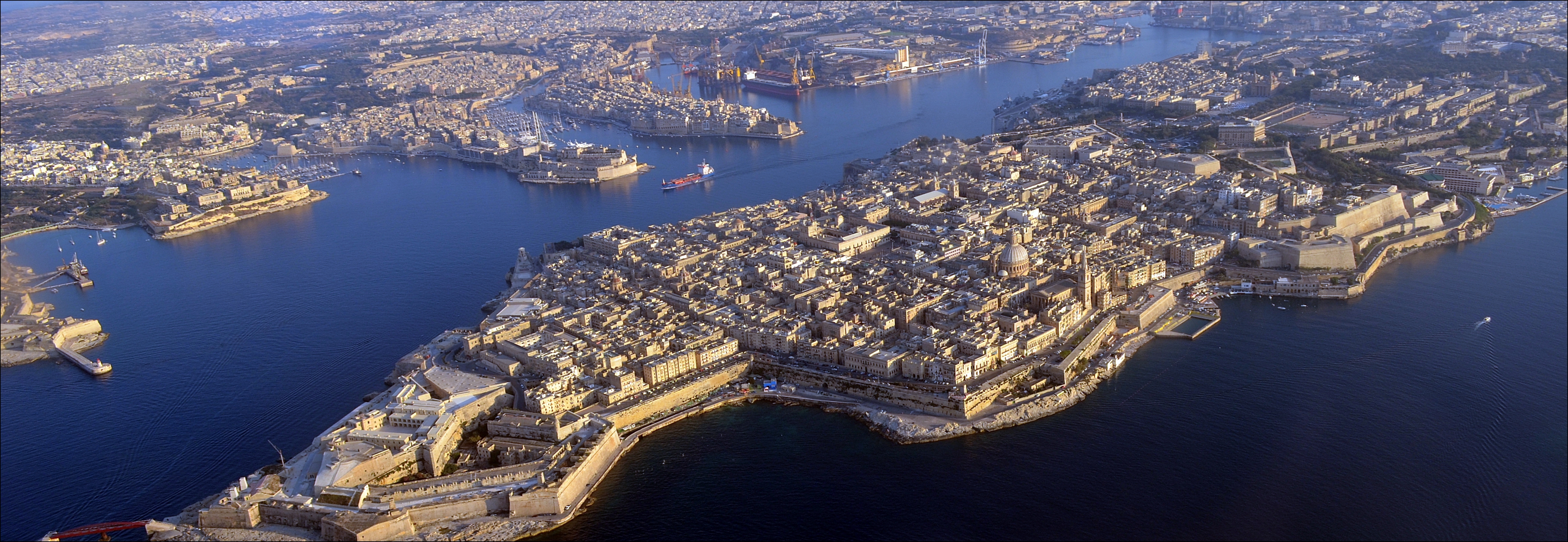
Valletta contains a number of unofficial neighbourhoods, including:
- Strada Rjali – the main thoroughfare, Triq ir-Repubblika
- l-Arċipierku – an area close to the Sacra Infermeria. Its name possibly derives from archipelago since it contains a number of lanes which break up the area into many "islands" of houses, or from archi-borgo since the area is located just outside Fort Saint Elmo.
- il-Baviera – an area around the English Curtain, bounded by Old Bakery, Archbishop, Marsamxett and St. Sebastian Streets. It is named after Auberge de Bavière.
- il-Biċċerija – an area close to il-Baviera, named after the slaughterhouse which was formerly located there.
- il-Kamrata – an area close to the Sacra Infermeria. It is named after the Camerata, a spiritual retreat which was demolished in the 19th century and replaced by social housing.
- Deux Balles () – an area close to il-Baviera. The name probably originates from the French occupation.
- il-Fossa – an area close to the Jews' Sally Port and Fort Saint Elmo. It is regarded as the worst maintained area of Valletta.
- Manderaggio () – an area behind Manderaggio Curtain, bounded by St. Mark, St. Lucia, St. Patrick and Marsamxett Streets. This was meant to be a small harbour (mandracchio) but it was never completed, and a slum area developed instead. The slums were demolished in the 1950s and were rebuilt as housing estates.
Economy
Eurostat estimates the labour force in 2015 for the greater Valletta area at around 91,000 people. This corresponds to a share of just under 50 percent of Malta. As in Malta as a whole, tourism is an important economic sector. The most important tourist zone is the area surrounding the Grand Harbour. For the cruise industry, after several years of planning, work began in 2002 to build the Valletta Waterfront Project, a cruise terminal, in the Grand Harbour. There is also a publishing house in Valletta, Allied Newspapers Ltd., a media company. This company publishes the two market-leading newspapers, Times of Malta and The Sunday Times of Malta.
Education
The Valletta Campus of the University of Malta is situated in the Old University Building. It serves as an extension of the Msida Campus, especially offering international masters programmes.
A church school, "St. Albert the Great", is also situated in Valletta. The Headmaster is Alternattiva Demokratika politician Mario Mallia.
Culture


.jpg)
Valletta was designated European Capital of Culture for 2018. The year was inaugurated with an event called Erba' Pjazez (Four Squares), with shows focused in 4 plazas in the city – Triton Square, St. George's Square, St. John's Square, and Castille Square – along with other shows in other points. This was followed by the unveiling of a public art installation, Kif Jgħid il-Malti (Maltese Sayings), which featured a number of Maltese language proverb figured in gypsum, in order to engage linguistic heritage.
Saint James Cavalier
Saint James Cavalier, originally a raised gun platform, was converted into a Centre of Creativity in the year 2000 as part of Malta's Millennium Project. It now houses a small theatre, a cinema, music rooms and art galleries. Various exhibitions are regularly held there. It has welcomed over a million visitors since opening.
Music
The Valletta International Baroque Festival is held every year in January. Jazz music in Malta was introduced in the Strait Street area, frequented by Allied sailors during both World Wars. Malta's Jazz Festival took place here. Strait Street is also known as The Gut. This area is undergoing a programme of regeneration. The city's dual band clubs are the "King's Own Band Club" () and "La Valette National Philharmonic Society" ().
Carnival
Valletta is the scene of the Maltese Carnival, held in February each year, leading up to Lent.
In 1823 the Valletta carnival was the scene of a human crush tragedy in which at least 110 boys died.
Feasts
- The feast of Our Lady of Mount Carmel is celebrated on 16 July
- Saint Paul's feast is celebrated on 10 February
- Saint Dominic's feast is celebrated in Valletta on 4 August or before
- The feast of Saint Augustine is celebrated on the third Sunday after Easter
- The city's residents also conduct an annual procession in honour of St. Rita
In literature and the arts
- The poetical illustrations (painted by T. C. Dibden, engraved by J. Tingle) and (painted by Samuel Prout, engraved by J, Carter) by Letitia Elizabeth Landon were both published in Fisher's Drawing Room Scrap Book, 1837. A further poem illustrates a painting of the procession in the Strada St Giovanni painted by Samuel Prout and engraved by E. Challis is in Fisher's Drawing Room Scrap Book, 1838.
Twin towns – sister cities
Valletta is twinned with:
- ITA Palermo, Italy
- ITA Pisa, Italy
- ITA Cortona, Italy, since August 26, 2022
- GRC Rhodes, Greece
- LBN Byblos, Lebanon
- SVN Piran, Slovenia
Transport

Malta International Airport is 8 km from the city in the town of Luqa. Malta's public transport system, which uses buses, operates mostly on routes to or from Valletta, with their central terminus just outside the city gate. Traffic within the city itself is restricted, with some principal roads being completely pedestrian areas. In 2006, a park and ride system was implemented in order to increase the availability of parking spaces in the city. People can leave their vehicles in a nearby Floriana car park and transfer to a van for the rest of the trip.
In 2007, a congestion pricing scheme was implemented to reduce long-term parking and traffic while promoting business in the city. An ANPR-based automated system takes photos of vehicles as they enter and exit the charging zone and vehicle owners are billed according to the duration of their stay.
Valletta is served by a fleet of electric taxis which transport riders from 10 points in Valletta to any destination in the city.
As of 2021, an underground Malta Metro is being planned, with a projected total cost of €6.2 billion, centred on the Valletta urban area.
Virtu Ferries offer passenger and goods services to Pozzallo and Catania, Sicily.
Notable people
Main article: Category:People from Valletta
Sports
- Valletta F.C. Association Football team and Futsal team
- Valletta Lions RFC Rugby Football Union team
- Valletta's Marsamxett Harbour a "Regatta" (Rowing) Team, which takes part in the annual traditional Regatta on Victory Day (8 September).
- Valletta United W.P.C., a Water Polo Club hailing from Marsamxett side
- Valletta V.C., a Volleyball club.
- Marsamxett Boċċi, a Boċċi Club from Marsamxett, Valletta.
- Valletta St. Paul's Boċċi, a Boċċi Club from L-Arċipierku side, Valletta.
References
Notes
References
- Badger, George Percy. (1869). "Historical Guide to Malta and Gozo". Calleja.
- (2020). "Population on 1 January by age groups and sex – functional urban areas".
- "Valletta".
- "Geography and History".
- (16 May 2014). "Estimated Population by Locality 31st March, 2014". [[Government of Malta]].
- [[List of national capitals by latitude. Valletta, Malta – Intercultural City]] – [[Council of Europe]]
- (31 May 2018). "The 10 Smallest Countries in Europe".
- "History of Valletta – Story About Valletta – Interesting Facts".
- "City of Valletta".
- "Valletta travel".
- [https://www.maltauncovered.com/valletta-capital-city/ Valletta (Malta) – The Complete Overview of Malta's Capital City] – maltauncovered.com
- [http://bay.com.mt/grab-your-shades-valletta-is-crowned-the-sunniest-city-in-europe/ Valletta is crowned the sunniest city in Europe] {{Webarchive. link. (5 March 2022 – bay.com.mt, 2016)
- [https://www.currentresults.com/Weather-Extremes/Europe/sunniest-cities.php Sunniest Cities in Europe] – currentresults.com, 2016
- "thinksite.eu".
- "'Xagħret Mewwija: L-Istorja tal-Belt … Milwija' aka Dragut's revenge – The Malta Independent".
- "The Secrets of underground Valletta – The Malta Independent".
- [http://www.thinksite.eu/userfiles/Glossary%20of%20placenames%20related%20to%20Islam%20Christianity%20and%20Ethnicity.pdf p. 21, footnote 163] {{Webarchive. link. (17 January 2016 .)
- "p. 231".
- Manley, Deborah. (10 February 2012). "Malta: A Traveller's Anthology". Andrews UK Limited.
- (9 December 2011). "Foundation, Dedication and Consecration in Early Modern Europe". BRILL.
- [https://books.google.com/books?id=wbFQAAAAYAAJ&q=Valletta+Sceberras de Piro].
- "Thalassic imaginaries : witnesses to (an) unwritten history". Taylor & Francis.
- "The Valletta Fortifications".
- Leopardi, E. R.. (1949). "The First Printed Description of Malta : Lyons 1536". Scientia.
- (January 2018). "Triton Square and Bisjuttin Area-Embellishment projects". Ministry for Tourism.
- "History of Valletta".
- Blouet, Brian W.. (October 1964). "Town Planning in Malta, 1530–1798". [[Liverpool University Press]].
- Gugliuzzo, Carmelina. (9 December 2011). "Foundation, Dedication and Consecration in Early Modern Europe". Booksandjournals.brillonline.com.
- "L-Istorja tal-Ilsien Malti".
- Graff, Philippe. (1994). "La Valette: une ville nouvelle du XVIe siècle et son évolution jusqu'à nos jours". [[Publications de l'Université de Provence]].
- (2010). "Historical Dictionary of Malta". Scarecrow Press.
- Cassar, Paul. (1946). "The Hospital of the Order of St. John in Malta". Scientia.
- (1986). "Carlo Gimach (1651–1730) – Architect and Poet". Historical Society of Malta.
- (4 May 2014). "Floriana's Pavilion from the Knights to the British". [[Times of Malta]].
- (2008). "Global and Local Football: Politics and Europeanization on the Fringes of the EU". Routledge.
- (2012). "Hospitaller Gunpowder Magazines". Arx – International Journal of Military Architecture and Fortification.
- (2011). "The Cambridge World History of Slavery: Volume 3: AD 1420-AD 1804". Cambridge University Press.
- Mifsud Bonnici, Carmelo. (August 1936). "Fr. Emanuel Pinto de Fonseca". Malta Letteraria.
- (2005). "Reassessing the September 1775 Rebellion: a Case of Lay Participation or a 'Rising of the Priests'?".
- Zammit, Andre. (1986). "Valletta and the system of human settlements in the Maltese Islands". Athens Center of Ekistics.
- (18 November 2012). "Let's hide the majestic bastions". [[Times of Malta]].
- Cole, Beverly. (2011). "Trains". H.F.Ullmann.
- Peter Jacobs. (31 January 2016). "Fortress Islands Malta: Defence & Re-Supply During the Siege". Pen and Sword.
- "24th Chess Olympiad". OlimpBase.
- (26 November 2015). "Queen to greet line-up of despots at meeting of Commonwealth leaders in Malta". Daily Telegraph.
- "Valletta awarded the title of European Capital of Culture in 2018". gov.mt.
- "About Local Administration".
- "About Local Government".
- "Elezzjonijiet tal-Kunsilli Lokali fis-Snin li Għaddew (1993–2013)".
- "Elezzjonijiet tal-Kunsilli Lokali 2015–2023".
- "Council Members".
- (17 July 2015). "No immediate solution to finding new premises for Valletta council". [[Times of Malta]].
- (16 August 2014). "Mayors from 1993".
- (20 February 2019). "Watch: 'Valletta 2018 was a missed opportunity,' says former mayor".
- "Christian Micallef sworn in as new Mayor of Valletta – The Malta Independent".
- (29 May 2019). "Alfred Zammit is-sindku tal-Belt Valletta – TVM".
- "The Maltese Islands".
- "The Capital City Valletta".
- Maitland, Robert. (2014). "Tourism in National Capitals and Global Change". Routledge.
- "Il-Palazz tal-Belt".
- (28 December 2012). "Auberge de Castille et Leon".
- Gatt, Oliver. (2008). "Valletta City of the Knights". Bdlbooks.com.
- Guillaumier, Alfie. (2005). "Bliet u Rħula Maltin". Klabb Kotba Maltin.
- "Luqa Weather Averages 1991–2020". Meteo-climat-bzh.dyndns.org.
- "Malta's Climate". Maltaweather.com.
- "Valletta – the Capital City". Maltaexpo.com.
- "LP21 – Valletta 'Citta Umilissima' Lapel Pin". Maltaexpo.com.
- Patrick, James. (2007). "Renaissance and Reformation". Marshall Cavendish.
- (28 December 2012). "Grandmaster Palace".
- (1999). "Laqmijiet ta' Postijiet fil-Belt Valletta". Melita Historica.
- "Valletta Action Plan – Integrated Cultural Heritage Management Plan".
- (2011). "Regeneration of Jews Sally Port (Il-Fossa), Valletta".
- (17 July 2005). "Restoring and reviving Valletta's waterfront".
- "Valletta Campus – Youth Information".
- "Find Us".
- "People – Alternattiva Demokratika".
- "Valletta 2018".
- "Erba' Pjazez".
- "A bum, a bird and a pig: Valletta 2018 unveils 'Kif Jgħid Il-Malti' public art installations – The Malta Independent".
- (2 February 2018). "Arts & Entertainment".
- "St.James Cavalier Theatre Overview in Valletta, Malta". Gozo Tourism Association.
- (2017-09-01). "What are the best events taking place throughout the year in Malta?". The Telegraph.
- (October–December 1949). "The Order of St. John in Maltese folk-memory". Scientia.
- (March–September 1823). "Niles' Weekly Registrar". William Ogden Niles.
- Landon, Letitia Elizabeth. (1836). "Fisher's Drawing Room Scrap Book, 1837". Fisher, Son & Co.}}{{cite book.
- Landon, Letitia Elizabeth. (1836). "Fisher's Drawing Room Scrap Book, 1837". Fisher, Son & Co.}}{{cite book.
- Landon, Letitia Elizabeth. (1837). "Fisher's Drawing Room Scrap Book, 1838". Fisher, Son & Co..
- (30 December 2017). "Palermo and Valletta together for 2018. Cultural twinning at Palazzo Asmundo". Palermo World.
- "CVA System – The Purpose Of".
- (6 May 2007). "Valletta traffic congestion considerably reduced". MaltaMedia News.
- (15 June 2007). "Valletta gets its own clean taxi service". [[Times of Malta]].
- (October 2021). "Government unveils 25-station, €6.2 billion underground Metro proposal".
- "London to Valletta". [[The Man in Seat Sixty-One]].
This article was imported from Wikipedia and is available under the Creative Commons Attribution-ShareAlike 4.0 License. Content has been adapted to SurfDoc format. Original contributors can be found on the article history page.
Ask Mako anything about Valletta — get instant answers, deeper analysis, and related topics.
Research with MakoFree with your Surf account
Create a free account to save articles, ask Mako questions, and organize your research.
Sign up freeThis content may have been generated or modified by AI. CloudSurf Software LLC is not responsible for the accuracy, completeness, or reliability of AI-generated content. Always verify important information from primary sources.
Report