From Surf Wiki (app.surf) — the open knowledge base
Vajradhara
Buddha
Buddha
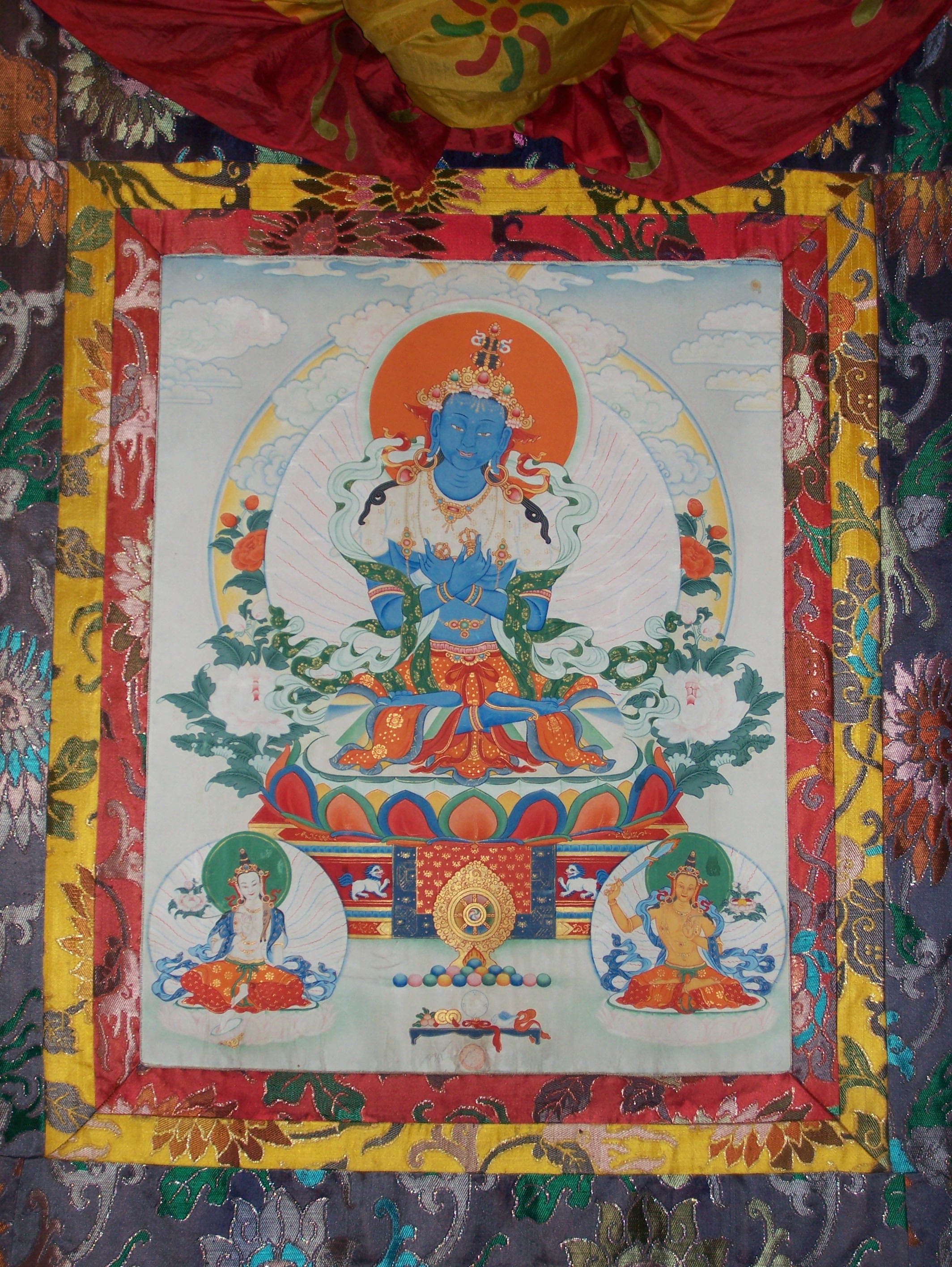
Vajradhara (; ; ; ; ; ; ) is the ultimate primordial Buddha, or Adi-Buddha, according to the Sakya, Gelug and Kagyu schools of Tibetan Buddhism. It is also a name of Indra, because "Vajra" means diamond, as well as the thunderbolt, or anything hard more generally.
In the evolution of Indian Buddhism, Buddha Vajradhara gradually displaced Samantabhadra, who is the 'Primordial Buddha' in the Nyingma, or 'Ancient School.' However, the two are metaphysically equivalent. Achieving the 'state of Vajradhara' is synonymous with complete realisation.
According to the Kagyu lineage, Buddhā Vajradhara is the primordial Buddha, the Dharmakaya Buddha. He is depicted as dark blue in color, expressing the quintessence of buddhahood itself and representing the essence of the historical Buddha's realization of enlightenment.
As such, Buddha Vajradhara is thought to be the supreme essence of all (male) Buddhas; It is the Tantric form of Sakyamuni which is called Vajradhara. Tantras are texts specific to Tantrism and are believed to have been originally taught by the Tantric form of Sakyamuni called Buddha Vajradhara. He is an expression of Buddhahood itself in both single and yabyum form. Buddha Vajradhara is considered to be the prime Buddha of the Father tantras (tib. pha-rgyud) such as Guhyasamaja, Yamantaka, and so on.
From the primordial Buddha Vajradhara/Samantabhadra Buddha/Dorje Chang were manifested the Five Wisdom Buddhas (Dhyani Buddhas):
- Akshobhya
- Amoghasiddhi
- Amitabha
- Ratnasambhava
- Vairocana
Buddha Vajradhara and the Wisdom Buddhas are often subjects of mandala.
Buddha Vajradhara and Samantabhadra Buddha are cognate deities in Tibetan Buddhist cosmology with different names, attributes, appearances and iconography. Both are Dharmakaya Buddhas, that is primordial Buddhas: Samantabhadra is unadorned, that is depicted without any attributes; conversely, Buddha Vajradhara is often adorned and bears attributes, which is generally the iconographic representation of a Sambhogakaya Buddha. Both Buddha Vajradhara and Samantabhadra are generally depicted in yab-yum unity with their respective consorts and are primordial Buddhas, embodying void and ultimate emptiness.
Dharmakaya as part of the Trikaya
The Trikaya doctrine (; ; , in Japanese) is an important Buddhist teaching both on the nature of reality, and what a Buddha is. By the 4th century CE, the Trikaya doctrine had assumed the form that we now know.
Briefly, the doctrine says that a Buddha has three ('bodies'): the ('created body'), which manifests in time and space; the ('body of mutual enjoyment'), which is an archetypal manifestation; and the ('reality body'), which embodies the very principle of enlightenment and knows no limits or boundaries.
In the view of Anuyoga, the "mindstream" () is the "continuity" (; Wylie: ) that links the Trikaya. The Trikaya, as a triune, is symbolised by the Gankyil.
Literature
'Shining Relics of Enlightened Body' () is numbered amongst the 'Seventeen Tantras of Menngagde' () within Dzogchen discourse and is part of the textual support for the Vima Nyingtik. In the Dzogchen tantric text rendered in English as "Shining Relics" (), an enlightened personality entitled Buddha Vajradhara and a Dakini whose name may be rendered into English as "Clear mind" engage in discourse and dialogue, which is a common convention in such esoteric Buddhist literature and tantric literature in general.
Notes
Link
- The Essential Songs of Milarepa / VI. Songs About Vajra Love 46. Answer to Dakini Tzerima
- body, speech, mind A Dictionary of Buddhism
- rdo rje chos (vajradharma) ( b. ) The Tibetan Buddhist Resource Center
Nonsectarian movement
Sutra
References
- "Buddha Vajradhara, Originating Deity of the Sakya Lineage".
- Getty, Alice (1914). [https://archive.org/details/godsofnorthernbu00gettrich The gods of northern Buddhism], their history, iconography, and progressive evolution through the northern Buddhist countries, Oxford: The Clarendon press, pp. 4-6.
- [https://www.amazon.com/Images-Enlightenment-Tibetan-Art-Practice/dp/1559390247 ''Images of Enlightenment: Tibetan Art in Practice'']
- [http://www.britannica.com/EBchecked/topic/202522/Father-Tantra Father Tantra]
- Welwood, John (2000). ''The Play of the Mind: Form, Emptiness, and Beyond''. Source: http://www.purifymind.com/PlayMind.htm (accessed: Saturday January 13, 2007)
- Martin, Dan (1994). 'Pearls from Bones: Relics, Chortens, Tertons and the Signs of Saintly Death in Tibet'. ''Numen'', Vol. 41, No. 3. (Sep., 1994), p.274.
This article was imported from Wikipedia and is available under the Creative Commons Attribution-ShareAlike 4.0 License. Content has been adapted to SurfDoc format. Original contributors can be found on the article history page.
Ask Mako anything about Vajradhara — get instant answers, deeper analysis, and related topics.
Research with MakoFree with your Surf account
Create a free account to save articles, ask Mako questions, and organize your research.
Sign up freeThis content may have been generated or modified by AI. CloudSurf Software LLC is not responsible for the accuracy, completeness, or reliability of AI-generated content. Always verify important information from primary sources.
Report