From Surf Wiki (app.surf) — the open knowledge base
Vacuum insulated evaporator
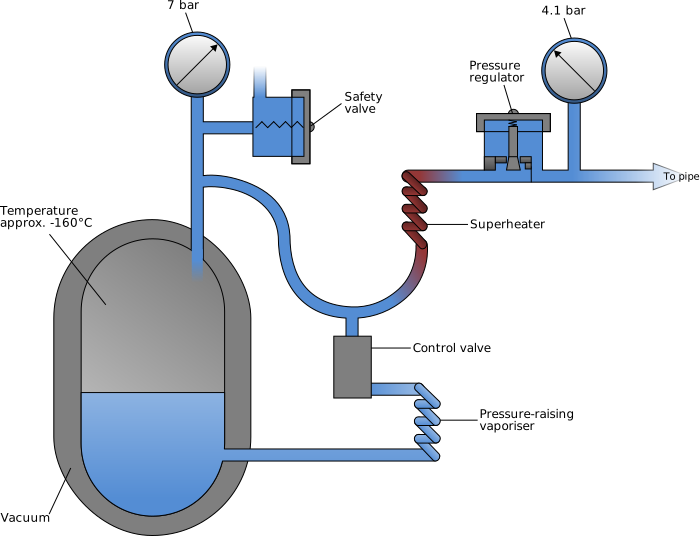

A vacuum insulated evaporator (VIE) is a form of pressure vessel that allows the bulk storage of cryogenic liquids including oxygen, nitrogen and argon for industrial processes and medical applications.
The purpose of the vacuum insulation is to prevent heat transfer between the inner shell, which holds the liquid, and surrounding atmosphere. Without functioning insulation, the stored liquid will rapidly warm and undergo a phase transition to gas, increasing significantly in volume and potentially causing a catastrophic failure to the vessel due to an increase in pressure. To combat such an event, VIEs are installed with a pressure safety valve.
To remain a liquid, the vessel contents must be kept at or below its critical temperature. The critical temperature of oxygen is −118 °C; above this temperature, applying more pressure will not result in a liquid, but rather a supercritical fluid.
References
References
- "Vacuum Insulated Evaporators".
- (2016-05-19). "Structure, Mechanism, and Application of Vacuum Insulation Panels in Chinese Buildings". Advances in Materials Science and Engineering.
- "How Does Vacuum Insulation Work?".
This article was imported from Wikipedia and is available under the Creative Commons Attribution-ShareAlike 4.0 License. Content has been adapted to SurfDoc format. Original contributors can be found on the article history page.
Ask Mako anything about Vacuum insulated evaporator — get instant answers, deeper analysis, and related topics.
Research with MakoFree with your Surf account
Create a free account to save articles, ask Mako questions, and organize your research.
Sign up freeThis content may have been generated or modified by AI. CloudSurf Software LLC is not responsible for the accuracy, completeness, or reliability of AI-generated content. Always verify important information from primary sources.
Report