From Surf Wiki (app.surf) — the open knowledge base
V speeds
Standard terms to define airspeeds
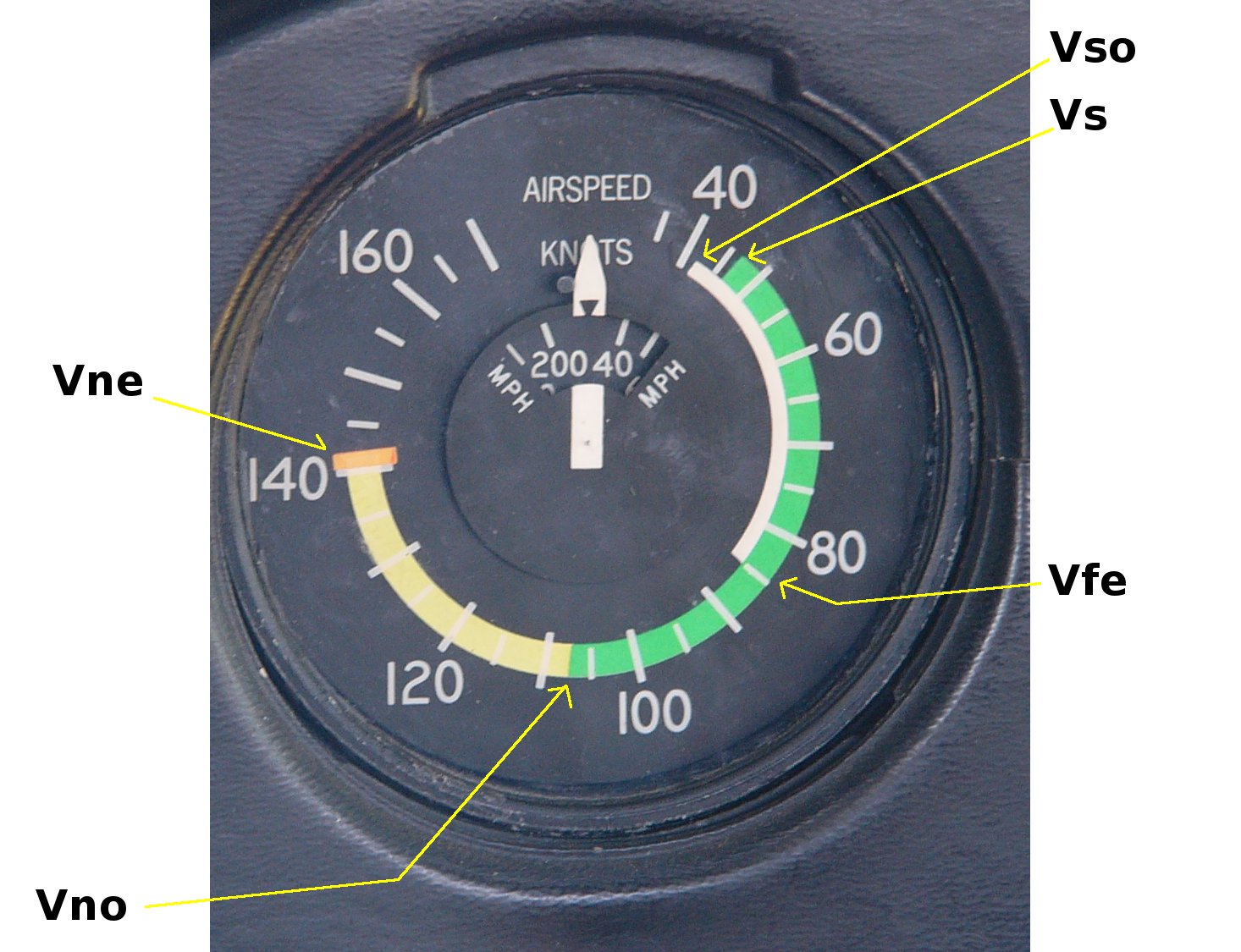
Standard terms to define airspeeds
In aviation, V-speeds are standard terms used to define airspeeds important or useful to the operation of all aircraft. These speeds are derived from data obtained by aircraft designers and manufacturers during flight testing for aircraft type-certification. Using them is considered a best practice to maximize aviation safety, aircraft performance, or both.
The actual speeds represented by these designators are specific to a particular model of aircraft. They are expressed by the aircraft's indicated airspeed (and not by, for example, the ground speed), so that pilots may use them directly, without having to apply correction factors, as aircraft instruments also show indicated airspeed.
In general aviation aircraft, the most commonly used and most safety-critical airspeeds are displayed as color-coded arcs and lines located on the face of an aircraft's airspeed indicator. The lower ends of the white arc and the green arc are the stalling speed with wing flaps in landing configuration, and stalling speed with wing flaps retracted, respectively. These are the stalling speeds for the aircraft at its maximum weight. The yellow band is the range in which the aircraft may be operated in smooth air, and then only with caution to avoid abrupt control movement. The red line is the VNE, the never-exceed speed.
Proper display of V-speeds is an airworthiness requirement for type-certificated aircraft in most countries.
Regulations
The most common V-speeds are often defined by a particular government's aviation regulations. In the United States, these are defined in title 14 of the United States Code of Federal Regulations, known as the Federal Aviation Regulations (FARs). In Canada, the regulatory body, Transport Canada, defines 26 commonly used V-speeds in their Aeronautical Information Manual. V-speed definitions in FAR 23, 25 and equivalent are for designing and certification of airplanes, not for their operational use. The descriptions below are for use by pilots.
Regulatory V-speeds
These V-speeds are defined by regulations. They are typically defined with constraints such as weight, configuration, or phases of flight. Some of these constraints have been omitted to simplify the description.
| V-speed designator | Description | |||||||||
|---|---|---|---|---|---|---|---|---|---|---|
| V1 | The speed beyond which takeoff should no longer be aborted (or "the point of no return") . | |||||||||
| V2 | Takeoff safety speed. The speed at which the aircraft may safely climb with one engine inoperative. | |||||||||
| V2min | Minimum takeoff safety speed. | |||||||||
| V3 | Flap retraction speed. | |||||||||
| V4 | Steady initial climb speed. The all engines operating take-off climb speed used to the point where acceleration to flap retraction speed is initiated. Should be attained by a gross height of 400 ft. | |||||||||
| VA | url=https://web.archive.org/web/20161207154456/http://rgl.faa.gov/Regulatory_and_Guidance_Library/rgAdvisoryCircular.nsf/0/d1a4060f22939f36862572eb0061ca3f/$FILE/AC%2023-19A.pdf | date=7 December 2016 }} Retrieved 2012-01-06 | ||||||||
| Vat | Indicated airspeed at threshold, which is usually equal to the stall speed VS0 multiplied by 1.3 or stall speed VS1g multiplied by 1.23 in the landing configuration at the maximum certificated landing mass, though some manufacturers apply different criteria. If both VS0 and VS1g are available, the higher resulting Vat shall be applied. Also called "approach speed". Also known as Vth | |||||||||
| VB | Design speed for maximum gust intensity. | |||||||||
| VC | Design cruise, also known as the optimum cruise speed, is the most efficient speed in terms of distance, speed and fuel usage. | |||||||||
| Vcef | See V1; generally used in documentation of military aircraft performance. Denotes "critical engine failure" speed as the speed during takeoff where the same distance would be required to either continue the takeoff or abort to a stop. | |||||||||
| VD | Design diving speed, the highest speed planned to be achieved in testing. | |||||||||
| VDF | Demonstrated flight diving speed, the highest actual speed achieved in testing. | |||||||||
| VEF | The speed at which the critical engine is assumed to fail during takeoff. | |||||||||
| VF | Designed flap speed. | |||||||||
| VFC | Maximum speed for stability characteristics. | |||||||||
| VFE | Maximum flap extended speed. | |||||||||
| VFTO | Final takeoff speed. | |||||||||
| VH | Maximum speed in level flight at maximum continuous power. | |||||||||
| VLE | title=Pilot's Encyclopedia of Aeronautical Knowledge | url=https://books.google.com/books?id=m5V04SXE4zQC&q=v+speeds+%2B+Vyse&pg=PT333 | access-date=2008-05-12 | year=2007 | publisher=Federal Aviation Administration | isbn=978-1-60239-034-8 | pages=G–16}} | |||
| VLO | Maximum landing gear operating speed. This is the maximum speed at which the landing gear on a retractable gear aircraft should be extended or retracted. | |||||||||
| VLOF | Lift-off speed. | |||||||||
| VMC | Minimum control speed. The minimum speed at which the aircraft is still controllable with the critical engine inoperative. Like the stall speed, there are several important variables that are used in this determination. Refer to the minimum control speed article for a thorough explanation. VMC is sometimes further refined into more discrete V-speeds e.g. VMCA,VMCG. | |||||||||
| VMCA | Minimum control speed air. The minimum speed that the aircraft is still controllable with the critical engine inoperative while the aircraft is airborne. VMCA is sometimes simply referred to as VMC. | |||||||||
| VMCG | Minimum control speed ground. The minimum speed that the aircraft is still controllable with the critical engine inoperative while the aircraft is on the ground. | |||||||||
| VMCL | Minimum control speed in the landing configuration with one engine inoperative. | |||||||||
| VMO | last1=Administration | first1=Federal Aviation | title=Airplane Flying Handbook: FAA-H-8083-3B | date=2017 | publisher=Skyhorse Publishing, Inc. | isbn=9781510712843 | pages=15–9 | url=https://books.google.com/books?id=CpTfDQAAQBAJ&q=vmo+overspeed&pg=PT530 | access-date=3 October 2017 | language=en}} |
| VMU | Minimum unstick speed. | |||||||||
| VNE | Never exceed speed. In a helicopter, this is chosen to prevent retreating blade stall and prevent the advancing blade from going supersonic. | |||||||||
| VNO | title=Pilot's Handbook of Aeronautical Knowledge: FAA-H-8083-25B | date=25 September 2016 | publisher=Federal Aviation Administration (FAA) | url=https://books.google.com/books?id=C99DDQAAQBAJ | access-date=6 June 2022 | language=en}} | ||||
| VO | Maximum operating maneuvering speed. | |||||||||
| VR | Rotation speed. The speed at which the pilot begins to apply control inputs to cause the aircraft nose to pitch up, after which it will leave the ground. | |||||||||
| Vrot | Used instead of VR (in discussions of the takeoff performance of military aircraft) to denote rotation speed in conjunction with the term Vref (refusal speed). | |||||||||
| VRef | title=Code of Federal Regulations 23.73 | url=https://www.govinfo.gov/content/pkg/CFR-2011-title14-vol1/pdf/CFR-2011-title14-vol1-sec23-69.pdf | access-date=27 June 2022}} | |||||||
| VS | Stall speed or minimum steady flight speed for which the aircraft is still controllable. | |||||||||
| VS0 | Stall speed or minimum flight speed in landing configuration. | |||||||||
| VS1 | Stall speed or minimum steady flight speed for which the aircraft is still controllable in a specific configuration. | |||||||||
| VSR | Reference stall speed. | |||||||||
| VSR0 | Reference stall speed in landing configuration. | |||||||||
| VSR1 | Reference stall speed in a specific configuration. | |||||||||
| VSW | Speed at which the stall warning will occur. | |||||||||
| VTOSS | Category A rotorcraft takeoff safety speed. | |||||||||
| VX | Speed that will allow for best angle of climb. | |||||||||
| VY | Speed that will allow for the best rate of climb. |
Other V-speeds
Some of these V-speeds are specific to particular types of aircraft and are not defined by regulations.
| V-speed designator | Description | |||||||||
|---|---|---|---|---|---|---|---|---|---|---|
| VAPP | last1=Brenner | first1=Thiago Lopes | title=Aircraft Performance Weight and Balance | date=15 May 2021 | publisher=Thiago Lopes Brenner | isbn=979-8-5678-1522-9 | page=245 | url=https://books.google.com/books?id=lY-BEAAAQBAJ | access-date=26 October 2022 | language=en}} VREF plus safety increment, typically minimum 5 knots, and maximum 15 knots to avoid exceeding flap limiting speeds. Typically it is calculated as half the headwind component plus the gust factor. The purpose is to ensure that turbulence or gusts will not result in the airplane flying below VREF at any point on the approach. Also known as VFLY. |
| VBE | Best endurance speed – the speed that gives the greatest airborne time for fuel consumed. | |||||||||
| VBG | Best power-off glide speed – the speed that provides maximum lift-to-drag ratio and thus the greatest gliding distance available. | |||||||||
| VBR | Best range speed – the speed that gives the greatest range for fuel consumed – often identical to Vmd. | |||||||||
| VFS | url = http://www.airplanedriver.net/study/part25.htm | title = Cessna Citation | access-date = 2009-02-14 | last = airplanedriver.net | archive-date = 21 September 2008 | archive-url = https://web.archive.org/web/20080921202350/http://www.airplanedriver.net/study/part25.htm | url-status = dead }} | |||
| Vimd | Minimum drag | |||||||||
| Vimp | Minimum power | |||||||||
| VLLO | Maximum landing light operating speed – for aircraft with retractable landing lights. | |||||||||
| VLS | Lowest selectable speed | |||||||||
| Vmbe | url = https://books.google.com/books?id=wfiGiY2ixTkC&q=Vt+Threshold+speed&pg=RA3-PR26 | title = Canadian Professional Pilot Studies | access-date = 2009-01-20 | last=Croucher | first=Phil | year = 2007 | publisher=Lulu.com | isbn = 9780968192894}} | ||
| Vmd | Minimum drag (per lift) – often identical to VBE. (alternatively same as Vimd) | |||||||||
| Vmin | Minimum speed for instrument flight (IFR) for helicopters | |||||||||
| Vmp | Minimum power | |||||||||
| Vms | url = https://www.willswing.com/key-to-hang-glider-specifications/ | title = Wills Wing Hang Glider Mfg. | date = 25 September 2014 | access-date = 2016-05-31}} | ||||||
| Vp | Aquaplaning speed | |||||||||
| VPD | Maximum speed at which whole-aircraft parachute deployment has been demonstrated{{Cite book | |||||||||
| Vra | Rough air speed (turbulence penetration speed). | |||||||||
| VSL | Stall speed in a specific configuration | |||||||||
| Vs1g | Stall speed at 1g load factor | |||||||||
| Vsse | Safe single-engine speed | |||||||||
| Vt | Threshold speed | |||||||||
| VTD | Touchdown speed | |||||||||
| VTGT | Target speed | |||||||||
| VTO | Take-off speed. (see also VLOF) | |||||||||
| Vtocs | Take-off climbout speed (helicopters) | |||||||||
| Vtos | Minimum speed for a positive rate of climb with one engine inoperative | |||||||||
| Vtmax | url = http://acronyms.thefreedictionary.com/Maximum+Threshold+Speed+(aviation) | title = VTMAX | access-date = 2009-01-19 | work = The Free Dictionary | year = 2009}} | |||||
| Vwo | url = http://www.blueridgeairworks.com/specs.htm | title = Cessna 152 – 4843H General Info | access-date = 2009-02-13 | last = Blue Ridge Air Works | date = n.d. | archive-url = https://web.archive.org/web/20080705202030/http://www.blueridgeairworks.com/specs.htm | archive-date = 5 July 2008 | url-status = dead}} | ||
| VXSE | Best angle of climb speed with one engine inoperative (OEI) in a light, twin-engine aircraft – the speed that provides the most altitude gain per unit of horizontal distance following an engine failure, while maintaining a small bank angle that should be presented with the engine-out climb performance data. | |||||||||
| VYSE | Best rate of climb speed with one engine inoperative (OEI) in a light, twin-engine aircraft – the speed that provides the most altitude gain per unit of time following an engine failure, while maintaining a small bank angle that should be presented with the engine-out climb performance data. | |||||||||
| VZF | Minimum zero flaps speed | |||||||||
| VZRC | 144–145}} |
Mach numbers
Whenever a limiting speed is expressed by a Mach number, it is expressed relative to the local speed of sound, e.g. VMO: Maximum operating speed, MMO: Maximum operating Mach number.
V1 definitions
V1 is the critical engine failure recognition speed or takeoff decision speed. It is the speed above which the takeoff will continue even if an engine fails or another problem occurs, such as a blown tire. The speed will vary among aircraft types and varies according to factors such as aircraft weight, runway length, wing flap setting, engine thrust used and runway surface contamination; thus, it must be determined by the pilot before takeoff. Aborting a takeoff after V1 is strongly discouraged because the aircraft may not be able to stop before the end of the runway, thus suffering a runway overrun.
V1 is defined differently in different jurisdictions, and definitions change over time as aircraft regulations are amended.
- The US Federal Aviation Administration and the European Union Aviation Safety Agency define it as: "the maximum speed in the takeoff at which the pilot must take the first action (e.g., apply brakes, reduce thrust, deploy speed brakes) to stop the airplane within the accelerate-stop distance. V1 also means the minimum speed in the takeoff, following a failure of the critical engine at VEF, at which the pilot can continue the takeoff and achieve the required height above the takeoff surface within the takeoff distance." V1 thus includes reaction time. In addition to this reaction time, a safety margin equivalent to 2 seconds at V1 is added to the accelerate-stop distance.
- Transport Canada defines it as: "Critical engine failure recognition speed" and adds: "This definition is not restrictive. An operator may adopt any other definition outlined in the aircraft flight manual (AFM) of TC type-approved aircraft as long as such definition does not compromise operational safety of the aircraft."
Notes
References
References
- Love, Michael C.. (2005). "Better Takeoffs & Landings". Mc-Graw Hill.
- Craig, Paul A.. (2004). "Multiengine Flying". McGraw Hill.
- FAA. (July 2008). "Title 14: Aeronautics and Space PART 23—AIRWORTHINESS STANDARDS: NORMAL, UTILITY, ACROBATIC, AND COMMUTER CATEGORY AIRPLANES Subpart G—Operating Limitations and Information Markings And Placards, Part 23, §23.1545".
- "Pilot's Handbook of Aeronautical Knowledge – Chapter 7". FAA.
- "Pilot's Handbook of Aeronautical Knowledge – Chapter 8". FAA.
- FAA. (July 2008). "Title 14: Aeronautics and Space PART 25—AIRWORTHINESS STANDARDS: TRANSPORT CATEGORY AIRPLANES Subpart G—Operating Limitations and Information Airplane Flight Manual, Part 25, §25.1583".
- "Title 14 – Aeronautics and Space; Chapter I – Federal Aviation Administration, Subchapter A – Definitions and General Requirements; Part 1 – Definitions and Abbreviations; § 1.2 Abbreviations and symbols". Federal Register.
- Transport Canada. (October 2012). "Aeronautical Information Manual GEN – 1.0 GENERAL INFORMATION".
- Peppler, I.L.: ''From The Ground Up'', page 327. Aviation Publishers Co. Limited, Ottawa Ontario, Twenty Seventh Revised Edition, 1996. {{ISBN. 0-9690054-9-0
- (2006). "CAP 698: Civil Aviation Authority JAR-FCL Examinations: Aeroplane Performance Manual". [[Civil Aviation Authority (United Kingdom)]].
- [http://rgl.faa.gov/Regulatory_and_Guidance_Library/rgAdvisoryCircular.nsf/0/d1a4060f22939f36862572eb0061ca3f/$FILE/AC%2023-19A.pdf FAA Advisory Circular 23-19A ''Airframe Guide for Certification of Part 23 Airplanes'', Section 48 (p.27)] {{Webarchive. link. (7 December 2016 Retrieved 2012-01-06)
- PANS-OPS, Volume I, Part I, Section 4, Chapter 1, 1.3.3
- Aircraft Noise Abatement: Hearings Before the Subcommittee on Aeronautics and Space Technology of the Committee on Science and Astronautics, U.S. House of Representatives, Ninety-third Congress, Second Session, July 24, 25, 1974, page 593.
- Aerodrome Design Manual, Part 2, Taxiways, Aprons and Holding Bays. Fourth Edition, 2005. ICAO Doc 9157 AN/901. Page 1-34. https://skybrary.aero/bookshelf/books/3090.pdf
- (1971). "Handling the Big Jets: An Explanation of the Significant Differences in Flying Qualities Between Jet Transport Aeroplanes and Piston Engined Transport Aeroplanes, Together with Some Other Aspects of Jet Transport Handling". Air Registration Board.
- MiMi. "Cruising speed". en.mimi.hu.
- ["] 14 CFR 1.2 Abbreviations and symbols "VC""](https://www.ecfr.gov/current/title-14/chapter-I/subchapter-A/part-1/section-1.2#p-1.2(VC)).
- "14 CFR 25.335(a) Design cruising speed VC".
- [http://everyspec.com/MIL-STD/MIL-STD-3000-9999/MIL-STD-3013A_22905/ MIL-STD-3013A] Department of Defense Standard Practice: Glossary of definitions, ground rules, and mission profiles to define air vehicle performance capability. 9 September 2008. Page 21.
- (2007). "Pilot's Encyclopedia of Aeronautical Knowledge". [[Federal Aviation Administration]].
- [[Federal Aviation Administration]].. (February 2009). "Title 14: Aeronautics and Space PART 25—AIRWORTHINESS STANDARDS: TRANSPORT CATEGORY AIRPLANES Subpart B—Flight Controllability and Maneuverability § 25.149 Minimum control speed.".
- (2017). "Airplane Flying Handbook: FAA-H-8083-3B". Skyhorse Publishing, Inc..
- Bell Helicopter Textron: ''Bell Model 212 Rotorcraft Flight Manual'', page II. Bell Helicopters Textron Publishers, Fort Worth, Texas, Revision 3, 1 May 1998. BHT-212IFR-FM-1
- (25 September 2016). "Pilot's Handbook of Aeronautical Knowledge: FAA-H-8083-25B". Federal Aviation Administration (FAA).
- [http://rgl.faa.gov/Regulatory_and_Guidance_Library/rgFAR.nsf/0/2A0AA756267EFE8F85256687007232CC?OpenDocument USA 14 CFR §23.1507] {{Webarchive. link. (12 February 2017 Retrieved 2012-01-06)
- Cox, John. (2013-09-29). "Ask the Captain: How do pilots decide when to take off?". USA Today.
- "Code of Federal Regulations 23.73".
- [https://archive.today/20130204203513/http://www.tpub.com/content/aviation2/P-862/P-8620053.htm TPUB INTERMEDIATE FLIGHT PREPARATION WORKBOOK APPENDIX A]
- (15 May 2021). "Aircraft Performance Weight and Balance". Thiago Lopes Brenner.
- (1990). "Aircraft Performance: Flying Training". Department of the Air Force, Headquarters US Air Force.
- (August 1985). "Flying Magazine".
- (1988). "Airbus". Osprey.
- (12 April 2007). "Aircraft Accident Report: Runway Overrun During Landing". U.S. Government.
- Brandon, John. (October 2008). "Flight Theory: Airspeed and the properties of air".
- airplanedriver.net. "Cessna Citation".
- Bristow, Gary. (22 April 2002). "Ace the Technical Pilot Interview". McGraw Hill Professional.
- (July 2017). "Procedures". skybrary.aero.
- Croucher, Phil. (2007). "Canadian Professional Pilot Studies". Lulu.com.
- (27 July 2006). "Transportation Safety Board of Canada – A05W0109".
- (25 September 2014). "Wills Wing Hang Glider Mfg.".
- Flight Sim Aviation. (2009). "Aviation Rules of Thumb – V-Speeds Abbreviations List".
- E.G. Tulapurkara, [http://nptel.ac.in/courses/101106041/Chapter%2010%20Lecture%2032%2022-12-2011.pdf Chapter 10 Performance analysis VI – Take-off and landing], retrieved 18 November 2015
- "C-130 Takeoff and Landing Data Card". Elite Electronic Engineering, Inc..
- (2009). "VTMAX". The Free Dictionary.
- Blue Ridge Air Works. (n.d.). "Cessna 152 – 4843H General Info".
- "Speeds: Various Aviation Authorities".
- "Takeoff Safety Training Aid". Federal Aviation Administration.
- "Code of Federal Regulations. Title 14 Chapter I Subchapter C Part 25 Subpart B Performance, Section 25.107 Takeoff speeds". Federal Register.
- "Code of Federal Regulations. Title 14 Chapter I Subchapter C Part 25 Subpart B Performance, Section 25.109 Accelerate-stop distance". Federal Register.
- (November 2014). "Aircraft Performance: Certification versus the real world". Business & Commercial Aviation.
This article was imported from Wikipedia and is available under the Creative Commons Attribution-ShareAlike 4.0 License. Content has been adapted to SurfDoc format. Original contributors can be found on the article history page.
Ask Mako anything about V speeds — get instant answers, deeper analysis, and related topics.
Research with MakoFree with your Surf account
Create a free account to save articles, ask Mako questions, and organize your research.
Sign up freeThis content may have been generated or modified by AI. CloudSurf Software LLC is not responsible for the accuracy, completeness, or reliability of AI-generated content. Always verify important information from primary sources.
Report