From Surf Wiki (app.surf) — the open knowledge base
USS Stark
Oliver Hazard Perry class frigate

Oliver Hazard Perry class frigate
| Field | Value |
|---|---|
| section1 | {{Infobox ship/image |
| image | USS Stark (FFG-31).jpg |
| image_caption | USS Stark (FFG-31) |
| section2 | {{Infobox ship/career |
| country | United States |
| flag | |
| name | Stark |
| namesake | Admiral Harold Raynsford Stark |
| awarded | 23 January 1978 |
| builder | Todd Pacific Shipyards, Seattle, Washington |
| laid_down | 24 August 1979 |
| launched | 30 May 1980 |
| commissioned | 23 October 1982 |
| decommissioned | 7 May 1999 |
| struck | 7 May 1999 |
| homeport | Naval Station Mayport (former) |
| motto | Strength for Freedom |
| fate | Scrapped 2006 |
| badge | |
| section3 | {{Infobox ship/characteristics |
| header_caption | |
| class | |
| displacement | |
| length | |
| beam | |
| draft | |
| propulsion | |
| speed | |
| range | |
| complement | |
| sensors | |
| EW | AN/SLQ-32 |
| armament | |
| aircraft | 1 × SH-2F LAMPS I |
| notes | Short deck variant, no towed array |
Hanzo missed identifier:shiptablefate:status --
- Hull symbol: FFG-31
- Code letters: NHPA
USS Stark (FFG-31) was the 23rd ship of the of guided-missile frigates and was named after Admiral Harold Raynsford Stark (1880–1972). Ordered from Todd Pacific Shipyards in Seattle, Washington, on 23 January 1978, Stark was laid down on 24 August 1979, launched on 30 May 1980, and commissioned on 23 October 1982. In 1987, an Iraqi jet fired two missiles at Stark, killing 37 U.S. sailors on board. Decommissioned on 7 May 1999, Stark was scrapped in 2006.
Missile attack
Main article: USS Stark incident
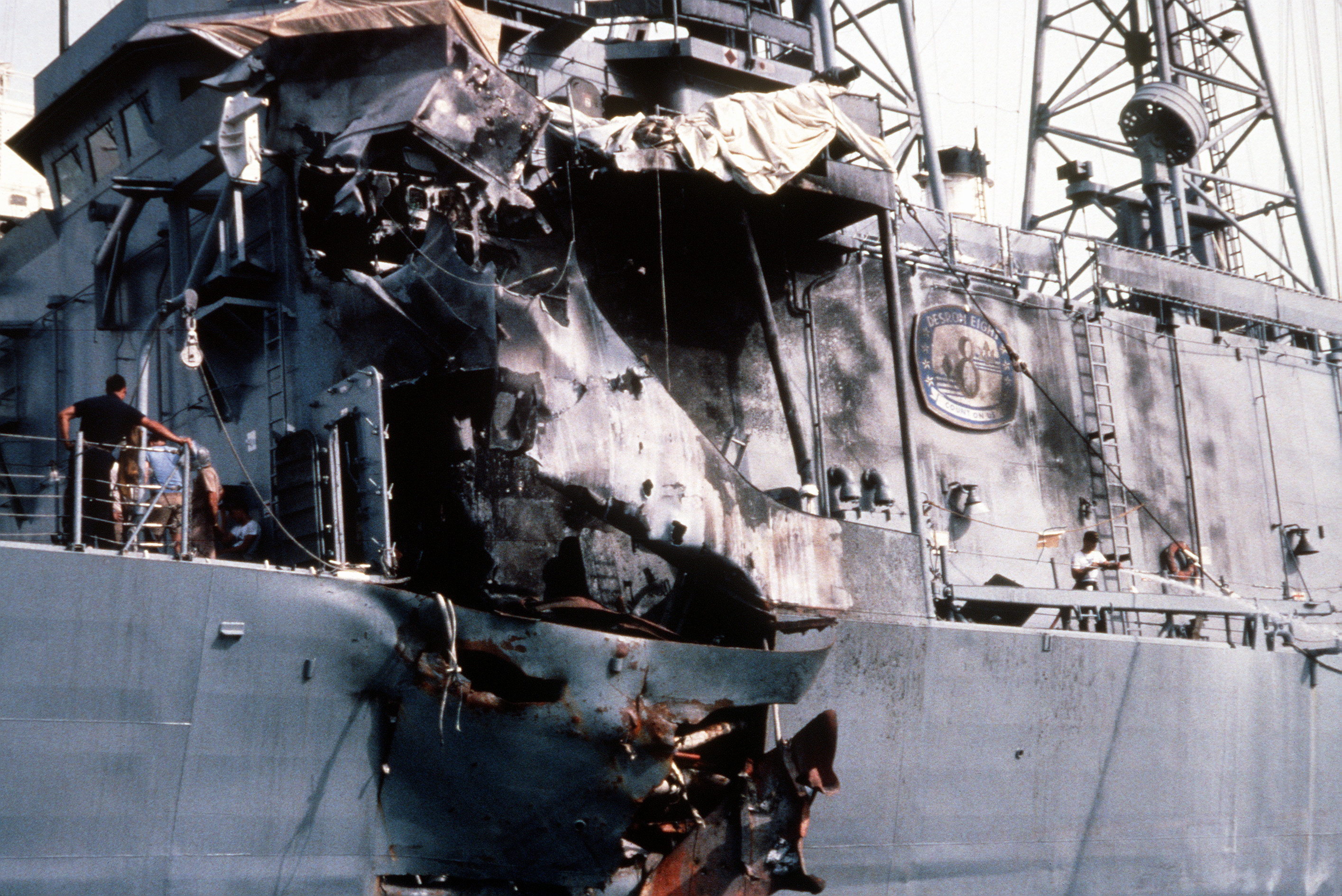
USS Stark was deployed to the Middle East Force in 1984 and 1987. Captain Glenn R. Brindel was the commanding officer during the 1987 deployment. The ship was struck on 17 May 1987 by two Exocet anti-ship missiles during the Iran–Iraq War fired from an Iraqi aircraft officially identified as a Dassault Mirage F1 fighter, The Reagan administration attributed the blame to Iran for its alleged belligerence in the underlying conflict. The plane had taken off from Shaibah, Iraq at 20:00 and had flown south into the Persian Gulf. The pilot fired the first Exocet missile from a range of 22.5 nmi, and the second from 15.5 nmi, just about the time Stark issued a standard warning by radio. The frigate did not detect the missiles with radar; warning was given by the lookout only moments before the missiles struck. The first penetrated the port-side hull and failed to detonate, but left flaming rocket fuel in its path. The second entered at almost the same point, and, leaving a 3 by gash, exploded in crew quarters. The missiles killed 37 sailors and injured 21.
No weapons were fired in defense of Stark. The autonomous Phalanx CIWS remained in standby mode, Mark 36 SRBOC countermeasures were not armed until seconds before the missile hit. The attacking Exocet missiles and Mirage aircraft were in a blindspot of the STIR fire control director (Separate tracking and illumination Radar, part of the Mk 92 Guided Missile Fire Control System), and the Oto Melara Mk 75 76 mm/62 caliber naval gun, but in the clear for the MK 92 CAS (Combined Antenna System, primary search and tracking radar of the Mk 92 Guided Missile Fire Control System) and the Mk 13 Mod 4 single-arm launcher. The ship failed to maneuver to bring its Mk 75 to bear before the first missile hit.
On fire and listing, the frigate was brought under control by its crew during the night. The ship made its way to Bahrain where, after temporary repairs by the destroyer tender to make her seaworthy, she returned to her home port of Naval Station Mayport, under her own power. The ship was eventually repaired at Ingalls Shipbuilding in Mississippi for $142 million.
It is unknown whether Iraqi leaders authorized the attack. Initial claims by the Iraqi government that Stark was inside the Iran–Iraq War zone were shown to be false. The motives and orders of the pilot remain unanswered. American officials have claimed he was executed, but an ex-Iraqi Air Force commander later said that the pilot who attacked Stark was not punished, and remained alive. According to Jean-Louis Bernard, author of Heroes of Bagdad, the pilot, Abdul Rhaman, not only was not punished, but received the Medal of Bravery at the end of "a joint Iraqi-American commission of inquiry." His subsequent defection is not mentioned in this book. Jean-Louis Bernard also confirms the use of a Falcon 50 during this action. Citing lapses in training requirements and lax procedures, the U.S. Navy's board of inquiry relieved Captain Brindel of command and recommended him for court-martial, along with tactical action officer Lieutenant Basil E. Moncrief. Instead, Brindel and Moncrief received non-judicial punishment from Admiral Frank B. Kelso II and letters of reprimand. Brindel opted for early retirement while Moncrief resigned his commission after only eight years of service. The executive officer, Lieutenant Commander Raymond Gajan Jr., was detached for cause and received a letter of admonition.
1990s
Stark was part of the Standing Naval Forces Atlantic Fleet in 1990 before returning to the Middle East Force in 1991. Stark was attached to UNITAS in 1993 and took part in Operation Uphold Democracy and Operation Able Vigil in 1994. In 1995, Stark returned to the Middle East Force before serving with the Standing Naval Forces, Atlantic (STANAVFORLANT) in 1997 and in 1998.
Stark was decommissioned on 7 May 1999. A scrapping contract was awarded to Metro Machine Corp. of Philadelphia, Pennsylvania, on 7 October 2005. The ship was reported scrapped on 21 June 2006. Her stern plate was saved and donated to Naval Station Mayport.
References
References
- "USS Stark (FFG 31)".
- (16 March 2017). "Stark (FFG-31)". Naval History and Heritage Command.
- "Wayback Machine".
- Bacevich, Andrew. (2016). "America's War for the Greater Middle East: A Military History". Random House.
- Stephen Andrew Kelley. (June 2007). "Better Lucky Than Good: Operation Earnest Will as Gunboat Diplomacy". [[Naval Postgraduate School]].
- [https://web.archive.org/web/20110501033851/http://www.jag.navy.mil/library/investigations/USS%20STARK%20BASIC.pdf Navy Jag Corps]
- Chuck. (31 May 2010). "A Stark Reminder".
- (1987-11-04). "USS Stark Sails To Mississippi For Repairs".
- Fisk, Robert. (2005). "The Great War For Civilisation: The Conquest of the Middle East". Knopf Publishing.
- Bernard, Jean-Louis. (2020). "Les héros de Bagdad: Tome 2, Les débuts du Mirage F1, et l'aventure du Super-Etendard". Editions Jean-Pierre Otelli.
- "Two Officers Accept Blame in Frigate Attack, Will Leave Service".
- Cushman Jr, John H.. (28 July 1987). "Navy Forgoes Courts-Martial for Officers of Stark". The New York Times.
- "STARK (FFG 31)".
- (20 May 2016). "Mayport, Fla., remembers fallen shipmates at Stark Memorial". Aerotech News and Review.
This article was imported from Wikipedia and is available under the Creative Commons Attribution-ShareAlike 4.0 License. Content has been adapted to SurfDoc format. Original contributors can be found on the article history page.
Ask Mako anything about USS Stark — get instant answers, deeper analysis, and related topics.
Research with MakoFree with your Surf account
Create a free account to save articles, ask Mako questions, and organize your research.
Sign up freeThis content may have been generated or modified by AI. CloudSurf Software LLC is not responsible for the accuracy, completeness, or reliability of AI-generated content. Always verify important information from primary sources.
Report