From Surf Wiki (app.surf) — the open knowledge base
USS New Jersey (BB-16)
Pre-dreadnought battleship of the United States Navy

Pre-dreadnought battleship of the United States Navy
| Field | Value | ||||||
|---|---|---|---|---|---|---|---|
| section1 | {{Infobox ship/image | ||||||
| image | USS New Jersey (BB-16) in camouflage coat, 1918 edit.jpg | ||||||
| image_caption | USS New Jersey (BB-16) in a camouflage paint scheme, 1918 | ||||||
| section2 | {{Infobox ship/career | ||||||
| country | United States | ||||||
| flag | |||||||
| name | New Jersey | ||||||
| namesake | New Jersey | ||||||
| builder | Fore River Shipyard | ||||||
| laid_down | 3 April 1902 | ||||||
| launched | 10 November 1904 | ||||||
| commissioned | 12 May 1906 | ||||||
| decommissioned | 6 August 1920 | ||||||
| struck | 12 July 1922 | ||||||
| fate | Sunk as target 5 September 1923 | ||||||
| section3 | {{Infobox ship/characteristics | ||||||
| class | |||||||
| *Normal: {{convert | 14948 | LT | t | lk | on}} | ||
| length | 441 ft | ||||||
| beam | 76 ft | ||||||
| draft | 23 ft | ||||||
| *{{convert | 19000 | ihp | kW | lk | on | abbr=on}} | |
| speed | 19 kn | ||||||
| complement | 812 | ||||||
| armament | *4 × 12 in/40 caliber guns | ||||||
| *Belt: {{convert | 6 | - | 11 | in | abbr | on | 0}} |
| *Barbettes: {{convert | 10 | in | abbr | on | 0}} | ||
| *Turrets: {{convert | 12 | in | abbr | on | 0}} | ||
| *Conning tower: {{convert | 9 | in | abbr | on | 0}} |
- Normal: 14948 LT
- Full load: 16094 LT
- 12 × Babcock & Wilcox boilers
- 19000 ihp
- 2 × triple-expansion steam engines
- 2 × screw propellers
- 8 × 8 in/45 cal guns
- 12 × 6 in/50 cal guns
- 12 × 3 in/50 cal guns
- 12 × 3-pounder guns
- 4 × 21 inch (533 mm) torpedo tubes
- Belt: 6 -
- Barbettes: 10 in
- Turrets: 12 in
- Conning tower: 9 in
**USS ''New Jersey''''' (hull number **BB-16''') was the fourth of five s of the United States Navy, and the first ship to carry her name. She was laid down at the Fore River Shipbuilding Company in Quincy, Massachusetts, in May 1902, launched in November 1904, and commissioned into the fleet in May 1906. The ship was armed with an offensive battery of four 12 in guns and eight 8 in guns, and she was capable of a top speed of 19 kn.
New Jersey spent her entire career in the Atlantic Fleet. In late 1906, she took part in the Second Occupation of Cuba, and she participated in the Jamestown Exposition in April – May 1907. At the end of the year, she joined the Great White Fleet for its circumnavigation of the globe, which lasted into 1909. The ship spent the following five years conducting peacetime training. In April 1914, New Jersey took part in the occupation of Veracruz during the Mexican Revolution. During World War I, she was used as a training ship, and after the war, she was tasked with transporting American soldiers back from Europe. New Jersey was decommissioned in 1920 and slated for destruction in bombing tests in 1923. Martin NBS-1 bombers sank the ship on 5 September 1923 in a series of bomb attacks.
Design
Main article: Virginia-class battleship
Design work on the began in 1899, after the United States' victory in the Spanish–American War, which had demonstrated the need for sea-going battleships suitable for operations abroad, finally resolving the debate between proponents of that type and those who favored low-freeboard types useful for coastal defense. The designers included a superposed arrangement of the main and some of the secondary guns, which proved to be a significant disappointment in service, as firing either set of guns interfered with the others, slowing the rate of fire.
New Jersey was 441 ft long overall and had a beam of 76 ft and a draft of 23 ft. She displaced 14948 LT as designed and up to 16094 LT at full load. The ship was powered by two-shaft triple-expansion steam engines rated at 19000 ihp, with steam provided by twelve coal-fired Babcock & Wilcox boilers. The propulsion system generated a top speed of 19 kn. As built, she was fitted with heavy military masts, but these were quickly replaced by cage masts in 1909. She had a crew of 812 officers and enlisted men.
The ship was armed with a main battery of four 12 in /40 caliber Mark 4 guns in two twin gun turrets on the centerline, one forward and aft. The secondary battery consisted of eight 8 in /45 caliber guns and twelve 6 in /50 caliber guns. The 8-inch guns were mounted in four twin turrets; two of these were superposed atop the main battery turrets, with the other two turrets abreast the forward funnel. The 6-inch guns were placed in casemates in the hull. For close-range defense against torpedo boats, she carried twelve 3 in/50 caliber guns mounted in casemates along the side of the hull and twelve 3-pounder guns. She also carried two 1-pounder guns. As was standard for capital ships of the period, New Jersey carried four 21 inch (533 mm) torpedo tubes, submerged in her hull on the broadside.
New Jerseys main armored belt was 11 in thick over the magazines and the machinery spaces and 6 in elsewhere. The faces of the main battery gun turrets (and the secondary turrets on top of them) were 12 in thick. Each turret rested on a supporting barbettes that had 10 in of armor plating. The conning tower had 9 in thick sides.
Service history
Early career and Great White Fleet
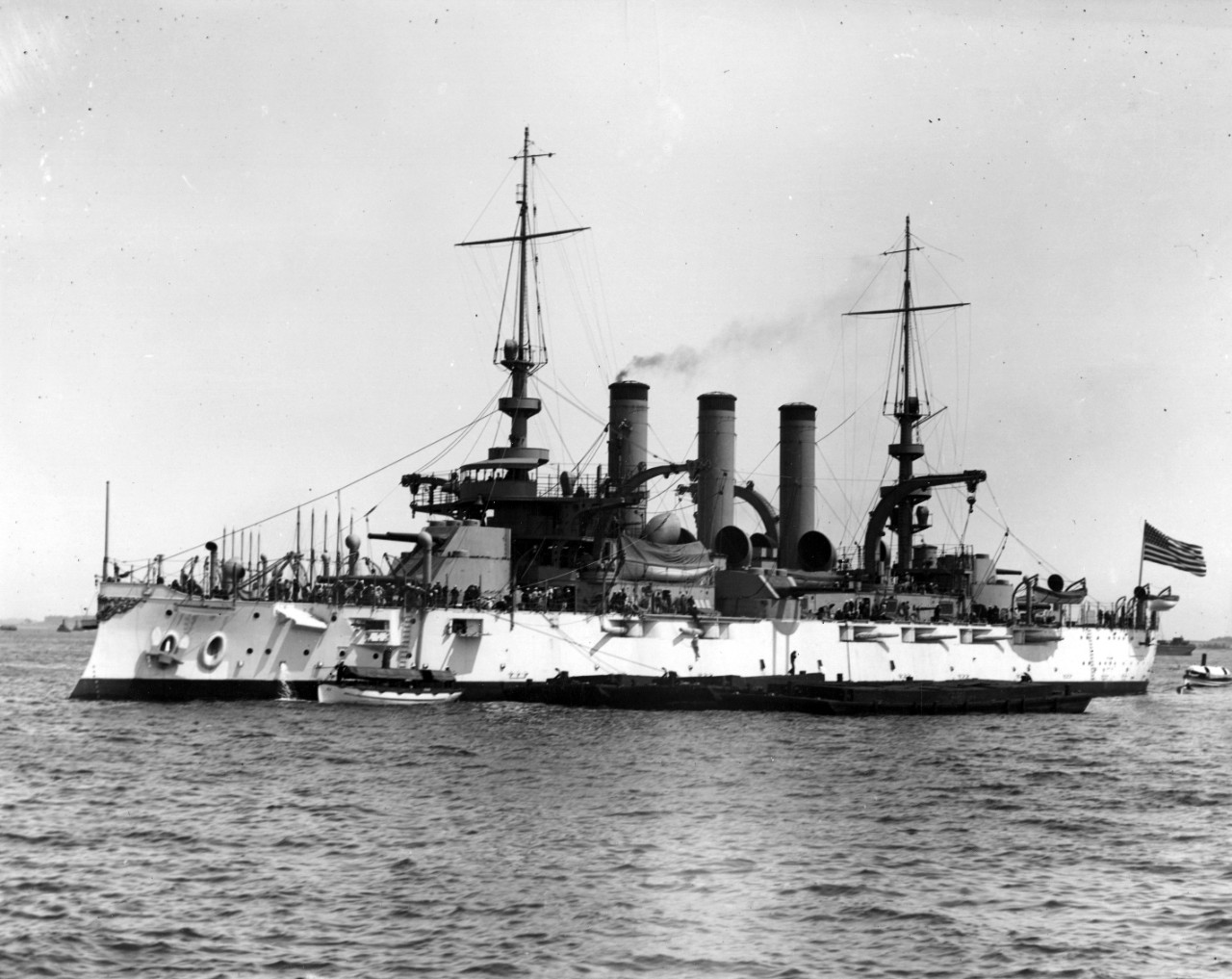
The keel for New Jersey was laid down at the Fore River Shipyard on 3 April 1902. She was launched on 10 November 1904; the daughter of Franklin Murphy, then the Governor of New Jersey, christened the ship. She was commissioned into the US fleet on 12 May 1906, Captain William Kimball in command. New Jersey began her initial training in the Atlantic and Caribbean, which was interrupted by a naval review for President Theodore Roosevelt in Oyster Bay in September. On 21 September, the ship was deployed to Cuba to take part in the Second Occupation of Cuba; she remained there until 13 October. New Jersey participated in the Jamestown Exposition from 15 April to 14 May 1907, which commemorated the 300th anniversary of the founding of the Jamestown colony. An international fleet that included British, French, German, Japanese, and Austro-Hungarian warships joined the US Navy at the event.
New Jersey joined the Great White Fleet on 16 December 1907, when they departed Hampton Roads to begin their circumnavigation of the globe. The cruise of the Great White Fleet was conceived as a way to demonstrate American military power, particularly to Japan. Tensions had begun to rise between the United States and Japan after the latter's victory in the Russo-Japanese War in 1905, particularly over racist opposition to Japanese immigration to the United States. The press in both countries began to call for war, and Roosevelt hoped to use the demonstration of naval might to deter Japanese aggression. The fleet cruised south to the Caribbean and then to South America, making stops in Port of Spain, Rio de Janeiro, Punta Arenas, and Valparaíso, among other cities. After arriving in Mexico in March 1908, the fleet spent three weeks conducting gunnery practice. The fleet then resumed its voyage up the Pacific coast of the Americas, stopping in San Francisco and Seattle before crossing the Pacific to Australia, stopping in Hawaii on the way. Stops in the South Pacific included Melbourne, Sydney, and Auckland.
After leaving Australia, the fleet turned north for the Philippines, stopping in Manila, before continuing on to Japan where a welcoming ceremony was held in Yokohama, which helped to defuse tensions between the two countries. Three weeks of exercises followed in Subic Bay in the Philippines in November. The ships passed Singapore on 6 December and entered the Indian Ocean; they coaled in Colombo before proceeding to the Suez Canal and coaling again at Port Said, Egypt. The fleet called in several Mediterranean ports before stopping in Gibraltar, where an international fleet of British, Russian, French, and Dutch warships greeted the Americans. The ships then crossed the Atlantic to return to Hampton Roads on 22 February 1909, having traveled 46729 nmi. There, they conducted a naval review for Theodore Roosevelt.
1910–1923
New Jersey spent the next several years in the peacetime routine of the Atlantic Fleet, with various training maneuvers and gunnery practice in the Atlantic and Caribbean. During this period, she spent a year out of commission at Boston from 2 May 1910 to 15 July 1911, and in the summers of 1912 and 1913, she conducted training cruises for midshipmen from the United States Naval Academy. The ship was deployed to the Caribbean to protect American interests as the Mexican Revolution worsened in late 1913. On 21 April 1914, the United States occupied Veracruz in the aftermath of the Tampico Affair. On 13 August, New Jersey departed Mexican waters and steamed to Santo Domingo, where unrest gripped both the Dominican Republic and Haiti. After observing conditions in the two countries, the ship continued on, arriving in Hampton Roads on 9 October. She spent the next three years conducting her normal training routine.
On 6 April 1917, the United States declared war on Germany owing to the unrestricted submarine warfare campaign Germany initiated earlier that year. New Jersey was employed as a training ship for naval draftees, based in Chesapeake Bay. In November 1918, Germany signed the Armistice that ended the war; New Jersey was thereafter used to transport American soldiers back from Europe. In the course of four voyages between late 1918 and 9 June 1919, she carried some 5,000 soldiers. New Jersey was decommissioned on 6 August 1920 at the Boston Naval Shipyard, and was to be disposed of under the terms of the Washington Naval Treaty signed in 1922. New Jersey, along with her sister and the battleship were allocated for weapons tests conducted with the US Army Air Service, under the supervision of General Billy Mitchell.
The bombing tests against New Jersey were conducted on 5 September 1923 in the Atlantic Ocean off Diamond Shoals, North Carolina, by Martin NBS-1 bombers of the 2nd Bombardment Group. Observers were aboard the Army transport ship . Four of the NBS-1s attacked New Jersey with 600 lb bombs at an altitude of 10000 ft, scoring four hits and several near-misses, which caused significant flooding. Another attack was made, this time with 2000 lb bombs at 6000 ft, seven of which landed close to the ship. By this time, flooding had increased to the point that the casemate gun ports were submerged. Two more NBS-1s then attacked with two 1100 lb bombs apiece; the first two missed but the third was a direct hit. It caused a large explosion and New Jersey capsized and sank 24 minutes later.
Footnotes
Notes
Citations
References
- {{cite book
- {{cite book | editor1-last = Chesneau | editor1-first = Roger | editor2-last = Kolesnik | editor2-first = Eugene M. | url-access = registration | name-list-style=amp
- {{cite journal
- {{cite book
- {{cite book
- {{cite web |access-date=6 June 2015
- {{cite book
References
This article was imported from Wikipedia and is available under the Creative Commons Attribution-ShareAlike 4.0 License. Content has been adapted to SurfDoc format. Original contributors can be found on the article history page.
Ask Mako anything about USS New Jersey (BB-16) — get instant answers, deeper analysis, and related topics.
Research with MakoFree with your Surf account
Create a free account to save articles, ask Mako questions, and organize your research.
Sign up freeThis content may have been generated or modified by AI. CloudSurf Software LLC is not responsible for the accuracy, completeness, or reliability of AI-generated content. Always verify important information from primary sources.
Report