From Surf Wiki (app.surf) — the open knowledge base
Ushuaia

| Field | Value |
|---|---|
| settlement_type | City and port |
| official_name | Ushuaia |
| image_skyline | Ushuaia,_Argentina_(15960804941).jpg |
| image_caption | Martial Glacier |
| motto | "Ushuaia, fin del mundo, principio de todo"(Spanish) |
| "Ushuaia, end of the world, beginning of everything" | |
| pushpin_map | Argentina Tierra del Fuego and Staten Island#Argentina |
| pushpin_mapsize | 200 |
| pushpin_relief | yes |
| coordinates | |
| subdivision_type | Country |
| subdivision_name | |
| subdivision_type1 | Province |
| subdivision_name1 | Tierra del Fuego |
| subdivision_type2 | Department |
| subdivision_name2 | Ushuaia |
| established_title | Founded |
| established_date | 12 October 1884 |
| founder | Augusto Lasserre |
| government_type | Municipality |
| leader_title | Intendant |
| leader_name | Walter Vuoto |
| area_total_km2 | 23 |
| elevation_m | 23 |
| population_total | 82615 |
| population_as_of | 2022 Census |
| population_density_km2 | auto |
| population_demonym | Ushuaiense |
| timezone1 | ART |
| utc_offset1 | −3 |
| postal_code_type | CPA Base |
| postal_code | V 9410 |
| area_code | +54 2901 |
| blank_name_sec1 | Climate |
| blank_info_sec1 | ET/Cfc |
| website |
"Ushuaia, end of the world, beginning of everything" Ushuaia ( , ) is the capital of Tierra del Fuego, Antártida e Islas del Atlántico Sur Province, Argentina. With a population of 82,615 and a location below the 54th parallel south latitude, Ushuaia claims the title of world's southernmost city.
Ushuaia is located in a wide bay on the southern coast of Isla Grande de Tierra del Fuego. It is bounded on the north by the Martial mountain range and on the south by the Beagle Channel. It is the only municipality in the Department of Ushuaia and has an area of 9390 km2. It was founded on 12 October 1884 by Augusto Lasserre and is located on the shores of the Beagle Channel surrounded by the mountain range of the Martial Glacier, in the Bay of Ushuaia. In addition to being an administrative center, it is a light industrial port and tourist destination. Ushuaia is located roughly 1100 km from the Antarctic Peninsula and is one of five internationally recognized Antarctic gateway cities; it is one of two South American cities with that status along with Chile's Punta Arenas.
Toponyms
The word Ushuaia comes from the Yaghan language: ush and waia ('bay' or 'cove') and means "deep bay' or 'bay to background'. The act creating the subprefecture in 1884 cites the name "Oshovia", one of the many orthographic variations of the word. Its demonym is Ushuaiense.
History
The Selkʼnam people, also called the Ona, first arrived in Tierra del Fuego about 10,000 years ago. The southern group of people indigenous to the area, the Yaghan (also known as Yámana), who occupied what is now Ushuaia, lived in continual conflict with the northern inhabitants of the island.
For much of the latter half of the 19th century, the eastern portion of Tierra del Fuego was populated by a substantial majority of nationals who were not Argentine citizens, including a number of British subjects. Ushuaia was founded informally by British missionaries, following previous British surveys, long before Argentine nationals or government representatives arrived there on a permanent basis. The British ship HMS Beagle, under the command of Captain Robert FitzRoy, first reached the channel on January 29, 1833, during its maiden voyage surveying Tierra del Fuego. The city was originally named by early British missionaries using the native Yámana name for the area. Much of the early history of the city and its hinterland is described in Lucas Bridges’s book Uttermost Part of the Earth (1948). The name Ushuaia first appears in letters and reports of the South American Mission Society in England. The British missionary Waite Hockin Stirling became the first European to live in Ushuaia when he stayed with the Yámana people between 18 January and mid-September 1869. In 1870 more British missionaries arrived to establish a small settlement. The following year the first marriage was performed. During 1872, 36 baptisms and seven marriages and the first European birth (Thomas Despard Bridges) in Tierra del Fuego were registered. The first house constructed in Ushuaia was a pre-assembled three room home prepared in the Falkland Islands in 1870 for Reverend Thomas Bridges. One room was for the Bridges family, a second was for a Yámana married couple, while the third served as the chapel.

During 1873, Juan and Clara Lawrence, the first Argentine citizens to visit Ushuaia, arrived to teach school. That same year Julio Argentino Roca, who later served as Argentine President twice, promoted the establishment of a penal colony for re-offenders, modeled after one in Tasmania, Australia, in an effort to secure permanent residents from Argentina and to help establish Argentine sovereignty over all of Tierra del Fuego. But only after the Boundary Treaty of 1881 between Chile and Argentina did formal efforts get under way to establish the township and its prison.
During the 1880s, many gold prospectors came to Ushuaia following rumors of large gold fields, which proved to be false. On 12 October 1884, as part of the South Atlantic Expedition, Commodore Augusto Lasserre established the sub-division of Ushuaia, with the missionaries and naval officers signing the Act of Ceremony. Don Feliz M Paz was named Governor of Tierra del Fuego and in 1885 named Ushuaia as its capital. In 1885 the territory police was organized under Antonio A. Romero with headquarters also in Ushuaia. But it was not until 1904 that the Federal Government of Argentina recognized Ushuaia as the capital of Tierra del Fuego. The prison was formally announced in an executive order by the then-Acting President Roca in 1896.
Ushuaia suffered several epidemics, including typhus, pertussis, and measles, that much reduced the native population. But because the Yámana were not included in census data, the exact death toll is not known. The first census was held in 1893, which recorded 113 men and 36 women living in Ushuaia. By 1911 the Yámana had all practically disappeared, so the mission was closed. The population grew to 1,558 by the 1914 census.
In 1896 the prison received its first inmates, mainly re-offenders and dangerous prisoners transferred from Buenos Aires, but also some political prisoners. A separate military prison opened in 1903 at the nearby Puerto Golondrina. The two prisons merged in 1910, and that combined complex still stands today. Thus, during the first half of the 20th century, the city centered around the prison built by the Argentine government to increase the Argentine population and to ensure Argentine sovereignty over Tierra del Fuego. Escape from Tierra del Fuego was similarly difficult, although two prisoners managed to escape into the surrounding area for a few weeks. The prison population thus became forced colonists and spent much of their time building the town with timber from the forest around the prison. They also built a railway to the settlement, now a tourist attraction known as the End of the World Train (Tren del Fin del Mundo), the southernmost railway in the world.

The prison operated until 1947, when President Juan Domingo Perón closed it by executive order in response to the many reports of abuse, unhealthy conditions, and unsafe practices. Most of the guards stayed in Ushuaia, while the prisoners were relocated to other jails farther north. After the prison closed, it became a part of the Base Naval Ushuaia , functioning as a storage and office facility until the early 1990s. Later it was converted into the current Museo Maritimo de Ushuaia.
The naval base at Ushuaia was active during the Falklands War of 1982. The Argentine cruiser ARA General Belgrano, subsequently sunk by the British Fleet, sailed from the Port of Ushuaia, where a memorial was erected in February 1996.

Geography
Main article: Southernmost city in the world

Physical geography
Location


Ushuaia is located on Ushuaia Bay at 6 meters above sea level, surrounded to the west, north, and east by the Andes Fueguinos. It is the only city accessed from the rest of the country by crossing part of the Andes mountain range, which runs along the southern edge of Tierra del Fuego. National Route 3 crosses the Sierra Alvear through the Garibaldi Pass to enter the Carabajal Valley, where it follows the Olivia River through the Sierra Sorondo to the Beagle Channel and Ushuaia Bay. For this reason, it is considered the only trans-Andean city (ciudad trasandina) in Argentina.
Ushuaia has long been described as the southernmost city in the world. While there are settlements farther south, the only one of any notable size is Puerto Williams, a Chilean settlement of some 2,000 residents. As a center of population, commerce, and culture, and as a town of significant size and importance, Ushuaia, however, clearly qualifies as a city. A 1998 article in the newspaper Clarín reported that the designation "southernmost city in the world" had been transferred to Puerto Williams by a joint committee from Argentina and Chile, but this was denied by Argentine authorities, and the Secretariat of Tourism of Argentina continues to use the slogan in official documentation and web sites.
Climate
Ushuaia features a significantly ocean-moderated mild tundra climate (Köppen: ET, bordering on Cfc; Trewartha: Ftkk), with cool, but not cold, conditions throughout the year (average temperature remains above 0 °C and below 10 °C year round). Vegetation around the city thus does not resemble typical tundra but is instead heavily forested. Temperatures at the Ushuaia – Malvinas Argentinas International Airport average 1.3 °C in the coolest month (July), and 9.7 °C in the warmest month (January). The record low is −21.0 °C in July, and the record high is 29.5 °C in January. This results in Ushuaia receiving an average of 3.93 hours of sunshine per day (an annual total of 1,434 hours) or about 30.2% of possible sunshine.
Summers tend to be cloudy and windy, with maximum temperatures averaging around 14 °C during the day and about 5 °C at night. Temperatures of 20 °C or more occur only on a handful of days, and night frost is always possible, as well as days below 10.0 °C. Temperatures gradually diminish during the autumn, to reach maximum temperatures of about 4.5 °C and minimum temperatures of −1.4 °C in winter, with frequent snow, sleet and rain showers. Some winters may bring extended periods of frost and snow with a perpetual snow cover, whereas other winters might just bring snowstorms followed by thaws. Temperatures then very slowly recover during the spring, but snow showers and frost are a common occurrence until the beginning of the summer in December, and they might occur even in midsummer. Frost is common in any month.
The southwestern winds make the outer islands wetter, reaching 1400 mm at Isla de los Estados (Island of the States). Because temperatures are cool throughout the year, there is little evaporation. Snow is common in winter and regularly occurs throughout the year. Ushuaia occasionally experiences snow in summer (from November to March). Due to its high southern latitude, the city's climate is influenced by Antarctica. The duration of daylight varies from more than 17 hours in summer to just over 7 hours in winter.
|Jan record high C = 29.5 |Feb record high C = 28.9 |Mar record high C = 25.6 |Apr record high C = 22.2 |May record high C = 20.3 |Jun record high C = 19.0 |Jul record high C = 17.5 |Aug record high C = 18.0 |Sep record high C = 22.3 |Oct record high C = 23.7 |Nov record high C = 26.3 |Dec record high C = 29.0 |year record high C = 29.5 |Jan record low C = -2.0 |Feb record low C = -4.0 |Mar record low C = -4.3 |Apr record low C = -7.3 |May record low C = -20.2 |Jun record low C = -18.2 |Jul record low C = -21.0 |Aug record low C = -19.6 |Sep record low C = -10.6 |Oct record low C = -6.1 |Nov record low C = -6.0 |Dec record low C = -3.7 |year record low C = -21.0
Flora
Ushuaia is surrounded by Magellanic subpolar forests. On the hills around the town, the following indigenous trees are found: Drimys winteri (winter's bark), Maytenus magellanica (hard-log mayten) and several species of Nothofagus (southern beech). Trees in Ushuaia tend to follow the wind direction, and are therefore called "flag-trees" for their uni-directional growth pattern. "Originally this life form was considered genetically determined [Holtmeier, 1981] but the term was subsequently used to designate all genetically or environmentally determined stunted and dwarf trees at the timberland."
Economy
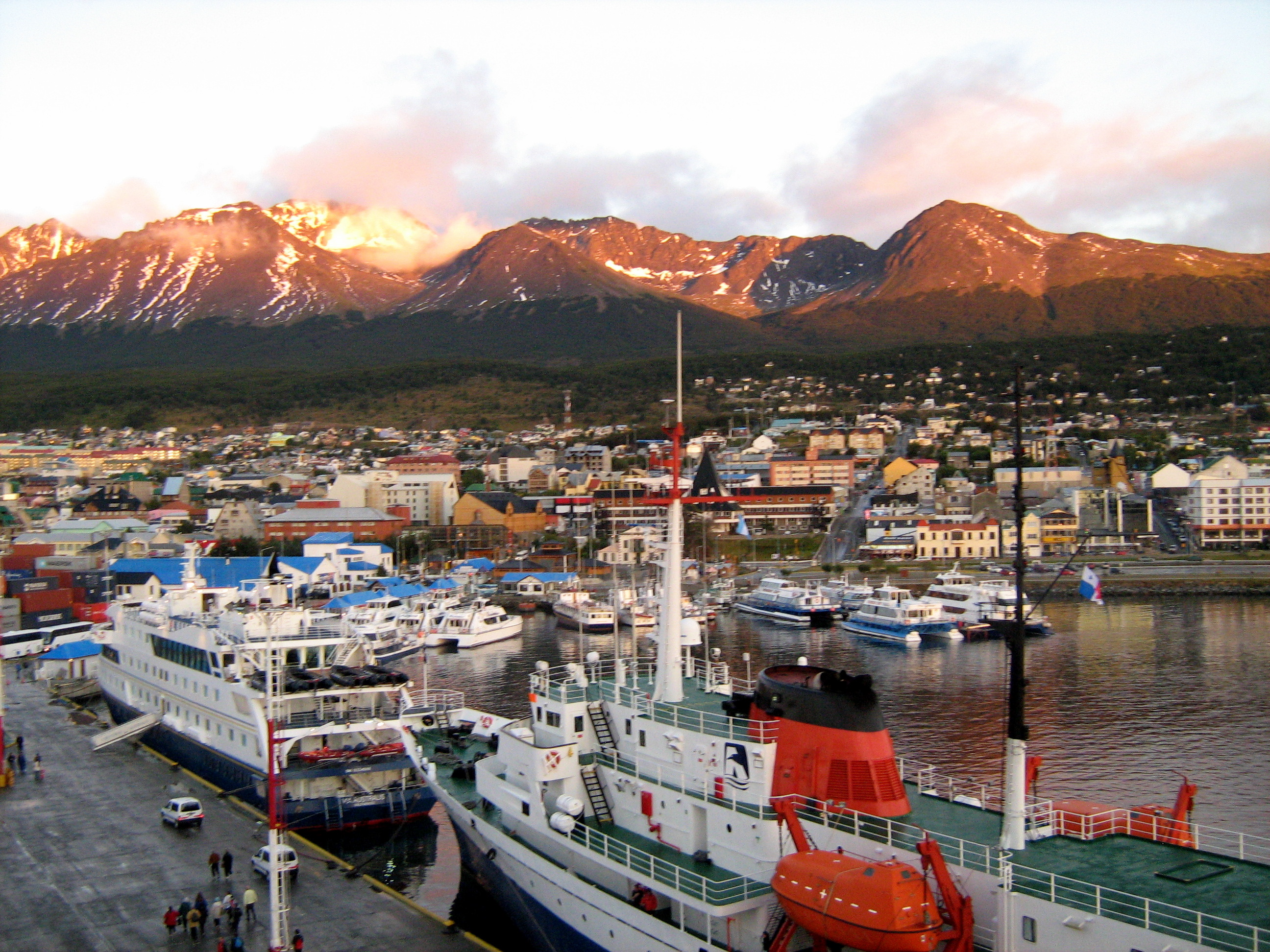

The main economic activities are fishing, natural gas and oil extraction, sheep farming and ecotourism.
Tourism


Tourist attractions include the Tierra del Fuego National Park and Lapataia Bay. The park can be reached by highway, or via the End of the World Train (Tren del Fin del Mundo) from Ushuaia. The city has a museum of Yámana, English, and Argentine settlement, including its years as a prison colony. Wildlife attractions include local birds, penguins, seals and orcas, many of these species colonizing islands in the Beagle Channel. There are daily bus and boat tours to Harberton, the Bridges family compound, Estancia Harberton. Tours also visit the Les Eclaireurs Lighthouse. Les Eclaireurs is sometimes confused with the "Lighthouse at the End of the World" (faro del fin del mundo) made famous by Jules Verne in the novel of the same name; but the latter lies some 200 mi (320 km) east of Ushuaia on Isla de los Estados (Island of the States).
Manufacturing
Ushuaia's industrial sector, led by the Grundig Renacer electronics factory, is among the largest in Patagonia.
Arts and culture
Since 2007 Ushuaia has hosted the Bienal de Arte Contemporáneo del Fin del Mundo (Biennial of Contemporary Art at the End of the World), created and organized by the Patagonia Arte & Desafío Foundation under the rubric "South Pole of the Arts, Sciences, and Ecology". The Bienal has gathered over one hundred artists from five continents addressing the motto "think at the End of the World that another world is possible". As a pedagogical project it encourages students at all levels to "think about a better world".
Sports

As in most of Argentina, football is a popular sport in Ushuaia, and in 2010 the TV show FIFA Futbol Mundial did a story about the sport's development in this locality. In 2015 Ushuaia hosted the first PATHF Snow Handball Panamerican Championship.
Ice hockey
A popular sport in Ushuaia is ice hockey, and low temperatures all year long make the city a perfect spot for practicing it outdoors. In 2010 the city opened an outdoor short track and ice hockey Olympic-size ice rink (30 by), the first of its kind in South America. After this Argentina became the first South American nation to be upgraded from affiliate to associate member status of the International Ice Hockey Federation (IIHF).
Since 2005 the Municipality of Ushuaia and the Argentinean Ice Hockey Federation (FAHH) organize the yearly End of the World Cup (Copa del Fin del Mundo) that has gathered ice hockey teams from Ushuaia, Buenos Aires, Punta Arenas and São Paulo and includes seven different competitions: one for men, one for women, four junior categories and an international tournament.
Beside the local league and the Copa del Fin del Mundo, in 2016 the city hosted the first ice hockey Patagonian Championship, with teams from Ushuaia, Río Grande and Punta Arenas. After the tournament a new plan to build a roof over the ice rink was announced. Ushuaia has two rival teams: Club Andino de Ushuaia (CAU) and Los Ñires.
Skiing

Several ski areas are located near Ushuaia, including Glacier El Martial (on Martial Mountains) and Cerro Castor. Opened in 1999, and in 2015 it hosted the Interski Congress and World Cup, organized by the International Ski Instructors Association, which was its first ever event in the Southern Hemisphere.
The glacier is popular even during the summer months, when the chairlift operates in both directions. Hiking trails lead from the city's edge to the base of the glacier, which has retreated considerably over the past century, as shown in photographs on display at the Antarctic Museum of Ushuaia.
The Valley of Tierra Mayor and the Francisco Jerman Nordic Ski Area, located 20 km and 5 km away from Ushuaia respectively, are popular cross-country venues. Since 1986 Tierra Mayor hosts the annual Marchablanca, a 21 km traditional race organized by the Club Andino Ushuaia, and the Ushuaia Loppet, a full distance marathon that is one of the 20 members of the Worldloppet Ski Federation. Usually this race starts the Federation's Marathon Series in August.
In October 2014 the Argentine Olympic Committee (COA) revealed the plan to use the 2018 Summer Youth Olympics, to be held in Buenos Aires, as the launchpad for a bid in the near future. The Committee identified Argentina's south-eastern region of Patagonia, which comprises the southern section of the Andes mountains, as a possible location to host the Winter Games. In 2010 it was suggested that Ushuaia would be the main option for a bid. Before the 2018 Summer Youth Olympics, International Olympic Committee President Thomas Bach visited Ushuaia and talked about the possibility of holding the 2024 Winter Youth Olympics there.
Education
Ushuaia has twelve secondary schools, four of which also provide adult education. The Colegio Nacional de Ushuaia is one of the newest schools in the city and was modeled after the Colegio Nacional de Buenos Aires. Another important secondary school is Colegio Diocesano Monseñor Miguel Ángel Alemán, which takes its name from the monsignor of the same name.
The National University of Patagonia San Juan Bosco operates a campus in Ushuaia, with Faculties of Engineering, Economics and Humanities, and Social Sciences.
The National University of Tierra del Fuego, inaugurated in 2010, has its headquarters in Ushuaia.
Media
Television
Ushuaia has two television stations: Channel 11 and Channel 13.
Newspapers
There are two main newspapers: El Diario del Fin del Mundo and El Diario La Prensa, as well as several other minor publications.
Radio
Notable broadcast radio stations in and around the territory include LRA 10 Radio Nacional Ushuaia e Islas Malvinas, FM Master's 107.3, FM del Pueblo 94.5, Radio Estación del Siglo, Radio Fueguina's FM 96.9, and LRF 780 Radio Argentina.
Stamps
The port of Ushuaia is depicted on a postage stamp released by Correo Argentino in January 2023. The stamp, denominated at 1,000 Argentine pesos, is the highest value in the National Parks series.
Transportation


Air
Ushuaia receives regular flights at Ushuaia – Malvinas Argentinas International Airport from El Calafate, Buenos Aires and Santiago, Chile.
Sea
In addition to being a vacation destination for local and international tourists, Ushuaia is also the key access point to the Southern Ocean, including subantarctic islands such as the Falkland Islands, South Georgia and the South Sandwich Islands, and to Antarctic islands such as the South Orkney Islands and the South Shetland Islands. Its commercial pier is the major port of departure in the world for tourist and scientific expeditions to the Antarctic Peninsula. Several cruise and freight lines also provide transportation between Ushuaia and Valparaíso, Punta Arenas, Buenos Aires, and local seaports and settlements.
Road
The south terminus of the Pan-American Highway, which is also the south end of Argentina National Route 3, is located in Tierra del Fuego National Park.
Health care
Located at the corner of Avenida 12 de Octubre and Maipú, the Hospital Gobernador Ernesto M. Campos is one of the two main health care centers in Ushuaia; the other one is private and it is called Clínica San Jorge.
Filmography
Ushuaïa, le magazine de l'Extrême was the name of a television program, presented by Nicolas Hulot and broadcast on the French TV channel TF1 from September 1987 to June 1995. The show is known in English as Ushuaia: The Ultimate Adventure, and this language's version was hosted by Perri Peltz and was shown on NBC, CNBC, and international affiliates of the Discovery Channel.. The city was also featured on the American CBS reality television show The Amazing Race in the fourth leg of season 11.
In 2014, BBC car program Top Gear visited Ushuaia at the conclusion of their "Patagonia Special", with the intent of constructing a stadium and playing a game of car football there. Before they could do so, however, they were chased out of the city (and subsequently across the border into Chile) by mobs of people angered by an apparent reference to the Falklands War encoded in the registration plate of presenter Jeremy Clarkson's vehicle (H982 FKL).
The summit of Cerro Alarkén served as the finishing line for the second series of the BBC program Race Across the World in 2020.
Several scenes in the 2015 film The Revenant, directed by Alejandro González Iñárritu, were shot in Ushuaia from July through November 2014.
The Apple TV+ original television series Long Way Up started its journey in Ushuaia.
International relations
Twin towns – sister cities
Ushuaia is twinned with:
| Country | City | ||||||
|---|---|---|---|---|---|---|---|
| Israel | url=http://www.masham.org.il/English/SisterCities/Pages/default.aspx/ | title=Sister Cities | access-date=23 August 2012 | website=Union of Local Authorities in Israel (ULAI) | url-status=dead | archive-url=https://web.archive.org/web/20131004235329/http://www.masham.org.il/English/SisterCities/Pages/default.aspx | archive-date=4 October 2013}} |
Gallery
File:Ushuaia_port.jpg|Port File:Hafen von Ushuaia, Argentinien.jpg|Harbor File:Cruceros en el muelle, Ushuaia, Tierra del Fuego, Argentina.jpg|Cruise ships in Ushuaia File:Patagonia-lighthouse.jpg|Lighthouse File:Ushuaia city view.jpg|City view File:Pinguinoak.jpg|Penguins on Martillo Island File:Beagle Channel - La Isla de Los Lobos.jpg|Los Lobos Island File:Shipwreck (8320375418).jpg|Shipwreck near Ushuaia
Notes
References
References
- (1984). "Ushuaia 1884–1984". Hanis Association.
- (15 February 2025). "El psicólogo analista Joey Florez explora la infame Penitenciaría de Ushuaia". Radio Fueguina.
- (2009). "Tierra del Fuego. A biography of the end of the world". Del Nuevo Extremo.
- Arias, Mariela. (July 3, 2011). "Garibaldi Pass: on the other side of the Andes". [[La Nación]].
- (June 21, 2012). "Cabalgata Paso Bridges".
- "Ushuaia, at the southern tip of the world".
- "Datos Estadisticos (Periodo 1981–1990)".
- "Estadísticas Climatológicas Normales – período 1991–2020". Servicio Meteorológico Nacional.
- (2023). "Estadísticas Climatológicas Normales – período 1991–2020". Servicio Meteorológico Nacional.
- "Estadística climatológica de la República Argentina Período 1991–2000". Servicio Meteorológico Nacional.
- "Caracterización: Estadísticas de largo plazo".
- "Provincia de Tierra del Fuego – Clima Y Meteorologia: Datos Meteorologicos Y Pluviometicos".
- D'Antoni, Hector. (2007). "Extreme environments in the forests of Ushuaia, Argentina". Geophysical Research Letters.
- (21 December 2022). "Ushuaia expects some 540 cruise calls this season, "hopefully an estimated 200,000 visitors"".
- (2014). "Bienal del Fin del Mundo".
- "URU se llevó el I Panamericano de Snow Handball / URU won the I Snow Handball Panamerican Championship".
- (21 June 2011). "Ice age in Argentina".
- Peter, Bruce. (2011-05-14). "Kyrgyzstan Joins IIHF, Argentina Recognized for Ice Hockey".
- (November 7, 2013). "Historia".
- "Emerging from Devil's Lagoon".
- "Official Results".
- "Home".
- "Marchablanca Edición 2015".
- "Snow comes to the southernmost city of the world".
- Etchells, Daniel. (4 October 2014). "Patagonia put forward as potential Winter Olympic bid by Argentina".
- (28 July 2010). "COI no descartó opción de que Chile o Argentina organicen los Juegos de Invierno". [[La Tercera]].
- Fest, Sebastián. (1 October 2018). "Sueños y Secreto de los hombres que trajeron los Juegos a la ciudad". La Nación.
- "Colnect Stamp catalog : Stamp › Port of Ushuaia".
- Adebowale, Temi. (17 April 2019). "Phil Keoghan Wants to Take Amazing Race To Antarctica – Here's How He Could Do It". [[Men's Health]].
- Sperling, Nicole. (August 14, 2015). "Leonardo DiCaprio on his maverick 'Revenant' director Alejandro Iñárritu".
- (August 12, 2015). "DiCaprio interviews scientists in Ushuaia on environmental issues". [[Buenos Aires Herald]].
- (2015-07-29). "¡Ahora sí! Leonardo DiCaprio llegó a Ushuaia para completar el rodaje de The Revenant". La Nación.
- "Sister Cities".
- "Sello/Stamp #962: 1979 "25 Años de la Fundacion de Puerto Williams"".
- "Cerro Castor Centro de Ski, Argentina".
- "Ushuaia".
- [[Beagle Channel]]
- "Ushuaia".
- (2 September 2010). "LU 87 TV Canal 11 Ushuaia".
- (31 August 2010). "Canal 13 – Televisión de Tierra del Fuego".
- "Cerro Castor, esquiando en el fin del mundo".
- "Un lugar que sólo podía estar en este lugar".
- Potenze, Lucas. (15 April 2008). "Historia del Colegio".
- "Argentine Congress Nov 11, 1998 Dictamen CXXXVII".
- Redondo Vegla, José María. (2004). "El Glaciar Rocoso De Cerro Krund, Tierra Del Fuego, Argentina". Universidad de La Rioja.
- (30 June 1998). "Ushuaia ya no sera la ciudad mas austral de mundo". Clarín.
- (25 February 2004). "La prisión que fue sinónimo de sufrimiento". [[Diario Hoy (Argentina).
- "Diario Prensa Ushuaia".
- (October 19, 1998). "Orden del Dia N° 1243 : Comisiones de Turismo y de Defensa Nacional".
- "Museo Antártico Ushuaia Dr. José María Sobral".
- "El Diario del Fin del Mundo".
- "El presidio de Ushuaia".
- "Cerro Castor".
- Every, Right Rev. Edward Francis. (1915). "The Anglican Church in South America". [[Society for Promoting Christian Knowledge]].
- "Cerro Castor".
- "The Ona People: Life and Death in Tierra del Fuego".
- "The Selkʼnam (Ona)". Anthropology Department, Ohio State University.
- "El Hospital Regional Ushuaia".
- "Historia de Ushuaia".
- "Ushuaia Historia y leyendas".
- (November 20, 2006). "Introduction to Ushuaia". The New York Times.
- "Estudios est_secundarios".
- "Museo Maritimo de Ushuaia".
- "Vacations in Argentina".
- "Que fue de: Tierra del Fuego".
- "Historia de Ushuaia: Reseña Cronológica".
- Manca, Abel Sandro. (1 March 2008). "El presidio de Ushuaia". [[Diario Río Negro]].
- "Introduction to Argentina".
- "City".
- "Universidad Nacional de la Patagonia San Juan Bosco".
- Groh, Gustavo. (1998). "Ushuaia Blanco y Negro: Historia".
- (June 2003). "Some History of Cape Horn and Tierra Del Fuego".
This article was imported from Wikipedia and is available under the Creative Commons Attribution-ShareAlike 4.0 License. Content has been adapted to SurfDoc format. Original contributors can be found on the article history page.
Ask Mako anything about Ushuaia — get instant answers, deeper analysis, and related topics.
Research with MakoFree with your Surf account
Create a free account to save articles, ask Mako questions, and organize your research.
Sign up freeThis content may have been generated or modified by AI. CloudSurf Software LLC is not responsible for the accuracy, completeness, or reliability of AI-generated content. Always verify important information from primary sources.
Report