From Surf Wiki (app.surf) — the open knowledge base
Usedom
Island in the southern Baltic Sea divided between Germany and Poland
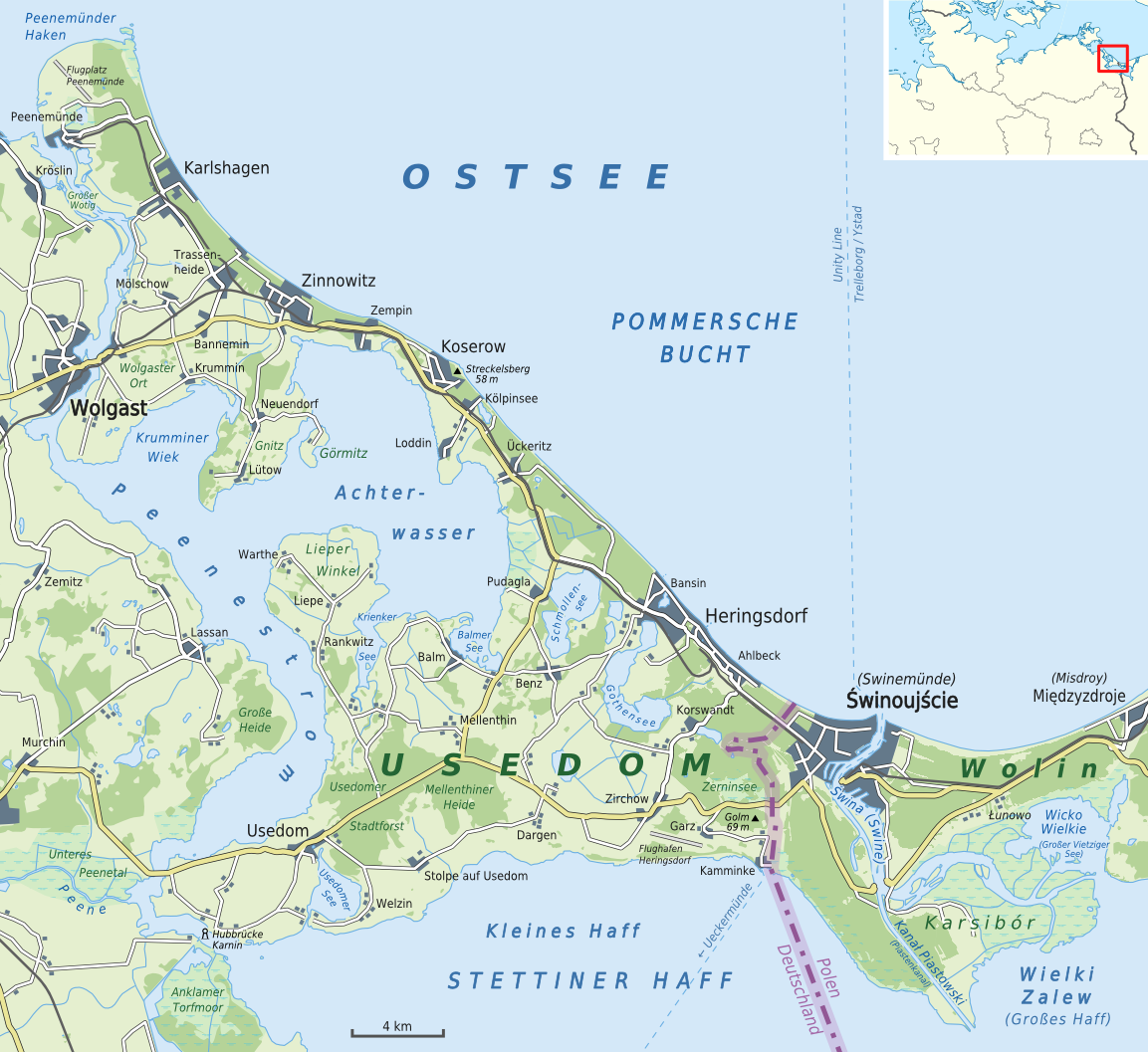
Island in the southern Baltic Sea divided between Germany and Poland
| Field | Value |
|---|---|
| name | Usedom |
| Uznam | |
| image_name | StrandDüne.JPG |
| image_caption | Beach, dune, and promenade in Ahlbeck – a distinctive seaside resort, typical for the Island of Usedom |
| image_size | 300px |
| map_image | Baltic Sea map Usedom location.png |
| map_caption | Map of the Baltic Sea with the island highlighted |
| nickname | Sunny Island |
| location | Baltic Sea |
| area_km2 | 445 |
| length_km | 66.4 |
| width_km | 23.9 |
| coastline_km | 110 |
| highest_mount | Golm |
| elevation_m | 69 |
| country | Germany |
| country_admin_divisions_title | State |
| country_admin_divisions | Mecklenburg-Vorpommern |
| country_admin_divisions_title_1 | District |
| country_admin_divisions_1 | Vorpommern-Greifswald |
| country1_admin_divisions_title_1 | County |
| country1_admin_divisions_1 | Świnoujście (city county) |
| country_largest_city | Heringsdorf, Zinnowitz (settlements), Usedom (town) |
| country1 | Poland |
| country1_admin_divisions_title | Voivodeship |
| country1_admin_divisions | West Pomeranian Voivodeship |
| country1_largest_city | Świnoujście |
| demonym | Usedomers |
| population | 76,500 |
| population_as_of | 2012 |
| density_km2 | 172 |
| ethnic_groups | Poles, Germans |
Uznam
Usedom ( , ) is a Baltic Sea island in Pomerania, divided between Germany and Poland. It is the second largest Pomeranian island after Rügen, and the most populous island in the Baltic Sea.
It lies north of the Szczecin Lagoon estuary of the Oder river. About 80% of the island belongs to the German district of Vorpommern-Greifswald in the state of Mecklenburg-Vorpommern. The eastern part and the largest city on the island, Świnoujście, are part of the Polish West Pomeranian Voivodeship. The island's total area is 445 km2 – 373 km2 in the German part and 72 km2 in the Polish part. Its population is 76,500 (German part 31,500; Polish part 45,000).
With an annual average of 1,906 hours of sunshine, Usedom is the sunniest region of both Germany and Poland, and it is also one of the sunniest islands in the Baltic Sea, hence its nickname "Sun Island" (, ).
The island has been a tourist destination since the Gründerzeit in the 19th century, and features resort architecture. Seaside resorts include Zinnowitz and the Amber Spas in the west, the Kaiserbad and Świnoujście in the east.
Geography
The island is separated from the neighbouring island of Wolin to the east by the Strait of Świna, which is the main route connecting Szczecin Bay with Pomeranian Bay, a part of the Baltic Sea. The strait between the island and the mainland is called the Peenestrom; it is a downstream extension of the valley of the Peene river, which flows into the westernmost part of the Szczecin Lagoon. The island is mostly flat, and partly covered by marshes.
Geographical features include a number of lakes:
| Lake | Elevation | Surface area | ||
|---|---|---|---|---|
| Cämmerer See | ||||
| Gothensee | ||||
| Kachliner See | ||||
| Schmollensee | ||||
| Wolgastsee |

The largest town on the island is Świnoujście, which has a total population of 41,500. The western part of Świnoujście covers the entire Polish part of the island. Another town, Usedom, gives its name to the island. The largest municipalities in the German part are Heringsdorf (from 2005 to 2006 called Dreikaiserbäder, literally "The Three Imperial Spas") and Zinnowitz.
There are many seaside resorts on the Baltic Sea coast, including Zinnowitz and Koserow in the west – and the three Imperial Spas Ahlbeck, Heringsdorf, and Bansin forming a town, as well as neighbouring Świnoujście in the east of Usedom.
The hinterland is called Achterland, referring to the Achterwasser lagoon (Rear Waters). It is characterized by unspoilt forests, lagoon landscapes, and hills, as well as calm villages such as Loddin and Balmer See with its golf course.
Main economic activities include tourism, health and life sciences, retail, agriculture, fishing, animal husbandry, food processing, and timber production.
History
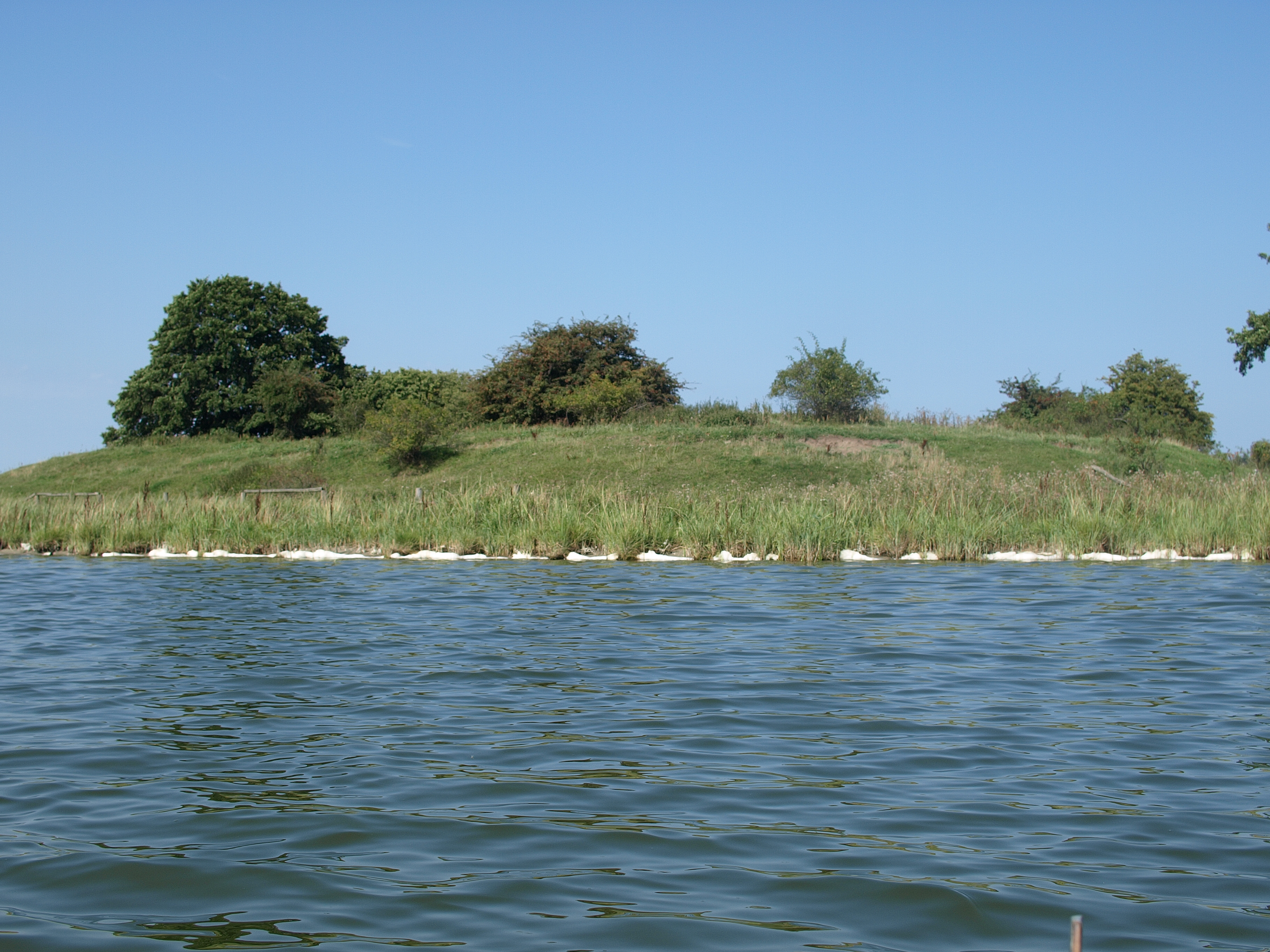
Settled since the Stone Age, the area was probably inhabited by Germanic Rugians, before the Polabian Slavs moved in during the fifth, sixth, and seventh centuries. Around the island, Wendish/Scandinavian trade centres such as Vineta/Jomsborg and Menzlin were established. In the 1110s, the town of Uznam was destroyed by the Danes. In the 1120s, the island along with Western Pomerania came under Polish suzerainty under Bolesław III Wrymouth, and became part of a newly formed vassal state of Poland, the Duchy of Pomerania. The Polish ruler initiated Christianization, entrusting this task to Otto of Bamberg, and in 1128 the Slavic Pomeranian Duke Wartislaw I was converted to Christianity through the efforts of Otto. In 1155 the Premonstratensians established a monastery in Grobe, generally known as Usedom Abbey, which in 1309 was moved to the village of Pudagla. In the meantime, a Cistercian nunnery was founded in Krummin and soon almost the whole island was in the possession of one or the other of the ecclesiastical orders. In the 1170s, the island was ravaged by King Valdemar I of Denmark. During the Reformation, ownership passed to the Slavic dukes of Pomerania, who took over the island.
During the Thirty Years' War, on June 26, 1630, the Swedish Army under King Gustavus Adolphus landed in the village of Peenemünde, located on the Peenestrom strait. In 1637 the last duke of Pomerania Bogislaw XIV died, the House of Griffin became extinct and the duchy ceased to exist. Usedom was annexed by Sweden after the war for almost a century, until in 1720 it was sold for 2 million thalers to Prussian King Frederick William I. In 1740 Frederick the Great of Prussia developed a seaport in Świnoujście (then Swinemünde). With the Kingdom of Prussia the island became part of the German Empire in 1871.
The small village of Peenemünde came to prominence again during World War II. The Luftwaffe tested missiles and rockets, including the V-1 and V-2 nearby. Germany used thousands of slave laborers on Usedom during World War II. During the war, a subcamp of the Sachsenhausen concentration camp was located in the town of Usedom. In the final stages of the war, in 1945, German-perpetrated death marches of Allied prisoners-of-war from the Stalag XX-B and Stalag Luft IV POW camps passed through the island.
In 1945 the eastern part of the island, together with the city and port of Swinemünde (now Świnoujście), was assigned to Poland under border changes promulgated at the Potsdam Conference, and the surviving German inhabitants of the town were expelled to the west. The territory was repopulated with Poles, most of whom had been expelled by the Soviets from what had been eastern Poland.
Tourism

Usedom is one of Germany's major holiday and recreation areas due to its beaches, its natural environment, and seaside towns such as Ahlbeck, Heringsdorf and Bansin, which, since the Gründerzeit in the 19th century, have been frequented by the German and international nobility as well as the general public.
According to The Guardian, the island, as of 2022, "... is known by some as the 'bathtub of Berlin' and by others, slightly more poetically, as 'sun island'," but "... remains largely undiscovered by international visitors."
Hotels and bed and breakfast establishments are available on both sides of the German-Polish border. Many of them are decorated in nautical themes, and seafood is a major drawcard. St. Peter's Church in Benz is featured in the works of several artists, including the German-American painter Lyonel Feininger who spent summer vacations on the island from 1909 to 1918. In addition to the coastline, the hinterland features nature reserves, castles, lakes and historic villages.
Points of interest in the German part of the island include:
- Usedom Botanical Gardens, Mellenthin, a botanical garden
- Karnin Lift Bridge, a technical monument to the former bridge over the Peenestrom.
- Dannenfeldt Mausoleum
.JPG)
In the Polish part of the island, points of interest include:
- Karsiborskie Paprocie nature reserve
- Sea Fishing Museum (Muzeum Rybołówstwa Morskiego)
- Western Fort (Fort Zachodni), which houses the Museum of the History of the Świnoujście Fortress (Muzeum Historii Twierdzy Świnoujście)
- Park Zdrojowy
Military
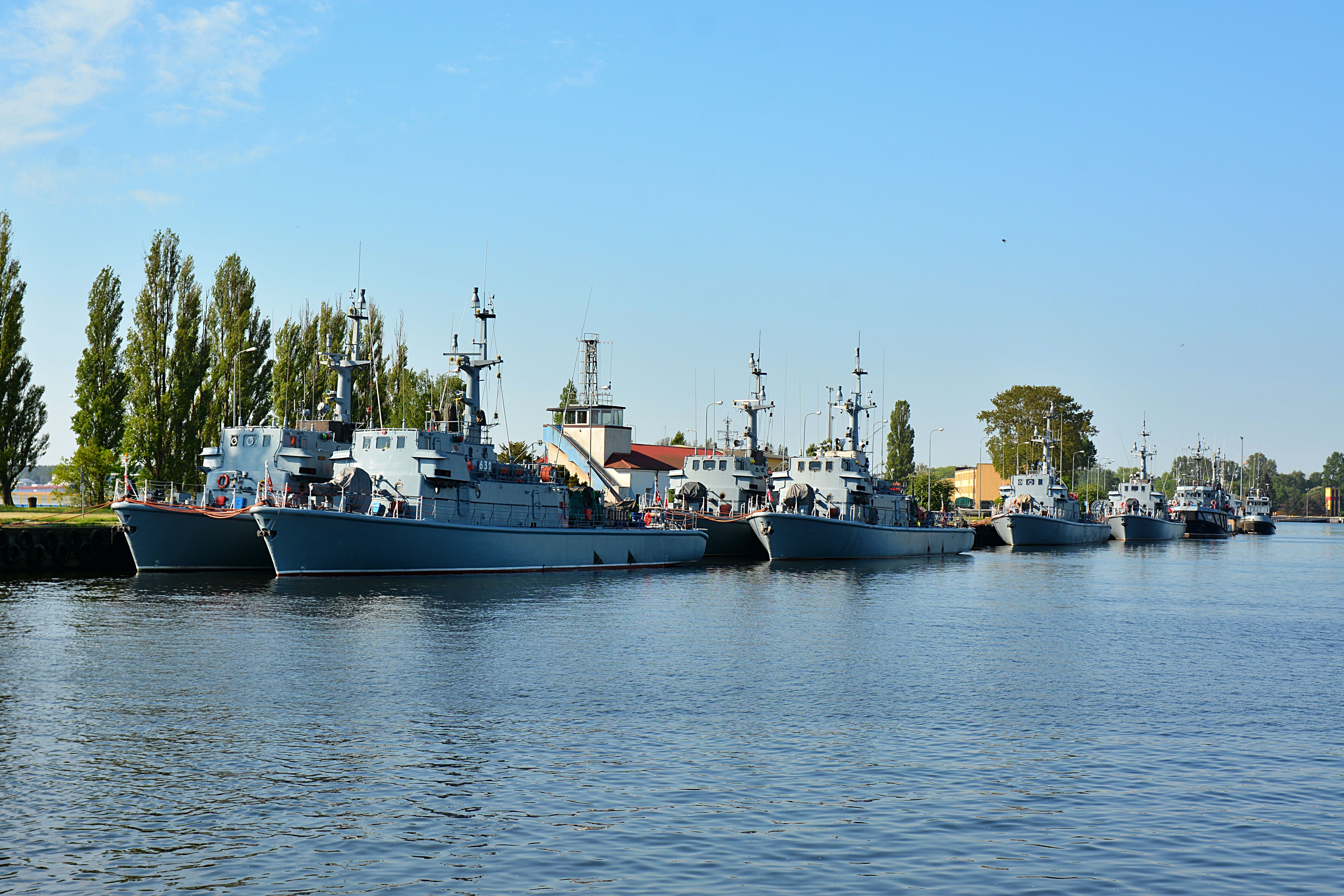
The Polish Naval Base Świnoujście is located on the island.
References
References
- [http://www.sueddeutsche.de/reisefuehrer/usedom/auftakt According to meteorological records of the last 30 years: Usedom is the sunniest region of Germany] (German article, ''[[Süddeutsche Zeitung]]'')
- S.A., Wirtualna Polska Media. (15 July 2013). "Wczasy nad morzem - Świnoujście, Uznam, Wyspa Słońca".
- Kratz, Gustav. (1865). "Die Städte der Provinz Pommern. Abriss ihrer Geschichte, zumeist nach Urkunden".
- D. J. Medley, ''The church and the empire'', Kessinger Publishing, 2004, p. 152
- Kratz, p. 535
- Девятаев М. П. Полет. "Наш "хейнкель"". ВОЕННАЯ ЛИТЕРАТУРА(Мемуары).
- "Anlage zu § 1. Verzeichnis der Konzentrationslager und ihrer Außenkommandos gemäß § 42 Abs. 2 BEG".
- Kaszuba, Sylwia. (2021). "Stalag XX B: historia nieopowiedziana". Muzeum Miasta Malborka.
- "Stalag Luft IV. Marsz Śmierci".
- (24 January 2022). "The bathtub of Berlin: soaking it up on Germany's sunniest island". [[The Guardian]].
- (16 December 2014). "The island of Usedom: Where the last German emperor was staying for summer".
- (30 July 2020). "Radtour: Auf Lyonel Feiningers Spuren über Usedom".
This article was imported from Wikipedia and is available under the Creative Commons Attribution-ShareAlike 4.0 License. Content has been adapted to SurfDoc format. Original contributors can be found on the article history page.
Ask Mako anything about Usedom — get instant answers, deeper analysis, and related topics.
Research with MakoFree with your Surf account
Create a free account to save articles, ask Mako questions, and organize your research.
Sign up freeThis content may have been generated or modified by AI. CloudSurf Software LLC is not responsible for the accuracy, completeness, or reliability of AI-generated content. Always verify important information from primary sources.
Report