From Surf Wiki (app.surf) — the open knowledge base
USC School of Cinematic Arts
Private media school at the University of Southern California

Private media school at the University of Southern California
| Field | Value |
|---|---|
| name | USC School of Cinematic Arts |
| image_name | USC School of Cinematic Arts logo.svg |
| image_size | 250px |
| established | |
| parent | University of Southern California |
| motto | Limes regiones rerum |
| mottoeng | Reality ends here |
| type | Private film school |
| dean | Elizabeth M. Daley (1991–present) |
| faculty | 96 full time |
| 219 part time | |
| administrative_staff | 144 full time |
| 499 student workers | |
| undergrad | 876 |
| postgrad | 715 |
| city | Los Angeles |
| state | California |
| country | U.S. |
| website |
219 part time 499 student workers The USC School of Cinematic Arts is an academic unit of the University of Southern California, in Los Angeles. With a history that dates to the first years of talkies, the school descends from America's first program to confer a college degree in film. Under a name that directly preceded its present one, it became, in the 1980s, an academic unit of its own, within the university. Colloquially "SCA" or "the USC film school," it now has several divisions or programs, which treat artistic or business aspects of the creation of motion pictures and related media.
History
In 1927, when Douglas Fairbanks became the first president of the nascent Academy of Motion Picture Arts and Sciences, one of his recommendations was that the academy have a “training school”. Fairbanks and his enablers reasoned that training in the cinematic arts should be seen as a legitimate academic discipline at major universities and be accorded degree considerations the same as those of fields like medicine and law. Although cinema-studies programs are now widely-entrenched in academia, this was a novel idea, and many universities turned Fairbanks down.
Tepid acceptance of this recommendation by Fairbanks came at the University of Southern California, which agreed to allow one class, called “Introduction to the Photoplay”. This debuted in 1929, the same year as the Academy Awards. Determined to make it a success, Fairbanks brought in the biggest industry names of the era to lecture. These included Douglas Fairbanks, Mary Pickford, D. W. Griffith, Charlie Chaplin, William C. DeMille, Ernst Lubitsch, Irving Thalberg, and Darryl Zanuck. From that one class grew a Department of Cinematography, established in 1932 in the College of Letters, Arts and Sciences. USC became the first American college or university to offer a course of study leading to a bachelor’s degree in cinema.[[File:Douglas Fairbanks and Rufus von Kleinsmid - inaugural lecture USC film school - February 6, 1929.jpg|thumb|left|alt=Douglas Fairbanks delivers inaugural lecture of USC film school.|With university president [[Rufus B. von KleinSmid|Rufus von KleinSmid]] standing at left, [[Douglas Fairbanks|Douglas Fairbanks Sr.]], as 1st President of the Academy of Motion Picture Arts and Sciences, delivers the inaugural lecture, Photoplay Appreciation, at the USC film school, February 6, 1929.]]
In 1940, the department was renamed the Department of Cinema. By the latter 1970s, it was the Division of Cinema-Television, which, in 1983, became an independent academic unit, the USC School of Cinema-Television. This, in 2006, was renamed the USC School of Cinematic Arts.
On September 19, 2006, USC announced that alumnus George Lucas had donated US$175 million to expand the film school with a new 137000 sqft facility. This represented the largest single donation to USC and the largest to any film school in the world. Lucas's previous donations had resulted in the naming of two buildings in the school's previous complex after him and his then-wife Marcia, though Lucas was not fond of the Spanish Colonial Revival architecture used in those buildings. That complex had opened in 1984. For several years before it, the film school was housed in now-forgotten shacks that stood, along with campus tennis courts, between Waite Phillips Hall and Birnkrant Residential College. The site is now occupied by Leavey Library and its reflecting pool, along with the Generations Fountain.[[File:USC campus map - film school - Lucas buildings - marked and cropped.jpg|thumb|left|alt=Undated campus map shows "Future Home of USC School of Cinematic Arts."|On undated campus map, site of facility that opened in 2009 is marked “Future Home of USC School of Cinematic Arts.” Directly to its east are the buildings of the complex that opened in 1984. Farther east, [[Thomas and Dorothy Leavey Library|Leavey Library]], which opened in 1994, occupies the site of the tennis courts and film-school shacks of old.]]
An additional $50 million having been contributed by Warner Bros., 20th Century Fox, and The Walt Disney Company for its creation, the new facility opened in early 2009. Lucas, an architectural hobbyist, had laid out its original designs, inspired by the Mediterranean Revival Style that had been used in older campus buildings and elsewhere in the Los Angeles area.
In fall 2006, the school, together with the Royal Film Commission of Jordan, had created the Red Sea Institute of Cinematic Arts (RSICA) in Aqaba, Jordan. The first classes were held in 2008, and the first graduating class for the university was in 2010.
In 2020, the School of Cinematic Arts announced it would remove an exhibit devoted to actor and former USC student John Wayne. This was after months of insistence on the part of students who denounced the Hollywood star’s views and the portrayal of indigenous Americans in his films. The exhibit has been relocated to the Cinematic Arts library, which has many collections for the study of figures whose lives and works are part of society's shared history. These materials are preserved for posterity and made accessible for research and scholarship, as will be the materials in the Wayne Collection.
Facilities
The school maintains the following facilities:
- School of Cinematic Arts Complex, completed in 2010, which includes:
- 20th Century Fox soundstage
- George Lucas and Steven Spielberg Buildings, featuring the Ray Stark Family Theatre, which is equipped for 3D presentation, as well as two digital theatres, the Albert and Dana Broccoli Theatre and Fanny Brice Theatre
- Marcia Lucas Post-Production Center
- Marilyn & Jeffrey Katzenberg Center for Animation
- Sumner Redstone Production Building which contains two stages, Redstone 1 and Redstone 2
- Interactive building (SCI), home of the USC Interactive Media & Games Division, the USC Division of Media Arts and Practice, and several research labs (including the Game Innovation Lab, Mobile and Environmental Media Lab, Mixed Reality Lab, and Creative Media & Behavioral Health Center)
- Robert Zemeckis Center for Digital Arts, home of Trojan Vision, USC's student television station
- Eileen Norris Cinema Theatre Complex, featuring a 365-seat theatre that also serves as a classroom with USC faculty member and Academy Award winner Tomlinson Holman's THX audiovisual reproduction standard used in film venues worldwide. The Frank Sinatra Hall, dedicated in 2002, houses a public exhibit and collection of extensive memorabilia commemorating Sinatra's life and contributions to American popular culture.
- David L. Wolper Center at Doheny Memorial Library
- Louis B. Mayer Film and Television Study Center at Doheny Memorial Library
- Hugh M. Hefner Moving Image Archive
At the center of the new television complex is a statue of founder Douglas Fairbanks. He is seen holding a fencing foil in one hand and a script in the other to reflect his strong ties with the USC Fencing Club.
Distinctions
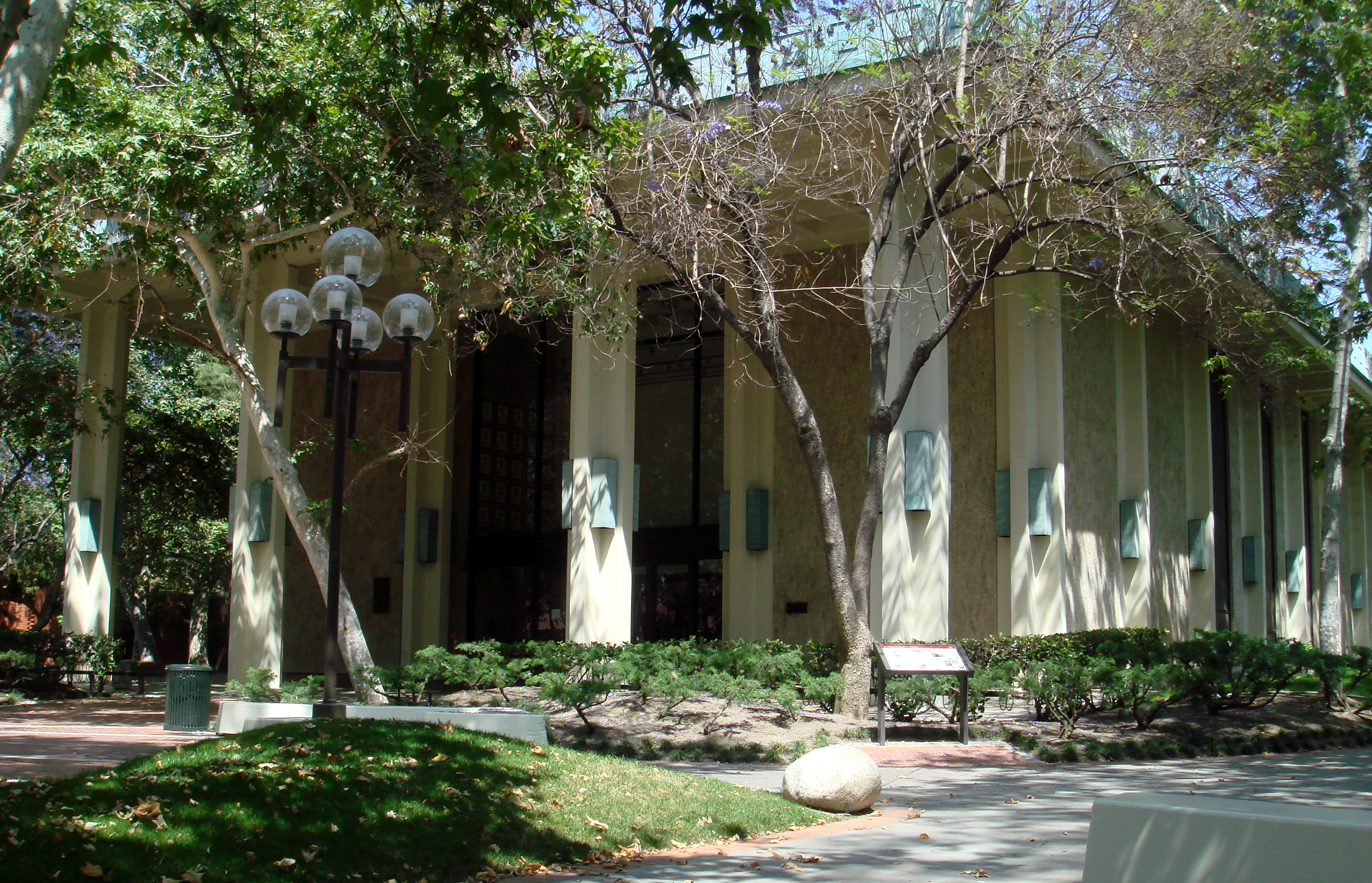
- Since 1973, at least one alumnus of SCA has been nominated for an Academy Award annually, totaling 256 nominations and 78 wins.
- Since 1973, at least one SCA alumnus or alumna has been nominated for the Emmy Award annually, totaling 473 nominations and 119 wins.
- The top 17 grossing films of all time have had an SCA graduate in a key creative position.
- The current acceptance rate for the USC School of Cinematic Arts is 3%.
Awards for USC Cinema short films
- In 1956, producer Wilber T. Blume, a USC Cinema instructor at the time, received an Academy Award for best live action short film for a film he created entitled The Face of Lincoln. Blume also received an Academy Award nomination that year for documentary short.
- In 1968, George Lucas won first prize in the category of Dramatic films at the third National Student Film Festival held at Lincoln Center, New York for his futuristic Electronic Labyrinth: THX 1138 4EB.
- In 1970, producer John Longenecker received an Academy Award for best live action short film for a film he produced while attending USC Cinema 480 classes as an undergraduate—The Resurrection of Broncho Billy. The film's crew and cast included Nick Castle, cinematographer; John Carpenter, film editor and original music; James Rokos, director; Johnny Crawford, lead actor; and Kristin Nelson, lead actress.
- In 1973, Robert Zemeckis won a Special Jury Award at the Academy of Motion Picture Arts & Sciences' second annual Student Film Awards presentation for A Field of Honor.
- In 2001, MFA student David Greenspan won the Palme d’Or for short film at the Cannes Film Festival for his student film Bean Cake.
- In 2006, director, co-writer, and producer Ari Sandel received an Academy Award for best live action short film ("West Bank Story") made as a USC Cinema graduate school project.
- In 2009, MFA student Gregg Helvey was nominated for an Academy Award for his MFA thesis film, Kavi.
Awards for USC Cinema feature films
- In 2019, the crime / thriller film Samir became an official selection for the 2019 Heartland International Film Festival with the help of Warner Bros. Entertainment.
Divisions
As presented at its own website, the film school’s divisions or programs are the following:
-
John C. Hench Division of Animation + Digital Arts
-
Division of Cinema & Media Studies
-
Film & Television Production
-
Interactive Media & Games
-
Media Arts + Practice
-
Peter Stark (1944–1970) Producing Program
-
John Wells Division of Writing for Screen & Television
-
The John H. Mitchell Business of Cinematic Arts Program
-
Expanded Animation Research + Practice
References
References
- Michael Cieply, [https://www.nytimes.com/2009/02/09/movies/09film.html A Film School’s New Look Is Historic], ''The New York Times'', February 9, 2009, Accessed February 10, 2009.
- ''The New York Times'' reports the motto as meaning "Reality ends here", but a more direct translation of the Latin approximates as, "The border is the regions of things".
- (2013). "USC Cinematic Arts". University of Southern California, School of Cinematic Arts.
- [https://www.latimes.com/entertainment/movies/la-et-mn-usc-film-school-90-20190406-story.html From Douglas Fairbanks to George Lucas: USC’s School of Cinematic Arts turns 90]Los Angeles Times, April 6, 2019
- Rachel Abramowitz, [http://www.latimes.com/news/education/highered/la-125highed-11,1,4653236.story L.A.'s screening gems], ''Los Angeles Times'', Accessed June 16, 2008.
- [https://cinema.usc.edu/about/history/1929-1940.cfm Timeline 1929-1940]USC School of Cinematic Arts
- [https://cinema.usc.edu/about/history/1971-1992.cfm Timeline 1971-1992]USC School of Cinematic Arts
- [https://cinema.usc.edu/news/article.cfm?id=9635 Record-Breaking Groundbreaking]School of Cinematic Arts News, October 5, 2006
- John Zollinger, [http://www.usc.edu/uscnews/stories/12754.html George Lucas Donates $175 Million to USC] {{Webarchive. link. (2015-02-23 , USC Public Relations, September 20, 2006)
- [https://www.washingtonpost.com/archive/lifestyle/1984/11/19/uscs-new-film-factory/137949f3-4ba5-4284-be4a-670e472b3c11/ USC’s New Film Factory]Washington Post, November 19, 1984
- [https://cinema.usc.edu/news/article.cfm?id=9765 And Action!—New Cinematic Arts Complex Opens]School of Cinematic Arts News, January 16, 2009
- [https://cinema.usc.edu/news/article.cfm?id=9771 World Premiere—Cinematic Arts Celebrates 80th Anniversary With All New Campus]School of Cinematic Arts News, March 31, 2009
- [https://www.architectmagazine.com/project-gallery/university-of-southern-californias-school-of-cinematic-arts University of Southern California’s School of Cinematic Arts]Architect Magazine, May 7, 2014
- [https://www.wsj.com/articles/SB10001424052748703460404575244732489548088 What George Lucas Wrought]Wall Street Journal, June 2, 2010
- [http://www.usc.edu/uscnews/stories/12756.html Jordan Signs Cinema Pact With USC] {{Webarchive. link. (2016-03-03 , USC Public Relations, September 20, 2006)
- (10 July 2020). "SCA to Remove John Wayne Exhibit". USC.
- [http://cinema.usc.edu/about/facilities/ Facilities]
- [http://www.gameinnovationlab.com/ Game Innovation Lab]
- [http://mobilemedia.usc.edu/ Mobile and Environmental Media Lab]
- [http://projects.ict.usc.edu/mxr/ Mixed Reality Lab]
- [http://cmbhc.usc.edu/ Creative Media & Behavioral Health Center]
- [http://cinema.usc.edu/about/facilities/eileen-norris-cinema-theatre/ Eileen Norris Cinema Theatre Complex], USC School of Cinematic Arts Facilities, Accessed January 3, 2009.
- [http://www.usc.edu/admission/undergraduate/private/0809/USC_self_guided_tour0809.pdf USC Self-Guided Tour] {{Webarchive. link. (2012-10-14 , University of Southern California, Accessed June 8, 2009.)
- Mel Cowan, [http://cinema.usc.edu/about/news/world-premiere.htm Cinematic Arts Celebrates 80th Anniversary With All New Campus] {{Webarchive. link. (2009-05-26 , University of Southern California, March 31, 2009, Accessed May 1, 2009.)
- (16 December 2019). "Amid deaths, students raise concerns over workload, culture and climate within the School of Cinematic Arts".
- (19 February 2015). "The 28th Academy Awards, 1956". Academy of Motion Picture Arts and Sciences.
- [https://web.archive.org/web/20101029062605/http://www.time.com/time/magazine/article/0,9171,837841,00.html The Student Movie Makers], ''[[TIME Magazine]]'', February 2, 1968
- Rinzler, J.W., ''The Complete Making of Indiana Jones; The Definitive Story Behind All Four Films'', Del Rey, 2008, {{ISBN. 978-0345501295.
- Bapis, Elaine M., ''Camera And Action: American Film As Agent of Social Change, 1965–1975'', McFarland, 2008, {{ISBN. 978-0-7864-3341-4.
- [http://www.usc.edu/dept/pubrel/trojan_family/spring02/alumninews/alumni_profile_Cannes.html Alumni Profile: Cannes Do Spirit] {{Webarchive. link. (2016-03-03 , ''Trojan Family Magazine'', Spring 2002, ''Accessed September 19, 2006''.)
- [http://kavithemovie.com/cast-crew/ KAVI – a short film written and directed by Gregg Helvey » Cast/Crew]. Kavithemovie.com. Retrieved on 2014-06-05.
- "Samir".
- (15 February 2021). "2019 Heartland International Film Festival Selections".
- "HIFF28 Archives".
- [https://cinema.usc.edu/ USC School of Cinematic Arts]
- (January 17, 2004). "Benign power broker & producer Stark dies". Variety.
This article was imported from Wikipedia and is available under the Creative Commons Attribution-ShareAlike 4.0 License. Content has been adapted to SurfDoc format. Original contributors can be found on the article history page.
Ask Mako anything about USC School of Cinematic Arts — get instant answers, deeper analysis, and related topics.
Research with MakoFree with your Surf account
Create a free account to save articles, ask Mako questions, and organize your research.
Sign up freeThis content may have been generated or modified by AI. CloudSurf Software LLC is not responsible for the accuracy, completeness, or reliability of AI-generated content. Always verify important information from primary sources.
Report