From Surf Wiki (app.surf) — the open knowledge base
USA-207
American communications satellite
American communications satellite
| Field | Value |
|---|---|
| name | USA-207 |
| image | PAN satellite patch.jpg |
| image_caption | PAN mission patch |
| mission_type | SIGINT |
| COSPAR_ID | 2009-047A |
| SATCAT | 35815 |
| spacecraft_bus | A2100 |
| manufacturer | Lockheed Martin |
| launch_date | UTC |
| launch_rocket | Atlas V 401 |
| launch_site | Cape Canaveral SLC-41 |
| launch_contractor | ULA |
| last_contact | |
| orbit_epoch | 10 January 2015, 14:22:18 UTC |
| orbit_reference | Geocentric |
| orbit_regime | Geostationary |
| orbit_periapsis | 35778 km |
| orbit_apoapsis | 35807 km |
| orbit_inclination | 0.09 degrees |
| orbit_period | 1436.12 minutes |
| apsis | gee |
USA-207, international COSPAR code 2009-047A, also known as PAN, officially meaning Palladium at Night, NEMESIS I, or P360 is a classified American SIGINT satellite, which was launched in September 2009. The US government has not confirmed which of its intelligence agencies operate the satellite, but leaked documents from the Snowden files point to the NSA. The spacecraft was constructed by Lockheed Martin, and is based on the A2100 satellite bus, using commercial off-the-shelf components. The contract to build PAN was awarded in October 2006, with the satellite initially scheduled to launch 30 months later, in March 2009.
PAN was launched by United Launch Alliance using an Atlas V 401 carrier rocket, with the serial number AV-018. The launch, from Space Launch Complex 41 at the Cape Canaveral Air Force Station, occurred at 21:35 GMT on 8 September 2009, at the start of a 129-minute launch window. PAN successfully separated from the rocket just under two hours after liftoff.
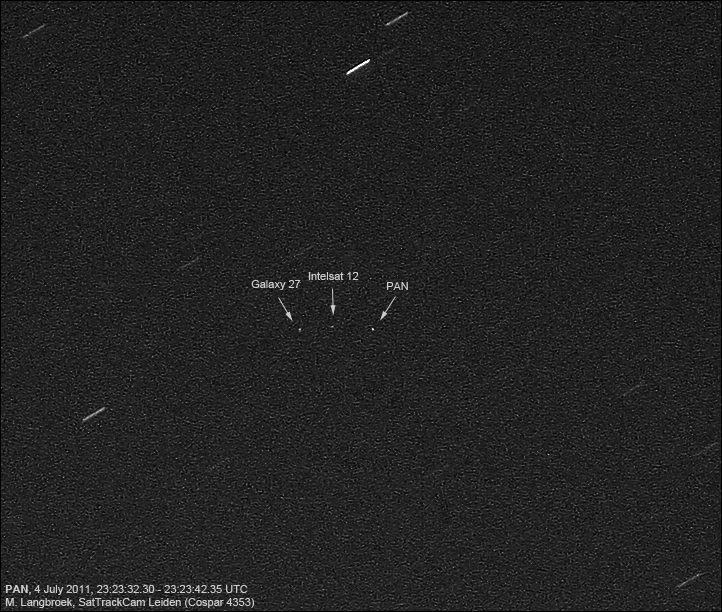
PAN has shown an unusual history of frequent relocations during the first 5 years of its operations, moving between at least 9 different orbital slots since launch. With each move, it was placed close to another commercial communications satellite. From 2013 onwards it was located at 47.7 deg E., over East Africa, staying in that position for several years. In February 2021 it started a slow drift eastwards.
Gallery
References
References
- Ray, Justin. (2009-07-09). "Atlas rocket team continues active year of launches". Spaceflight Now.
- McDowell, Jonathan. "Launch Log". Jonathan's Space Page.
- Peat, Chris. (10 January 2015). "USA 207 – Orbit". Heavens-Above.
- McDowell, Jonathan. (2009-09-10). "Issue 615". Jonathan's Space Page.
- (2009-09-30). "Spacewarn Bulletin Issue 671". NASA NSSDC.
- Day, Dwayne. (2009-08-24). "PAN's labyrinth". The Space Review.
- Langbroek, Marco. (2016-10-31). "A NEMESIS in the sky. PAN, Mentor 4 and close encounters of the SIGINT kind". The Space Review.
- (December 2007). "New Horizons". Lockheed Martin.
- Covault, Craig. (2009-05-26). "Secret PAN satellite leads Cape milspace launch surge". Spaceflight Now.
- (2016-09-06). "Inside Menwith Hill. The NSA's British Base at the Heart of U.S. Targeted Killing". The Intercept.
- (Spring 2007). "Highlights". Lockheed Martin Space Systems Company.
- Clark, Stephen. "Worldwide Launch Schedule". Spaceflight Now.
- Malik, Tariq. (2009-08-30). "Atlas 5 Rocket to Secret Satellite [''sic'']". Space.com.
- Langbroek, Marco. (2021-09-14). "PAN (NEMESIS 1) is on the move again". SatTrackCam Leiden.
This article was imported from Wikipedia and is available under the Creative Commons Attribution-ShareAlike 4.0 License. Content has been adapted to SurfDoc format. Original contributors can be found on the article history page.
Ask Mako anything about USA-207 — get instant answers, deeper analysis, and related topics.
Research with MakoFree with your Surf account
Create a free account to save articles, ask Mako questions, and organize your research.
Sign up freeThis content may have been generated or modified by AI. CloudSurf Software LLC is not responsible for the accuracy, completeness, or reliability of AI-generated content. Always verify important information from primary sources.
Report