From Surf Wiki (app.surf) — the open knowledge base
Uru people
Indigenous people of Bolivia and Peru
.jpg)
Indigenous people of Bolivia and Peru
| Field | Value |
|---|---|
| group | Uru People |
| image | Indigenous woman of Peru showing her traditional textiles.png |
| image_caption | Uro woman selling handicrafts |
| population | 5,343 |
| popplace | Lake Titicaca islands, Puno, Peru and Bolivia |
| region1 | Bolivia |
| pop1 | 3,343 |
| ref1 | |
| region2 | Peru |
| pop2 | 2,000 |
| ref2 | |
| langs | Aymara • Spanish • Uru-Chipaya |
| religions | Christianity |
| related | Aymaras |


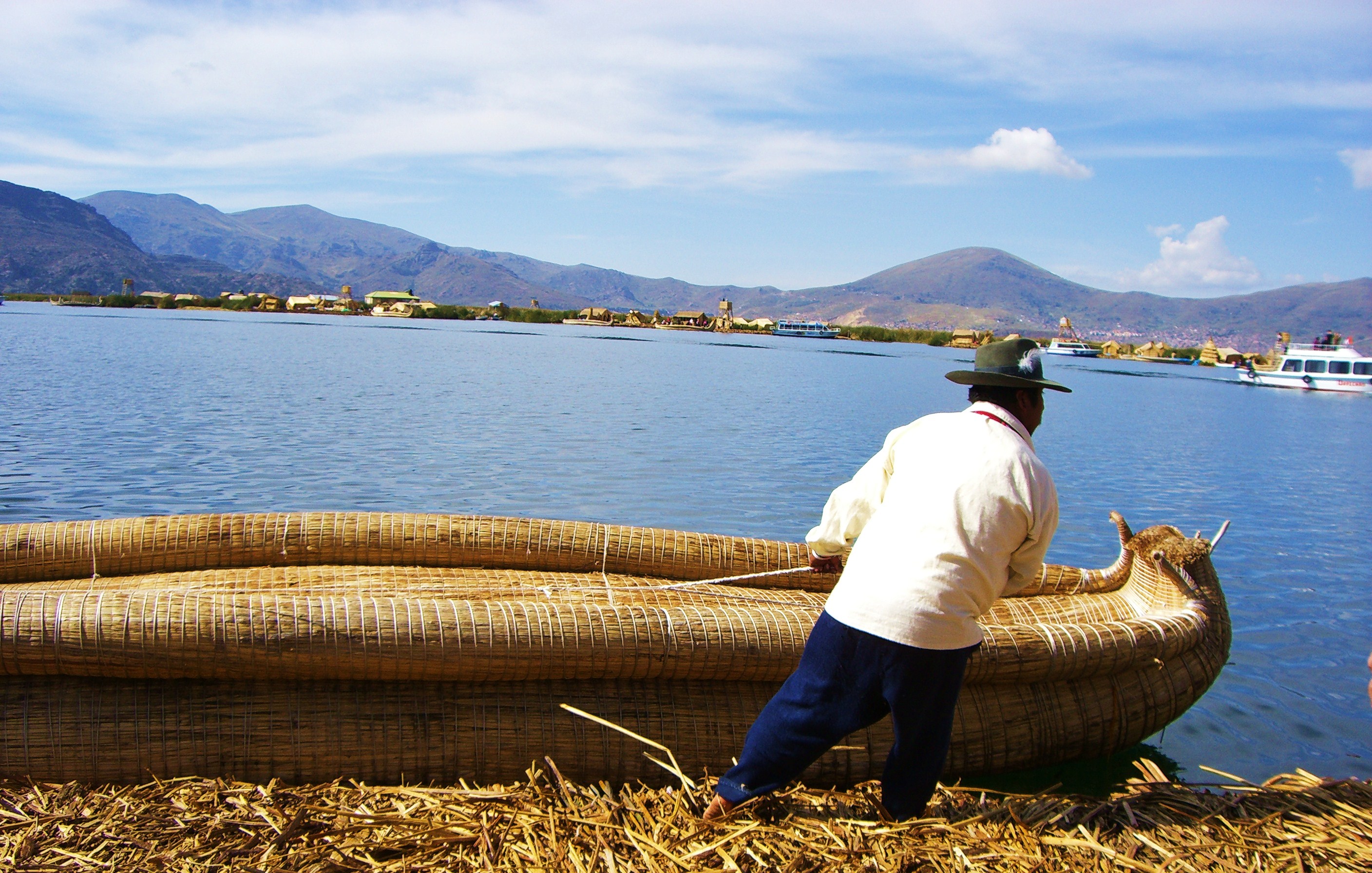
The Uru or Uros () are an indigenous people of Bolivia and Peru. They live on a still-growing group of about 120 self-fashioned floating islands in Lake Titicaca near Puno. They form three main groups: the Uru-Chipaya, Uru-Murato, and Uru-Iruito. The Uru-Iruito still inhabit the Bolivian side of Lake Titicaca and the Desaguadero River.
The indigenous Urus have darker skin than their neighbours Aymaras and Quechuas.
History
According to legend, the Uru descend from a people that spoke the Puquina language. While most of the Uru have shifted to Aymara and Spanish, two people still spoke in 2004 the nearly extinct Uru language, which is closely related to the Chipaya language.
The Uru considered themselves the owners of the lake and water. According to the legend, Uru used to say that they had black blood, because they did not feel the cold. They historically called themselves Lupihaques, "sons of the Sun". Although the Uru language is nearly extinct, the Uru continue to maintain their identity and some old customs.
The purpose of the island settlements was originally defensive: they could be moved if a threat arose. Many of the islands include a watchtower.[[File:Uros-floating-islands-puno-peru-aerial.jpg|alt=The constellation of the Uros Floating Islands as seen from the air, about 5km off the coast of Puno.|thumb|566x566px|The Uros Floating Islands as seen from the air, about 5 km off the coast of [[Puno]].|none]] The Uru traded with the Aymara tribe on the mainland, intermarrying with them and eventually abandoning the Uru language for that of the Aymara. They lost their original language about 500 years ago. When conquered by the Inca Empire, they had to pay taxes to them, and often were enslaved.
Starting from 1722 a conflict arose between the Uru and Aymara people, but these conflicts ended in the 1970s when the Aymara defeated the Uru, and took permanent control of the lands that belonged to them.
Reed island construction
The Uru use bundles of dried Totora reeds to make reed boats (balsas), and to make the islands themselves.{{cite encyclopedia |title=Totora (plant) |encyclopedia=Encyclopædia Britannica |year=2016 |url=https://www.britannica.com/plant/totora |url-status=live |archive-url=https://web.archive.org/web/20160521112819/http://www.britannica.com/plant/totora |archive-date=2016-05-21
The larger islands house about ten families, while smaller ones, only about thirty meters wide, house only two or three families. Each island lasts about 25 years. After 25 years, water seeps through the reeds and the inhabitants build a new island and let the old one sink to the bottom of the lake.
The islets are made of multiple natural layers harvested in Lake Titicaca. The base is made of large pallets of floating totora roots, which are tied together with ropes and covered in multiple layers of totora reeds. These dense roots that the plants develop and interweave form a natural layer called khili (about one to two meters thick), which are the main flotation and stability devices of the islands.
Each floating block of khili measures approximately 4 x. The blocks used to be harvested with eucalyptus wedges, but are now sourced using 1.5 m long metal saws custom made for this purpose. They are anchored with ropes attached to large eucalyptus poles driven into the bottom of the lake.
Once the khili pallets are tied together and anchored, multiple layers of cut reeds are added. The bottom layer of covering reeds rot away fairly quickly, so new reeds are added to the top constantly, about every two weeks to three months depending on weather. This is especially important in the rainy season when the reeds rot much faster.

Tourism via boats from Puno has become the primary financial income for people living on the islands.
The Uru's islands are located at 3810 m above sea level, and just five kilometers east from the Puno port.{{cite web |access-date=2008-10-25 |archive-date=2012-02-17 |archive-url=https://web.archive.org/web/20120217211646/http://www.mincetur.gob.pe/newweb/Portals/0/PUNO.pdf |url-status=dead |archive-url = https://web.archive.org/web/20041112095546/http://www.inei.gob.pe/biblioineipub/bancopub/Est/Lib0259/CAP5.htm |url-status = dead |archive-date = 2004-11-12


Food is classically cooked in pots on pottery stoves; these are placed on flat stones to prevent the flammable reed islands from catching fire. To relieve themselves, tiny "outhouse" islands are placed near the main islands with simple toilets installed in them. The ground root absorbs the waste.
Most islands feature a standardized shower building with tile roofs, water heating cells and a hot water boiler to allow for warm showers.
Houses on the floating islands are mostly made of reeds too; some have corrugated metal roofs. Few are insulated. All houses are built on top of an extra 1 m layer of dry reeds to prevent rheumatism.
Traditional lifestyle
Much of the Urus' diet and medicine also revolve around the same totora reeds used to construct the islands. When a reed is pulled, the white bottom is often eaten for iodine to prevent goitres. This white part of the reed is called the chullo (Aymara ). The Uru rely on totora reeds in the same way that the Andean people of Peru rely on the coca leaf for relief from hunger and the harsh climate. When in pain, they may wrap the reed around the body part that is in pain.
If it is hot outside, they sometimes roll the white part of the reed in their hands and split it open, placing the reed on their forehead. In this form, it is very cool to the touch. The white part of the reed is also used to help ease alcohol-related hangovers. The totora reeds are a primary source of food. The Uru also make a reed flower tea.
Local residents fish ispi, carachi and catfish. Trout was introduced to the lake from Canada in 1940, and kingfish was introduced from Argentina. Uru also hunt birds such as seagulls, ducks and flamingos, and graze their cattle on the islets. They also run crafts stalls aimed at the numerous tourists who visit ten of the islands each year. They barter totora reeds on the mainland in Puno to get products they need, such as quinoa and other foods.
Domesticated animals
References
- (September 13, 2013). "Uros people of Peru and Bolivia have distinctive genetic ancestries". Heritage Daily.
- "Censo de Población y Vivienda 2012 Bolivia Características de la Población".
- "Perú: Perfil Sociodemográfico". Instituto Nacional de Estadística e Informática.
- Cavagnaro Orellana, Luis. (1986). Materiales para la historia de Tacna., [[Tacna]]. Luis Cavagnaro Orellana. Tomo I
- "Uru Language and the Uru Indian Tribe (Uro)".
- "People & CultureGente y cultura".
- "Language".
- Montali, Stefano. "The floating homes of Lake Titicaca".
- https://10best.usatoday.com/interests/explore/how-to-visit-lake-titicaca-floating-uros-islands/
- "Raymond Behm :: The Uru and their floating islands".
- Adelaar, Willem F. H.. (2004). "The languages of the Andes". Cambridge; New York : Cambridge University Press.
- (2024-08-27). "Discover Peru's Uros Floating Islands on Lake Titicaca".
- (2024-08-27). "Discover Peru's Uros Floating Islands on Lake Titicaca".
- "The floating islands of Lake Titicaca, Peru/Bolivia: Guest post by Sumita Singha, B Arch (hons), RIBA".
- "The floating islands of Lake Titicaca, Peru/Bolivia: Guest post by Sumita Singha, B Arch (hons), RIBA".
- "Visiting Lake Titicaca’s Uros Islands Is a Unique Way to Experience Peruvian Indigenous Traditions".
- Jen. (2018-05-07). "24 hours in Puno & the Uros Floating Islands".
- Evan. (2011-09-17). "The floating islands of the Uros".
- shortinca. (2023-03-07). "The floating Islands of Uros in Lake Titicaca.".
- Montali, Stefano. "The floating homes of Lake Titicaca".
- "Puna Ibis (Plegadis ridgwayi)".
- "High UV occurs throughout the Altiplano region".
- Foer, Joshua. (February 25, 2011). "The Island People: The seventh hidden wonder of South America". [[Slate (magazine).
- Istvan, Zoltan. (July 3, 2003). "Rough Waters for Peru's Floating Islands".
This article was imported from Wikipedia and is available under the Creative Commons Attribution-ShareAlike 4.0 License. Content has been adapted to SurfDoc format. Original contributors can be found on the article history page.
Ask Mako anything about Uru people — get instant answers, deeper analysis, and related topics.
Research with MakoFree with your Surf account
Create a free account to save articles, ask Mako questions, and organize your research.
Sign up freeThis content may have been generated or modified by AI. CloudSurf Software LLC is not responsible for the accuracy, completeness, or reliability of AI-generated content. Always verify important information from primary sources.
Report