From Surf Wiki (app.surf) — the open knowledge base
Ursus deningeri
Extinct species of carnivore
Extinct species of carnivore
Ursus deningeri in Inventaire National du Patrimoine Naturel {{cite journal |last1=García |first1=Nuria |last2=Santos |first2=Elena |last3=Arsuaga |first3=Juan Luis |last4=Carretero |first4=Jose Miguel |title=Endocranial morphology of the Ursus deningeri Von Reichenau 1904 from the Sima de Los Huesos (Sierra de Atapuerca) Middle Pleistocene site |journal=Journal of Vertebrate Paleontology |date=12 December 2007 |volume=27 |issue=4 |pages=1007–1017 |doi=10.1671/0272-4634(2007)27[1007:EMOTUD]2.0.CO;2 Zapfe, 1946
- Ursus deningeri suevicus Koby, 1951
- Ursus deningeri romeviensis Prat and Thibault, 1976
Ursus deningeri (sometimes called Deninger's bear) is an extinct species of bear native to Eurasia from the late Early Pleistocene to the Middle Pleistocene. It is the earliest member of the cave bear lineage and is widely agreed to be the ancestor of later cave bears.
Evolution
Ursus deningeri is widely thought to have evolved from Ursus etruscus (which is also thought to be the ancestor of the brown bear Ursus arctos), perhaps via the intermediate species Ursus dolinensis, though this is debated. The genetic divergence between the ancestors of cave bears and the lineage which gave rise to brown bears and polar bears was estimated in a 2021 study which sequenced the genome of a 360,000 year old cave bear to be around 1.5 million years ago. The earliest fossils of U. deningeri date to the late Early Pleistocene, around 1.2-0.8 million years ago, though the fossil record of the species is most extensive during the following Middle Pleistocene. By the Late Pleistocene, U. deningeri had split into several genetically divergent lineages of cave bears.
Description
Ecology
Dental wear analysis suggests that U. deningeri had a diet heavy in abrasive herbivorous food, such as tubers, nuts and consumed grit surrounding such food items, consistent with its skeletal morphology which suggests an aptitude for digging and prising. However, isotopic analysis suggests that it was not entirely herbivorous and likely engaged in some carnivorous behaviour.
Distribution
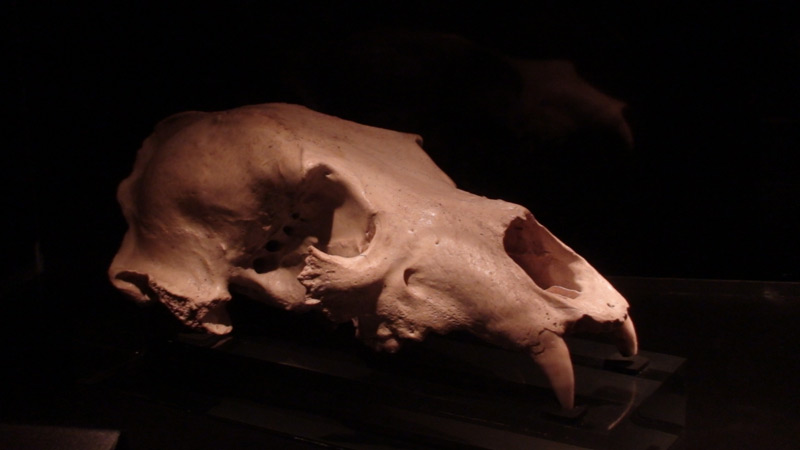
Relationship with humans
Remains at several sites suggest that the remains of U. deningeri were utilized by archaic humans. At the Boxgrove site in England, dating to approximately 480,000 years ago, a fragment of U. deningeri skull (the zygomatic bar) bears a cut mark suggesting that it had been defleshed/skinned, perhaps to utilize its pelt.396-403 At the Medzhibozh locality in Ukraine, dating to around 400,000 years ago, a U. deningeri tibia shows fracturing and cut marks consistent with butchery.
References
References
- (February 2025). "The mandible of Salbatore II: A new Ursus deningeri site in the northern Iberian Peninsula". Geobios.
- Galdies, Johann. (2022). "The bears of the European steppe: a review". Quaternaire. Revue de l'Association française pour l'étude du Quaternaire.
- van Heteren, Anneke H.. (2019-04-21). "Cranial and mandibular morphology of Middle Pleistocene cave bears ( Ursus deningeri ): implications for diet and evolution". Historical Biology.
- Barlow, Axel. (2021-04-26). "Middle Pleistocene genome calibrates a revised evolutionary history of extinct cave bears". Current Biology.
- Stiner, Mary C.. (1998). "Reconstructing cave bear paleoecology from skeletons: a cross-disciplinary study of middle Pleistocene bears from Yarimburgaz Cave, Turkey". Paleobiology.
- Tchernov, Eitan. (July 1997). "Middle Pleistocene (Early Toringian) Carnivore Remains from Northern Israel". Quaternary Research.
- (November 2018). "Presence of the Middle Pleistocene cave bears in China confirmed – Evidence from Zhoukoudian area". Quaternary Science Reviews.
- (1999). "Boxgrove : a Middle Pleistocene hominid site at Eartham Quarry, Boxgrove, West Sussex". English Heritage.
- Stepanchuk, V.N.. (July 2016). "MIS 11-locality of Medzhibozh, Ukraine: Archaeological and paleozoological evidence". Quaternary International.
This article was imported from Wikipedia and is available under the Creative Commons Attribution-ShareAlike 4.0 License. Content has been adapted to SurfDoc format. Original contributors can be found on the article history page.
Ask Mako anything about Ursus deningeri — get instant answers, deeper analysis, and related topics.
Research with MakoFree with your Surf account
Create a free account to save articles, ask Mako questions, and organize your research.
Sign up freeThis content may have been generated or modified by AI. CloudSurf Software LLC is not responsible for the accuracy, completeness, or reliability of AI-generated content. Always verify important information from primary sources.
Report