From Surf Wiki (app.surf) — the open knowledge base
Urmia
City in West Azerbaijan province, Iran

City in West Azerbaijan province, Iran
| Field | Value |
|---|---|
| official_name | Urmia |
| native_name | |
| settlement_type | City |
| image_skyline | {{multiple image |
| border | infobox |
| total_width | 300 |
| perrow | 1/2/2/2 |
| image1 | Uromia Iran,pareeke jangali - panoramio.jpg |
| alt1 | Skyline of the city |
| image2 | 3 Gonbad photo 2.jpg |
| alt2 | Segonbad |
| image3 | Jame Mosque of Urmia-5.JPG |
| alt3 | Jameh Mosque of Urmia |
| image4 | Urmia Nane Maryam Church ارومیه کلیسای ننه مریم.jpg |
| alt4 | St. Mary Church |
| image5 | Marsargiz church.jpg |
| alt5 | St. Sarkis Church |
| image_size | 250px |
| image_caption | Clockwise from top: Skyline of the city, Jameh Mosque of Urmia, St. Sarkis Church, St. Mary Church, Segonbad |
| image_flag | Urmia flag.gif |
| image_seal | Urmia government logo.svg |
| subdivision_type | Country |
| subdivision_name | Iran |
| subdivision_type1 | Region |
| subdivision_name1 | 3 |
| subdivision_type2 | Province |
| subdivision_name2 | West Azerbaijan |
| subdivision_type3 | County |
| subdivision_name3 | Urmia |
| subdivision_type4 | Bakhsh |
| subdivision_name4 | Central |
| leader_title | Mayor |
| leader_name | Hossein Mahdizadeh |
| leader_title1 | Parliament |
| leader_name1 | Vahid Jalalzadeh, Salman Zaker & Ruhollah Hazratpour |
| population_as_of | 2016 census |
| population_urban | 736224 |
| population_metro | 1,000,000 |
| population_blank1_title | Population Rank in Iran |
| population_blank1 | 10th |
| population_density_km2 | auto |
| timezone | IRST |
| utc_offset | +3:30 |
| pushpin_map | Iran |
| coordinates | |
| coordinates_footnotes | |
| elevation_m | 1332 |
| elevation_ft | 4370 |
| area_code | 044 |
| website | |
| mapframe | yes |
Urmia (; ) is the largest city in West Azerbaijan Province of Iran. In the Central District of Urmia County, it is capital of the province, the county, and the district. The city is situated near the borders of Iran with Turkey and Iraq.
The city lies at an altitude of 1330 m above sea level along the Shahar River on the Urmia Plain. Lake Urmia, one of the world's largest salt lakes, lies to the east of the city, and the border with Turkey lies to the west.
The city is the trading center for a fertile agricultural region where fruits (especially apples and grapes) and tobacco are grown. Even though the majority of the residents of Urmia are Muslims, the Christian history of Urmia is well preserved and is especially evident in the city's many churches and cathedrals.
An important town by the 9th century, the city has had a diverse population which has at times included Muslims (Shias and Sunnis), Christians (Catholics, Protestants, Nestorians, and Orthodox), Jews, Baháʼís and Sufis. Around 1900, Christians made up more than 40% of the city's population; however, in the next decades most of the Christians were either killed by the advancing Ottoman troops or in raids by Kurdish tribes or fled shortly after the end of the war.
Urmia, Takab and Piranshahr respectively have the highest number of registered provincial sites in the list of national sites.
Urmia is a historically diverse city where Azerbaijanis, Kurds, Persians, Assyrians, and Armenians have long lived side by side. It has also been home to Jewish and Baháʼí communities, reflecting its longstanding multicultural and multireligious character.
Etymology
Richard Nelson Frye suggested Urartian origin for the name, while T. Burrow connected the origin of the name Urmia to Indo-Iranian urmi- "wave" and urmya- "undulating, wavy".
The name could also derive from the combination of the Assyrian Aramaic words Ur (ܐܘܪ; a common name for cities around Mesopotamia, meaning "city") and Mia (), "City of Water" referring to the great Lake Urmia nearby. Compare Urhay, Ur of the Chaldees.
Variants and alternatives
As of 1921, Urmia was also called, Urumia and Urmi. During the Pahlavi dynasty (1925–1979), the city was called Rezaiyeh (رضائیه) after Reza Shah, the dynasty's founder, whose name ultimately derives from the Islamic concept of rida via the Eighth Imam in Twelver Shia Islam, Ali al-Ridha.
In his seyahatname, Evliya Çelebi referred to the city as Rûmiyye (), also mentioning that the Mongols called the city Urumiye (), Persians Rûmiyye-i Kübrâ (), and some historians Türkistân-ı İrân (), which he justified by the considerable amount of Turkoman awliya in the city.
Due to the city's contact with many ethnic groups and cultures throughout its history, the name of the city has many linguistic variants:
- ,
- , or
History

According to Vladimir Minorsky, there were villages in the Urmia Plain as early as 2000BC, with their civilization under the influence of the Kingdom of Van. Excavations of the ancient ruins near Urmia led to the discovery of utensils that date to the 20thcentury BC. In ancient times, the west bank of Urmia Lake was part of Gilzan, and in the 9thcentury BC an independent government ruled there, which later joined the Urartu or Manna empire; in the 8thcentury BC, the area was a vassal of the Asuzh government until it joined the Median Empire.
Assyrians who did survive the invasion of Baghdad by Timur fled through northern Iraq up into the Hakkari Mountains to the west of Lake Urmia and the area remained as their homeland until the 19th century.
During the Safavid era, the neighboring Ottoman Turks, who were the archrivals of the Safavids, made several incursions into the city and captured it on more than one occasion, but the Safavids successfully regained control over the area. When in 1622, during the reign of Safavid king AbbasI (1588–1629) Qasem Sultan Afshar was appointed governor of Mosul, he was forced to leave his office shortly afterwards due to the outbreak of a plague. He moved to the western part of Azerbaijan, and became the founder of the Afshar community of Urmia. The city was the capital of the Urmia Khanate from 1747 to 1865. The first monarch of Iran's Qajar dynasty, Agha Muhammad Khan, was crowned in Urmia in 1795.
Due to the presence of a substantial Christian minority at the end of the 19thcentury, Urmia was also chosen as the site of the first Christian missionaries from the United States in Iran in 1835 led by Justin Perkins (1805–1869) with Asahel Grant (1807–1844); and followed by Fidelia Fiske (1816–1864), Joseph Gallup Cochran (1817–1871), and Joseph Plumb Cochran (1855–1905). Another mission was soon underway in nearby Tabriz as well. During World War I, the population was estimated by Dr.Caujole to be 30,000 people, a quarter of which (7,500) were Assyrians and 1,000 Jews.
During the 19th century, the region became the center of a short-lived Assyrian renaissance with many books and newspapers being published in Syriac. Urmia was also the seat of a Chaldean diocese.
During late 1914 Ottoman forces under the command of Enver Pasha stepped up clandestine activity in the region with the aim of committing the Ottoman Empire to war. During World War I, the city changed hands several times between the Russians and the Ottoman troops and their Kurdish allies in the following two years. In 1914, before the declaration of war against Russia, Ottoman forces crossed the border into Persia and destroyed Christian villages. Large-scale attacks in late September and October 1914 targeted many Assyrian villages, and the attackers neared Urmia. Due to Ottoman attacks, thousands of Christians living along the border fled to Urmia.
Many Christians fled during the Russian withdrawal from Azerbaijan at the beginning of January 1915, and 20,000 to 25,000 refugees were left stranded in Urmia. Nearly 18,000 Christians sought shelter in the city's Presbyterian and Lazarist missions. Although there was reluctance to attack the missionary compounds, many died of disease. Between February and May (when the Ottoman forces pulled out), there was a campaign of mass execution, looting, kidnapping, and extortion against Christians in Urmia. More than 100 men were arrested at the Lazarist compound, and dozens (including Mar Dinkha, bishop of Tergawer) were executed on 23 and 24 February.
The Russian army advanced later in 1915. After Russia's withdrawal as a result of the 1917 Russian Revolution, about 5,000 Assyrian and Armenian militia policed the area, but they frequently abused their power and killed Muslims without provocation.

From February to July 1918, the region was engulfed by ethnic violence. On 22 February, local Muslims and the Persian governor began an uprising against the Christian militias in Urmia. The better-organized Christians, led by Agha Petros, brutally crushed the uprising; hundreds (possibly thousands) were killed. On 16 March, Mar Shimun and many of his bodyguards were killed by the Kurdish chieftain Simko Shikak, probably at the instigation of Persian officials fearing Assyrian separatism, after they met to discuss an alliance. Assyrians went on a killing and looting spree; unable to find Simko, they murdered Persian officials and inhabitants. The Kurds responded by massacring Christians, regardless of denomination or ethnicity. Christians were massacred in Salmas in June and in Urmia in early July, and many Assyrian women were abducted.
Christian militias in Azerbaijan were no match for the Ottoman army when it invaded in July 1918. Tens of thousands of Ottoman and Persian Assyrians fled south to Hamadan, where the British Dunsterforce was garrisoned, on 18 July to escape Ottoman forces approaching Urmia under Ali İhsan Sâbis. The Ottoman invasion was followed by killings of Christians, including Chaldean archbishop Toma Audo, and the sacking of Urmia.
On March 22, 2025, large-scale demonstrations were held in the city. Slogans against Kurdistan were chanted during the demonstrations. Anadolu Agency reported that there was ethnic tension between Turks and Kurds in the city and that Turks were protesting the Nowruz celebrations held by Kurds living in the city a few days ago. Some protesters stated that the Iranian government was trying to change the demographics by bringing Kurds to the city. It was reported that those who participated in the demonstration chanted Turkish slogans such as "Urumiyah is Turkish and will remain Turkish" and "Urumiyah's Turkish identity is not negotiable". 2 days after the protest, 22 people were arrested.
Demographics
Ethnic composition

The city has been home to various ethnic groups during its history. The population of Urmia in the early Islamic period was Christian. In late 19th century, George Curzon reported a population of 30 to 40 thousand people, chiefly Afshars, Nestorians, Jews, and Armenians, while other sources also referred to an additional Persian community. At the beginning of the 20thcentury, the city had a significant Christian minority (Assyrians and Armenians). According to Macuch, and Ishaya, the city was the spiritual capital of the Assyrians, who were influenced by four Christian missions that had been established in the city in the period from 1830 to the end of World War I. A large number of the Assyrians and Armenians were killed in 1914 during the Armenian and Assyrian genocides, which resulted in a change in the city's demographics. In the fourteenth edition of Encyclopædia Britannica from 1929, the town's population was roughly estimated to be 45 thousand before the war, mainly being Turkish with Armenian and Nestorian minorities. During the era of Reza Shah Pahlavi, Iranian Assyrians were invited to return to the region, and several thousand did return. There are around 5,000 Assyrians remaining in the city.
Until the Iran crisis of 1946 and the Establishment of the State of Israel in 1947, several thousand Jews also lived Urmia, and their language (Lishán Didán) is still spoken by an ageing community in Israel.
According to the Federal Research Division of Library of Congress, ethnic Azeris form around 40% of the population of Urmia region. The majority of the city's residents are Azerbaijanis, with a large minority of Kurds, and a smaller number of Assyrians, and Armenians, as well as Persian-speakers who moved to the city mostly for employment.
The majority of the population can speak the official language of Iran, Persian, in addition to their own native tongue.
Religion


The city is the archiepiscopal see of the Eastern Catholic Metropolitan Chaldean Catholic Archeparchy of Urmyā, which has a suffragan in Salmas. There are also Protestants, Church of the East adherents and Armenian Orthodox. There are four churches in the central part of the city, two being Assyrian Church of the East, one Armenian, and one Chaldean.
When 17th-century explorer Evliya Çelebi visited the region, the city's Muslim population was mostly Sunni and not yet converted to Shia Islam. Around 1900, Christians made up more than 40% of the city's population; however, most of the Christians were either killed when the Ottoman Empire invaded Qajar Iran and committed genocide against Urmia's Assyrian and Armenian population or fled shortly after the end of the war. Approximately 15,000 Assyrians reside in northern Iran, in Urmia and various Assyrian villages in the surrounding area. The Christian history of Urmia is well preserved and is especially evident in the city's many churches and cathedrals.
|graph-pos = |graph-width = |graph-height = |1956 |67,705 |1966 |110,749 |1976 |164,419 |1986 |300,746 |1991 |357,399 |1996 |435,200 |2006 |577,307 |2011 |667,499 |2016 |736,224
Population
Urmia is the 10th-most populous city in Iran. At the time of the 2006 National Census, the city's population was 577,307 in 153,570 households. The following census in 2011 counted 667,499 people in 197,749 households. The 2016 census measured the population of the city as 736,224 people in 225,050 households.
Parks and touristic centres
The tourist attractions of the city of Urmia include many parks and coastal villages lying on or near the shores of Lake Urmia. The oldest park in Urmia, called Park-e Saat, was established in the first Pahlavi era. Urmia's largest park is Ellar Bagi Park (Azerbaijani "People's Garden") along the Shahar Chayi, or the "City River".
Lakes and ponds
- Urmia Lake Natural Park
- Hasanloo Lake
- Marmisho lake
- Shahrchay ِDam
- Urmia Lake Islands
Lagoons
- Haft Abad
- Soole Dokel
- Dana Boğan
- Ali Pancesi
- Isti Sou
Parks
- Park-e Saat (Clock Park)
- Park-e Jangali (Jungle Park)
- Ellar Bagi (People's Garden)
- Park-e Shahr (City Park)
- Park-e Saheli (Riverside Park)
- Park-e Shaghayegh
- Alghadir Park
- Tokhmemorghi (Oval) Park
- Ghaem Park
Scenic coastal villages:
- Chichest
- Bari
- Fanoos
- Sier
- Band
- Khoshako
Landscape attractions:
- Qasimlu Valley
- Kazem Dashi Islet in Lake Urmia
- Kashtiban Village
- Imamzada Village
- Silvana Region
- Rashekan to Dash Aghol
- Nazloo
- Dalamper
- Kaboodan Island
Climate
Urmia's climate is cold semi-arid climate (Köppen: BSk, Trewartha: BS), bordering on humid continental climate (Köppen: Dfa, Trewartha: Dc), with cold winters, mild springs, hot dry summers, and cool autumns. Precipitation is heavily concentrated in late autumn, winter (mostly in the form of snow), and especially spring, while precipitation is scarce in summer. Temperatures in Urmia are much colder than most of the remainder of Iran. The drought of Urmia Lake will have a negative impact on the climate of the region.
Being on the downwind and rain shadow side of the Zagros Mountains, its winters are relatively drier and less snowy than Hakkari's (to the west) in southeastern Turkey due to the foehn effect.
|Jan record high C = 16.4 |Feb record high C = 19.8 |Mar record high C = 26.0 |Apr record high C = 30.8 |May record high C = 32.0 |Jun record high C = 37.0 |Jul record high C = 39.9 |Aug record high C = 39.2 |Sep record high C = 36.2 |Oct record high C = 30.0 |Nov record high C = 22.8 |Dec record high C = 21.4
|Jan record low C = −22.8 |Feb record low C = −22.0 |Mar record low C = −19.0 |Apr record low C = −12.0 |May record low C = −1.8 |Jun record low C = 3.9 |Jul record low C = 8.4 |Aug record low C = 7.8 |Sep record low C = 2.2 |Oct record low C = −5.0 |Nov record low C = −13.4 |Dec record low C = −20.0
| Jan dew point C =-6.1 | Feb dew point C =-5.1 | Mar dew point C =-2.3 | Apr dew point C =2.0 | May dew point C =6.1 | Jun dew point C =8.3 | Jul dew point C =10.8 | Aug dew point C =10.1 | Sep dew point C =6.7 | Oct dew point C =3.9 | Nov dew point C =0.0 | Dec dew point C =-3.9
|access-date = 27 December 2012}})(extremes from both)
Sport
Sports are an important part of Urmia's culture. The most popular sport in Urmia is volleyball. Urmia is considered Iran's volleyball capital, and that is because of the ranks that Shahrdari Urmia VC got in Iranian Volleyball Super League and for the great volleyball players who play on the Iran men's national volleyball team (such as Saed Marouf, Abdolreza Alizadeh, and Milad Ebadipour) and first-class coaches in Iran. Recently, Urmia has also been called "the city of volleyball lovers" by the Fédération Internationale de Volleyball (International Volleyball Federation, FIVB) official website.
The 2010 Asian Men's Cup Volleyball Championship was held in Ghadir Arena in Urmia, 2012 WAFF Futsal Championship, and the 2012 Asian Junior Men's Volleyball Championship was also held in Urmia. It is also one of the venues of the 2019 FIVB Volleyball Men's Nations League.
Culture
.JPG)
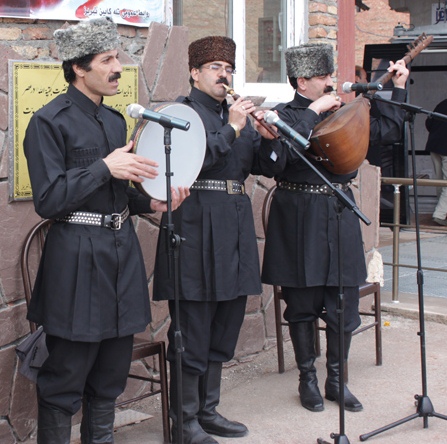
Azerbaijanis hold festivals and ceremonies such as Nowruz and Eid al-Adha like other Iranian ethnic groups with small differences. Ashik music is one of the features of the Turkish speaking people of the world. It has different versions in Iran. Meanwhile, as many experts of this art testify the Urmia Ashik, is the most original and oldest version in the world, which has preserved its origin until the present day. Ashik music has its unique styles. As a piece of the culture of Azerbaijan, Urmia Ashik music has been registered in Iran's national heritage.
Museums
- Natural History Museum – Displays the animals native to the vicinity of Urmia.
- Urmia Museum – Archaeological museum affiliated with the faculty of Shahid Beheshti University.
- Urmia Museum of Crafts and Classical Arts.
- Urmia Museum of َAnthropology.
Education

The first modern style school established in Urmia in 1834.

Higher education
Urmia was an important centre for higher education approximately a century ago; indeed, the medical college of Urmia, which was built by Joseph Cochran and a team of American medical associates in 1878, is the first modern university of Iran. Unfortunately, the college was shut down even before the establishment of the first official University of Iran, University of Tehran. Today, Urmia has become an important centre of education, with several state and private universities and institutes, including those listed below.
Universities in Urmia:
Libraries
- Allame Tabatabayee Library
- Central Library of Urmia
- Library of Ghaem
- Library of I.R. Iran Education Ministry
- Library of Imam Ali
- Library of kanoon parvaresh fekri
- Library of Khane-ye-Javan
- Library of Shahid Motahhari
- Library of Shahid Bahonar
- Library of Urmia Cultural and Artistical Center
Media
Television
Urmia has one state-owned television channel, Urmia TV, which broadcasts in both Azerbaijani, and Persian, and internationally through satellite Intelsat902.
Radio
Urmia has one radio channel broadcasting in Kurdish, Azerbaijani and Persian. The name of the local radio is Chichest.
Press
Among others, the city's print media include:
- Orumiye
- Barish news
- Sedaye Urmia
- Amanat
- Koosha
- Araz
Infrastructure
Transportation
Most of Urmia's residents travel by car through the system of roads and highways. Urmia is also served by taxis and public buses. There are also some private groups that provide services called "Phone-taxi." Two Tram-lines for Urmia are Planned.
Urmia is linked to Europe through Turkey's roads and Sero border crossing. Urmia Airport, which opened in 1964, was the first international airport in West Azerbaijan county, Iran. As of April 2015 it only has regularly scheduled domestic flights to Tehran's Mehrabad International Airport, although there are plans to establish a direct flight between Urmia and Erbil, due to the large number of passengers travelling between the two cities. The city is recently connected to Iran National Railways (IRIR, رجا).
Health systems
The Iranian government operates public hospitals in the Urmia metropolitan region. There are also a number of private hospitals and medical centers in the city. Hospitals include: Hospitals:
- 523 Artesh(Army) Hospital
- Arefian Hospital
- Azerbaijan Hospital
- Gholipour Children's Hospital
- Imam Khomeini Hospital
- Imam Reza Hospital
- Milad international medical center
- Motahari Hospital
- Omid Hospital
- Razi Psychiatry Hospital
- Taleghani Hospital
- Seyedoshohada Heart Hospital
- Shafa Hospital
- Shams Hospital
- Solati Hospital
Clinics:
- Fatimiye Pro-Medical Clinic
- Kosar Women's Pro-Medical Clinic
Consulates
The Turkish government has a consulate on Beheshti Avenue.
People
During its history Urmia was the origin for many Iranian illumination and modernization movements. The city was the hometown of numerous figures including politicians, revolutionaries, artists, and military leaders. Following is a partial list of some of the people who was born or lived in Urmia.
For a complete list see: :Category:People from Urmia File:Safiyeedin Urmavi.jpg|Safi al-Din al-Urmawi, was a renowned musician and writer on the theory of music. File:Amo-oghli.jpg|Haydar Khan e Amo-oghli, was a leftist revolutionary during the Iranian Constitutional Revolution and among the founders of the Communist Party of Iran. File:Fatma Mukhtarova.jpg|Fatma Mukhtarova, was a Soviet opera singer. File:Saeid Marouf IRN WC 2014.jpg|Saeid Marouf, is an Iranian volleyball player who plays as a setter for the Iranian national team which he captains. File:Picture Mehrsa Baradaran.jpg|Mehrsa Baradaran, an American law professor at the University of California, Irvine, was born in Urmia File:داوود آزاد- Davood Azad.jpg|Davood Azad, is an Iranian classical and folk music singer. File:Oyan Nəzəriani.jpg|Oyan Nazariani, is an Azerbaijani Beach wrestling and Greco-Roman wrestler born in Urmia. He is the head coach of the Azerbaijani beach wrestling team.
Twin towns and sister cities
- Turkey Erzurum, Turkey (since 2015)
- Turkey Trabzon, Turkey
- Bulgaria Varna, Bulgaria
Notes
References
References
- ((OpenStreetMap contributors)). (28 September 2024). "Urmia, بخش مرکزی [Central District], Urumia County, West Azerbaijan Province, Iran".
- "G3V7+HV5 Urmia, West Azerbaijan Province, Iran".
- "Orūmīyeh | Iran | Britannica".
- {{GEOnet3. -3077456
- Hassan. Habibi. fa. تاریخ تصویب (Approval date) 1369/06/21 (Iranian Jalali calendar). (12 September 1990 ). link. fa. لام تا کام [Lam ta Kam]. {{lang. fa. وزارت کشور [Ministry of the Interior]. fa. کمیسیون سیاسی دفاعی هیأت دولت [Political Defense Commission of the Government Board]. fa. شناسه [ID] D6D37EAB-50D7-43D6-B320-D774C01ADE50. {{lang. fa. شماره دوره [Course number] 69, {{lang. fa. شماره جلد [Volume number] 3.
- Channel, Aznews TV. (18 September 2023). "The Urmia Lake Crisis: Environmental Degradation, Ethnic Tensions, and Water Politics • Aznews TV".
- Hellot-Bellier, Florence. (2019). "Let Them Not Return: Sayfo – The Genocide Against the Assyrian, Syriac, and Chaldean Christians in the Ottoman Empire". Berghahn Books.
- Gaunt, David. (2006). "Massacres, Resistance, Protectors: Muslim-Christian Relations in Eastern Anatolia during World War I". Gorgias Press.
- "Urmia {{!".
- "Assyrians in the History of Urmia, Iran".
- E. J. Brill's First Encyclopaedia of Islam, 1913–1936, M.{{nbspTh{{nbspHoutsma, p.{{nbsp1035, 1987
- (17 May 2022). "ثبت ۳۴۳۱ قلم اثر آذربایجان غربی در سامانه جامع میراث فرهنگی کشور".
- https://en.mehrnews.com/news/205052/Urmia-Historic-UNESCO-registered-Iranian-city
- https://jinhaagency.com/en/actual/urmia-between-pluralism-and-denial-the-struggle-of-identities-in-the-public-sphere-37850
- https://thenewregion.com/posts/1857/kurds-azerbaijanis-in-iran-s-urmia-struggle-for-coexistence-contention-for-authority
- https://en.urmia.ac.ir/About%20Urmia
- Richard Nelson Frye, The history of ancient Iran, München (1984), 48–49
- The Proto-Indoaryans, by T. Burrow, The Journal of the Royal Asiatic Society of Great Britain and Ireland, No.{{nbsp2 (1973), pp. 123–140, published by Cambridge University Press, see 139
- "Search Entry".
- Sykes, Percy. (1921). "A History of Persia". Macmillan and Company.
- {{Cite EB1911
- "Evliyâ Çelebi Seyahatnâmesi: IV". Yapı Kredi Yayınları.
- Hakobyan T. Kh., Melik-Bakhshyan St. T., Barseghyan H. Kh. [http://www.nayiri.com/imagedDictionaryBrowser.jsp?dictionaryId=61&query=%D5%88%D6%82%D6%80%D5%B4%D5%AB%D5%A1 Dictionary of Toponyms of Adjacent Regions of Armenia, vol. 5], Yerevan University Publishing House", 2001, nayiri.com
- "Urmu İranın havası çirkli olan 10 şəhəri siyahısında".
- "Parêzgarên Ûrmiyê û Colemêrgê liser pirsên ewlekariyê civîn encam dan".
- "بەندیخانەی ورمێ؛ بەندکراوێک بەگومانی تووشبوون بە بە ڤایرۆسی کرۆنا ڕەوانەی نەخۆشخانە کرا".
- Thomas A. Carlson. "Urmia – ܐܘܪܡܝܐ". The Syriac Gazetteer.
- (1992). "The Encyclopaedia of Islam= : New Edition Vol. 7".
- Carl Skutsch. (2013). "Encyclopedia of the World's Minorities". Routledge.
- Speer, Robert Elliott. (1911). "The Hakim Sahib, the Foreign Doctor: A Biography of Joseph Plumb Cochran, M. D., of Persia". Revell.
- "CATHOLIC ENCYCLOPEDIA: Urmiah".
- Naby, Eden. (September 2007). "Theater, Language and Inter-Ethnic Exchange: Assyrian Performance before World War I Eden Naby1". Iranian Studies.
- Gaunt, David. (2015). "The Complexity of the Assyrian Genocide". Genocide Studies International.
- (1 September 2012). "Conflict, conquest, and conversion". Columbia University Press.
- (22 March 2025). "اعتراض شهروندان ارومیهای در ایران به برخی ادعاهای تحریکآمیز". [[TRT]].
- (22 March 2025). "تجمع گسترده مردم ارومیه؛ "ارومیه تُرک است و تُرک خواهد ماند"". [[Anadolu Agency]].
- (24 March 2025). "دستگیری 22 نفر از شرکتکنندگان در تجمع اخیر مردم ارومیه". [[Anadolu Agency]].
- "URMIYA", ''Encyclopaedia of Islam'' (edition 2)
- (1893). "The Quarterly Review Volume 176". John Murray.
- (1890). "Report of the Fifty-ninth Meeting of the British Association for the Advancement of Science Held at Newcastle-upon-Tyne in September 1889". John Murray.
- (2014). "Iran". Bradt Travel Guides.
- Foundation, Encyclopaedia Iranica. "Welcome to Encyclopaedia Iranica".
- Hovannisian, Richard G.. (31 December 2011). "The Armenian Genocide". Transaction Publishers.
- (1929). "The Encyclopedia Britannica". Encyclopedia britannica Company, Limited.
- Al-Jeloo, Nicholas. (2010). "Evidence in Stone and Wood: The Assyrian/Syriac History and Heritage of the Urmia Region in Iran". Parole de l'Orient.
- Curtis, Glenn E.. (2008). "Iran: A Country Study". Federal Research Division of the Library of Congress.
- (18 May 2016). "The idea of English in Iran: an example from Urmia". Journal of Multilingual and Multicultural Development.
- دكتر م پناهايان، مجموعه اي در چهار جلد به نام " فرهنگ جغرافياي ملي تركان ايران زمين " سال 1351 Dr. M. Panahian, a four-volume collection entitled "National Geographical Culture of the Turks of Iran" in 1351
- سيري در تاريخ زبان ولهجه هاي تركي , دكتر جواد هئيت- چاپ سوم , سال1380,ص 307 A Journey in the History of Turkish Language and Dialects, Dr. Javad Hayat – Third Edition, 2001, p. 307
- "Location of Nestorian Churches".
- "Location of Armenian and Chaldean churches".
- Hellot-Bellier, Florence. (2019). "Let Them Not Return: Sayfo – The Genocide Against the Assyrian, Syriac, and Chaldean Christians in the Ottoman Empire". Berghahn Books.
- "Cities with a population of 100,000 and more (1956-2006 census)". Iran data portal.
- fa. مرکز آمار ایران [Statistical Centre of Iran]. link
- link. fa. مرکز آمار ایران [Statistical Centre of Iran]
- fa. مرکز آمار ایران [Statistical Centre of Iran]. link
- [http://www.bari.ir/bari/en/tours/jazebeha/kaboodan/] {{Dead link. (July 2018)
- [https://www.researchgate.net/publication/266323729_Modeling_the_exceptional_south_Foehn_event_Garmij_over_the_Alborz_Mountains_during_the_extreme_forest_fire_of_December_2005 Modeling the exceptional south Foehn event (Garmij) over the Alborz Mountains during the extreme forest fire of December 2005] February 2014, Natural Hazards, Abbas Mofidi, Iman Soltanzadeh, Yadollah Yousefi, Azar Zarrin, MohsenSoltani, Jafar Masoompour Samakosh, Ghasem Azizi, et al. Retrieved 27 May 2022.
- "World Meteorological Organization climate normals for 1991-2020: Orumiyeh-40712". [[NOAA.
- "Moosighi Asheghi Azarbaijan Sahrghi (Asheqi Music From East Azerbaijan) by Asheq Rasul Qorbani".
- (31 August 2013). "معاون شهرسازی و معماری شهردار ارومیه خبر داد تخصیص بودجه 550 میلیارد تومانی شهرداری ارومیه". خبرگزاری فارس.
- "پایگاه اطلاع رسانی صدا و سیمای مرکز آذربایجان غربی".
- (21 April 2019). "Urmia-Erbil direct flights to be established in near future". Mehr News Agency.
- (21 April 2019). "Direct Flights to Start Between Urmia and Erbil: Iranian Official". Basnews.
- "Arefian hospital".
- "Azerbaijan Hospital".
- "خانه".
- "Milad hospital".
- "خانه".
- "Home".
- "خانه".
- "خانه".
- "مرکز آموزشی درمانی قلب حضرت سیدالشهداء (علیه السلام) | خانه".
- "Shafa Hospital".
- Bazzazzadeh, Reza. "Shams||private hospital".
- "بیمارستان دکتر صولتی".
- (21 September 2020). "Azərbaycan Güləş Federasiyasının iclası keçirilib". awf.az.
- (7 April 2015). "Urmia, Erzurum sign sisterhood agreement".
- (25 January 2012). "کدام شهرهای جهان با هم خواهر و برادرند؟". Honar News.
This article was imported from Wikipedia and is available under the Creative Commons Attribution-ShareAlike 4.0 License. Content has been adapted to SurfDoc format. Original contributors can be found on the article history page.
Ask Mako anything about Urmia — get instant answers, deeper analysis, and related topics.
Research with MakoFree with your Surf account
Create a free account to save articles, ask Mako questions, and organize your research.
Sign up freeThis content may have been generated or modified by AI. CloudSurf Software LLC is not responsible for the accuracy, completeness, or reliability of AI-generated content. Always verify important information from primary sources.
Report