From Surf Wiki (app.surf) — the open knowledge base
Urinal (health care)
Bottle for urination used in health care
_Heritage_Museum_Sha_Tin_Hong_Kong.jpg)
Bottle for urination used in health care
.jpg)
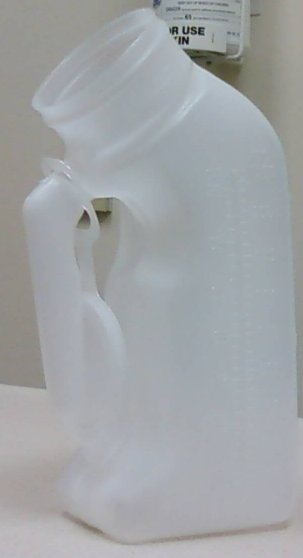

A urinal, urine bottle, or male urinal is a bottle for urination. It is most frequently used in health care for patients who find it impossible or difficult to get out of bed during sleep. Urinals allow the patient who has cognition and movement of their arms to urinate without the help of staff. A urinal bottle can also be used by travelers or transportation workers who are unable to immediately use a public restroom as part of an emergency kit, or in areas where restroom facilities are too distant.
Urinals are used as part of input and output measurement and feature embedded markings to measure the fluid.
Generally, patients who are able to are encouraged to walk to the toilet or use a bedside commode as opposed to a urinal. The prolonged use of a urinal has been shown to lead to constipation or difficulty urinating.
Urinals are most frequently used for male patients, since they are easier to use with male anatomy. While female urinals exist, they are more difficult to use, and the common practice for females is to use a bedpan. Female urinals require a wider opening and must be placed between the legs. For many women, female urinals are more practical in a wheelchair rather than in a bed. But the opening part of urinal may get infected by the germs and can be disinfected by various chemicals.
References
References
- (1981). "Illustrated Manual of Nursing Techniques". Lippincott.
- (1986). "Clinical Nursing Procedures". Jones and Bartlett Publishers.
- Simmers, L.. (2008). "Diversified Health Occupations". Cengage Learning.
- Harman, R.J.. (2002). "Patient Care in Community Practice: A Handbook of Non-medicinal Healthcare". Pharmaceutical Press.
- (1997). "The Urinary Incontinence Sourcebook". Lowell House.
This article was imported from Wikipedia and is available under the Creative Commons Attribution-ShareAlike 4.0 License. Content has been adapted to SurfDoc format. Original contributors can be found on the article history page.
Ask Mako anything about Urinal (health care) — get instant answers, deeper analysis, and related topics.
Research with MakoFree with your Surf account
Create a free account to save articles, ask Mako questions, and organize your research.
Sign up freeThis content may have been generated or modified by AI. CloudSurf Software LLC is not responsible for the accuracy, completeness, or reliability of AI-generated content. Always verify important information from primary sources.
Report