From Surf Wiki (app.surf) — the open knowledge base
Uranium hexafluoride
Uranium(VI) fluoride 151kPa}} |Solid, −2197.7±1.8kJ·mol−1 |Gaseous, −2148.1±1.8kJ·mol−1 |Solid, 227.8±1.3J·K−1·mol−1 |Gaseous, 377.8±1.3J·K−1·mol−1 |NFPA-H = 4 |NFPA-F = 0 |NFPA-R = 2 |NFPA-S = W+OX
Uranium hexafluoride, sometimes called hex, is the inorganic compound with the formula . Uranium hexafluoride is a volatile, white solid that is used in enriching uranium for nuclear reactors and nuclear weapons.
Preparation
Uranium dioxide is converted with hydrofluoric acid (HF) to uranium tetrafluoride: : The resulting is subsequently oxidized with fluorine to give the hexafluoride: : In samples contaminated with uranium trioxide, uranyl fluoride, an oxyfluoride compound is produced in the HF step: : which can be fluorinated to produce the same product, uranium hexafluoride. : The fluorination steps in both reactions above are highly exothermic.
Properties
Physical properties
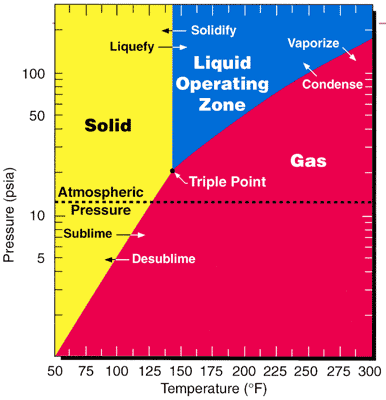
At atmospheric pressure, sublimes at 56.5 °C.
The solid-state structure was determined by neutron diffraction at 77 K and 293 K.
:[[Image:Uranium-hexafluoride-unit-cell-3D-balls.png|thumb|left|Packing of UF6 in its unit cell.]]
Chemical properties
UF6 reacts with water, releasing hydrofluoric acid. The compound reacts with aluminium, forming a surface layer of that resists any further reaction from the compound.
Uranium hexafluoride is a mild oxidant. It is a Lewis acid as evidenced by its binding to form heptafluorouranate(VI), .
Polymeric uranium(VI) fluorides containing organic cations have been isolated and characterized by X-ray diffraction.
Application in the fuel cycle
As one of the most volatile compounds of uranium, uranium hexafluoride is relatively convenient to process and is used in both of the main uranium enrichment methods, namely gaseous diffusion and the gas centrifuge method. Since the triple point of , which is 64 °C (147 °F; 337 K) and 152 kPa (22 psi; 1.5 atm), is close to ambient conditions, phase transitions can be achieved with little thermodynamic work.
Fluorine has only a single naturally occurring stable isotope, so isotopologues of differ in their molecular weight based solely on the uranium isotope present. This difference is the basis for the physical separation of isotopes in enrichment.
All the other uranium fluorides are nonvolatile solids that are coordination polymers.
The conversion factor for the isotopologue of ("hex") to "U mass" is 0.676.{{cite web
Gaseous diffusion requires about 60 times as much energy as the gas centrifuge process: gaseous diffusion-produced nuclear fuel produces 25 times more energy than is used in the diffusion process, while centrifuge-produced fuel produces 1,500 times more energy than is used in the centrifuge process.
In addition to its use in enrichment, uranium hexafluoride has been used in an advanced reprocessing method (fluoride volatility), which was developed in the Czech Republic. In this process, spent nuclear fuel is treated with fluorine gas to transform the oxides or elemental metals into a mixture of fluorides. This mixture is then distilled to separate the different classes of material. Some fission products form nonvolatile fluorides which remain as solids and can then either be prepared for storage as nuclear waste or further processed either by solvation-based methods or electrochemically.
Uranium enrichment produces large quantities of depleted uranium hexafluoride (D or D-) as a waste product. The long-term storage of D- presents environmental, health, and safety risks because of its chemical instability. When is exposed to moist air, it reacts with the water in the air to produce (uranyl fluoride) and HF (hydrogen fluoride) both of which are highly corrosive and toxic. In 2005, about 686,000 tonnes of D- was housed in 57,122 storage cylinders located near Portsmouth, Ohio; Oak Ridge, Tennessee; and Paducah, Kentucky. Storage cylinders must be regularly inspected for signs of corrosion and leaks. The estimated lifetime of the steel cylinders is measured in decades.
Accidents and disposal
There have been several accidents involving uranium hexafluoride in the US, including a cylinder-filling accident and material release at the Sequoyah Fuels Corporation in 1986 where an estimated 29,500 pounds of gaseous escaped. The US government has been converting D to solid uranium oxides for disposal. Such disposal of the entire D stockpile could cost anywhere from $15 million to $450 million. |File:UF6 cylinder rupture bw.png |Ruptured 14-ton shipping cylinder. 1 fatality, dozens injured. ~29500 lb of material released. Sequoyah Fuels Corporation 1986. |File:DUF6 storage yard far.jpg |D storage yard from afar |File:Corroded DUF6 cylinder.jpg |D cylinders: painted (left) and corroded (right)
References
References
- "Uranium Hexafluoride".
- (1979). "The Enthalpy of Formation of Uranium Hexafluoride". [[The Journal of Chemical Thermodynamics]].
- Uranium(VI) fluoride
- (2007). "Ullmann's Encyclopedia of Industrial Chemistry".
- (1948). "The Low Temperature Heat Capacities, Enthalpies, and Entropies of UF4 and UF6". [[J. Chem. Phys.]].
- (1976). "Structure of Fluorides. Part XII. Single-Crystal Neutron Diffraction Study of Uranium Hexafluoride at 293 K". J. Chem. Soc., Dalton Trans..
- J. H. Levy, J. C. Taylor and A. B. Waugh. (1983). "Neutron Powder Structural Studies of UF6, MoF6 and WF6 at 77 K". Journal of Fluorine Chemistry.
- J. C. Taylor, P. W. Wilson, J. W. Kelly: „The structures of fluorides. I. Deviations from ideal symmetry in the structure of crystalline UF6: a neutron diffraction analysis", ''[[Acta Crystallogr.]]'', '''1973''', ''B29'', p. 7–12; {{doi. 10.1107/S0567740873001895.
- (1968). "Electron-Diffraction Investigation of the Hexafluorides of Tungsten, Osmium, Iridium, Uranium, Neptunium, and Plutonium". [[J. Chem. Phys.]].
- (1978). "Synthetic methods and reactions. 46. Oxidation of organic compounds with uranium hexafluoride in haloalkane solutions". [[J. Am. Chem. Soc.]].
- (1976). "The oxidising and fluoride ion acceptor properties of uranium hexafluoride in acetonitrile". J. Chem. Soc., Dalton Trans..
- (1999). "From Molecules to Frameworks: Variable Dimensionality in the UO2(CH3COO)2·2H2O/HF(aq)/Piperazine System. Syntheses, Structures, and Characterization of Zero-Dimensional (C4N2H12)UO2F4·3H2O, One-Dimensional (C4N2H12)2U2F12·H2O, Two-Dimensional (C4N2H12)2(U2O4F5)4·11H2O, and Three-Dimensional (C4N2H12)U2O4F6". J. Am. Chem. Soc..
- "Uranium Hexafluoride: Source: Appendix A of the PEIS (DOE/EIS-0269): Physical Properties".
- "Uranium Enrichment and the Gaseous Diffusion Process". USEC Inc.
- "How much depleted uranium hexafluoride is stored in the United States?". [[Argonne National Laboratory]].
- "Depleted UF6 Management Program Documents".
- (2007-09-24). "What is DUF6? Is it dangerous and what should we do with it?". Institute for Energy and Environmental Research.
- (2007). "The Sequoyah Corporation Fuels Release and the Church Rock Spill: Unpublicized Nuclear Releases in American Indian Communities". American Journal of Public Health.
- "Have there been accidents involving uranium hexafluoride?". Argonne National Laboratory.
- "What is going to happen to the uranium hexafluoride stored in the United States?". Argonne National Laboratory.
- "Are there any currently-operating disposal facilities that can accept all of the depleted uranium oxide that would be generated from conversion of DOE's depleted UF6 inventory?". Argonne National Laboratory.
This article was imported from Wikipedia and is available under the Creative Commons Attribution-ShareAlike 4.0 License. Content has been adapted to SurfDoc format. Original contributors can be found on the article history page.
Ask Mako anything about Uranium hexafluoride — get instant answers, deeper analysis, and related topics.
Research with MakoFree with your Surf account
Create a free account to save articles, ask Mako questions, and organize your research.
Sign up freeThis content may have been generated or modified by AI. CloudSurf Software LLC is not responsible for the accuracy, completeness, or reliability of AI-generated content. Always verify important information from primary sources.
Report