From Surf Wiki (app.surf) — the open knowledge base
Upper Mississippi River
Upstream portion of the Mississippi river

Upstream portion of the Mississippi river
| Field | Value |
|---|---|
| name | Upper Mississippi River |
| image | Efmo View from Fire Point.jpg |
| image_caption | The Upper Mississippi River near Harpers Ferry, Iowa |
| source1_location | Lake Itasca, Minnesota |
| source1_coordinates | |
| mouth_location | St. Louis, Missouri (flows into the Middle Mississippi) |
| subdivision_type1 | Country |
| subdivision_name1 | US, Canada |
| length_mi | 1,300 |
| length_ref | |
| source1_elevation | 450 m |
| discharge1_avg | 5796 m3/s |
| basin_size_km2 | 490,000 |
| basin_size_ref |
The Upper Mississippi River is the portion of the Mississippi River upstream of St. Louis, Missouri, United States, a city at the confluence of its main tributary, the Missouri River. Historically, it may refer to the area above the Arkansas Post, above the confluence of Ohio River, or above Cape Girardeau.
History
In terms of geologic and hydrographic history, the Upper Mississippi east and south of Fort Snelling is a portion of the now-extinct Glacial River Warren which carved the valley of the Minnesota River, permitting the immense Glacial Lake Agassiz to join the world's oceans at the Gulf of Mexico. The collapse of ice dams holding back Glacial Lake Duluth and Glacial Lake Grantsburg carved out the Dalles of the St. Croix River at Interstate Park. The Upper Mississippi River valley likely originated as an ice-marginal stream during the Pre-Illinoian Stage.
The Driftless Area is a portion of North America left unglaciated at that ice age's height, hence not smoothed out or covered over by previous geological processes.
Characteristics
The Upper Mississippi from below St. Anthony Falls (Minneapolis, Minnesota) downstream to St. Paul, Minnesota is a gorge with high limestone bluffs carved by the glacial River Warren Falls. Upstream of St. Anthony Falls, the land slopes gently to river's edge. Downstream of downtown St. Paul, the river enters its wide preglacial valley. The states of Minnesota, Wisconsin and Iowa, along with the federal government, have preserved certain areas of the land along this reach of the river.
There are three National Park Service sites along the Upper Mississippi River. The Mississippi National River and Recreation Area is the National Park Service site dedicated to protecting and interpreting the Mississippi River itself. The other two National Park Service sites along the river are: Effigy Mounds National Monument and the Gateway Arch National Park (home to the Gateway Arch in St. Louis).
Unlike the Lower Mississippi, much of the upper river is a series of pools created by a system of 29 locks and dams. The structures were authorized by Congress in the 1930s, and most were completed by 1940.{{cite web | access-date=2006-03-13}} A primary reason for damming the river is to facilitate barge transportation. The dams regulate water levels for the Upper River and play a major part in regulating levels on the Lower Mississippi.
Ecology

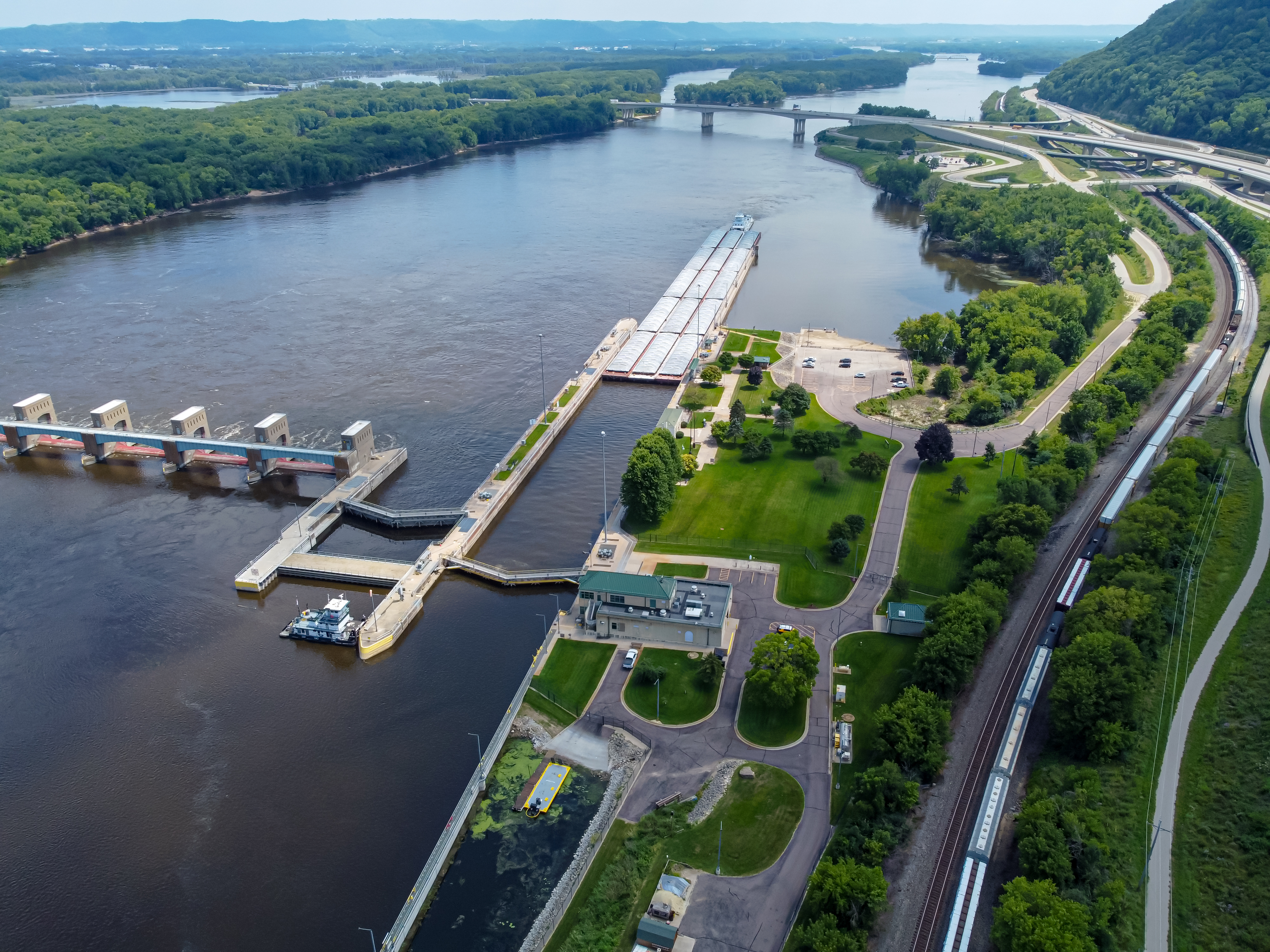
On the upper reaches near the Minnesota-Wisconsin border, the river's floodplain is between 1.5 and 5 kilometers (between 1 and 3 mi) wide. South of St. Louis, Missouri, the alluvial floodplain is approximately 80 kilometers (50 mi) wide. Major tributaries to the Upper Mississippi River include the Missouri, Illinois, Minnesota, St. Croix, Chippewa, Black, Wisconsin, and Kaskaskia Rivers.{{cite web | access-date=2006-04-01}}
The Upper Mississippi provides habitat for more than 125 fish species and 30 species of freshwater mussels. Three national wildlife refuges along the river cover a total of 465 square kilometers (285,000 ac). The largest of them, the Upper Mississippi River National Wildlife and Fish Refuge, is over 420 kilometers (260 mi) long, reaching from the Alma, Wisconsin area down to Rock Island, Illinois. The refuge consists of blufflands, marshes, bottomland forest, islands, channels, backwater lakes and sloughs.{{cite web |access-date = 2006-04-01 |url-status = dead |archive-url = https://web.archive.org/web/20050403235059/http://www.friendsofuppermiss.org/pages/Refuges.html |archive-date = April 3, 2005 It is part of the Mississippi Flyway.
Although the river is much cleaner than it was in recent decades, water quality is still a priority concern. Agricultural runoff, including sediment, excessive nutrients, (particularly nitrogen and phosphorus), and chemicals from agricultural and industrial sources continue to threaten Upper Mississippi River aquatic resources. In addition new threats continue to emerge such as personal care items including pharmaceuticals and endocrine-disrupting chemicals. The five states bordering the Upper Mississippi River are working together to address water quality issues.{{cite web | access-date=2008-04-11 |archive-url = https://web.archive.org/web/20071015212057/http://mississippi-river.com/umrcc/issues.html#WaterQuality |archive-date = 2007-10-15}}{{cite web | access-date=2008-04-11 | archive-date=May 15, 2008 | archive-url=https://web.archive.org/web/20080515080137/http://www.umrba.org/wq.htm | url-status=dead | access-date=2012-03-21 | archive-date=April 3, 2012 | archive-url=https://web.archive.org/web/20120403172654/http://www.umrba.org/wq/umr-nutrients.pdf | url-status=dead
The Minnesota Pollution Control Agency planned to test the entire 650 mile of the river within the state for the first time in 2024.
There is general agreement that nutrients are contributing to the Gulf of Mexico dead zone and to eutrophication problems in Lake Pepin, a large natural riverine lake that is part of Pool 4 of the Upper Mississippi River. National and regional efforts are addressing these problems, but nutrient impairment problems are occurring elsewhere in the Upper Mississippi River as well, particularly in off-channel portions. Excessive nutrients contribute to thick floating mats of filamentous algae or duckweeds that have a pronounced negative impact on light penetration and may threaten the growth and persistence of submerged aquatic vegetation that is important for fish and aquatic life, including waterfowl. Efforts to control nutrients from point and non-point sources in the basin have aimed to provide additional benefits.{{cite web | access-date=2008-04-11|archiveurl=https://web.archive.org/web/20080117073348/http://www.epa.gov/msbasin/taskforce/nutrient_workshop/index.htm#other |archivedate=2008-01-17}}
Navigation
Main article: List of locks and dams of the Upper Mississippi River
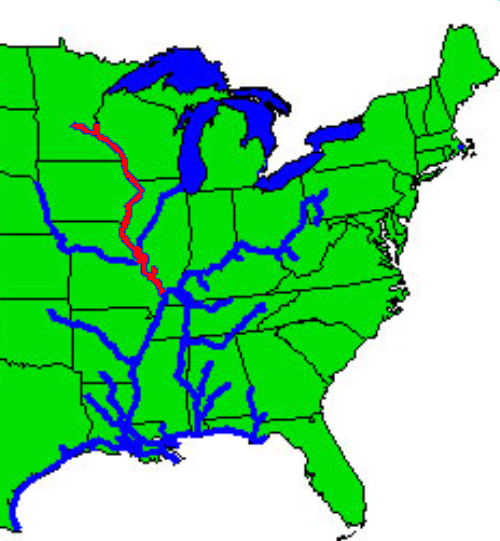
Navigation locks allow towboats, barges, and other vessels to transit the dams. Approximately 1350 kilometers (850 mi), from the head of navigation in Mile 858, Minneapolis, Minnesota down to Cairo, has been made suitable for commercial navigation with a depth of 2.75 meters (9 ft). The agriculture and barge transportation industries have lobbied in the late 20th and early 21st centuries for a multibillion-dollar project to upgrade the aging lock and dam system. Some environmental groups and advocates of budgetary restraint argue that the project lacks economic justification.
Each lock and dam complex creates a pool upstream of it. There are 29 locks on the Upper Mississippi maintained by the U.S. Army Corps of Engineers—from Upper St. Anthony Falls upstream to Chain of Rocks downstream.There is a Lock 5 as well as a Lock 5A, and there is no Lock 23. {{cite web |access-date = 2006-04-27 |archive-url = https://web.archive.org/web/20060719204859/http://www.mvr.usace.army.mil/mvrimi/omni/webrpts/omni_vl/river_lock.asp |archive-date = 2006-07-19 |url-status = dead The locks provide a collective 123 meters (404 ft) of lift.{{cite web |access-date = 2006-04-27 |url-status = dead |archive-url = https://web.archive.org/web/20070703141148/http://www.iwr.usace.army.mil/ndc/factcard/fc05/factcard.pdf |archive-date = 2007-07-03
| [[File:La Crosse Mississippi River barge and mooring dolphins-7.jpg | thumb | x150px | [[La Crosse County, Wisconsin | La Crosse County]] barge [[harbor]]]] | [[File:Lock and Dam 6 time lapse.webm | thumb | [[Lock and Dam No. 6 | Lock and Dam 6]] time lapse]] | [[File:Barge on the Upper Mississippi.webm | thumb | Barge on the Upper Mississippi]] |
|---|
Expansion proposals for locks

The Army Corps of Engineers has studied expanding locks 20, 21, 22, 24, and 25 on the Upper Mississippi.
List of pools and locks
| Pool | Locality | Lock | Mile marker | (km) | Distance | (km) |
|---|---|---|---|---|---|---|
| USAF Pool | Minneapolis MN | Upper St. Anthony Falls Lock | 854 | 1375 | ||
| LSAF Pool | Minneapolis MN | Lower St. Anthony Falls Lock | 853 | 1373 | 1 | 2 |
| Pool 1 | Minneapolis MN | Lock 1 | 848 | 1365 | 5 | 8 |
| Pool 2 | Hastings MN | Lock 2 | 815 | 1312 | 33 | 53 |
| Pool 3 | Welch MN | Lock 3 | 797 | 1283 | 18 | 29 |
| Pool 4 | Alma WI | Lock 4 | 753 | 1212 | 44 | 71 |
| Pool 5 | Minnesota City MN | Lock 5 | 738 | 1188 | 15 | 24 |
| Pool 5A | Fountain City WI | Lock 5A | 728 | 1172 | 10 | 16 |
| Pool 6 | Trempealeau WI | Lock 6 | 714 | 1150 | 14 | 23 |
| Pool 7 | La Crescent MN | Lock 7 | 703 | 1132 | 11 | 18 |
| Pool 8 | Genoa WI | Lock 8 | 679 | 1093 | 24 | 39 |
| Pool 9 | Eastman WI | Lock 9 | 648 | 1043 | 31 | 50 |
| Pool 10 | Guttenberg IA | Lock 10 | 615 | 990 | 33 | 53 |
| Pool 11 | Dubuque IA | Lock 11 | 583 | 939 | 32 | 52 |
| Pool 12 | Bellevue IA | Lock 12 | 557 | 897 | 26 | 42 |
| Pool 13 | Clinton IA | Lock 13 | 522 | 840 | 35 | 56 |
| Pool 14 | LeClaire IA | Lock 14 | 493 | 794 | 29 | 47 |
| Pool 15 | Rock Island IL | Lock 15 | 483 | 778 | 10 | 16 |
| Pool 16 | Illinois City IL | Lock 16 | 457 | 736 | 26 | 42 |
| Pool 17 | New Boston IL | Lock 17 | 437 | 704 | 20 | 32 |
| Pool 18 | Gladstone IL | Lock 18 | 410 | 660 | 27 | 43 |
| Pool 19 | Keokuk IA | Lock 19 | 364 | 586 | 46 | 74 |
| Pool 20 | Canton MO | Lock 20 | 343 | 552 | 21 | 34 |
| Pool 21 | Quincy IL | Lock 21 | 325 | 523 | 18 | 29 |
| Pool 22 | New London MO | Lock 22 | 301 | 485 | 24 | 39 |
| Pool 24 | Clarksville MO | Lock 24 | 273 | 440 | 28 | 45 |
| Pool 25 | Winfield MO | Lock 25 | 241 | 388 | 32 | 52 |
| Mel Price Pool | East Alton IL | Melvin Price Lock | 201 | 324 | 40 | 64 |
| Pool 27 | Granite City IL | Lock 27 | 185 | 298 | 16 | 26 |
References
References
- "UMESC - About the Upper Mississippi River System".
- "General Information about the Mississippi River". U.S. National Park Service.
- "Background on Upper Mississippi River Basin". EPA: Mississippi River Basin & Gulf of Mexico Hypoxia.
- "River and Basin Facts". Upper Mississippi River Basin Association.
- "Mississippi River {{!}} History, Physical Features, Culture, & Facts".
- (1986). "Pre-Wisconsin glacial stratigraphy of the central plains region in Iowa, Nebraska, Kansas, and Missouri". Quaternary Science Reviews.
- (1986). "Summation of quaternary glaciations in the United States of America". Quaternary Science Reviews.
- Hassanzadeh, Erin. (2024-09-02). "MPCA testing the entirety of the Mississippi River within Minnesota". CBS Minnesota.
- Marcia Zarley Taylor. (8 March 2006). "River debate continues". AgWeb.
- Walker, Brad. (February 2010). "Big Price—Little Benefit: Proposed Locks on the Upper Mississippi and Illinois Rivers are not Economically Viable". Nicollet Island Coalition.
This article was imported from Wikipedia and is available under the Creative Commons Attribution-ShareAlike 4.0 License. Content has been adapted to SurfDoc format. Original contributors can be found on the article history page.
Ask Mako anything about Upper Mississippi River — get instant answers, deeper analysis, and related topics.
Research with MakoFree with your Surf account
Create a free account to save articles, ask Mako questions, and organize your research.
Sign up freeThis content may have been generated or modified by AI. CloudSurf Software LLC is not responsible for the accuracy, completeness, or reliability of AI-generated content. Always verify important information from primary sources.
Report