From Surf Wiki (app.surf) — the open knowledge base
Unsaturated fat
Fat or fatty acid in which there is at least one double bond within the fatty acid chain
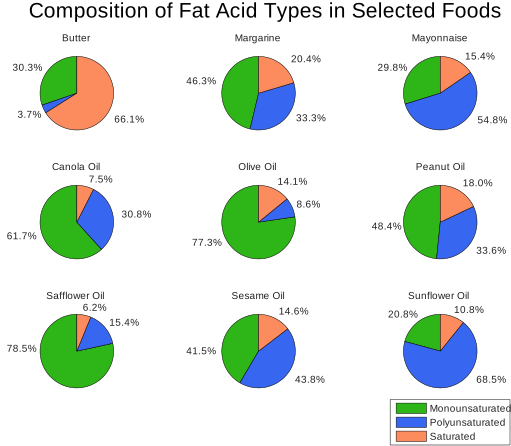
Fat or fatty acid in which there is at least one double bond within the fatty acid chain
An unsaturated fat is a fat or fatty acid in which there is at least one double bond within the fatty acid chain, which makes the fatty acid chain, which is basically a chain of hydrocarbons, an alkene. A fatty acid chain is monounsaturated if it contains one double bond, and polyunsaturated if it contains more than one double bond.
A saturated fat has no carbon-to-carbon double bonds, so the maximum possible number of hydrogen is bonded to carbon, and thus, is considered to be "saturated" with hydrogen atoms. To form carbon-to-carbon double bonds, hydrogen atoms are removed from the carbon chain. In cellular metabolism, unsaturated fat molecules contain less energy (i.e., fewer calories) than an equivalent amount of saturated fat. The greater the degree of unsaturation in a fatty acid (i.e., the more double bonds in the fatty acid) the more susceptible it becomes to lipid peroxidation (rancidity). Antioxidants can protect unsaturated fat from lipid peroxidation.
Composition of common fats
In chemical analysis, fats are broken down to their constituent fatty acids, which can be analyzed in various ways. In one approach, fats undergo transesterification to give fatty acid methyl esters (FAMEs), which are amenable to separation and quantitation using gas chromatography. Classically, unsaturated isomers were separated and identified by argentation thin-layer chromatography.
| fat source | saturated | monounsaturated | doubly unsaturated | triunsaturated |
|---|---|---|---|---|
| Palm kernel | 60–65 | 10–18 | 1–3 | trace |
| Cottonseed oil | 23–30 | 14–21 | 45–58 | trace |
| Corn oil | 10–15 | 25–35 | 40–60 | trace |
| Linseed oil | 8–11 | 18–26 | 14–20 | 51–56 |
| Soybean oil | 11–17 | 18–25 | 49–57 | 6–11 |
| Peanut oil | 12–17 | 35–42 | 39–44 | trace |
| Lard | 36–48 | 36–52 | 10–12 | 1 |
| Beef tallow | 43–64 | 26–45 | 2–6 | 1 |
The saturated fatty acid components are almost exclusively stearic (C18) and palmitic acids (C16). Monounsaturated fats are almost exclusively oleic acid. Linolenic acid comprises most of the triunsaturated fatty acid component.
Chemistry and nutrition
Although polyunsaturated fats are protective against cardiac arrhythmias, a study of post-menopausal women with a relatively low fat intake showed that polyunsaturated fat is positively associated with progression of coronary atherosclerosis, whereas monounsaturated fat is not. This probably is an indication of the greater vulnerability of polyunsaturated fats to lipid peroxidation, against which vitamin E has been shown to be protective.
Examples of unsaturated fatty acids are palmitoleic acid, oleic acid, myristoleic acid, linoleic acid, and arachidonic acid. Foods containing unsaturated fats include avocado, nuts, olive oils, and vegetable oils such as canola. Meat products contain both saturated and unsaturated fats.
Although unsaturated fats are conventionally regarded as 'healthier' than saturated fats, the United States Food and Drug Administration (FDA) recommendation stated that the amount of unsaturated fat consumed should not exceed 30% of one's daily caloric intake. Most foods contain both unsaturated and saturated fats. Marketers advertise only one or the other, depending on which one makes up the majority. Thus, various unsaturated fat vegetable oils, such as olive oils, also contain saturated fat.
Membrane composition as a metabolic pacemaker
Studies on the cell membranes of mammals and reptiles discovered that mammalian cell membranes are composed of a higher proportion of polyunsaturated fatty acids (DHA, omega-3 fatty acid) than reptiles. Studies on bird fatty acid composition have noted similar proportions to mammals but with 1/3rd less omega-3 fatty acids as compared to omega-6 for a given body size. This fatty acid composition results in a more fluid cell membrane but also one that is permeable to various ions (H+ & Na+), resulting in cell membranes that are more costly to maintain. This maintenance cost has been argued to be one of the key causes for the high metabolic rates and concomitant warm-bloodedness of mammals and birds. However polyunsaturation of cell membranes may also occur in response to chronic cold temperatures as well. In fish increasingly cold environments lead to increasingly high cell membrane content of both monounsaturated and polyunsaturated fatty acids, to maintain greater membrane fluidity (and functionality) at the lower temperatures.
References
References
- (January 2015). "Optimization of supercritical fluid consecutive extractions of fatty acids and polyphenols from Vitis vinifera grape wastes". Journal of Food Science.
- (July 1987). "Separation of fatty acids or methyl esters including positional and geometric isomers by alumina argentation thin-layer chromatography". Journal of Chromatographic Science.
- (2000). "Ullmann's Encyclopedia of Industrial Chemistry".
- (November 2004). "Dietary fats, carbohydrate, and progression of coronary atherosclerosis in postmenopausal women". The American Journal of Clinical Nutrition.
- (January 1990). "Dietary supplements of vitamin E, beta-carotene, coenzyme Q10 and selenium protect tissues against lipid peroxidation in rat tissue slices". The Journal of Nutrition.
- [https://web.archive.org/web/20100404063518/http://www.bbc.co.uk/health/treatments/healthy_living/nutrition/healthy_fatsugar.shtml Fats and sugars]. BBC Health, retrieved 2013-04-07
- "Fat Facts, the Right Amount for a Healthy Diet".
- (June 1996). "Dietary fats and insulin action". Diabetologia.
- (August 1999). "Membranes as possible pacemakers of metabolism". Journal of Theoretical Biology.
- (November 2002). "Acyl composition of muscle membranes varies with body size in birds". The Journal of Experimental Biology.
- (July 2003). "Life, death and membrane bilayers". The Journal of Experimental Biology.
- (May 1991). "Homeoviscous adaptation and thermal compensation of sodium pump of trout erythrocytes". The American Journal of Physiology.
This article was imported from Wikipedia and is available under the Creative Commons Attribution-ShareAlike 4.0 License. Content has been adapted to SurfDoc format. Original contributors can be found on the article history page.
Ask Mako anything about Unsaturated fat — get instant answers, deeper analysis, and related topics.
Research with MakoFree with your Surf account
Create a free account to save articles, ask Mako questions, and organize your research.
Sign up freeThis content may have been generated or modified by AI. CloudSurf Software LLC is not responsible for the accuracy, completeness, or reliability of AI-generated content. Always verify important information from primary sources.
Report