From Surf Wiki (app.surf) — the open knowledge base
University of Minnesota Armory
| Field | Value |
|---|---|
| name | University of Minnesota Armory |
| nrhp_type | cp |
| nocat | yes |
| image | UMN-Armory.jpg |
| caption | University of Minnesota Armory |
| location | Minneapolis, Minnesota |
| coordinates | |
| built | 1896 |
| architect | Charles Ronald Aldrich |
| designated_nrhp_type | August 23, 1984 |
| partof | University of Minnesota Old Campus Historic District |
| partof_refnum | 84001463 |
The University of Minnesota Armory is a building on the University of Minnesota campus in Minneapolis, Minnesota. The Armory was constructed in 1896 after the previous space for military training on the campus burnt in a fire in 1894. The facility served as the primary home for the Minnesota Golden Gophers men's basketball team as well as the University of Minnesota Marching Band after its construction. The basketball team moved to the Kenwood Armory in Downtown Minneapolis in 1925 while the band moved to the newly completed Music Education Building in 1922. Fielding H. Yost, Michigan Wolverines football coach, forgot the Little Brown Jug, one of the oldest college football traveling trophies, in the locker rooms of the Armory in 1903. The Armory was also the facility used for the University of Minnesota physical education department until 1935. The school's football team played some of their early games on the open field next to the Armory.
It is a contributing property in the University of Minnesota Old Campus Historic District, a historic district that is listed on the National Register of Historic Places.
Currently, it is used as the classrooms and office space of the University's three ROTC units, and offices for the University's program for High School students, with the gymnasium being available for campus activities.
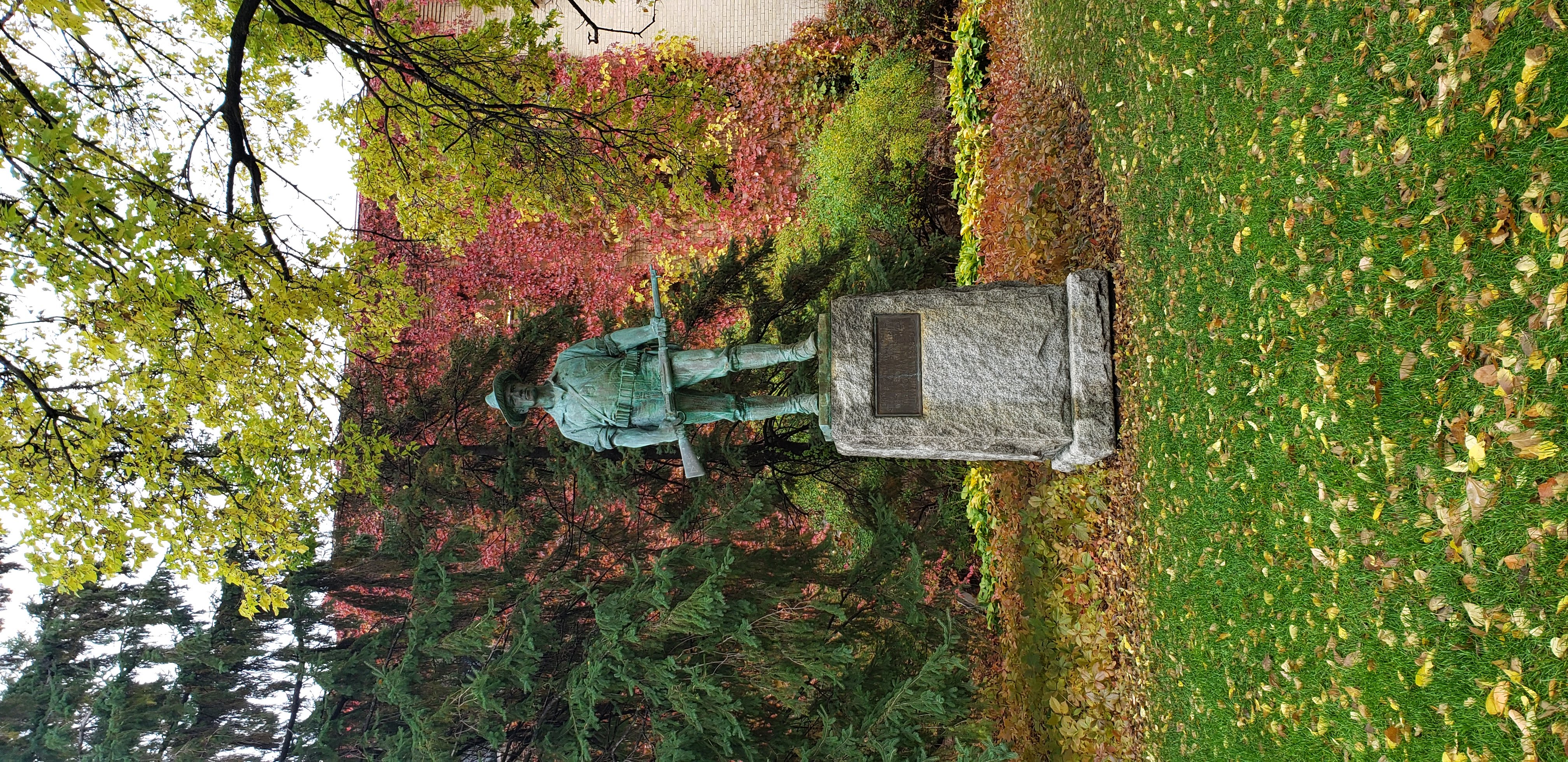
Outside the Armory building, there is a nine foot tall statue of a soldier on a seven-ton, six-foot-high Vermont granite pedestal. It is called "Iron Mike" and a memorial plaque underneath reads: "erected in honor of the students of the University who served their country in the war with Spain, 1898-99.” Sculptor Theo Alice Ruggles Kitson designed the statue, which was commissioned and paid for by a committee that had originally been formed to send Christmas gifts to student soldiers in the 13th Minnesota Infantry Regiment, who were stationed in Manila. Professor Arthur E. Haynes, who chaired this committee, suggested doing something more than just sending gifts. He donated the first ten dollars and led the fundraising and process of designing the statue. It was unveiled in 1906.
References
References
- (August 23, 1984). "University of Minnesota Old Campus Historic District". [[United States Department of the Interior]] - [[National Park Service]].
- "History and Philosophy of Reserver Officer Training." University of Minnesota ROTC Alumni Society. http://www.umnrotcalumnisociety.org/history.php {{Webarchive. link. (2005-09-11)
- Hugunin, Marc. (2006). "Minnesota Hoops: Basketball in the North Star State". St. Paul: Minnesota Historical Society Press.
- Bencriscutto, Frank. (1992). "Minnesota Hats Off to Thee". Taylor Publishing Company.
- Hugunin and Thornley, pg. 50.
- Bencriscutto and Gaffron, pg. 30-31.
- "History." University of Minnesota Air Force ROTC. http://www.afrotc.umn.edu/History/Armory.htm
This article was imported from Wikipedia and is available under the Creative Commons Attribution-ShareAlike 4.0 License. Content has been adapted to SurfDoc format. Original contributors can be found on the article history page.
Ask Mako anything about University of Minnesota Armory — get instant answers, deeper analysis, and related topics.
Research with MakoFree with your Surf account
Create a free account to save articles, ask Mako questions, and organize your research.
Sign up freeThis content may have been generated or modified by AI. CloudSurf Software LLC is not responsible for the accuracy, completeness, or reliability of AI-generated content. Always verify important information from primary sources.
Report