From Surf Wiki (app.surf) — the open knowledge base
Universe
Everything in space and time
Everything in space and time
| Field | Value | |
|---|---|---|
| title | Universe | |
| image | [[File:Hubble ultra deep field.jpg | 300px]] |
| caption | The Hubble Ultra-Deep Field image shows some of the most remote galaxies visible to present technology (diagonal is ~1/10 apparent Moon diameter) | |
| label1 | Age (within ΛCDM model) | |
| data1 | 13.787 ± 0.020 billion years | |
| label2 | Diameter | |
| data2 | Unknown | |
| Observable universe: (28.5 Gpc or 93 Gly) | ||
| label4 | Average density (with energy) | |
| data4 | ||
| label5 | Average temperature (cosmic microwave background) | |
| data5 | ||
| (, ) | ||
| label6 | Main contents | |
| data6 | Ordinary (baryonic) matter (4.9%) | |
| Dark matter (26.8%) | ||
| Dark energy (68.3%) | ||
| label7 | Shape | |
| data7 | Flat with 0.4% error margin |
Observable universe: (28.5 Gpc or 93 Gly) (, ) Dark matter (26.8%) Dark energy (68.3%)
The universe is all of space and time and their contents. It comprises all of existence, any fundamental interaction, physical process and physical constant, and therefore all forms of matter and energy, and the structures they form, from sub-atomic particles to entire galactic filaments. Since the early 20th century, the field of cosmology establishes that space and time emerged together at the Big Bang ago and that the universe has been expanding since then. The portion of the universe that can be seen by humans is approximately 93 billion light-years in diameter at present, but the total size of the universe is not known.
Some of the earliest cosmological models of the universe were geocentric, placing Earth at the center. During the European Scientific Revolution, astronomical observations led to a heliocentric model. Further observational improvements led to the realization that the Sun is one of a few hundred billion stars in the Milky Way, which is one of a few hundred billion galaxies in the observable universe. Many of the stars in a galaxy have planets. At the largest scale, galaxies are distributed uniformly and the same in all directions, meaning that the universe has neither an edge nor a center. At smaller scales, galaxies are distributed in clusters and superclusters, which form immense filaments and voids in space, creating a vast foam-like structure. Discoveries in the early 20th century lead to the Big Bang theory with a hot fireball, cooling and becoming less dense as the universe expanded, allowing the first subatomic particles and simple atoms to form. Giant clouds of hydrogen and helium were gradually drawn to the places where matter was most dense, forming the first galaxies, stars, and everything else seen today.
From studying the effects of gravity on both matter and light, it has been discovered that the universe contains much more matter than is accounted for by visible objects; stars, galaxies, nebulae and interstellar gas. This unseen matter is known as dark matter. In the widely accepted ΛCDM cosmological model, dark matter accounts for about of the mass and energy in the universe while about is dark energy, a mysterious form of energy responsible for the acceleration of the expansion of the universe. Ordinary ('baryonic') matter therefore composes only of the universe. Stars, planets, and visible gas clouds only form about 6% of this ordinary matter.
There are many competing hypotheses about the ultimate fate of the universe and about what, if anything, preceded the Big Bang, while other physicists and philosophers refuse to speculate, doubting that information about prior states will ever be accessible. Some physicists have suggested various multiverse hypotheses, in which the universe might be one among many.
Definition
The physical universe is defined as all of space and time (collectively referred to as spacetime) and their contents. Such contents comprise all of energy in its various forms, including electromagnetic radiation and matter, and therefore planets, moons, stars, galaxies, and the contents of intergalactic space. The universe also includes the physical laws that influence energy and matter, such as conservation laws, classical mechanics, and relativity.
The universe is often defined as "the totality of existence", or everything that exists, everything that has existed, and everything that will exist. In fact, some philosophers and scientists support the inclusion of ideas and abstract concepts—such as mathematics and logic—in the definition of the universe. The word universe may also refer to concepts such as the cosmos, the world, and nature.
Etymology
The word universe derives from the Old French word univers, which in turn derives from the Latin word universus, meaning 'combined into one'. The Latin word 'universum' was used by Cicero and later Latin authors in many of the same senses as the modern English word is used.
Synonyms
A term for universe among the ancient Greek philosophers from Pythagoras onwards was τὸ πᾶν (grc) 'the all', defined as all matter and all space, and τὸ ὅλον (grc) 'all things', which did not necessarily include the void. Another synonym was ὁ κόσμος (grc) meaning 'the world, the cosmos'. Synonyms are also found in Latin authors (totum, mundus, natura) and survive in modern languages, e.g., the German words Das All, Weltall, and Natur for universe. The same synonyms are found in English, such as everything (as in the theory of everything), the cosmos (as in cosmology), the world (as in the many-worlds interpretation), and nature (as in natural laws or natural philosophy).
Chronology and the Big Bang
Main article: Big Bang, Chronology of the universe
The prevailing model for the evolution of the universe is the Big Bang theory. The Big Bang model states that the earliest state of the universe was an extremely hot and dense one, and that the universe subsequently expanded and cooled. The model is based on general relativity and on simplifying assumptions such as the homogeneity and isotropy of space. A version of the model with a cosmological constant (Lambda) and cold dark matter, known as the Lambda-CDM model, is the simplest model that provides a reasonably good account of various observations about the universe.

The initial hot, dense state is called the Planck epoch, a brief period extending from time zero to one Planck time unit of approximately 10−43 seconds. During the Planck epoch, all types of matter and all types of energy were concentrated into a dense state, and gravity—currently the weakest by far of the four known forces—is believed to have been as strong as the other fundamental forces, and all the forces may have been unified. The physics controlling this very early period (including quantum gravity in the Planck epoch) is not understood, so we cannot say what, if anything, happened before time zero. Since the Planck epoch, the universe has been expanding to its present scale, with a very short but intense period of cosmic inflation speculated to have occurred within the first 10−32 seconds. This initial period of inflation would explain why space appears to be very flat.
Within the first fraction of a second of the universe's existence, the four fundamental forces had separated. As the universe continued to cool from its inconceivably hot state, various types of elementary particles associated stably into ever larger combinations, including stable protons and neutrons, which then formed more complex atomic nuclei through nuclear fusion.
This process, known as Big Bang nucleosynthesis, lasted for about 17 minutes and ended about 20 minutes after the Big Bang, so only the fastest and simplest reactions occurred. About 25% of the protons and all the neutrons in the universe, by mass, were converted to helium, with small amounts of deuterium (a form of hydrogen) and traces of lithium. Any other element was only formed in very tiny quantities. The other 75% of the protons remained unaffected, as hydrogen nuclei.
After nucleosynthesis ended, the universe entered a period known as the photon epoch. During this period, the universe was still far too hot for matter to form neutral atoms, so it contained a hot, dense, foggy plasma of negatively charged electrons, neutral neutrinos and positive nuclei. After about 377,000 years, the universe had cooled enough that electrons and nuclei could form the first stable atoms. This is known as recombination for historical reasons; electrons and nuclei were combining for the first time. Unlike plasma, neutral atoms are transparent to many wavelengths of light, so for the first time, the universe also became transparent. The photons released ("decoupled") when these atoms formed can still be seen today; they form the cosmic microwave background (CMB).
As the universe expands, the energy density of electromagnetic radiation decreases more quickly than does that of matter because the energy of each photon decreases as it is cosmologically redshifted. At around 47,000 years, the energy density of matter became larger than that of photons and neutrinos, and began to dominate the large scale behavior of the universe. This marked the end of the radiation-dominated era and the start of the matter-dominated era.
In the earliest stages of the universe, tiny fluctuations within the universe's density led to concentrations of dark matter gradually forming. Ordinary matter, attracted to these by gravity, formed large gas clouds and eventually, stars and galaxies, where the dark matter was most dense, and voids where it was least dense. After around 100–300 million years, the first stars formed, known as Population III stars. These were probably very massive, luminous, non metallic and short-lived. They were responsible for the gradual reionization of the universe between about 200–500 million years and 1 billion years, and also for seeding the universe with elements heavier than helium, through stellar nucleosynthesis.
The universe also contains a mysterious energy—possibly a scalar field—called dark energy, the density of which does not change over time. After about 9.8 billion years, the universe had expanded sufficiently so that the density of matter was less than the density of dark energy, marking the beginning of the present dark-energy-dominated era. In this era, the expansion of the universe is accelerating due to dark energy.
Physical properties
Main article: Observable universe, Age of the universe, Expansion of the universe
Of the four fundamental interactions, gravitation is the dominant at astronomical length scales. Gravity's effects are cumulative; by contrast, the effects of positive and negative charges tend to cancel one another, making electromagnetism relatively insignificant on astronomical length scales. The remaining two interactions, the weak and strong nuclear forces, decline very rapidly with distance; their effects are confined mainly to sub-atomic length scales.
The universe appears to have much more matter than antimatter, an asymmetry possibly related to the CP violation. This imbalance between matter and antimatter is partially responsible for the existence of all matter existing today, since matter and antimatter, if equally produced at the Big Bang, would have completely annihilated each other and left only photons as a result of their interaction.
Size and regions
.png)
Due to the finite speed of light, there is a limit (known as the particle horizon) to how far light can travel over the age of the universe. The spatial region from which we can receive light is called the observable universe. The proper distance (measured at a fixed time) between Earth and the edge of the observable universe is 46 billion light-years (14 billion parsecs), making the diameter of the observable universe about 93 billion light-years (28 billion parsecs). Although the distance traveled by light from the edge of the observable universe is close to the age of the universe times the speed of light, 13.8 e9ly, the proper distance is larger because the edge of the observable universe and the Earth have since moved further apart.
For comparison, the Milky Way is roughly 87,400 light-years in diameter, and the nearest sister galaxy to the Milky Way, the Andromeda Galaxy, is located roughly 2.5 million light-years away.
Because humans cannot observe space beyond the edge of the observable universe, it is unknown whether the size of the universe in its totality is finite or infinite. An estimate from 2011 suggests that if the cosmological principle holds, the whole universe must be more than 250 times larger than a Hubble sphere. Some disputed estimates for the total size of the universe, if finite, reach as high as 10^{10^{10^{122}}} megaparsecs, as implied by a suggested resolution of the No-Boundary Proposal.
Age and expansion
Main article: Age of the universe, Expansion of the universe
Assuming that the Lambda-CDM model is correct, the measurements of the parameters using a variety of techniques by numerous experiments yield a best value of the age of the universe at 13.799 ± 0.021 billion years, as of 2015.
Over time, the universe and its contents have evolved. For example, the relative population of quasars and galaxies has changed and the universe has expanded. This expansion is inferred from the observation that the light from distant galaxies has been redshifted, which implies that the galaxies are receding from us. Analyses of Type Ia supernovae indicate that the expansion is accelerating.
The more matter there is in the universe, the stronger the mutual gravitational pull of the matter. If the universe were too dense then it would re-collapse into a gravitational singularity. However, if the universe contained too little matter then the self-gravity would be too weak for astronomical structures, like galaxies or planets, to form. Since the Big Bang, the universe has expanded monotonically. Perhaps unsurprisingly, our universe has just the right mass–energy density, equivalent to about 5 protons per cubic meter, which has allowed it to expand for the last 13.8 billion years, giving time to form the universe as observed today.
There are dynamical forces acting on the particles in the universe which affect the expansion rate. Before 1998, it was expected that the expansion rate would be decreasing as time went on due to the influence of gravitational interactions in the universe; and thus there is an additional observable quantity in the universe called the deceleration parameter, which most cosmologists expected to be positive and related to the matter density of the universe. In 1998, the deceleration parameter was measured by two different groups to be negative, approximately −0.55, which technically implies that the second derivative of the cosmic scale factor \ddot{a} has been positive in the last 5–6 billion years.
Spacetime
Main article: Spacetime, World line
Modern physics regards events as being organized into spacetime.{{Cite book |author-link=Bernard Schutz
The special theory of relativity describes a flat spacetime. Its successor, the general theory of relativity, explains gravity as curvature of spacetime arising due to its energy content. A curved path like an orbit is not the result of a force deflecting a body from an ideal straight-line path, but rather the body's attempt to fall freely through a background that is itself curved by the presence of other masses. A remark by John Archibald Wheeler that has become proverbial among physicists summarizes the theory: "Spacetime tells matter how to move; matter tells spacetime how to curve", and therefore there is no point in considering one without the other. The Newtonian theory of gravity is a good approximation to the predictions of general relativity when gravitational effects are weak and objects are moving slowly compared to the speed of light.
The relation between matter distribution and spacetime curvature is given by the Einstein field equations, which require tensor calculus to express. The universe appears to be a smooth spacetime continuum consisting of three spatial dimensions and one temporal (time) dimension. Therefore, an event in the spacetime of the physical universe can be identified by a set of four coordinates: (x, y, z, t).
Shape
Main article: Shape of the universe
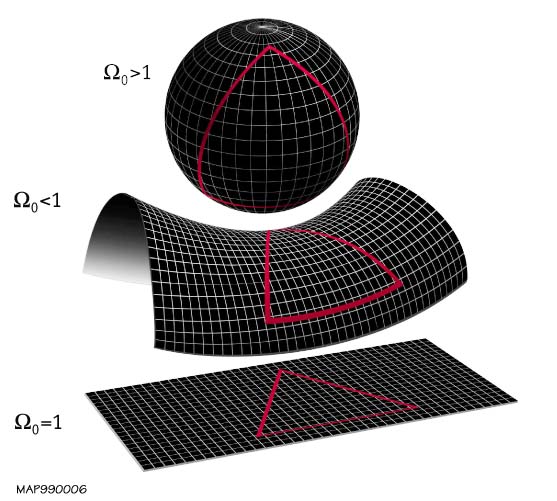
Cosmologists often work with space-like slices of spacetime that are surfaces of constant time in comoving coordinates. The geometry of these spatial slices is set by the density parameter, Omega (Ω), defined as the average matter density of the universe divided by a critical value. This selects one of three possible geometries depending on whether Ω is equal to, less than, or greater than 1. These are called, respectively, the flat, open and closed universes.
Observations, including the Cosmic Background Explorer (COBE), Wilkinson Microwave Anisotropy Probe (WMAP), and Planck maps of the CMB, suggest that the universe is infinite in extent with a finite age, as described by the Friedmann–Lemaître–Robertson–Walker (FLRW) models.{{cite journal |author-link = Jean-Pierre Luminet |access-date = August 21, 2018 |archive-date = May 17, 2021 |archive-url = https://web.archive.org/web/20210517180259/https://cds.cern.ch/record/647738 |url-status = live |access-date=March 21, 2013 |archive-date=March 24, 2013 |archive-url=https://web.archive.org/web/20130324022238/http://physicsworld.com/cws/article/news/2013/mar/21/planck-reveals-almost-perfect-universe |url-status=live
Support of life
Main article: Fine-tuned universe
The fine-tuned universe hypothesis is the proposition that the conditions that allow the existence of observable life in the universe can only occur when certain universal fundamental physical constants lie within a very narrow range of values. According to this hypothesis, if any of several fundamental constants were only slightly different, the universe would have been unlikely to be conducive to the establishment and development of matter, astronomical structures, elemental diversity, or life as it is understood. Whether this is true, and whether that question is even logically meaningful to ask, are subjects of much debate.{{cite web |access-date=February 15, 2022 |archive-date=October 10, 2023 |archive-url=https://web.archive.org/web/20231010234820/https://plato.stanford.edu/entries/fine-tuning/ |url-status=live
Composition
The universe is composed almost completely of dark energy, dark matter, and ordinary matter. Other contents are electromagnetic radiation (estimated to constitute from 0.005% to close to 0.01% of the total mass–energy of the universe) and antimatter.
The proportions of all types of matter and energy have changed over the history of the universe. The total amount of electromagnetic radiation generated within the universe has decreased by 1/2 in the past 2 billion years. Today, ordinary matter, which includes atoms, stars, galaxies, and life, accounts for only 4.9% of the contents of the universe. The present overall density of this type of matter is very low, roughly 4.5 × 10⁻³¹ grams per cubic centimeter, corresponding to a density of the order of only one proton for every four cubic meters of volume. The nature of both dark energy and dark matter is unknown. Dark matter, a mysterious form of matter that has not yet been identified, accounts for 26.8% of the cosmic contents. Dark energy, which is the energy of empty space and is causing the expansion of the universe to accelerate, accounts for the remaining 68.3% of the contents.


Matter, dark matter, and dark energy are distributed homogeneously throughout the universe over length scales longer than 300 million light-years (ly) or so. However, over shorter length-scales, matter tends to clump hierarchically; many atoms are condensed into stars, most stars into galaxies, most galaxies into clusters, superclusters and, finally, large-scale galactic filaments. The observable universe contains as many as an estimated 2 trillion galaxies and, overall, as many as an estimated 1024 stars – more stars (and earth-like planets) than all the grains of beach sand on planet Earth; but less than the total number of atoms estimated in the universe as 1082; and the estimated total number of stars in an inflationary universe (observed and unobserved), as 10100. Typical galaxies range from dwarfs with as few as ten million (107) stars up to giants with one trillion (1012) stars. Between the larger structures are voids, which are typically 10–150 Mpc (33 million–490 million ly) in diameter. The Milky Way is in the Local Group of galaxies, which in turn is in the Laniakea Supercluster. This supercluster spans over 500 million light-years, while the Local Group spans over 10 million light-years. The universe also has vast regions of relative emptiness; the largest known void measures 1.8 billion ly (550 Mpc) across.

The observable universe is isotropic on scales significantly larger than superclusters, meaning that the statistical properties of the universe are the same in all directions as observed from Earth. The universe is bathed in highly isotropic microwave radiation that corresponds to a thermal equilibrium blackbody spectrum of roughly 2.72548 kelvins. The hypothesis that the large-scale universe is homogeneous and isotropic is known as the cosmological principle. A universe that is both homogeneous and isotropic looks the same from all vantage points and has no center.
Dark energy
Main article: Dark energy
An explanation for why the expansion of the universe is accelerating remains elusive. It is often attributed to the gravitational influence of "dark energy", an unknown form of energy that is hypothesized to permeate space. On a mass–energy equivalence basis, the density of dark energy (~ 7 × 10⁻³⁰ g/cm3) is much less than the density of ordinary matter or dark matter within galaxies. However, in the present dark-energy era, it dominates the mass–energy of the universe because it is uniform across space.
Two proposed forms for dark energy are the cosmological constant, a constant energy density filling space homogeneously, and scalar fields such as quintessence or moduli, dynamic quantities whose energy density can vary in time and space while still permeating them enough to cause the observed rate of expansion. Contributions from scalar fields that are constant in space are usually also included in the cosmological constant. The cosmological constant can be formulated to be equivalent to vacuum energy.
Dark matter
Main article: Dark matter
Dark matter is a hypothetical kind of matter that is invisible to the entire electromagnetic spectrum, but which accounts for most of the matter in the universe. The existence and properties of dark matter are inferred from its gravitational effects on visible matter, radiation, and the large-scale structure of the universe. Other than neutrinos, a form of hot dark matter, dark matter has not been detected directly, making it one of the greatest mysteries in modern astrophysics. Dark matter neither emits nor absorbs light or any other electromagnetic radiation at any significant level. Dark matter is estimated to constitute 26.8% of the total mass–energy and 84.5% of the total matter in the universe.
Ordinary matter
Main article: Matter

The remaining 4.9% of the mass–energy of the universe is ordinary matter, that is, atoms, ions, electrons and the objects they form. This matter includes stars, which produce nearly all of the light we see from galaxies, as well as interstellar gas in the interstellar and intergalactic media, planets, and all the objects from everyday life that we can bump into, touch or squeeze. The great majority of ordinary matter in the universe is unseen, since visible stars and gas inside galaxies and clusters account for less than 10 percent of the ordinary matter contribution to the mass–energy density of the universe.{{Cite journal | doi-access=free
Ordinary matter commonly exists in four states (or phases): solid, liquid, gas, and plasma. However, advances in experimental techniques have revealed other previously theoretical phases, such as Bose–Einstein condensates and fermionic condensates. Ordinary matter is composed of two types of elementary particles: quarks and leptons. For example, the proton is formed of two up quarks and one down quark; the neutron is formed of two down quarks and one up quark; and the electron is a kind of lepton. An atom consists of an atomic nucleus, made up of protons and neutrons (both of which are baryons), and electrons that orbit the nucleus.
Soon after the Big Bang, primordial protons and neutrons formed from the quark–gluon plasma of the early universe as it cooled below two trillion degrees. A few minutes later, in a process known as Big Bang nucleosynthesis, nuclei formed from the primordial protons and neutrons. This nucleosynthesis formed lighter elements, those with small atomic numbers up to lithium and beryllium, but the abundance of heavier elements dropped off sharply with increasing atomic number. Some boron may have been formed at this time, but the next heavier element, carbon, was not formed in significant amounts. Big Bang nucleosynthesis shut down after about 20 minutes due to the rapid drop in temperature and density of the expanding universe. Subsequent formation of heavier elements resulted from stellar nucleosynthesis and supernova nucleosynthesis.
Particles

Main article: Particle physics
Ordinary matter and the forces that act on matter can be described in terms of elementary particles. These particles are sometimes described as being fundamental, since they have an unknown substructure, and it is unknown whether or not they are composed of smaller and even more fundamental particles.{{cite book |access-date=January 27, 2016 |archive-date=August 26, 2016 |archive-url=https://web.archive.org/web/20160826133823/https://books.google.com/books?id=e8YUUG2pGeIC&pg=PA1 |url-status=live |author-last=Close |author-first=Frank
Of central importance is the Standard Model, a theory that is concerned with electromagnetic interactions and the weak and strong nuclear interactions. The Standard Model is supported by the experimental confirmation of the existence of particles that compose matter: quarks and leptons, and their corresponding "antimatter" duals, as well as the force particles that mediate interactions: the photon, the W and Z bosons, and the gluon. The Standard Model predicted the existence of the recently discovered Higgs boson, a particle that is a manifestation of a field within the universe that can endow particles with mass.{{cite web |access-date=January 8, 2013 |archive-date=October 12, 2013 |archive-url=https://web.archive.org/web/20131012130340/https://wikis.utexas.edu/display/utatlas/Higgs+boson+FAQ |url-status=live |author-link=Matt Strassler |access-date=January 8, 2013 [A] Well, actually, they don't. What they really care about is the Higgs field, because it is so important. [emphasis in original] |archive-date=October 12, 2013 |archive-url=https://web.archive.org/web/20131012042637/http://profmattstrassler.com/articles-and-posts/the-higgs-particle/the-higgs-faq-2-0/ |url-status=live
Hadrons
Main article: Hadron
A hadron is a composite particle made of quarks held together by the strong force. Hadrons are categorized into two families: baryons (such as protons and neutrons) made of three quarks, and mesons (such as pions) made of one quark and one antiquark. Of the hadrons, protons are stable, and neutrons bound within atomic nuclei are stable. Other hadrons are unstable under ordinary conditions and are thus insignificant constituents of the modern universe.
From approximately 10−6 seconds after the Big Bang, during a period known as the hadron epoch, the temperature of the universe had fallen sufficiently to allow quarks to bind together into hadrons, and the mass of the universe was dominated by hadrons. Initially, the temperature was high enough to allow the formation of hadron–anti-hadron pairs, which kept matter and antimatter in thermal equilibrium. However, as the temperature of the universe continued to fall, hadron–anti-hadron pairs were no longer produced. Most of the hadrons and anti-hadrons were then eliminated in particle–antiparticle annihilation reactions, leaving a small residual of hadrons by the time the universe was about one second old.
Leptons
Main article: Lepton
A lepton is an elementary, half-integer spin particle that does not undergo strong interactions but is subject to the Pauli exclusion principle; no two leptons of the same species can be in exactly the same state at the same time.{{cite encyclopedia |access-date=September 29, 2010 |archive-date=May 11, 2015 |archive-url=https://web.archive.org/web/20150511203531/http://www.britannica.com/EBchecked/topic/336940/lepton |url-status=live | editor1-last=Balian | editor1-first=R. | editor2-last=Llewellyn-Smith | editor2-first=C.H. |book-title=Proceedings of the XII Rencontre de Moriond |access-date=May 29, 2020 |archive-date=May 13, 2020 |archive-url=https://web.archive.org/web/20200513180308/https://www.slac.stanford.edu/cgi-bin/getdoc/slac-pub-1974.pdf |url-status=live |access-date=June 2, 2015 |archive-date=July 5, 2013 |archive-url=https://web.archive.org/web/20130705100832/http://web.mit.edu/newsoffice/2007/neutrino.html |url-status=live
The lepton epoch was the period in the evolution of the early universe in which the leptons dominated the mass of the universe. It started roughly 1 second after the Big Bang, after the majority of hadrons and anti-hadrons annihilated each other at the end of the hadron epoch. During the lepton epoch, the temperature of the universe was still high enough to create lepton–anti-lepton pairs, so leptons and anti-leptons were in thermal equilibrium. Approximately 10 seconds after the Big Bang, the temperature of the universe had fallen to the point where lepton–anti-lepton pairs were no longer created. Most leptons and anti-leptons were then eliminated in annihilation reactions, leaving a small residue of leptons. The mass of the universe was then dominated by photons as it entered the following photon epoch.
Photons
Main article: Photon epoch
A photon is the quantum of light and all other forms of electromagnetic radiation. It is the carrier for the electromagnetic force. The effects of this force are easily observable at the microscopic and at the macroscopic level because the photon has zero rest mass; this allows long distance interactions.
The photon epoch started after most leptons and anti-leptons were annihilated at the end of the lepton epoch, about 10 seconds after the Big Bang. Atomic nuclei were created in the process of nucleosynthesis which occurred during the first few minutes of the photon epoch. For the remainder of the photon epoch the universe contained a hot dense plasma of nuclei, electrons and photons. About 380,000 years after the Big Bang, the temperature of the universe fell to the point where nuclei could combine with electrons to create neutral atoms. As a result, photons no longer interacted frequently with matter and the universe became transparent. The highly redshifted photons from this period form the cosmic microwave background. Tiny variations in the temperature of the CMB correspond to variations in the density of the universe that were the early "seeds" from which all subsequent structure formation took place.
Habitability
The frequency of life in the universe has been a frequent point of investigation in astronomy and astrobiology, being the issue of the Drake equation and the different views on it, from identifying the Fermi paradox, the situation of not having found any signs of extraterrestrial life, to arguments for a biophysical cosmology, a view of life being inherent to the physical cosmology of the universe.
Cosmological models
Model of the universe based on general relativity
Main article: Solutions of the Einstein field equations
General relativity is the geometric theory of gravitation published by Albert Einstein in 1915 and the current description of gravitation in modern physics. It is the basis of current cosmological models of the universe. General relativity generalizes special relativity and Newton's law of universal gravitation, providing a unified description of gravity as a geometric property of space and time, or spacetime. In particular, the curvature of spacetime is directly related to the energy and momentum of whatever matter and radiation are present.
The relation is specified by the Einstein field equations, a system of partial differential equations. In general relativity, the distribution of matter and energy determines the geometry of spacetime, which in turn describes the acceleration of matter. Therefore, solutions of the Einstein field equations describe the evolution of the universe. Combined with measurements of the amount, type, and distribution of matter in the universe, the equations of general relativity describe the evolution of the universe over time.
With the assumption of the cosmological principle that the universe is homogeneous and isotropic everywhere, a specific solution of the field equations that describes the universe is the metric tensor called the Friedmann–Lemaître–Robertson–Walker metric, : ds^2 = -c^{2} dt^2 + R(t)^2 \left( \frac{dr^2}{1-k r^2} + r^2 d\theta^2 + r^2 \sin^2 \theta , d\phi^2 \right) where (r, θ, φ) correspond to a spherical coordinate system. This metric has only two undetermined parameters. An overall dimensionless length scale factor R describes the size scale of the universe as a function of time (an increase in R is the expansion of the universe), and a curvature index k describes the geometry. The index k is defined so that it can take only one of three values: 0, corresponding to flat Euclidean geometry; 1, corresponding to a space of positive curvature; or −1, corresponding to a space of positive or negative curvature. The value of R as a function of time t depends upon k and the cosmological constant Λ. The cosmological constant represents the energy density of the vacuum of space and could be related to dark energy. The equation describing how R varies with time is known as the Friedmann equation after its inventor, Alexander Friedmann.
The solutions for R(t) depend on k and Λ, but some qualitative features of such solutions are general. First and most importantly, the length scale R of the universe can remain constant only if the universe is perfectly isotropic with positive curvature (k = 1) and has one precise value of density everywhere, as first noted by Albert Einstein.
Second, all solutions suggest that there was a gravitational singularity in the past, when R went to zero and matter and energy were infinitely dense. It may seem that this conclusion is uncertain because it is based on the questionable assumptions of perfect homogeneity and isotropy (the cosmological principle) and that only the gravitational interaction is significant. However, the Penrose–Hawking singularity theorems show that a singularity should exist for very general conditions. Hence, according to Einstein's field equations, R grew rapidly from an unimaginably hot, dense state that existed immediately following this singularity (when R had a small, finite value); this is the essence of the Big Bang model of the universe. Understanding the singularity of the Big Bang likely requires a quantum theory of gravity, which has not yet been formulated.
Third, the curvature index k determines the sign of the curvature of constant-time spatial surfaces averaged over sufficiently large length scales (greater than about a billion light-years). If k = 1, the curvature is positive and the universe has a finite volume. A universe with positive curvature is often visualized as a three-dimensional sphere embedded in a four-dimensional space. Conversely, if k is zero or negative, the universe has an infinite volume. It may seem counter-intuitive that an infinite and yet infinitely dense universe could be created in a single instant when R = 0, but exactly that is predicted mathematically when k is nonpositive and the cosmological principle is satisfied. By analogy, an infinite plane has zero curvature but infinite area, whereas an infinite cylinder is finite in one direction and a torus is finite in both.
The ultimate fate of the universe is still unknown because it depends critically on the curvature index k and the cosmological constant Λ. If the universe were sufficiently dense, k would equal +1, meaning that its average curvature throughout is positive and the universe will eventually recollapse in a Big Crunch, possibly starting a new universe in a Big Bounce. Conversely, if the universe were insufficiently dense, k would equal 0 or −1 and the universe would expand forever, cooling off and eventually reaching the Big Freeze and the heat death of the universe. Modern data suggests that the expansion of the universe is accelerating; if this acceleration is sufficiently rapid, the universe may eventually reach a Big Rip. Observationally, the universe appears to be flat (k = 0), with an overall density that is very close to the critical value between recollapse and eternal expansion.
Multiverse hypotheses
Main article: Multiverse, Many-worlds interpretation, Bubble universe theory
Some speculative theories have proposed that our universe is but one of a set of disconnected universes, collectively denoted as the multiverse, challenging or enhancing more limited definitions of the universe. Max Tegmark developed a four-part classification scheme for the different types of multiverses that scientists have suggested in response to various problems in physics. An example of such multiverses is the one resulting from the chaotic inflation model of the early universe.
Another is the multiverse resulting from the many-worlds interpretation of quantum mechanics. In this interpretation, parallel worlds are generated in a manner similar to quantum superposition and decoherence, with all states of the wave functions being realized in separate worlds. Effectively, in the many-worlds interpretation the multiverse evolves as a universal wavefunction. If the Big Bang that created our multiverse created an ensemble of multiverses, the wave function of the ensemble would be entangled in this sense. Whether scientifically meaningful probabilities can be extracted from this picture has been and continues to be a topic of much debate, and multiple versions of the many-worlds interpretation exist. The subject of the interpretation of quantum mechanics is in general marked by disagreement.
The least controversial, but still highly disputed, category of multiverse in Tegmark's scheme is Level I. The multiverses of this level are composed by distant spacetime events "in our own universe". Tegmark and others have argued that, if space is infinite, or sufficiently large and uniform, identical instances of the history of Earth's entire Hubble volume occur every so often, simply by chance. Tegmark calculated that our nearest so-called doppelgänger is 1010115 metres away from us (a double exponential function larger than a googolplex). However, the arguments used are of speculative nature.
It is possible to conceive of disconnected spacetimes, each existing but unable to interact with one another. An easily visualized metaphor of this concept is a group of separate soap bubbles, in which observers living on one soap bubble cannot interact with those on other soap bubbles, even in principle. According to one common terminology, each "soap bubble" of spacetime is denoted as a universe, whereas humans' particular spacetime is denoted as the universe, just as humans call Earth's moon the Moon. The entire collection of these separate spacetimes is denoted as the multiverse.
With this terminology, different universes are not causally connected to each other. In principle, the other unconnected universes may have different dimensionalities and topologies of spacetime, different forms of matter and energy, and different physical laws and physical constants, although such possibilities are purely speculative. Others consider each of several bubbles created as part of chaotic inflation to be separate universes, though in this model these universes all share a causal origin.
Historical conceptions
Historically, there have been many ideas of the cosmos (cosmologies) and its origin (cosmogonies). Theories of an impersonal universe governed by physical laws were first proposed by the Greeks and Indians. Over the centuries, improvements in astronomical observations and theories of motion and gravitation led to ever more accurate descriptions of the universe. The modern era of cosmology began with Albert Einstein's 1915 general theory of relativity, which made it possible to quantitatively predict the origin, evolution, and conclusion of the universe as a whole. Most modern, accepted theories of cosmology are based on general relativity and, more specifically, the predicted Big Bang.
Mythologies
Main article: Creation myth, Cosmogony, Religious cosmology
Many cultures have stories describing the origin of the world and universe. Cultures generally regard these stories as having some truth. There are however many differing beliefs in how these stories apply amongst those believing in a supernatural origin, ranging from a god directly creating the universe as it is now to a god just setting the "wheels in motion" (for example via mechanisms such as the big bang and evolution).
Ethnologists and anthropologists who study myths have developed various classification schemes for the various themes that appear in creation stories. For example, in one type of story, the world is born from a world egg; such stories include the Finnish epic poem Kalevala, the Chinese story of Pangu or the Indian Brahmanda Purana. In related stories, the universe is created by a single entity emanating or producing something by him- or herself, as in the Tibetan Buddhism concept of Adi-Buddha, the ancient Greek story of Gaia (Mother Earth), the Aztec goddess Coatlicue myth, the ancient Egyptian god Atum story, and the Judeo-Christian Genesis creation narrative in which the Abrahamic God created the universe. In another type of story, the universe is created from the union of male and female deities, as in the Māori story of Rangi and Papa. In other stories, the universe is created by crafting it from pre-existing materials, such as the corpse of a dead god—as from Tiamat in the Babylonian epic Enuma Elish or from the giant Ymir in Norse mythology—or from chaotic materials, as in Izanagi and Izanami in Japanese mythology. In other stories, the universe emanates from fundamental principles, such as Brahman and Prakrti, and the creation myth of the Serers.
Philosophical models
The pre-Socratic Greek philosophers and Indian philosophers developed some of the earliest philosophical concepts of the universe. The earliest Greek philosophers noted that appearances can be deceiving, and sought to understand the underlying reality behind the appearances. In particular, they noted the ability of matter to change forms (e.g., ice to water to steam) and several philosophers proposed that all the physical materials in the world are different forms of a single primordial material, or arche. The first to do so was Thales, who proposed this material to be water. Thales' student, Anaximander, proposed that everything came from the limitless apeiron. Anaximenes proposed the primordial material to be air on account of its perceived attractive and repulsive qualities that cause the arche to condense or dissociate into different forms. Anaxagoras proposed the principle of Nous (Mind), while Heraclitus proposed fire (and spoke of logos). Empedocles proposed the elements to be earth, water, air and fire. His four-element model became very popular. Like Pythagoras, Plato believed that all things were composed of number, with Empedocles' elements taking the form of the Platonic solids. Democritus, and later philosophers—most notably Leucippus—proposed that the universe is composed of indivisible atoms moving through a void (vacuum), although Aristotle did not believe that to be feasible because air, like water, offers resistance to motion. Air will immediately rush in to fill a void, and moreover, without resistance, it would do so indefinitely fast.
Although Heraclitus argued for eternal change, his contemporary Parmenides emphasized changelessness. Parmenides' poem On Nature has been read as saying that all change is an illusion, that the true underlying reality is eternally unchanging and of a single nature, or at least that the essential feature of each thing that exists must exist eternally, without origin, change, or end. His student Zeno of Elea challenged everyday ideas about motion with several famous paradoxes. Aristotle responded to these paradoxes by developing the notion of a potential countable infinity, as well as the infinitely divisible continuum.
The Indian philosopher Kanada, founder of the Vaisheshika school, developed a notion of atomism and proposed that light and heat were varieties of the same substance. In the 5th century AD, the Buddhist atomist philosopher Dignāga proposed atoms to be point-sized, durationless, and made of energy. They denied the existence of substantial matter and proposed that movement consisted of momentary flashes of a stream of energy.
The notion of temporal finitism was inspired by the doctrine of creation shared by the three Abrahamic religions: Judaism, Christianity and Islam. The Christian philosopher, John Philoponus, presented the philosophical arguments against the ancient Greek notion of an infinite past and future. Philoponus' arguments against an infinite past were used by the early Muslim philosopher, Al-Kindi (Alkindus); the Jewish philosopher, Saadia Gaon (Saadia ben Joseph); and the Muslim theologian, Al-Ghazali (Algazel).
Pantheism is the philosophical religious belief that the universe itself is identical to divinity and a supreme being or entity. The physical universe is thus understood as an all-encompassing, immanent deity. The term 'pantheist' designates one who holds both that everything constitutes a unity and that this unity is divine, consisting of an all-encompassing, manifested god or goddess.
Astronomical concepts
Main article: History of astronomy, Timeline of astronomy
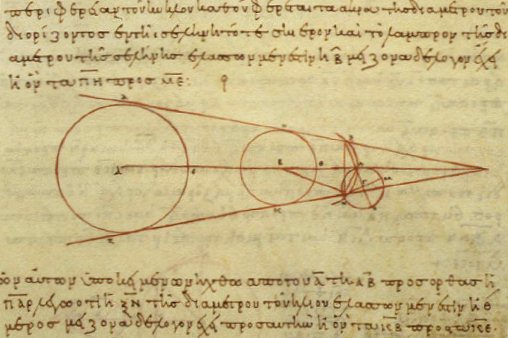
The earliest written records of identifiable predecessors to modern astronomy come from Ancient Egypt and Mesopotamia from around 3000 to 1200 BCE. Babylonian astronomers of the 7th century BCE viewed the world as a flat disk surrounded by the ocean.
Later Greek philosophers, observing the motions of the heavenly bodies, were concerned with developing models of the universe based more profoundly on empirical evidence. Some of the earliest cosmological models of the universe were developed by ancient Greek and Indian philosophers and were geocentric, placing Earth at the center. The first coherent model was proposed by Eudoxus of Cnidos, a student of Plato who followed Plato's idea that heavenly motions had to be circular. In order to account for the known complications of the planets' motions, particularly retrograde movement, Eudoxus' model included 27 different celestial spheres: four for each of the planets visible to the naked eye, three each for the Sun and the Moon, and one for the stars. All of these spheres were centered on the Earth, which remained motionless while they rotated eternally. Aristotle elaborated upon this model, increasing the number of spheres to 55 in order to account for further details of planetary motion. For Aristotle, normal matter was entirely contained within the terrestrial sphere, and it obeyed fundamentally different rules from heavenly material.
The post-Aristotle treatise De Mundo (of uncertain authorship and date) stated, "Five elements, situated in spheres in five regions, the less being in each case surrounded by the greater—namely, earth surrounded by water, water by air, air by fire, and fire by ether—make up the whole universe". This model was also refined by Callippus and after concentric spheres were abandoned, it was brought into nearly perfect agreement with astronomical observations by Ptolemy. The success of such a model is largely due to the mathematical fact that any function (such as the position of a planet) can be decomposed into a set of circular functions (the Fourier modes). Other Greek scientists, such as the Pythagorean philosopher Philolaus, postulated (according to Stobaeus' account) that at the center of the universe was a "central fire" around which the Earth, Sun, Moon and planets revolved in uniform circular motion.
The Greek astronomer Aristarchus of Samos was the first known individual to propose a heliocentric model of the universe. Though the original text has been lost, a reference in Archimedes' book The Sand Reckoner describes Aristarchus's heliocentric model. Archimedes wrote:
You, King Gelon, are aware the universe is the name given by most astronomers to the sphere the center of which is the center of the Earth, while its radius is equal to the straight line between the center of the Sun and the center of the Earth. This is the common account as you have heard from astronomers. But Aristarchus has brought out a book consisting of certain hypotheses, wherein it appears, as a consequence of the assumptions made, that the universe is many times greater than the universe just mentioned. His hypotheses are that the fixed stars and the Sun remain unmoved, that the Earth revolves about the Sun on the circumference of a circle, the Sun lying in the middle of the orbit, and that the sphere of fixed stars, situated about the same center as the Sun, is so great that the circle in which he supposes the Earth to revolve bears such a proportion to the distance of the fixed stars as the center of the sphere bears to its surface.
Aristarchus thus believed the stars to be very far away, and saw this as the reason why stellar parallax had not been observed, that is, the stars had not been observed to move relative each other as the Earth moved around the Sun. The stars are in fact much farther away than the distance that was generally assumed in ancient times, which is why stellar parallax is only detectable with precision instruments. The geocentric model, consistent with planetary parallax, was assumed to be the explanation for the unobservability of stellar parallax.
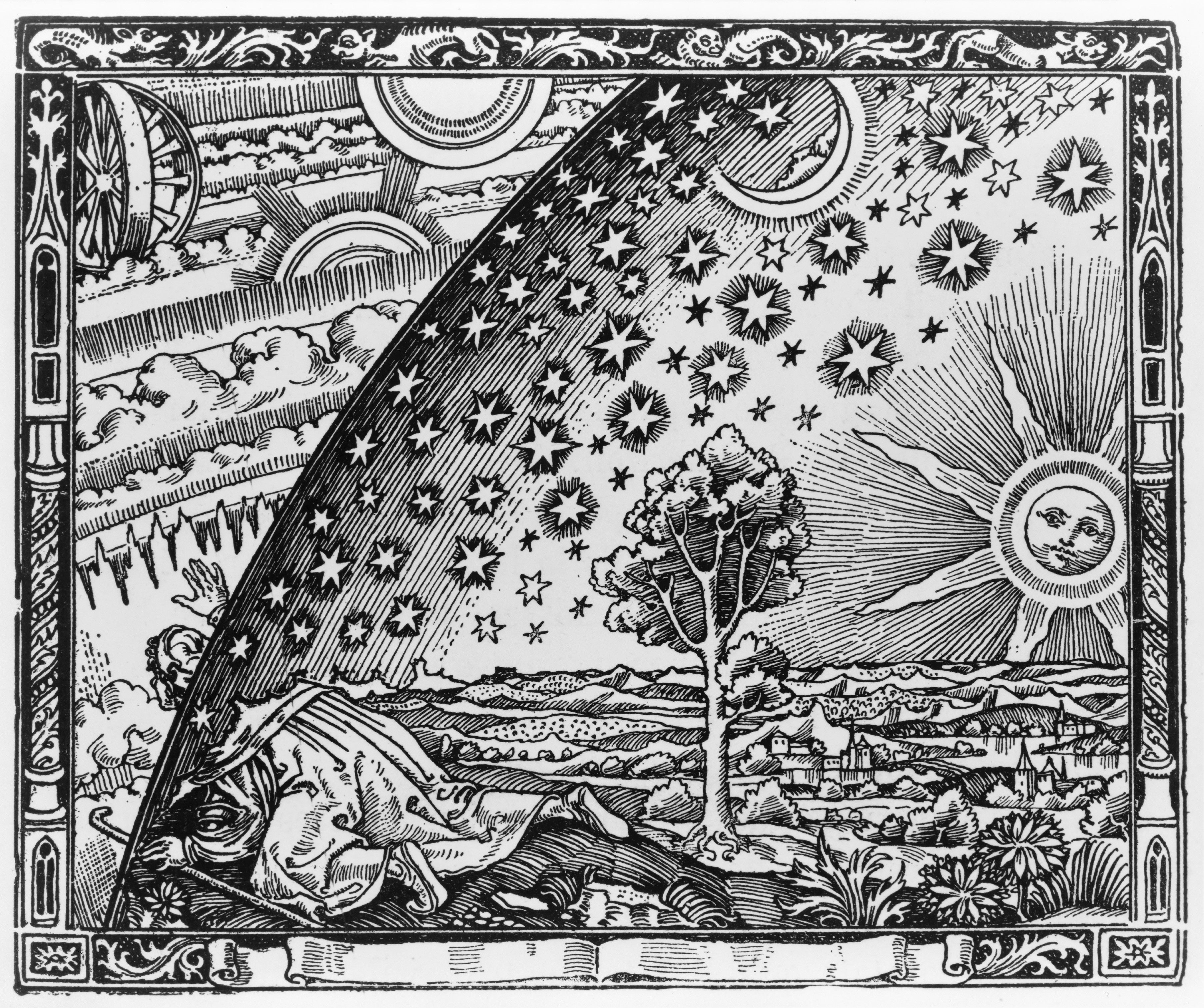
The only other astronomer from antiquity known by name who supported Aristarchus's heliocentric model was Seleucus of Seleucia, a Hellenistic astronomer who lived a century after Aristarchus. According to Plutarch, Seleucus was the first to prove the heliocentric system through reasoning, but it is not known what arguments he used. Seleucus' arguments for a heliocentric cosmology were probably related to the phenomenon of tides. According to Strabo (1.1.9), Seleucus was the first to state that the tides are due to the attraction of the Moon, and that the height of the tides depends on the Moon's position relative to the Sun. Alternatively, he may have proved heliocentricity by determining the constants of a geometric model for it, and by developing methods to compute planetary positions using this model, similar to Nicolaus Copernicus in the 16th century. During the Middle Ages, heliocentric models were also proposed by the Persian astronomers Albumasar and Al-Sijzi.
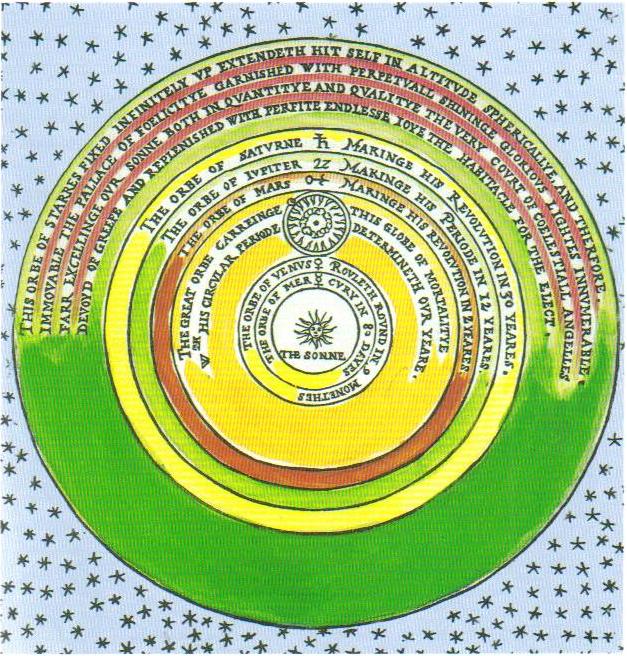
The Aristotelian model was accepted in the Western world for roughly two millennia, until Copernicus revived Aristarchus's perspective that the astronomical data could be explained more plausibly if the Earth rotated on its axis and if the Sun were placed at the center of the universe.
As noted by Copernicus, the notion that the Earth rotates is very old, dating at least to Philolaus (), Heraclides Ponticus () and Ecphantus the Pythagorean. Roughly a century before Copernicus, the Christian scholar Nicholas of Cusa also proposed that the Earth rotates on its axis in his book, On Learned Ignorance (1440). Al-Sijzi also proposed that the Earth rotates on its axis. Empirical evidence for the Earth's rotation on its axis, using the phenomenon of comets, was given by Tusi (1201–1274) and Ali Qushji (1403–1474).
This cosmology was accepted by Isaac Newton, Christiaan Huygens and later scientists. Newton demonstrated that the same laws of motion and gravity apply to earthly and to celestial matter, making Aristotle's division between the two obsolete. Edmund Halley (1720) and Jean-Philippe de Chéseaux (1744) noted independently that the assumption of an infinite space filled uniformly with stars would lead to the prediction that the nighttime sky would be as bright as the Sun itself; this became known as Olbers' paradox in the 19th century. Newton believed that an infinite space uniformly filled with matter would cause infinite forces and instabilities causing the matter to be crushed inwards under its own gravity. This instability was clarified in 1902 by the Jeans instability criterion. One solution to these paradoxes is the Charlier universe, in which the matter is arranged hierarchically (systems of orbiting bodies that are themselves orbiting in a larger system, ad infinitum) in a fractal way such that the universe has a negligibly small overall density; such a cosmological model had also been proposed earlier in 1761 by Johann Heinrich Lambert.
Deep space astronomy
During the 18th century, Immanuel Kant speculated that nebulae could be entire galaxies separate from the Milky Way, and in 1850, Alexander von Humboldt called these separate galaxies Weltinseln, or "world islands", a term that later developed into "island universes". In 1919, when the Hooker Telescope was completed, the prevailing view was that the universe consisted entirely of the Milky Way Galaxy. Using the Hooker Telescope, Edwin Hubble identified Cepheid variables in several spiral nebulae and in 1922–1923 proved conclusively that Andromeda Nebula and Triangulum among others, were entire galaxies outside our own, thus proving that the universe consists of a multitude of galaxies. With this Hubble formulated the Hubble constant, which allowed for the first time a calculation of the age of the universe and size of the Observable Universe, which became increasingly precise with better meassurements, starting at 2 billion years and 280 million light-years, until 2006 when data of the Hubble Space Telescope allowed a very accurate calculation of the age of the universe and size of the Observable Universe.
The modern era of physical cosmology began in 1917, when Albert Einstein first applied his general theory of relativity to model the structure and dynamics of the universe. The discoveries of this era, and the questions that remain unanswered, are outlined in the sections above.
References
Footnotes
Citations
Bibliography
References
- "Hubble sees galaxies galore". spacetelescope.org.
- (2009). "Extra Dimensions in Space and Time". Springer.
- NASA/WMAP Science Team. (January 24, 2014). "Universe 101: What is the Universe Made Of?". NASA.
- (2009). "The Temperature of the Cosmic Microwave Background". [[The Astrophysical Journal]].
- NASA/WMAP Science Team. (January 24, 2014). "Universe 101: Will the Universe expand forever?". NASA.
- (1998). "Introductory Astronomy & Astrophysics". Saunders College.
- (September 2020). "Planck 2018 results: VI. Cosmological parameters". Astronomy & Astrophysics.
- Greene, Brian. (2011). "The Hidden Reality". [[Alfred A. Knopf]].
- (2013). "An Introduction to Modern Astrophysics". Pearson.
- "What is Dark Matter?".
- "Planck 2015 results, table 9".
- (September 1, 1992). "The baryon content of the Universe". Monthly Notices of the Royal Astronomical Society.
- (August 3, 2011). "'Multiverse' theory suggested by microwave background". BBC News.
- (2012). "Universe".
- "Universe". Merriam-Webster Dictionary.
- "Universe". Dictionary.com.
- Schreuder, Duco A.. (2014). "Vision and Visual Perception". Archway Publishing.
- Mermin, N. David. (2004). "Could Feynman Have Said This?". Physics Today.
- Holt, Jim. (2012). "Why Does the World Exist?". Liveright Publishing.
- Ferris, Timothy. (1997). "The Whole Shebang: A State-of-the-Universe(s) Report". Simon & Schuster.
- (2004). "Creation Out of Nothing: A Biblical, Philosophical, and Scientific Exploration". Baker Academic.
- Bolonkin, Alexander. (2011). "Universe, Human Immortality and Future Human Evaluation". Elsevier.
- ''The Compact Edition of the Oxford English Dictionary'', volume II, Oxford: Oxford University Press, 1971, p. 3518. {{isbn. 978-0198611172.
- Lewis, C.T. and Short, S (1879) ''A Latin Dictionary'', Oxford University Press, {{ISBN. 0-19-864201-6, pp. 1933, 1977–1978.
- "A Greek-English Lexicon".
- "A Greek-English Lexicon".
- "A Greek–English Lexicon".
- Lewis, C.T.. (1966). "A Latin Dictionary". Clarendon Press (originally published by Oxford University Press).
- (1971). "The Compact Edition of the Oxford English Dictionary". Oxford University Press.
- Silk, Joseph. (2009). "Horizons of Cosmology". Templeton Pressr.
- Singh, Simon. (2005). "Big Bang: The Origin of the Universe". Harper Perennial.
- Sivaram. (1986). "Evolution of the Universe through the Planck epoch". Astrophysics and Space Science.
- Johnson, Jennifer A.. (February 2019). "Populating the periodic table: Nucleosynthesis of the elements". Science.
- Durrer, Ruth. (2008). "The Cosmic Microwave Background". Cambridge University Press.
- Steane, Andrew M.. (2021). "Relativity Made Relatively Easy, Volume 2: General Relativity and Cosmology". Oxford University Press.
- (March 2002). "The First Stars in the Universe". Scientific American.
- [[Barbara Ryden. Ryden, Barbara]], "Introduction to Cosmology", 2006, eqn. 6.33
- (October 28, 2003). "Antimatter". Particle Physics and Astronomy Research Council.
- Smorra C.. (October 20, 2017). "A parts-per-billion measurement of the antiproton magnetic moment". [[Nature (journal).
- (2018). "Extra Dimensions in Space and Time". Springer.
- Crane, Leah. (29 June 2024). "How big is the universe, really?". New Scientist.
- Crockett, Christopher. (February 20, 2013). "What is a light-year?". EarthSky.
- (August 1998). "The relative size of the Milky Way". The Observatory.
- Ribas. (2005). "First Determination of the Distance and Fundamental Properties of an Eclipsing Binary in the Andromeda Galaxy". Astrophysical Journal.
- Janek, Vanessa. (February 20, 2015). "How can space travel faster than the speed of light?".
- (1997). "Is faster-than-light travel or communication possible? Section: Expansion of the Universe". Philip Gibbs.
- (January 28, 2011). "Applications of Bayesian model averaging to the curvature and size of the Universe". Monthly Notices of the Royal Astronomical Society: Letters.
- Schreiber, Urs. (June 6, 2008). "Urban Myths in Contemporary Cosmology". [[University of Texas at Austin]].
- [[Don Page (physicist). (2007). "Susskind's Challenge to the Hartle-Hawking No-Boundary Proposal and Possible Resolutions". Journal of Cosmology and Astroparticle Physics.
- Planck Collaboration. (2016). "Planck 2015 results. XIII. Cosmological parameters". Astronomy & Astrophysics.
- Berardelli, Phil. (March 25, 2010). "Galaxy Collisions Give Birth to Quasars". Science News.
- Riess, Adam G.. (1998). "Observational evidence from supernovae for an accelerating universe and a cosmological constant". Astronomical Journal.
- Perlmutter, S.. (1999). "Measurements of Omega and Lambda from 42 high redshift supernovae". Astrophysical Journal.
- (2004). "Modern Physics". Cengage Learning.
- (2022). "Astronomy 2e". OpenStax.
- "The Nobel Prize in Physics 2011".
- Overbye, Dennis. (October 11, 2003). "A 'Cosmic Jerk' That Reversed the Universe". New York Times.
- Mermin, N. David. (2021). "It's About Time: Understanding Einstein's Relativity". Princeton University Press.
- (2006). "Spacetime and Euclidean geometry". General Relativity and Gravitation.
- Wheeler, John Archibald. (2010). "Geons, Black Holes, and Quantum Foam: A Life in Physics". W. W. Norton & Company.
- Kersting, Magdalena. (May 2019). "Free fall in curved spacetime – how to visualise gravity in general relativity". [[Physics Education]].
- Hawking, Stephen. (1988). "A Brief History of Time". Bantam.
- (2002). "Classical Mechanics". Addison Wesley.
- Goodstein, Judith R.. (2018). "Einstein's Italian Mathematicians: Ricci, Levi-Civita, and the Birth of General Relativity". American Mathematical Society.
- Choquet-Bruhat, Yvonne. (2009). "General Relativity and the Einstein Equations". Oxford University Press.
- Prescod-Weinstein, Chanda. (2021). "The Disordered Cosmos: A Journey into Dark Matter, Spacetime, and Dreams Deferred". Bold Type Books.
- "What is the Ultimate Fate of the Universe?". National Aeronautics and Space Administration.
- "WMAP – Shape of the Universe".
- (2008). "A test of the Poincare dodecahedral space topology hypothesis with the WMAP CMB data". Astronomy and Astrophysics.
- Aurich, Ralf. (2004). "Hyperbolic Universes with a Horned Topology and the CMB Anisotropy". Classical and Quantum Gravity.
- Planck Collaboration. (2014). "Planck 2013 results. XVI. Cosmological parameters". Astronomy & Astrophysics.
- (2005). "CI301: The Anthropic Principle". [[TalkOrigins Archive]].
- Fritzsche, Hellmut. "electromagnetic radiation {{!}} physics".
- "Physics 7:Relativity, SpaceTime and Cosmology". University of California Riverside.
- "Physics – for the 21st Century". Harvard-Smithsonian Center for Astrophysics Annenberg Learner.
- (2015). "Dark matter – A history shapes by dark force". National Geographic.
- Redd, SPACE.com, Nola Taylor. "It's Official: The Universe Is Dying Slowly".
- Parr, Will. "RIP Universe – Your Time Is Coming… Slowly {{!}} Video". Space.com.
- (March 21, 2013). "First Planck results: the universe is still weird and interesting". Ars technica.
- Peebles. (2003). "The cosmological constant and dark energy". Reviews of Modern Physics.
- (1986). "Large-scale homogeneity of the universe measured by the microwave background". Nature.
- Gunn, Alistair. (November 29, 2023). "How many galaxies are there in the universe? – Do astronomers know how many galaxies exist? How many can we see in the observable Universe?". [[BBC Sky at Night]].
- "New Horizons spacecraft answers the question: How dark is space?".
- (March 20, 2018). "How Many Galaxies Are There?".
- Staff. (2019). "How Many Stars Are There In The Universe?". [[European Space Agency]].
- (2015). "The Fundamentals of Modern Astrophysics".
- Mackie, Glen. (February 1, 2002). "To see the Universe in a Grain of Taranaki Sand". [[Centre for Astrophysics and Supercomputing]].
- Mack, Eric. (March 19, 2015). "There may be more Earth-like planets than grains of sand on all our beaches – New research contends that the Milky Way alone is flush with billions of potentially habitable planets – and that's just one sliver of the universe.". [[CNET]].
- (March 13, 2015). "Using the inclinations of Kepler systems to prioritize new Titius–Bode-based exoplanet predictions". [[Monthly Notices of the Royal Astronomical Society]].
- Baker, Harry. (July 11, 2021). "How many atoms are in the observable universe?". [[Live Science]].
- Totani, Tomonori. (February 3, 2020). "Emergence of life in an inflationary universe". [[Scientific Reports]].
- (May 3, 2000). "Unveiling the Secret of a Virgo Dwarf Galaxy". ESO.
- (February 28, 2006). "Hubble's Largest Galaxy Portrait Offers a New High-Definition View". NASA.
- (September 3, 2014). "Earth's new address: 'Solar System, Milky Way, Laniakea'". Nature.
- (May 4, 2009). "Local Group". Universe Today.
- (April 20, 2015). "Astronomers discover largest known structure in the universe is ... a big hole". The Guardian.
- "Content of the Universe – WMAP 9yr Pie Chart".
- {{harvnb. Rindler. 1986
- Liddle, Andrew. (2003). "An Introduction to Modern Cosmology". John Wiley & Sons.
- Livio, Mario. (2001). "The Accelerating Universe: Infinite Expansion, the Cosmological Constant, and the Beauty of the Cosmos". John Wiley and Sons.
- (2003). "The cosmological constant and dark energy". Reviews of Modern Physics.
- (2006). "Why the cosmological constant is small and positive". Science.
- "Dark Energy". Hyperphysics.
- Carroll, Sean. (2001). "The cosmological constant". Living Reviews in Relativity.
- Sean Carroll, Ph.D., Caltech, 2007, The Teaching Company, ''Dark Matter, Dark Energy: The Dark Side of the Universe'', Guidebook Part 2. p. 46, Accessed October 7, 2013, "...dark matter: An invisible, essentially collisionless component of matter that makes up about 25 percent of the energy density of the universe... it's a different kind of particle... something not yet observed in the laboratory..."
- (March 21, 2013). "Planck captures portrait of the young universe, revealing earliest light". University of Cambridge.
- Lineweaver, Charles H.. (October 1, 2023). "All objects and some questions". American Journal of Physics.
- Davies. (1992). "The New Physics: A Synthesis". [[Cambridge University Press]].
- (November 1, 2012). "The Baryon Census in a Multiphase Intergalactic Medium: 30% of the Baryons May Still Be Missing". The Astrophysical Journal.
- (May 28, 2020). "A census of baryons in the Universe from localized fast radio bursts". Nature.
- (2019). "Chemistry 2e". OpenStax.
- "The Nobel Prize in Physics 2001".
- (2011). "Advances In Atomic Physics: An Overview". World Scientific.
- 't Hooft. (1997). "In search of the ultimate building blocks". [[Cambridge University Press]].
- (2022). "College Physics 2e". OpenStax.
- (1983). "Principles of Stellar Evolution and Nucleosynthesis". The University of Chicago Press.
- Veltman, Martinus. (2003). "Facts and Mysteries in Elementary Particle Physics". World Scientific.
- Mann, Adam. (August 20, 2022). "What Are Elementary Particles?".
- Zwiebach, Barton. (2022). "Mastering Quantum Mechanics: Essentials, Theory, and Applications". MIT Press.
- Oerter. (2006). "The Theory of Almost Everything: The Standard Model, the Unsung Triumph of Modern Physics". [[Penguin Group]].
- Weinberg, Steven. (2011). "Dreams of a Final Theory: The Scientist's Search for the Ultimate Laws of Nature". Knopf Doubleday Publishing Group.
- (2002). "Quarks, Leptons and the Big Bang". IOP Publishing.
- "Thermal history of the universe and early growth of density fluctuations". [[Max Planck Institute for Astrophysics]].
- "First few minutes". Harvard Smithsonian Center for Astrophysics.
- "Timeline of the Big Bang". The physics of the Universe.
- Dick, Steven J.. (2020). "Space, Time, and Aliens". Springer International Publishing.
- {{harvtxt. Raine. Thomas. 2001
- (1998). "Introductory Astronomy & Astrophysics". Saunders College Publishing.
- Friedmann. (1922). "Über die Krümmung des Raumes". Zeitschrift für Physik.
- {{harvtxt. Raine. Thomas. 2001
- {{harvtxt. Raine. Thomas. 2001
- {{harvtxt. Raine. Thomas. 2001
- {{harvtxt. Raine. Thomas. 2001
- {{harvtxt. Raine. Thomas. 2001
- Munitz. (1959). "One Universe or Many?". Journal of the History of Ideas.
- Linde. (1986). "Eternal chaotic inflation". Mod. Phys. Lett. A.
- (1957). "Relative State Formulation of Quantum Mechanics". Reviews of Modern Physics.
- Ball, Philip. (February 17, 2015). "Too many worlds".
- Peres, Asher. (1995). "[[Quantum Theory: Concepts and Methods]]". Kluwer Academic Publishers.
- Kent, Adrian. (February 2015). "Does it Make Sense to Speak of Self-Locating Uncertainty in the Universal Wave Function? Remarks on Sebens and Carroll". Foundations of Physics.
- (August 1, 2013). "A snapshot of foundational attitudes toward quantum mechanics". Studies in History and Philosophy of Science Part B: Studies in History and Philosophy of Modern Physics.
- Mermin, N. David. (July 1, 2012). "Commentary: Quantum mechanics: Fixing the shifty split". [[Physics Today]].
- Cabello, Adán. (2017). "What is Quantum Information?". Cambridge University Press.
- (2007). "Many Worlds in One". Physical Review D.
- Tegmark. (2003). "Parallel universes. Not just a staple of science fiction, other universes are a direct implication of cosmological observations". Scientific American.
- Tegmark, Max. (2003). "Parallel Universes". Scientific American.
- (2013). "About the Infinite Repetition of Histories in Space". Theoria: An International Journal for Theory, History and Foundations of Science.
- Ellis. (2011). "Does the Multiverse Really Exist?". Scientific American.
- Moskowitz, Clara. (August 12, 2011). "Weird! Our Universe May Be a 'Multiverse,' Scientists Say". livescience.
- (2004). "Multiverses and physical cosmology". [[Monthly Notices of the Royal Astronomical Society]].
- Gernet, J.. (1993–1994). "Space and time: Science and religion in the encounter between China and Europe". Chinese Science.
- Blandford R. D.. (2015). "A century of general relativity: Astrophysics and cosmology". Science.
- Leeming, David A.. (2010). "Creation Myths of the World". ABC-CLIO.
- (1975). "Myth and Reality (Religious Traditions of the World)". Harper & Row (originally published by Allen & Unwin).
- (2004). "Myth and Knowing: An Introduction to World Mythology". McGraw-Hill.
- ([[Henry Gravrand]], "La civilisation Sereer -Pangool") [in] [[Universität Frankfurt am Main]], Frobenius-Institut, Deutsche Gesellschaft für Kulturmorphologie, Frobenius Gesellschaft, "Paideuma: Mitteilungen zur Kulturkunde, Volumes 43–44", F. Steiner (1997), pp. 144–145, {{ISBN. 3-515-02842-0
- Graham, Daniel W.. (September 3, 2019). "Heraclitus".
- Palmer, John. (October 19, 2020). "Parmenides".
- Palmer, John. (April 8, 2021). "Zeno of Elea".
- Dowden, Bradley. "Zeno's Paradoxes".
- [[Will Durant]], ''Our Oriental Heritage'': {{blockquote. "Two systems of Hindu thought propound physical theories suggestively similar to those of [[Ancient Greece. Greece]]. Kanada, founder of the Vaisheshika philosophy, held that the world is composed of atoms as many in kind as the various elements. The [[Jainism. Jains]] more nearly approximated to [[Democritus]] by teaching that all atoms were of the same kind, producing different effects by diverse modes of combinations. Kanada believed light and heat to be varieties of the same substance; [[Udayana]] taught that all heat comes from the Sun; and [[Vācaspati Miśra. Vachaspati]], like [[Isaac Newton. Newton]], interpreted light as composed of minute particles emitted by substances and striking the eye."
- Stcherbatsky, F. Th. (1930, 1962), ''Buddhist Logic'', Volume 1, p. 19, Dover, New York: {{blockquote. "The Buddhists denied the existence of substantial matter altogether. Movement consists for them of moments, it is a staccato movement, momentary flashes of a stream of energy... "Everything is evanescent",... says the Buddhist, because there is no stuff... Both systems [[[Samkhya. Sānkhya]], and later Indian Buddhism] share in common a tendency to push the analysis of existence up to its minutest, last elements which are imagined as absolute qualities, or things possessing only one unique quality. They are called "qualities" (''guna-dharma'') in both systems in the sense of absolute qualities, a kind of atomic, or intra-atomic, energies of which the empirical things are composed. Both systems, therefore, agree in denying the objective reality of the categories of Substance and Quality,... and of the relation of Inference uniting them. There is in Sānkhya philosophy no separate existence of qualities. What we call quality is but a particular manifestation of a subtle entity. To every new unit of quality corresponds a subtle quantum of matter which is called ''guna'', "quality", but represents a subtle substantive entity. The same applies to early Buddhism where all qualities are substantive... or, more precisely, dynamic entities, although they are also called ''dharmas'' ('qualities')."
- Viney. (1985). "Charles Hartshorne and the Existence of God". SUNY Press.
- (1998). "The New Oxford Dictionary Of English". Clarendon Press.
- (1967). "Encyclopedia of Philosophy". Macmillan.
- (1967). "Encyclopedia of Philosophy ed. Paul Edwards". Macmillan and Free Press.
- Reid-Bowen, Paul. (April 15, 2016). "Goddess as Nature: Towards a Philosophical Thealogy". [[Taylor & Francis]].
- Lindberg, David C.. (2007). "The beginnings of Western science: the European Scientific tradition in philosophical, religious, and institutional context". University of Chicago Press.
- Grant, Edward. (2007). "A History of Natural Philosophy: From the Ancient World to the Nineteenth Century". Cambridge University Press.
- Horowitz, Wayne. (1988). "The Babylonian Map of the World". Iraq.
- (1997). "The Symbolism of the Biblical World". Eisenbrauns.
- Dold-Samplonius, Yvonne. (2002). "From China to Paris: 2000 Years Transmission of Mathematical Ideas". Franz Steiner Verlag.
- (2005). "Medieval Science Technology and Medicine: An Encyclopedia". Routledge.
- Wright, Larry. (August 1973). "The astronomy of Eudoxus: Geometry or physics?". Studies in History and Philosophy of Science.
- Dicati, Renato. (2013). "The Ancients' Astronomy". Springer Milan.
- Aristotle. (1914). "De Mundo". The Clarendon Press.
- Goldstein, Bernard R.. (1997). "Saving the phenomena: the background to Ptolemy's planetary theory". Journal for the History of Astronomy.
- Boyer, C. (1968) [https://archive.org/details/AHistoryOfMathematics ''A History of Mathematics'']. Wiley, p. 54.
- Heath, Thomas. (2013). "Aristarchus of Samos, the Ancient Copernicus: A History of Greek Astronomy to Aristarchus, Together with Aristarchus's Treatise on the Sizes and Distances of the Sun and Moon". Cambridge University Press.
- Kolkata, James J.. (2015). "Elementary Cosmology: From Aristotle's Universe to the Big Bang and Beyond". IOP Publishing.
- Neugebauer, Otto E.. (1945). "The History of Ancient Astronomy Problems and Methods". Journal of Near Eastern Studies.
- Sarton. (1955). "Chaldaean Astronomy of the Last Three Centuries B. C.". Journal of the American Oriental Society.
- William P. D. Wightman (1951, 1953), ''The Growth of Scientific Ideas'', Yale University Press. p. 38, where Wightman calls him [[Seleucus of Seleucia. Seleukos]] the [[Chaldea]]n.
- [[Lucio Russo]], ''Flussi e riflussi'', Feltrinelli, Milano, Italy, 2003, {{ISBN. 88-07-10349-4.
- {{harvtxt. Van Der Waerden. 1987
- {{harvtxt. Van Der Waerden. 1987
- {{harvtxt. Van Der Waerden. 1987
- Nasr, Seyyed H.. (1993). "An Introduction to Islamic Cosmological Doctrines". 1st edition by [[Harvard University Press]], 2nd edition by [[State University of New York Press]].
- (2007). "The Mechanical Universe: Mechanics and Heat". Cambridge University Press.
- [[#Misner. Misner, Thorne and Wheeler]], p. 754.
- Ālī, Ema Ākabara. "Science in the Quran". Malik Library.
- Ragep, F. Jamil. (2001). "Tusi and Copernicus: The Earth's Motion in Context". Science in Context.
- [[#Misner. Misner, Thorne and Wheeler]], pp. 755–756.
- [[#Misner. Misner, Thorne and Wheeler]], p. 756.
- de Cheseaux JPL. (1744). "Traité de la Comète". Lausanne.
- Olbers HWM. (1826). "Unknown title". M.I.T. Press.
- (1902). "The Stability of a Spherical Nebula". [[Philosophical Transactions of the Royal Society A]].
- {{harvnb. Rindler. 1986
- [[#Misner. Misner, Thorne and Wheeler]], p. 757.
- Jones, Kenneth Glyn. (February 1971). "The Observational Basis for Kant's Cosmogony: A Critical Analysis". Journal for the History of Astronomy.
- Smith, Robert W.. (February 2008). "Beyond the Galaxy: The Development of Extragalactic Astronomy 1885–1965, Part 1". Journal for the History of Astronomy.
- (1993). "Edwin Hubble, the discoverer of the big bang universe". Cambridge University Press.
- (December 8, 2017). "Cosmic Times".
- Einstein, Albert. (1917). "Kosmologische Betrachtungen zur allgemeinen Relativitätstheorie". Preussische Akademie der Wissenschaften, Sitzungsberichte.
This article was imported from Wikipedia and is available under the Creative Commons Attribution-ShareAlike 4.0 License. Content has been adapted to SurfDoc format. Original contributors can be found on the article history page.
Ask Mako anything about Universe — get instant answers, deeper analysis, and related topics.
Research with MakoFree with your Surf account
Create a free account to save articles, ask Mako questions, and organize your research.
Sign up freeThis content may have been generated or modified by AI. CloudSurf Software LLC is not responsible for the accuracy, completeness, or reliability of AI-generated content. Always verify important information from primary sources.
Report