From Surf Wiki (app.surf) — the open knowledge base
Units of information
Unit of measure for digital data
Unit of measure for digital data
A unit of information is any unit of measure of digital data size. In digital computing, a unit of information is used to describe the capacity of a digital data storage device. In telecommunications, a unit of information is used to describe the throughput of a communication channel. In information theory, a unit of information is used to measure information contained in messages and the entropy of random variables.
Due to the need to work with data sizes that range from small to large, units of information cover a wide range of data sizes. Units are defined as multiples of a smaller unit except for the smallest unit which is based on convention and hardware design. Multiplier prefixes are used to describe relatively large sizes.
For binary hardware, the most common hardware today, the smallest unit is the bit, which represents a value that is one of two possibilities, typically shown as 0 and 1. The nibble, 4 bits, represents the value of a single hexadecimal digit. The byte (8 bits, 2 nibbles) is possibly the most commonly known and used base unit to describe data size. The word is a size that varies by and has a special importance for a particular hardware context. On modern hardware, a word is typically 2, 4 or 8 bytes, but the size varies dramatically on older hardware. Larger sizes can be expressed as multiples of a base unit via SI metric prefixes (powers of ten) or the newer and generally more accurate IEC binary prefixes (powers of two).
Information theory
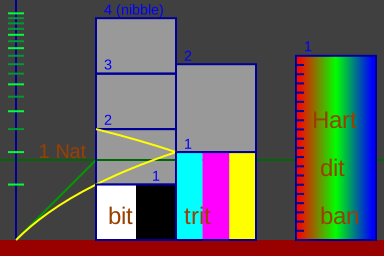
In 1928, Ralph Hartley observed a fundamental storage principle, which was further formalized by Claude Shannon in 1945: the information that can be stored in a system is proportional to the logarithm of N possible states of that system, denoted logb N. Changing the base of the logarithm from b to a different number c has the effect of multiplying the value of the logarithm by a fixed constant, namely . Therefore, the choice of the base b determines the unit used to measure information. In particular, if b is a positive integer, then the unit is the amount of information that can be stored in a system with b possible states.
When b is 2, the unit is the shannon, equal to the information content of one "bit". A system with 8 possible states, for example, can store up to bits of information. Other units that have been named include: ; Base b = 3 : the unit is called "trit", and is equal to log2 3 (≈ 1.585) bits. ; Base b = 10 : the unit is called decimal digit, hartley, ban, decit, or dit, and is equal to log2 10 (≈ 3.322) bits. ; Base b = e, the base of natural logarithms : the unit is called a nat, nit, or nepit (from Neperian), and is worth log2 e (≈ 1.443) bits. The trit, ban, and nat are rarely used to measure storage capacity. But the nat, in particular, is often used in information theory, because natural logarithms are mathematically more convenient than logarithms in other bases.
Units derived from bit
Several conventional names are used for collections or groups of bits.
Byte
Historically, a byte was the number of bits used to encode a character of text in the computer, which depended on computer hardware architecture, but today it almost always means eight bits – that is, an octet. An 8-bit byte can represent 256 distinct values, such as non-negative integers from 0 to 255, or signed integers from −128 to 127. The IEEE 1541-2002 standard specifies "B" (upper case) as the symbol for byte (IEC 80000-13 uses "o" for octet in French, but also allows "B" in English). Bytes, or multiples thereof, are almost always used to specify the sizes of computer files and the capacity of storage units. Most modern computers and peripheral devices are designed to manipulate data in whole bytes or groups of bytes, rather than individual bits.
Nibble
A group of four bits, or half a byte, is sometimes called a nibble, nybble or nyble. This unit is most often used in the context of hexadecimal number representations, since a nibble has the same number of possible values as one hexadecimal digit has.
Word, block, and page
Computers usually manipulate bits in groups of a fixed size, conventionally called words. The number of bits in a word is usually defined by the size of the registers in the computer's CPU, or by the number of data bits that are fetched from its main memory in a single operation. In the IA-32 architecture more commonly known as x86-32, a word is 32 bits, but other past and current architectures use words with 4, 8, 9, 12, 13, 16, 18, 20, 21, 22, 24, 25, 29, 30, 31, 32, 33, 35, 36, 38, 39, 40, 42, 44, 48, 50, 52, 54, 56, 60, 64, 72 bits or others.
Some machine instructions and computer number formats use two words (a "double word" or "dword"), or four words (a "quad word" or "quad").
Computer memory caches usually operate on blocks of memory that consist of several consecutive words. These units are customarily called cache blocks, or, in CPU caches, cache lines.
Virtual memory systems partition the computer's main storage into even larger units, traditionally called pages.
Multiplicative prefixes
A unit for a large amount of data can be formed using either a metric or binary prefix with a base unit. For storage, the base unit is typically a byte. For communication throughput, a base unit of bit is common. For example, using the metric kilo prefix, a kilobyte is 1000 bytes and a kilobit is 1000 bits.
Use of metric prefixes is common. In the context of computing, some of these prefixes (primarily kilo, mega and giga) are used to refer to the nearest power of two. For example, 'kilobyte' often refers to 1024 bytes even though the standard meaning of kilo is 1000.
| Symbol | Prefix | Multiple |
|---|---|---|
| k | kilo | 1000 |
| M | mega | 10002 |
| G | giga | 10003 |
| T | tera | 10004 |
| P | peta | 10005 |
| E | exa | 10006 |
| Z | zetta | 10007 |
| Y | yotta | 10008 |
| R | ronna | 10009 |
| Q | quetta | 100010 |
The International Electrotechnical Commission (IEC) standardized binary prefixes for binary multiples to avoid ambiguity through their similarity to the standard metric terms. These are based on powers of 1024, which is a power of 2.
| Symbol | Prefix | Multiple | Example |
|---|---|---|---|
| Ki | kibi | 210, 1024 | kibibyte (KiB) |
| Mi | mebi | 220, 10242 | mebibyte (MiB) |
| Gi | gibi | 230, 10243 | gibibyte (GiB) |
| Ti | tebi | 240, 10244 | tebibyte (TiB) |
| Pi | pebi | 250, 10245 | pebibyte (PiB) |
| Ei | exbi | 260, 10246 | exbibyte (EiB) |
| Zi | zebi | 270, 10247 | zebibyte (ZiB) |
| Yi | yobi | 280, 10248 | yobibyte (YiB) |
| Ri | robi | 290, 10249 | robibyte (RiB) |
| Qi | quebi | 2100, 102410 | quebibyte (QiB) |
The JEDEC memory standard JESD88F notes that its inclusion of the definitions of kilo (K), mega (M) and giga (G) based on powers of two are included only to reflect common usage, but that these are otherwise deprecated.
Size examples
- 1 bit: Answer to a yes/no question
- 1 byte: A number from 0 to 255
- 90 bytes: Enough to store a typical line of text from a book
- 512 bytes = 0.5 KiB: The typical sector size of an old style hard disk drive (modern Advanced Format sectors are 4096 bytes).
- 1024 bytes = 1 KiB: A block size in some older UNIX filesystems
- 2048 bytes = 2 KiB: A CD-ROM sector
- 4096 bytes = 4 KiB: A memory page in x86 (since Intel 80386) and many other architectures, also the modern Advanced Format hard disk drive sector size.
- 4 kB: About one page of text from a novel
- 120 kB: The text of a typical pocket book
- 1 MiB: A 1024×1024 pixel bitmap image with 256 colors (8 bpp color depth)
- 3 MB: A three-minute song (133 kbit/s)
- 650–900 MB – a CD-ROM
- 1 GB: 114 minutes of uncompressed CD-quality audio at 1.4 Mbit/s
- 16 GB: DDR5 DRAM laptop memory under $40 (as of early 2024)
- 32/64/128 GB: Three common sizes of USB flash drives
- 1 TB: The size of a $30 hard disk (as of early 2024)
- 6 TB: The size of a $100 hard disk (as of early 2022)
- 16 TB: The size of a small/cheap $130 (as of early 2024) enterprise SAS hard disk drive
- 24 TB: The size of $440 (as of early 2024) "video" hard disk drive
- 32 TB: Largest hard disk drive (as of mid-2024)
- 100 TB: Largest commercially available solid-state drive (as of mid-2024)
- 200 TB: Largest solid-state drive constructed (prediction for mid-2022)
- 1.6 PB (1600 TB): Amount of possible storage in one 2U server (world record as of 2021, using 100 TB solid-states drives). [As of 2024] As the world’s highest capacity and highest density SSD, ExaDrive offers capacity, energy efficiency, and endurance, thanks to patent-pending architecture. It is available in capacities ranging from 16TB to 100TB, using either SATA or dual-port SAS interfaces, with both TLC and QLC flash models."--
- 1.3 ZB: Prediction of the volume of the whole internet in 2016
Obsolete and unusual units
- READ THIS** This section is intended for unit names that are unusual AND not already included elsewhere in this article AND actually used in serious (!) literature supported by reliable references. Do not include unit names that are intended solely for humor or do not have a reliable reference. --
Some notable unit names that are today obsolete or only used in limited contexts.
-
1 bit: unibit
-
2 bits: dibit, crumb, quartic digit, quad, semi-nibble, nyp
-
3 bits: tribit, triad, triade
-
4 bits: see nibble
-
5 bits: pentad, pentade,
-
6 bits: byte (in early IBM machines using BCD alphamerics), hexad, hexade, sextet
-
7 bits: heptad, heptade
-
8 bits: octad, octade
-
9 bits: nonet, rarely used
-
10 bits: declet, decle
-
12 bits: slab
-
15 bits: parcel (on CDC 6600 and CDC 7600)
-
16 bits: doublet, wyde, parcel (on Cray-1), chawmp (on a 32-bit machine)
-
18 bits: chomp, chawmp (on a 36-bit machine)
-
32 bits: quadlet, tetra
-
64 bits: octlet, octa
-
96 bits: bentobox (in ITRON OS)
-
128 bits: hexlet, paragraph (on Intel x86 processors)
-
256 bytes: page (on Intel 4004, 8080 and 8086 processors, also many other 8-bit processors – typically much larger on many 16-bit/32-bit processors)
-
6 trits: tryte
-
combit, comword
References
Citations
References
- (2010-01-13). "Metric (SI) Prefixes".
- Maleval, Jean Jacques. (2021-02-12). "Nimbus Data SSDs Certified for Use With Dell EMC PowerEdge Servers".
- (1969-01-01). "British Commercial Computer Digest: Pergamon Computer Data Series". [[Pergamon Press]].
- (1971). "Philips – Philips Data Systems' product range – April 1971". [[Philips]].
- (1996). "The New Hacker's Dictionary". MIT Press.
- (1963). "Information theory and coding". [[McGraw-Hill]].
- "The Art of Computer Programming: Seminumerical algorithms". [[Addison Wesley]].
- Shanmugam. (2006). "Digital and Analog Computer Systems".
- (2007). "Quantum information: an overview".
- (2001). "Comprehensive Statistical Theory of Communication".
- (2017-08-22). "The Mathematical-Function Computation Handbook – Programming Using the MathCW Portable Software Library". [[Springer International Publishing AG]].
- (February 2025). "Quantities and units – Part 13: Information science and technology".
- (February 2018). "Dictionary of Terms for Solid State Technology – 7th Edition". JEDEC Solid State Technology Association.
- [http://dictionary.reference.com/browse/nybble ''Nybble''] at dictionary reference.com; sourced from Jargon File 4.2.0, accessed 2007-08-12
- "Unibit".
- (1967). "Taschenbuch der Nachrichtenverarbeitung". [[Springer-Verlag OHG]].
- (1974). "Taschenbuch der Informatik – Band III – Anwendungen und spezielle Systeme der Nachrichtenverarbeitung".
- (2007). "Webster's New World Telecom Dictionary". [[John Wiley & Sons]].
- (1994). "Theory of magnetic recording". [[Cambridge University Press]].
- "Crumb". [[MathWorld]].
- (2013). "Elektrotechnik und Elektronik für Informatiker – Grundgebiete der Elektronik". [[B.G. Teubner]] Stuttgart / [[Springer Verlag.
- (2013-07-02). "Programmierung von Prozeßrechnern". {{ill.
- (1965). "Digitale Rechenanlagen – Grundlagen / Schaltungstechnik / Arbeitsweise / Betriebssicherheit". [[Springer-Verlag]] / [[IBM]].
- (1962). "Taschenbuch der Nachrichtenverarbeitung". [[Springer-Verlag OHG]].
- (2016). "Advanced Logical Circuit Design Techniques". [[Garland STPM Press]] (original issue) / WhitePubs Enterprises, Inc. (reissue).
- (April 1, 2005). "UTF-9 and UTF-18 Efficient Transformation Formats of Unicode".
- "IEEE Standard for Floating-Point Arithmetic".
- (2010). "Handbook of Floating-Point Arithmetic". [[Birkhäuser]].
- (2008-11-21). "Algorithms and Hardware Designs for Decimal Multiplication".
- (2015). "Numbers and Computers". [[Springer Verlag]].
- "AS1600 Quick-and-Dirty Documentation".
- (November 1965). "315 Electronic Data Processing System". [[NCR Corporation.
- (1963). "NCR 315 Seminar". Computer Usage Communique.
- (2013). "Datenverarbeitungs-Lexikon". [[Springer Fachmedien Wiesbaden GmbH]] / [[Betriebswirtschaftlicher Verlag Dr. Th. Gabler GmbH]].
- (1995). "IEEE Standard for a 32-bit Microprocessor Architecture }} (NB. The standard defines doublets, quadlets, octlets and hexlets as 2, 4, 8 and 16 [[byte]]s, giving the numbers of [[bit]]s (16, 32, 64 and 128) only as a secondary meaning. This might be important given that bytes were not always understood to mean 8 bits ([[octet (computing)".
- (2004-02-15). [[Addison-Wesley]]. link
- (1986). "Calculatrices". Presses polytechniques romandes.
- (1993). "Proceedings". [[USENIX Association]].
- (May 1982). "8086 Family Utilities – User's Guide for 8080/8085-Based Development Systems". [[Intel Corporation]].
- (December 1973). "MCS-4 Assembly Language Programming Manual – The INTELLEC 4 Microcomputer System Programming Manual". [[Intel Corporation]].
- "Development of ternary computers at Moscow State University".
- "Three-state signaling system".
- "US4319227". Google.
- "US4319227". Patentimages.
- (1990). "Microprocessors – A Programmer's View". [[McGraw-Hill Publishing Company]].
- (1964). "Control Data 8092 TeleProgrammer: Programming Reference Manual". [[Control Data Corporation]].
- "The Art of Computer Programming: Cobinatorial Algorithms part 1". [[Addison Wesley]].
This article was imported from Wikipedia and is available under the Creative Commons Attribution-ShareAlike 4.0 License. Content has been adapted to SurfDoc format. Original contributors can be found on the article history page.
Ask Mako anything about Units of information — get instant answers, deeper analysis, and related topics.
Research with MakoFree with your Surf account
Create a free account to save articles, ask Mako questions, and organize your research.
Sign up freeThis content may have been generated or modified by AI. CloudSurf Software LLC is not responsible for the accuracy, completeness, or reliability of AI-generated content. Always verify important information from primary sources.
Report