From Surf Wiki (app.surf) — the open knowledge base
United States Senate Committee on Appropriations
Standing committee of the United States Senate
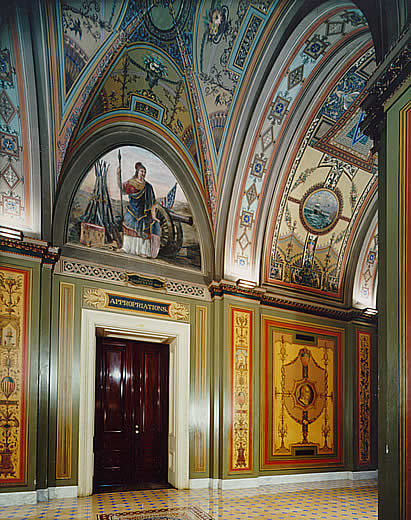
Standing committee of the United States Senate
| Field | Value |
|---|---|
| name | Senate Appropriations Committee |
| type | standing |
| chamber | senate |
| congress | 119th |
| status | active |
| formed | March 6, 1867 |
| chair | Susan Collins |
| chair_party | R |
| chair_since | January 3, 2025 |
| vice_chair | Patty Murray |
| vc_party | D |
| vc_since | January 3, 2025 |
| seats | 29 members |
| majority1 | R |
| majority1_seats | 15 |
| minority1 | D |
| minority1_seats | 14 |
| policy_areas | Appropriations bills, Discretionary spending, Rescission bills |
| oversight | Federal government of the United States |
| counterpart | House Committee on Appropriations |
| subcommittees | |
| meeting_place | 304 Dirksen Senate Office Building |
| Washington, D.C., S-128 United States Capitol | |
| Washington, D.C. | |
| website |
Washington, D.C., S-128 United States Capitol Washington, D.C. The United States Senate Committee on Appropriations, informally known as the Senate Appropriations Committee, is a standing committee of the United States Senate. It has jurisdiction over all discretionary spending legislation in the Senate.
The Senate Appropriations Committee is the largest committee in the U.S. Senate, with 30 members in the 117th Congress. Its role is defined by the U.S. Constitution, which requires "appropriations made by law" prior to the expenditure of any money from the Treasury, and the committee is therefore one of the most powerful committees in the Senate. The committee was first organized on March 6, 1867, when power over appropriations was taken out of the hands of the Finance Committee.
The chair of the Appropriations Committee has enormous power to bring home special projects (sometimes referred to as "pork barrel spending") for their state as well as having the final say on other senators' appropriation requests. For example, in fiscal year 2005, per capita federal spending in Alaska, the home state of Chair Ted Stevens, was $12,000, double the national average. Alaska has 11,772 special earmarked projects for a combined cost of $15,780,623,000. This represents about four percent of the overall spending in the $388 billion Consolidated Appropriations Act of 2005 passed by Congress.
From 2001 to 2021, every Senate Majority Leader was a previous or concurrently serving member of the Appropriations Committee: Tom Daschle (committee member, 1991–1999; majority leader, 2001–2003), Bill Frist (committee member, 1995–2002; majority leader, 2003–2007), Harry Reid (committee member, 1989–2006; majority leader, 2007–2015), and Mitch McConnell (current committee member; majority leader, 2015–2021).
Appropriations process


The federal budget is divided into two main categories: discretionary spending and mandatory spending. Each appropriations subcommittee develops a draft appropriations bill covering each agency under its jurisdiction based on the Congressional Budget Resolution, which is drafted by an analogous Senate Budget committee. Each subcommittee must adhere to the spending limits set by the budget resolution and allocations set by the full Appropriations Committee, though the full Senate may vote to waive those limits if 60 senators vote to do so. The committee also reviews supplemental spending bills (covering unforeseen or emergency expenses not previously budgeted).
Each appropriations bill must be passed by both houses of Congress and signed by the president prior to the start of the federal fiscal year, October 1. If that target is not met, as has been common in recent years, the committee drafts a continuing resolution, which is then approved by Congress and signed by the president to keep the federal government operating until the individual bills are approved.
Jurisdiction
In accordance of Rule XXV of the United States Senate, all proposed legislation, messages, petitions, memorials, and other matters relating to the following subjects is referred to the Senate Committee on Appropriations:
- Appropriation of the revenue for the support of the Government, except as provided in subparagraph (e);
- Rescission of appropriations contained in appropriation Acts (referred to in section 105 of title 1, United States Code);
- The amount of new spending authority described in section 401(c)(2) (A) and (B) of the Congressional Budget Act of 1974 which is to be effective for a fiscal year; and,
- New spending authority described in section 401(c)(2)(C) of the Congressional Budget Act of 1974 provided in bills and resolutions referred to the committee under section 401(b)(2) of that Act (but subject to the provisions of section 401(b)(3) of that Act).
Likewise, Article I, Section 9, Clause 7 of the United States Constitution, clearly vesting the power of the purse in Congress, states: "No Money shall be drawn from the Treasury, but in Consequence of Appropriations made by Law...and a regular Statement and Account of the Receipts and expenditures of all public Money shall be published from time to time." This clause is the foundation for the congressional appropriations process and the fundamental source of the Senate Appropriations Committee's institutional power – as is the same with its counterpart in the lower house. In other words, Article I, Section 9, Clause 7 of the United States Constitution charges the United States Congress with the legislative duty of controlling government spending separate from the executive branch of government – a significant check and balance in the American constitutional system.
Members, 119th Congress
Main article: 119th United States Congress
| Majority | Minority |
|---|
Subcommittees
| Subcommittee | Chair | Ranking Member |
|---|---|---|
| Agriculture, Rural Development, Food and Drug Administration, and Related Agencies | John Hoeven (R-ND) | Jeanne Shaheen (D-NH) |
| Commerce, Justice, Science, and Related Agencies | Jerry Moran (R-KS) | Chris Van Hollen (D-MD) |
| Defense | Mitch McConnell (R-KY) | Chris Coons (D-DE) |
| Energy and Water Development | John Kennedy (R-LA) | Patty Murray (D-WA) |
| Financial Services and General Government | Bill Hagerty (R-TN) | Jack Reed (D-RI) |
| Homeland Security | Katie Britt (R-AL) | Chris Murphy (D-CT) |
| Interior, Environment, and Related Agencies | Lisa Murkowski (R-AK) | Jeff Merkley (D-OR) |
| Labor, Health and Human Services, Education, and Related Agencies | Shelley Moore Capito (R-WV) | Tammy Baldwin (D-WI) |
| Legislative Branch | Markwayne Mullin (R-OK) | Martin Heinrich (D-NM) |
| Military Construction, Veterans Affairs, and Related Agencies | John Boozman (R-AR) | Jon Ossoff (D-GA) |
| State, Foreign Operations, and Related Programs | Lindsey Graham (R-SC) | Brian Schatz (D-HI) |
| Transportation, Housing and Urban Development, and Related Agencies | Cindy Hyde-Smith (R-MS) | Kirsten Gillibrand (D-NY) |
Committee reorganization during the 110th Congress
At the outset of the 110th Congress, Chair Robert Byrd and Chair Dave Obey, his counterpart on the House Appropriations Committee, developed a committee reorganization plan that provided for common subcommittee structures between both houses, a move that both the chairs hope will allow Congress to "complete action on each of the government funding on time for the first time since 1994." The subcommittees were last overhauled between the 107th and 108th Congresses, after the creation of the Subcommittee on Homeland Security and again during the 109th Congress, when the number of subcommittees was reduced from 13 to 12.
A key part of the new subcommittee organization was the establishment of a new Subcommittee on Financial Services and General Government, which consolidates funding for the Treasury Department, the United States federal judiciary, and the District of Columbia. These functions were previously handled by two separate Senate subcommittees.
Committee leadership
,_Leahy_(D-VT),_Stevens_(R-AK).jpg)
Former chairs and vice chairs are listed below.
| Name | Party | State | Start | End |
|---|---|---|---|---|
| Republican | ME | 1867 | 1869 | |
| Republican | ME | 1869 | ||
| Republican | ME | 1869 | 1871 | |
| Republican | CA | 1871 | 1873 | |
| Republican | ME | 1873 | 1876 | |
| Republican | MN | 1876 | 1879 | |
| Democratic | WV | 1879 | 1881 | |
| Republican | IA | 1881 | 1893 | |
| Democratic | MO | 1893 | 1895 | |
| Republican | IA | 1895 | 1908 | |
| Republican | ME | 1908 | 1911 | |
| Republican | WY | 1911 | 1913 | |
| Democratic | VA | 1913 | 1919 | |
| Republican | WY | 1919 | 1929 | |
| Republican | WA | 1929 | 1932 | |
| Republican | ME | 1932 | 1933 | |
| Democratic | VA | 1933 | 1946 | |
| Democratic | TN | 1946 | 1947 | |
| Republican | NH | 1947 | 1949 | |
| Democratic | TN | 1949 | 1953 | |
| Republican | NH | 1953 | 1955 | |
| Democratic | AZ | 1955 | 1969 | |
| Democratic | GA | 1969 | 1971 | |
| Democratic | LA | 1971 | 1972 | |
| Democratic | AR | 1972 | 1977 | |
| Democratic | WA | 1977 | 1981 | |
| Republican | OR | 1981 | 1987 | |
| Democratic | MS | 1987 | 1989 | |
| Democratic | WV | 1989 | 1995 | |
| Republican | OR | 1995 | 1997 | |
| Republican | AK | 1997 | 2001 | |
| Democratic | WV | 2001 | ||
| Republican | AK | 2001 | ||
| Democratic | WV | 2001On June 6, 2001, the Democrats took control of the Senate after Senator James Jeffords (VT) switched from the | 2003 | |
| Republican | AK | 2003 | 2005 | |
| Republican | MS | 2005 | 2007 | |
| Democratic | WV | 2007 | 2009 | |
| Democratic | HI | 2009 | 2012 | |
| Democratic | MD | 2012 | 2015 | |
| Republican | MS | 2015 | 2018 | |
| Republican | AL | 2018 | 2021 | |
| Democratic | VT | 2021 | 2023 | |
| Democratic | WA | 2023 | 2025 | |
| Republican | ME | 2025 | present |
| Name | Party | State | Start | End |
|---|---|---|---|---|
| Republican | CA | 1867 | 1869 | |
| Republican | RI | 1869 | 1871 | |
| Republican | MN | 1871 | 1873 | |
| Republican | IA | 1873 | 1875 | |
| Democratic | AR | 1875 | 1877 | |
| Democratic | WV | 1877 | 1879 | |
| Republican | MN | 1879 | 1881 | |
| Democratic | WV | 1881 | 1883 | |
| Democratic | KY | 1883 | 1889 | |
| Democratic | MO | 1889 | 1893 | |
| Republican | IA | 1893 | 1895 | |
| Democratic | MO | 1895 | 1905 | |
| Democratic | CO | 1905 | 1909 | |
| Democratic | SC | 1909 | 1913 | |
| Republican | WY | 1913 | 1919 | |
| Democratic | NC | 1919 | 1930 | |
| Democratic | GA | 1931 | 1932 | |
| Democratic | VA | 1932 | 1933 | |
| Republican | ME | 1933 | 1941 | |
| Republican | ND | 1941 | 1945 | |
| Republican | NH | 1945 | 1947 | |
| Democratic | TN | 1947 | 1949 | |
| Republican | NH | 1949 | 1953 | |
| Democratic | AZ | 1953 | 1955 | |
| Republican | NH | 1955 | 1961 | |
| Republican | MA | 1961 | 1967 | |
| Republican | ND | 1967 | 1981 | |
| Democratic | WI | 1981 | 1983 | |
| Democratic | MS | 1983 | 1987 | |
| Republican | OR | 1987 | 1995 | |
| Democratic | WV | 1995 | 2001 | |
| Republican | AK | 2001 | ||
| Democratic | WV | 2001 | ||
| Republican | AK | 2001 | 2003 | |
| Democratic | WV | 2003 | 2007 | |
| Republican | MS | 2007 | 2013 | |
| Republican | AL | 2013 | 2015 | |
| Democratic | MD | 2015 | 2017 | |
| Democratic | VT | 2017 | 2021 | |
| Republican | AL | 2021 | 2023 | |
| Republican | ME | 2023 | 2025 | |
| Democratic | WA | 2025 | present |
Historical membership rosters
118th Congress
Main article: 118th United States Congress
| Majority | Minority |
|---|
117th Congress
Main article: 117th United States Congress
| Majority | Minority |
|---|
116th Congress
Main article: 116th United States Congress
| Majority | Minority |
|---|
115th Congress
| Majority | Minority |
|---|
Source :
114th Congress
| Majority | Minority |
|---|
Source:
113th Congress
| Majority | Minority |
|---|
Source:
112th Congress
| Majority | Minority |
|---|
111th Congress
| Majority | Minority |
|---|
110th Congress
| Majority | Minority |
|---|
109th Congress
| Majority | Minority |
|---|
References
: : : : : : :
References
- (2008). "Senate Manual of the United States Senate". United States Senate.
- "The U.S. Constitution | Constitution Center".
- "Article I, Section 9, Clause 7, United States Constitution: Appropriations Clause". National Constitution Center.
- {{USBill. 119. SRes. 16 (119th Congress)
- {{USBill. 119. SRes. 17 (119th Congress)
- (January 29, 2025). "Collins, Murray Announce Appropriations Subcommittees Leadership and Rosters for the 119th Congress". U.S. Senate: Committee on Appropriations.
- (2008). "Senate Document No. 110-14 – History of the United States Senate Committee on Appropriations". U.S. Government Printing Office.
- (1993). "Committees in the U.S. Congress, 1947–1992". Congressional Quarterly.
- Died September 8, 1869.
- Resigned July 7, 1876.
- Died August 4, 1908.
- Died May 28, 1946.
- Died January 21, 1971.
- Died July 27, 1972.
- Died November 28, 1977.
- At the beginning of the 107th Congress in January 2001 the Senate was evenly divided. With a Democratic president and vice president still serving until January 20, the Democratic vice president was available to break a tie, and the Democrats thus controlled the Senate for 17 days, from January 3 to January 20. On January 3 the Senate adopted S. Res. 7 designating Democratic senators as committee chairs to serve during this period and Republican chairs to serve effective at noon on January 20, 2001.
- Died December 17, 2012.
- Resigned April 1, 2018.
- Died December 12, 1930.
- Died April 18, 1932.
- Died on November 26, 1961.
- {{USBill. 118. SRes. 30 (118th Congress)
- {{USBill. 118. SRes. 31 (118th Congress)
- Joe Manchin is an independent but caucuses with the Democrats.
- Kyrsten Sinema is an independent but caucuses with the Democrats.
- (October 17, 2023). "Majority Leader Schumer Announces New Senate Democratic Committee Assignments".
- "Committee Members | United States Senate Committee on Appropriations".
- "U.S. Senate: Committee on Appropriations".
This article was imported from Wikipedia and is available under the Creative Commons Attribution-ShareAlike 4.0 License. Content has been adapted to SurfDoc format. Original contributors can be found on the article history page.
Ask Mako anything about United States Senate Committee on Appropriations — get instant answers, deeper analysis, and related topics.
Research with MakoFree with your Surf account
Create a free account to save articles, ask Mako questions, and organize your research.
Sign up freeThis content may have been generated or modified by AI. CloudSurf Software LLC is not responsible for the accuracy, completeness, or reliability of AI-generated content. Always verify important information from primary sources.
Report