From Surf Wiki (app.surf) — the open knowledge base
United States Naval Forces Central Command
Service component command of the United States Navy
Service component command of the United States Navy
| Field | Value | |
|---|---|---|
| unit_name | United States Naval Forces Central Command (USNAVCENT) | |
| image | United States Naval Forces Central Command patch 2014.png | |
| image_size | 200 | |
| dates | 1983–present | |
| country | United States | |
| branch | United States Navy | |
| type | Service component command | |
| command_structure | United States Central Command | |
| garrison | Naval Support Activity Bahrain | |
| garrison_label | Headquarters | |
| website | www.cusnc.navy.mil | |
| <!-- Commanders --> | commander1 | VADM Curt A. Renshaw |
| commander1_label | Commander | |
| commander2 | RDML Matthew J. Kawas | |
| commander2_label | Deputy Commander | |
| commander3 | RDML Jeffrey A. Jurgemeyer | |
| commander3_label | Vice Commander | |
| commander4 | Commodore Phillip Dennis | |
| commander4_label | United Kingdom Maritime Component Commander | |
| commander5 | Vacant | |
| commander5_label | Command Master Chief | |
| notable_commanders |
United States Naval Forces Central Command (NAVCENT) is the United States Navy element of United States Central Command (USCENTCOM). Its area of responsibility includes the Red Sea, Gulf of Oman, Persian Gulf, and Arabian Sea. It consists of the United States Fifth Fleet and several other subordinate task forces, including Combined Task Force 150, Combined Task Force 158 and others.
Iraqi invasion of Kuwait
In August 1990, Captain Robert Sutton USN, who had been selected for promotion to rear admiral (lower half), was serving as ComUSNAVCENT. The first Central Command operations order for Desert Shield, issued on 10 August 1990, reflected the Pearl Harbor/MIDEASTFOR split and split the tasks between the two organisations, but, 'most likely,' Pokrant writes, 'Schwarzkopf had already decided to do things differently.' As Pokrant recounts, in a meeting on 6 August 1990, the Central Command plans chief, Rear Admiral Grant Sharp, had advised Schwarzkopf to have a [numbered] fleet commander assigned to CENTCOM to control the extensive naval forces that would deploy. Schwarzkopf discussed the issue with Commander-in-Chief, Pacific Command, Admiral Huntington Hardisty. It was agreed that the Commander, U.S. Seventh Fleet (COMSEVENTHFLT) staff, under Vice Admiral Henry H. Mauz, Jr. ("Hank" Mauz), would be despatched to command in the Middle East and, tentatively, the Commander, U.S. Third Fleet staff would be earmarked to replace them in six months.
Mauz, his staff, and his flagship, , were all located at Yokosuka, Japan, their normal homeport. To speed the process of taking over command, Mauz obtained permission from Hardisty to fly immediately to Diego Garcia aboard a VIP-configured Lockheed P-3 Orion, 'Peter Rabbit,' with key members of his staff. The rest of the command group would steam to the Persian Gulf aboard Blue Ridge. When Mauz was cleared to proceed from Diego Garcia to Bahrain, he expected to land and have some days to familiarise himself with the situation before taking over command of NAVCENT from Rear Admiral William M. Fogarty. However, on landing he found a message from Schwarzkopf ordering him to assume command immediately.
After arriving in-theatre in late 1990, Vice Admiral Mauz "retained the Middle East Force, designated CTG 150.1 [Commander Task Group 150.1], for most warfighting functions inside the Persian Gulf. Under this hat, Rear Admiral Fogarty would control only the half-dozen ships or so of the Middle East Force, augmented by the battleship Wisconsin when it arrived. Under a second hat, CTG 150.2, Fogarty would be the commander of the U.S. Maritime Interception Force. For this job, his authority would extend outside the Persian Gulf to ships operating in the North Arabian Sea and Red Sea, but only for interception operations." The CVBGs in the North Arabian Sea and Red Sea were designated Task Groups 150.4 and 150.5 respectively; the Amphibious and Landing Forces were CTG 150.6 and CTG 150.8 (Major General Jenkins). Rear Admiral Stephen S. Clarey was Commander U.S. Maritime Prepositioning Force, Commander Task Group 150.7 (CTG 150.7), with the equipment for the U.S. Marine Corps aboard. After the ships had disembarked the Marine equipment in Saudi Arabia, CTG 150.7 was disestablished on 12 September 1990.
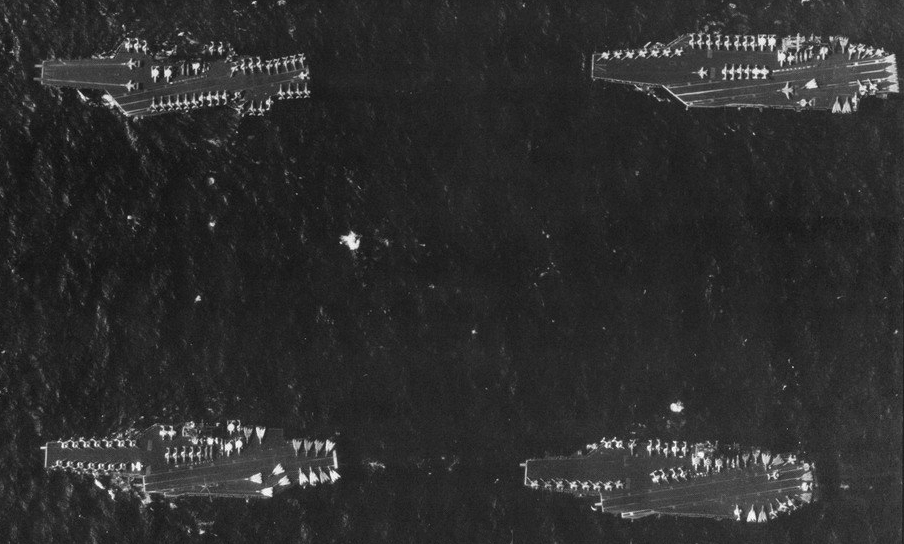
From 1 January 1991, the six carriers deployed were divided into Battle Force Yankee (two carriers, including Saratoga, in the Red Sea under Rear Admiral Riley Mixson, Commander, Carrier Group Two/Task Force 155) and Task Force 154, Battle Force Zulu (four carriers in the Arabian Sea/Persian Gulf under Rear Admiral Daniel P. March, Commander, Carrier Group Five). TF 150 was Vice Admiral Henry H. Mauz, Jr. himself, TF 151 the Middle East Force, now including , TG 150.3 Naval Logistics Support Force (Rear Admiral Bob Sutton), and TF 156 the amphibious force.
Since ComUSNAVCENT operated from on board ship, he established NAVCENT-Riyadh as a staff organization to provide continuous Navy representation at CENTCOM headquarters. This mission was assigned initially to Commander, Carrier Group Three (COMCARGRU 3). During succeeding months, the NAVCENT-Riyadh staff was augmented substantially but remained small, relative to the ARCENT and CENTAF staffs. In November, the NAVCENT-Riyadh command was transferred from COMCARGRU 3 to Commander, Cruiser-Destroyer Group 5. This change resulted in the Navy flag officer at NAVCENT Riyadh's remaining relatively junior to other Service representatives, particularly CENTAF. This imbalance in size and seniority between the Navy and other staffs, coupled with the geographic separation with NAVCENT headquarters, made it difficult for NAVCENT-Riyadh to represent the interests of the Navy in the overall coordination and planning efforts.
On 24 April 1991, Vice Admiral Stan Arthur turned over command of NAVCENT to Rear Admiral Ray Taylor, Fogerty's replacement as Commander, Middle East Force, and Arthur and Blue Ridge began their voyage back to the Pacific. Two months earlier, Rear Admiral Taylor had submitted thoughts on the reorientation of the NAVCENT command structure to Schwarzkopf following an earlier direction from Admiral Arthur. The proposal, which was modified in the staffing process, eventually meant that the one-staff ComUSNAVCENT in Hawaii was upgraded to a two-star appointment co-located with Central Command headquarters in Tampa, Florida. Rear Admiral David Rogers became the first two-star Navy representative in Tampa when he relieved Rear Admiral Sutton.[[File:Cosgriff and Sultanov 2008.jpg|thumb|220px|Vice Admiral Kevin Cosgriff, commander, U.S. Naval Forces Central Command, meets with Vice Admiral, [[Azerbaijani Navy]], Shahin Sultanov during his visit to [[Baku]], [[Azerbaijan]] in June 2008.]]
Although COMSEVENTHFLT held command responsibility during this period, no numbered fleet existed permanently within the USCENTCOM area of responsibility during the first Gulf War and for the next four years thereafter. By July 1995, a new numbered fleet was deemed necessary by the senior U.S. Navy leadership, and after a 48-year hiatus, the U.S. Fifth Fleet was reactivated, replacing COMMIDEASTFOR. Dual-hatted as COMUSNAVCENT as the naval component command of USCENTCOM, the same Vice Admiral (and his staff) as Commander, U.S. Fifth Fleet (COMFIFTHFLT) now directs naval operations in the Persian Gulf, Red Sea, and the Arabian Sea. The combined COMUSNAVCENT/COMFIFTHFLT headquarters is located at NSA Bahrain in Manama, Bahrain. The command oversees both afloat and shore-based units that rotationally deploy or surge from the United States, plus a few smaller surface ships that are based in the Gulf for longer periods. Ships rotationally deploy to the U.S. Fifth Fleet from the Pacific and Atlantic Fleets.
From 2010 through 2013, the U.S. maintained two aircraft carriers east of Suez, known as a "2.0 carrier presence," although it sometimes temporarily dipped below that level. The heightened presence aimed to provide air and sea striking power for U.S. operations in Iraq and Afghanistan and also to deter Iran from bad behavior in the region and keep the Strait of Hormuz open.
In 2016 the , , , and came under attack as they moved through the Bab al-Mandeb strait on the southern end of the Red Sea. Shortly after the attacks, the USS Nitze destroyed three radar sites in Yemen in retaliation for the two separate attacks on U.S. ships in the Red Sea.
On 1 December 2018, NAVCENT commander Vice Admiral Scott A. Stearney was found dead in his residence in Bahrain. No foul play was suspected. Rear Admiral Paul J. Schlise assumed interim command. Vice Admiral Jim Malloy flew to Bahrain to take command.
Task Forces
See United States Fifth Fleet#Composition for more historical detail and context
| Task Force | Role | Elements | Current Units (If available) |
|---|---|---|---|
| Task Force 50 | Carrier Strike Group | Nimitz-class Aircraft Carrier | Carrier Strike Group 1 |
| Task Force 51 | Naval Amphibious Force/Marine Expeditionary Brigade | Wasp-class LHD | US Navy Task Force 51 ARG |
| Task Force 53 | Logistics | Fast Combat Support Ship | Unknown |
| Task Force 54 | Submarine Forces | Ohio-Class Guided-Missile Submarine | Unknown |
| Task Force 55 | Non-CSG/Independent Surface Forces | Ticonderoga-class Cruiser | At least 5 deployed destroyers in the region: |
| Task Force 56 | Expeditionary Combat Forces: | Marine Mammals | Unknown |
| Task Force 57 | Maritime Patrol Forces: | P-8A Poseidon, MMA Aircraft | Unknown |
| Task Force 59 | Unmanned Systems & AI | Unmanned Aerial Vehicles | Unknown |
Combined Maritime Forces
In February 2002 the Combined Maritime Forces was established within USNAVCENT headquarters as an embedded activity. It is an international naval partnership that provides security for civilian maritime traffic by conducting counter-piracy and counter-terrorism missions in the heavily trafficked waters of the Middle East, Africa and South Asia, including the Red Sea, the Persian Gulf, the Gulf of Aden, Arabian Sea and the wider Indian Ocean.
As of May 2025, there were 46 sovereign state participants. Most states joined and then continued to participate in a variety of ways. The United Arab Emirates became a member of the task force, but has not participated since March 2023.
USNAVCENT has organised the CMF into four principal task forces:
- Combined Task Force 150 (CTF-150) – Maritime Security & Counter-terrorism
- Combined Task Force 151 (CTF-151) – Counter-piracy
- Combined Task Force 152 (CTF-152) – Persian Gulf Security Cooperation
- Combined Task Force 153 (CTF-153) – Red Sea Maritime Security
After the September 11 terrorist attacks on the United States, Commander, Task Force 150, previously a single-nation U.S. formation, was made into a multinational effort as Combined Task Force 150 (HOA MIO Force), and was given a renewed focus on maritime security and counter-terrorism. It was established on 3 February 2002, by Vice Admiral Charles W. Moore, Commander, US Naval Forces Central Command. Over time, it became increasingly involved in combating the rising incidence of piracy in Somalia.
Combined Task Force 151 was established in January 2009 by Vice Admiral William E. Gortney specifically to address counter-piracy operations.
Operating alongside CTF 151 and Operation Ocean Shield are other national deployments such as the People's Liberation Army Navy, most recently with "CTF 526" aboard the Type 054 frigate Wenzhou (which had the hull number 526).
Combined Task Force 153 was established in April 2022 by Vice Admiral Brad Cooper with a mission of maritime security and capacity building efforts in the Red Sea, Bab al-Mandeb, and Gulf of Aden. Captain Robert Francis was designated the first CTF-153 commander.
Combined Maritime Forces Participants
_Map.png)
There are now 46 members of the CMF, including:
- Albania
- Argentina
- Australia
- Bahrain
- Belgium
- Brazil
- Canada
- Denmark
- Ecuador
- Djibouti
- Egypt
- Finland
- France
- Germany
- Greece
- India
- Iraq
- Italy
- Japan
- Jordan
- Kenya
- Kuwait
- Malaysia
- Netherlands
- New Zealand
- Norway
- Oman
- Pakistan
- Philippines
- Poland
- Portugal
- Qatar
- Saudi Arabia
- Seychelles
- Singapore
- South Korea
- Spain
- Sri Lanka
- Sweden
- Thailand
- Turkey
- United Arab Emirates (2002–2023)
- United Kingdom
- United States
- Yemen
List of commanders
| No. | Commander | Term | Notes | Portrait | Name | Took office | Left office | Term length | Commander, U.S. Naval Forces Central Command (COMUSNAVCENT) | Commander, U.S. Naval Forces Central Command (COMUSNAVCENT) and U.S. Seventh Fleet (C7F) | Commander, U.S. Naval Forces Central Command (COMUSNAVCENT) | Commander, U.S. Naval Forces Central Command (COMUSNAVCENT) and U.S. Fifth Fleet (C5F) | Commander, U.S. Naval Forces Central Command (COMUSNAVCENT), U.S. Fifth Fleet (C5F) and Combined Maritime Forces (CMF) | |
|---|---|---|---|---|---|---|---|---|---|---|---|---|---|---|
| order = 1 | Rear Admiral (lower half)]] | image = Rear Adm. Stanley R. Arthur.jpg | Stanley R. Arthur]] | officeholder_sort = | born_year = 1935 | died_year = | term_start = 1 January 1983 | term_end = 1987 | 1 January 1983 | 1 January 1987}} | ref = Later served as the 5th NAVCENT commander from 1990 to 1991. | order = 2 | military_rank = Rear Admiral (lower half) | image = Rear Admiral (lower half) Philip F. Duffy.jpg |
References
- Naval Institute Press, Annapolis, Maryland
References
- These two paragraphs are based on David F. Winkler, 'Admirals, Amirs, and Desert Sailors,' Naval Institute Press, Annapolis, Maryland, 2007, p.21-25
- David M. Key, Jr. Admiral Jerauld Wright: Warrior among Diplomats (Manhattan, Kansas: Sunflower University Press, 2001), 278-9.
- Winkler, p.86
- (28 July 2015). "Klakring (FFG 42), 1982-2013".
- Edward J. Marolda, Robert John Schneller. "Shield and Sword: The United States Navy and the Persian Gulf War".
- Conduct of the Persian Gulf War, Final Report to Congress, pg 553 start
- Pokrant, 192.
- Winkler, 127-8.
- Barbara Starr, 'US Fifth Fleet reborn for active duty in the Persian Gulf, Jane's Defence Weekly, 27 May 1995, p.11
- "NAVCENT/5th Fleet History".
- (17 October 2015). "Navy won't have aircraft carrier in Persian Gulf as Iran deal takes effect". The Hill.
- Rogoway, Tyler. (19 October 2016). "USS San Antonio Was Targeted During Anti-Ship Missile Attack Last Week Off Yemen".
- (1 December 2018). "UPDATED: U.S. 5th Fleet Commander Found Dead in Bahrain - USNI News". [[United States Naval Institute]].
- (1 December 2018). "Navy admiral Scott Stearney found dead in Bahrain, no foul play suspected". [[NBC News]].
- "Task Forces".
- Merrow, Mariel Ferragamo, Diana Roy, Jonathan Masters, Will. "U.S. Forces in the Middle East: Mapping the Military Presence {{!}} Council on Foreign Relations".
- LaGrone, Sam. (2025-06-20). "5 U.S. Ballistic Missile Defense Destroyers Now in the Mediterranean Sea".
- "About CMF".
- (31 May 2023). "U.A.E. Says It Exited U.S.-Led Naval Force". [[The Wall Street Journal]].
- "CTF-150: Maritime Security".
- "CTF-151: Counter-piracy".
- "CTF-152: Gulf Maritime Security".
- (12 April 2022). "CTF: 153 Red Sea Maritime Security".
- "Piracy and HOA Operations".
- "New Counter-Piracy Task Force Established".
- "New International Naval Task Force to Enhance Red Sea Security".
- (9 September 2024). "La Armada Argentina pasa a formar parte de la Fuerza Marítima Combinada".
- (22 January 2024). "Ecuador Joins Combined Maritime Forces in Middle East as 40th Member".
- "The Passing of Rear Admiral Robert "Bob" Sutton". United States Navy.
- "Anchor of Resolve: A History of US Naval Forces Central Command".
- "ADMIRAL HENRY H. MAUZ JR. '59, USN (RET.)".
- "Anchor of Resolve: A History of US Naval Forces Central Command".
- "Admiral Thomas B. Fargo, U.S. Navy (Ret.)".
- "COMUSNAVCENT/COMFIFTHFLT Bio".
- (2005-11-03). "Vice Adm. Nichols Turns Over the Reigns to Vice Adm. Walsh [Image 3 of 3]".
- (2007-02-27). "Cosgriff Assumes Command of NAVCENT, 5th Fleet".
- (2008-07-05). "Cosgriff Highlights Regional Cooperation during Change of Command".
- (2010-07-05). "Vice Adm. Fox Assumes Command of US Navy in Middle East".
- (2012-05-24). "VICE ADM. MILLER TAKES HELM OF U.S. NAVY IN MIDDLE EAST AND COMBINED MARITIME FORCES".
- (2015-09-08). "Prolific fighter pilot takes over 5th Fleet".
- (2019-07-19). "U.S. Fifth Fleet Welcomes New Commander".
- (2018-05-08). "VADM Stearney Takes Command of 5th Fleet; RADM Corey Takes Over PEO Unmanned Aviation and Strike Weapons".
- (2018-12-07). "Vice Admiral James Malloy Assumes Duties as U.S. Naval Forces Central Command/U.S. 5th Fleet Commander".
- (2019-08-19). "NAVCENT, FIFTH FLEET, CMF WELCOME NEW COMMANDER".
- (2021-05-06). "NAVCENT, U.S. Fifth Fleet, CMF Change of Command".
This article was imported from Wikipedia and is available under the Creative Commons Attribution-ShareAlike 4.0 License. Content has been adapted to SurfDoc format. Original contributors can be found on the article history page.
Ask Mako anything about United States Naval Forces Central Command — get instant answers, deeper analysis, and related topics.
Research with MakoFree with your Surf account
Create a free account to save articles, ask Mako questions, and organize your research.
Sign up freeThis content may have been generated or modified by AI. CloudSurf Software LLC is not responsible for the accuracy, completeness, or reliability of AI-generated content. Always verify important information from primary sources.
Report