From Surf Wiki (app.surf) — the open knowledge base
United States Food Administration
Former US federal agency (1917–1920)
Former US federal agency (1917–1920)
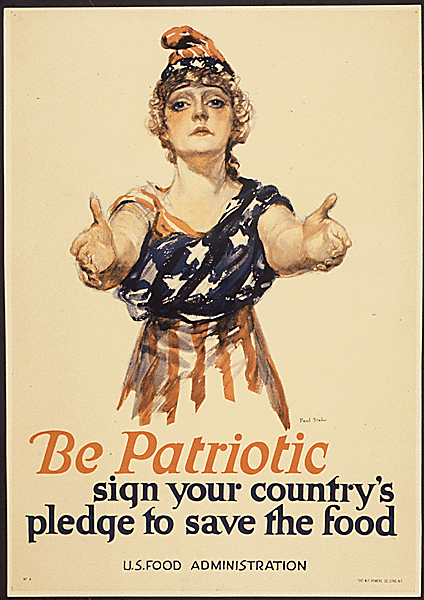
The United States Food Administration (1917–1920) was an independent federal agency that controlled the production, distribution, and conservation of food in the U.S. during the nation's participation in World War I. It was established to prevent monopolies and hoarding, and to maintain government control of foods through voluntary agreements and licensing. The agency was established by of August 10, 1917, pursuant to the Food and Fuel Control Act, and was abolished by on August 21, 1920. Herbert Hoover was appointed to serve as Food Administrator.
One of the agency's important tasks was the stabilization of the price of wheat on the U.S. market. Concepts such as "meatless Mondays" and "wheatless Wednesdays" were also implemented to help ration food, so that the government could prioritize the war effort.
Branches of the United States Food Administration were set up in all states as well as Alaska, Hawaii, Puerto Rico and Washington, D.C. The agency had broad powers but few mechanisms for enforcement of its policies. It relied largely upon patriotic appeals and voluntary compliance in the formal absence of rationing.
History

The appointment of Hoover
Woodrow Wilson realised he would need a dynamic leader to ensure the Food administration was effective. His advisor Edward House suggested Herbert Hoover, who had previously run the Commission for Relief in Belgium. Walter Hines Page, the British ambassador, endorsed this choice and Wilson, a Democrat, agreed although Hoover was a Republican. Hoover accepted the position only on the basis that he would have a completely free hand as regards the Washington bureaucracy, which in particular referred to David F. Houston, the Secretary of Agriculture. Despite initial resistance, Houston acquiesced and Hoover was appointed.
Grain Corporation
The administration employed its Grain Corporation, organized under the provisions of the Food Control Act of August 10, 1917, as an agency for the purchase and sale of foodstuffs. Having done transactions in the size of $7 billion, the United States Food Administration was rendered obsolete by the armistice in Europe. President Woodrow Wilson promoted its transition in a new agency for the support of the reconstruction of Europe. It became the American Relief Administration, approved by an Act (Public, No. 274, 65th Congress) on February 25, 1919.
The Food Administration Grain Corporation became the United States Grain Corporation pursuant to of May 14, 1919.
Poster gallery
File:Clean Plate Club pic..png File:"Sugar means Ships...Every Spoonful -Every Sip- Means less for a Fighter.", ca. 1918 - ca. 1918.tif File:"Member of the United States Food Administration. Please Hang This Card In Your Front Window.", ca. 1917 - ca. 1919 - NARA - 512510.jpg File:"Will you help the Women of France^ Save Wheat. They are struggling against starvation and trying to feed not only... - NARA - 512574.tif File:"Member of U.S. Food Administration. Food will win the war. We observe Meatless days, Wheatless days- Porkless days and - NARA - 512516.tif File:"Prices charged in this store will not exceed those indicated in the most recent list of Fair Prices applicable to this - NARA - 512556.jpg File:Food poster edit.jpg|alt=A numbered list of 1 through 6 reads '1. buy it with thought 2. cook it with care 3. use less wheat and meat 4. buy local foods 5. serve just enough 6. use what is left'. In larger text, the poster states 'food, don't waste it'.
References
References
- "Records of the United States Food Administration". The National Archives at Fort Worth.
- (2013). "The United States Food Administration During World War I: The Rise of Activist Government Through Food Control During Mobilization for Total War". Auburn University.
This article was imported from Wikipedia and is available under the Creative Commons Attribution-ShareAlike 4.0 License. Content has been adapted to SurfDoc format. Original contributors can be found on the article history page.
Ask Mako anything about United States Food Administration — get instant answers, deeper analysis, and related topics.
Research with MakoFree with your Surf account
Create a free account to save articles, ask Mako questions, and organize your research.
Sign up freeThis content may have been generated or modified by AI. CloudSurf Software LLC is not responsible for the accuracy, completeness, or reliability of AI-generated content. Always verify important information from primary sources.
Report