From Surf Wiki (app.surf) — the open knowledge base
United States Coast Guard Academy
Service academy in New London, Connecticut, U.S.

Service academy in New London, Connecticut, U.S.
| Field | Value |
|---|---|
| name | United States |
| Coast Guard Academy | |
| image | United States Coast Guard Academy seal.svg |
| image_size | 150 |
| former_names | Revenue Cutter Service School of Instruction (1876–1914) |
| Revenue Cutter Academy (1914–1915) | |
| motto | Scientiæ Cedit Mare (Latin) |
| mottoeng | The sea yields to knowledge |
| type | U.S. Service Academy |
| established | |
| superintendent | Gregory C. Rothrock |
| provost | Amy K. Donahue |
| head_label | Commandant of Cadets |
| head | Aaron Casavant |
| faculty | 175 |
| students | 1,113 cadets (As of fall 2023) |
| city | New London, Connecticut |
| country | United States |
| coor | |
| campus | Suburban |
| 103 acre | |
| free_label | Fight song |
| free | "Semper Paratus" |
| colors | Blue and orange |
| nickname | Bears |
| sporting_affiliations | |
| mascot | Objee the Bear |
| sports_free_label | Athletics |
| sports_free | 24 varsity teams |
| website | |
| logo | Us cga logo.svg |
| logo_size | 200 |
Coast Guard Academy Revenue Cutter Academy (1914–1915) 103 acre
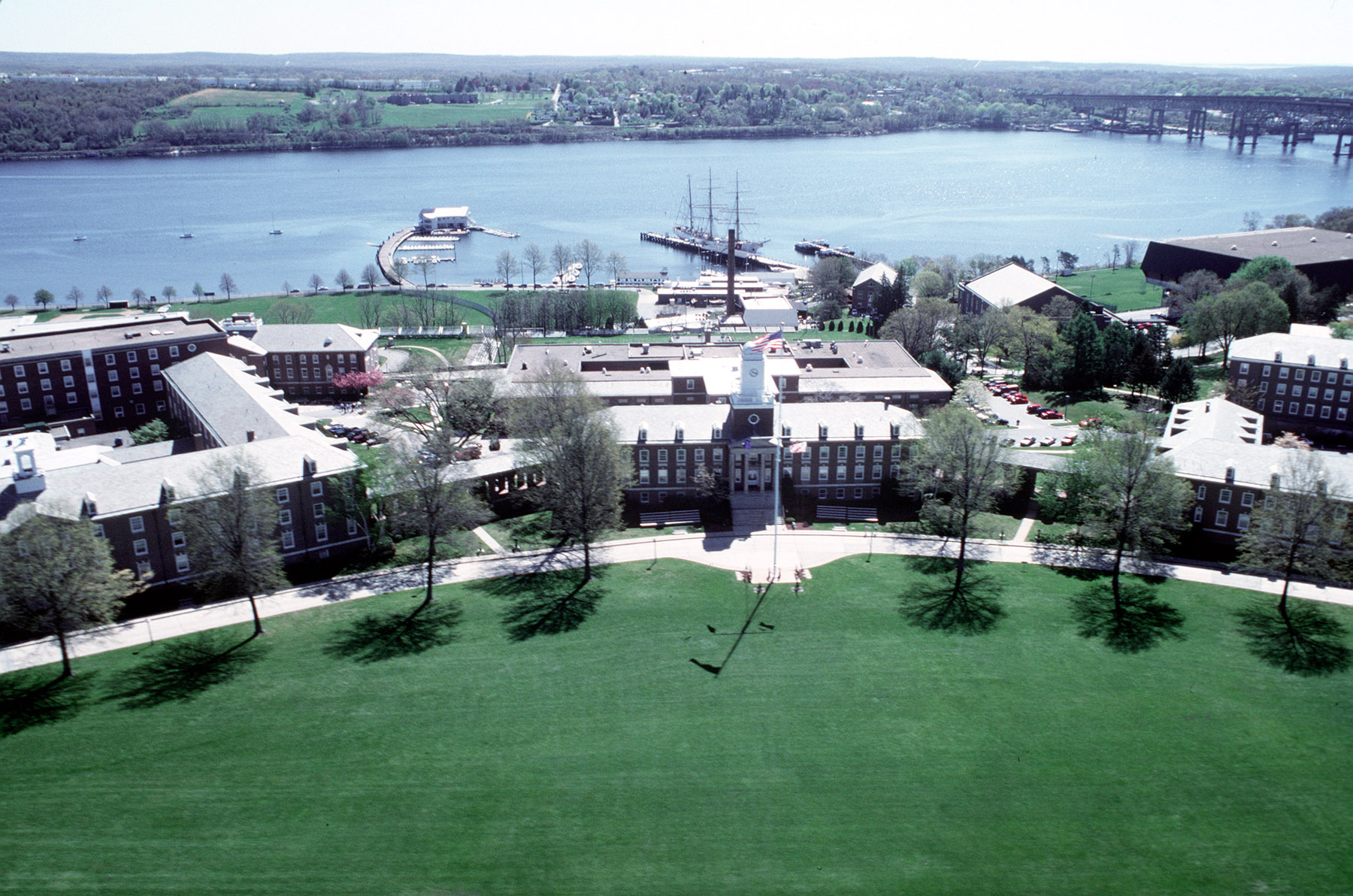
The United States Coast Guard Academy (USCGA), located in New London, Connecticut, is the U.S. service academy specifically for the United States Coast Guard. Founded in 1876, the academy provides education to future Coast Guard officers in one of nine major fields of study.
Students are officers-in-training, and are referred to as cadets. Upon graduation, cadets receive a Bachelor of Science degree and commission in the U.S. Coast Guard as an ensign. In exchange for their debt-free education valued at over $500,000, graduates incur a five-year active-duty service obligation,Cadets who do not graduate after their 2nd year (due to grades, conduct, etc) are obligated to enlist or pay back the monetary value of their education. with additional years if the graduate attends flight school or subsequent government-funded graduate school. Out of approximately 300 cadets entering the academy each summer, around 250 graduate. Cadets choose from nine majors, with a curriculum that is graded according to their performance in a holistic program of academics, military bearing, physical fitness, character, and leadership.
Cadets are required to adhere to the academy's "Honor Concept," "Who lives here reveres honor, honors duty," which is emblazoned in the walls of the academy's entrance. The academy's motto is Scientiæ Cedit Mare, which is Latin for "the sea yields to knowledge". Its academic programs are accredited by the New England Commission of Higher Education.
History
The roots of the academy lie in the "School of Instruction of the Revenue Cutter Service", the school of the Revenue Cutter Service. The School of Instruction was established near New Bedford, Massachusetts in 1876 and used USRC * James C. Dobbin* for its exercises. Captain John Henriques served as superintendent from founding until 1883. The one civilian instructor was Professor Edwin Emery, who taught mathematics, astronomy, English composition, French, physics, theoretical steam engineering, history, international law, and revenue law, among other subjects. The school was a two-year apprenticeship, in essence, supplemented by minimal classroom work.
The student body averaged five to ten cadets per class. With changes to new training vessels, the school moved to Curtis Bay, Baltimore in 1900 and to Fort Trumbull in 1910, a Revolutionary War–era Army installation in New London, Connecticut. In 1914, the school became the Revenue Cutter Academy, and then the Coast Guard Academy in 1915 with the merger of the Revenue Cutter Service and the United States Life-Saving Service to form the U.S. Coast Guard.
.jpg)
Land was purchased in New London on 31 July 1930 for the construction of the Coast Guard Academy. The 40-acre site was made up of two parcels from the Allyn and Payne estates and was purchased for $100,000. The $100,000 was not raised through a bond issue, as originally planned, but with a bank loan based on uncollected back taxes. The contract was awarded to Murch Brothers Construction Company of St. Louis and ground was broken in January 1931 by Jean Hamlet, daughter of Rear Admiral Harry G. Hamlet, Academy Superintendent from 1928 to 1932. On 15 May 1931, Treasury Secretary Andrew W. Mellon visited New London to lay the cornerstone of Hamilton Hall. Construction proceeded relatively on schedule and cadets moved in to the new buildings on 20 September 1932.
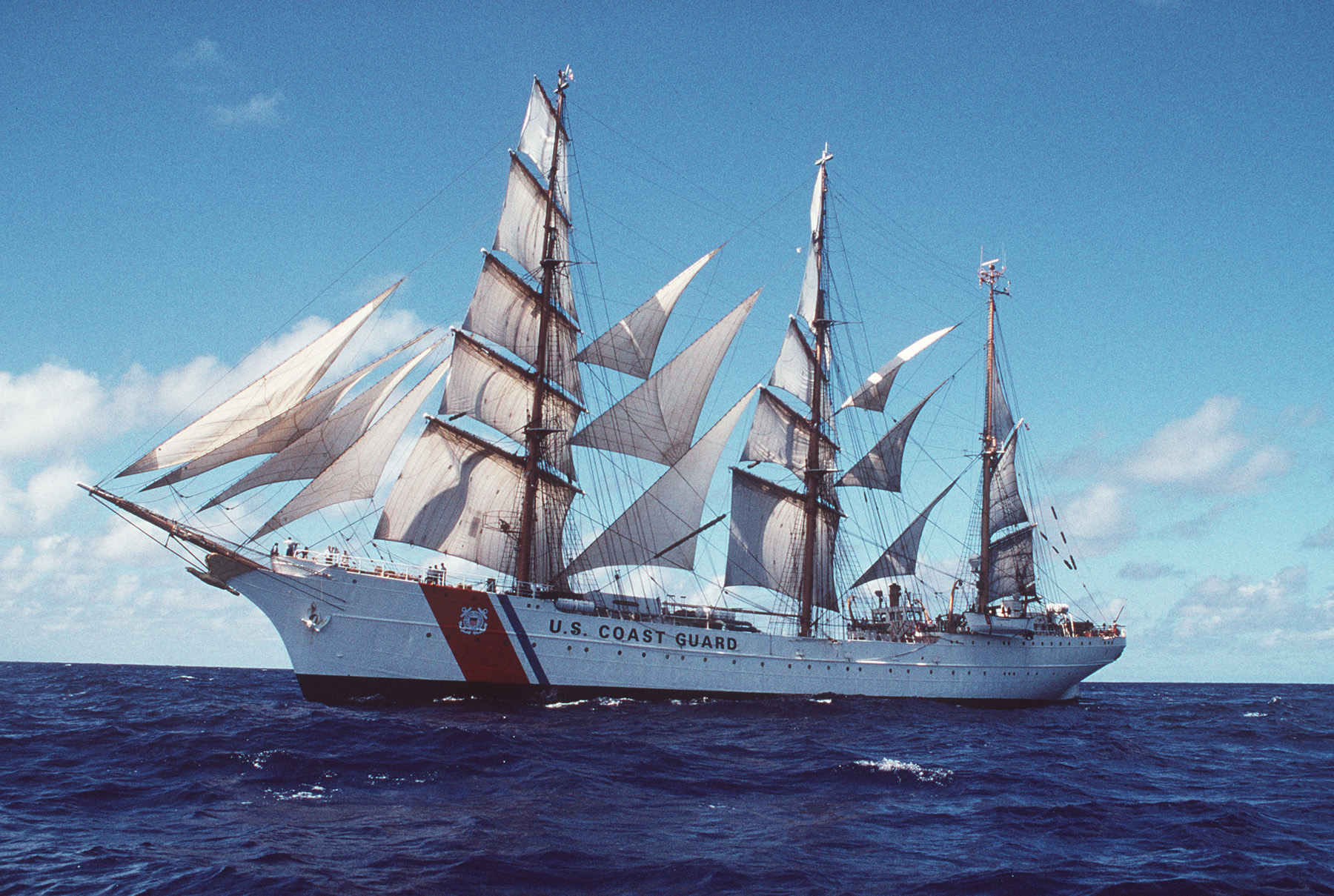
In 1946, the academy received the barque Horst Wessel as a war reparation from Germany, a 295-foot tall ship which was renamed . It remains the main training vessel for cadets at the academy as well as for officer candidates at the Coast Guard's Officer Candidate School, which is located on the grounds of the academy.
The academy was racially integrated in 1962 at the request of President Kennedy. The academy began admitting women in 1976 at the request of Congress.
In 2018, the academy emblem was redesigned by Nick Desjardins of the Biddeford Regional Center of Technology.
In December 2023, House Committee on Oversight and Accountability and Subcommittee on National Security, the Border, and Foreign Affairs opened a probe into the USCG’s mishandling of serious misconduct, including racism, hazing, discrimination, sexual harassment, sexual assault, and rape, and the withholding of internal investigations into these offenses from Congress and the public. The Coast Guard had conducted Operation Fouled Anchor, an investigation that ran from 2014 to 2019 that reviewed more than 100 allegations of sexual assault at the academy made from the early 1990s to 2006 and how they were handled. Coast Guard officials, however, did not fully disclose its existence to Congress or the public until last year.
Admission
Unlike the other service academies, admission to the USCGA does not require a congressional nomination. This is due to the fervent objections of Captain John A. Henriques, the first Superintendent of the Revenue Cutter School of Instruction (later the Revenue Cutter Academy). His objection stemmed from years of poor political appointments in the U.S. Revenue Cutter Service's bureaucracy. However, under the Compacts of Free Association between the United States and the Republics of Palau, Micronesia and the Marshall Islands, the USCGA is obliged to at all times have at least one student enrolled who is nominated by the governments of each of those states.
Each year more than 2,000 students apply and appointments are offered until the number accepting appointments to the incoming class numbers reaches approximately 400; the average entering class size is 300 cadets. Those who have received appointments as cadets report to the USCGA in late June or early July for "Swab Summer", a basic military training program designed to prepare them for the rigors of their Fourth Class year. After four years of study and training, approximately 250 of those cadets will graduate. About 40 percent of cadets are women.
Academics
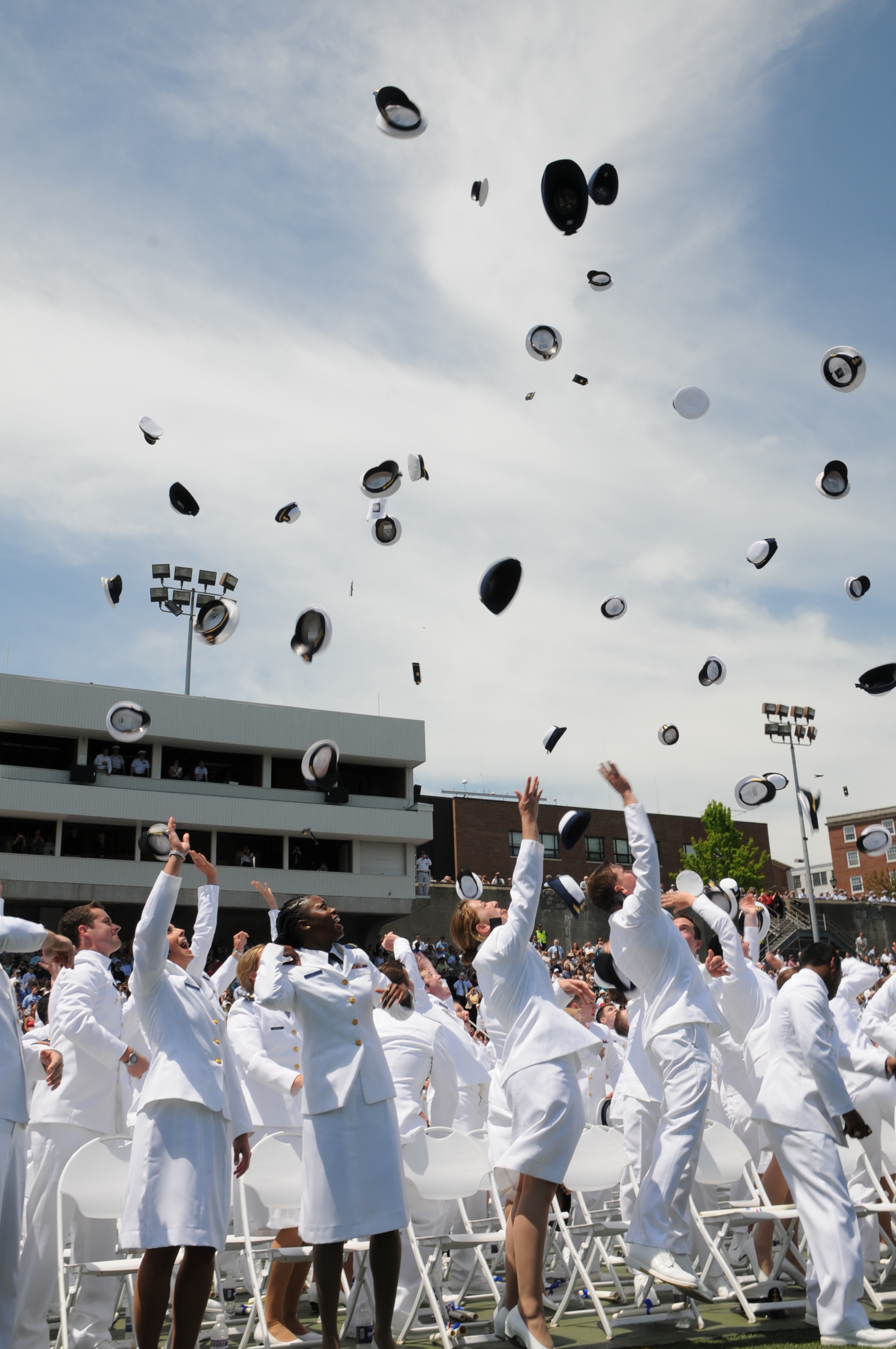
All graduating cadets earn commissions as ensigns in the United States Coast Guard, as well as Bachelor of Science degrees. For that reason the academy maintains a core curriculum of science and professional development courses in addition to major-specific courses. Each cadet takes two semesters of classes during the school year and then spends the majority of the summer in military training to produce officers of character with the requisite professional skills. Among these are courses in leadership, ethics, organizational behavior, and nautical science. The majority of cadets report to their first units after graduating, which are either afloat units, shore units, or basic flight training as student naval aviators, with the training conducted under the auspices of the U.S. Navy. Those that are assigned afloat serve as either deck watch officers or student engineers. Professional maritime studies courses help prepare cadets in piloting, voyage planning, deck seamanship, and all aspects of ship-handling, as well as Coast Guard leadership and administrative duties.
Majors
Academics at the USCGA stress the sciences and engineering, but different courses of study are available. In addition, several of the majors offer tracks of specialization (for example, marine and environmental science majors can choose to focus on biology, chemistry, or geophysics). Cadets sometimes opt to take elective courses with Connecticut College (adjacent the academy's campus) as part of an open exchange agreement.
Military training
Each summer, cadets participate in training programs according to their class. The summers are organized as follows:
- Swab Summer: The new class of freshmen report in to the academy, and are sworn into the military. They undergo a seven-week basic training program that culminates on a week-long voyage underway on the barque USCGC Eagle.
- Third-class (3/c) Summer: Five weeks aboard the USCGC Eagle training under sail, five weeks aboard an operational Coast Guard cutter or small boat station in the role of junior enlisted (i.e., standing watches as helmsman, lookout, quartermaster of the watch, or engineering watch).
- Second-class (2/c) Summer: damage control training, weapon qualifications, navigation rules certification, aviation internship, sail training program, and three weeks as members of the cadre, who train the incoming swabs.
- First-class (1/c) Summer: Ten weeks aboard an operational cutter in the role of a junior officer (i.e., standing bridge watches conning the ship as Officer of the Deck), or an optional internship for exceptional cadets who split their summer with five weeks at an internship and five weeks aboard a cutter.
Each week during the school year cadets participate in regimental review, a formal military drill. In addition, cadets perform a variety of military duties at the academy. Like all cadets and midshipmen at the United States service academies, Coast Guard cadets are on active duty in the military and wear uniforms at all times. Cadets receive a monthly stipend to pay for books, uniforms, and other necessities. Cadets receive monthly pay of $1,017.00, as of 2015. From this amount, pay is automatically deducted for the cost of uniforms, books, supplies, services, and other miscellaneous expenses.
Organization of the Corps of Cadets
The Corps is organized as one regiment divided into eight companies, each of which is composed of about 120 cadets of all classes. Although the Corps of Cadets is supervised directly by the Commandant of Cadets (a Coast Guard officer with the rank of captain), the academy operates on the concept of "the Corps leading the Corps."
The Corps of Cadets is largely a self-directed organization that follows a standard military chain of command:
- 1st class cadets lead the corps
- 2nd class cadets are cadre in swab summer training and are primarily responsible for leading and developing 4th class cadets. They serve as mentors
- 3rd class cadets are role models to 4th class cadets
- 4th class cadets are responsible for learning and applying Coast Guard core values such as leadership, teamwork, attention to detail, accountability, etc.
The highest-ranking cadet in each company is the company commander, a first-class cadet ("firstie"), equivalent to a senior. Although each company has some leeway in their standards and practices, every company commander reports to the regimental staff which plans and oversees all aspects of cadet life. At the top of the cadet chain of command is the regimental commander, the highest ranking cadet. Command positions, both in companies and on regimental staff, are highly competitive, and a cadet's overall class rank is often a deciding factor in who is awarded the position.
The eight companies are named for the first eight letters of the NATO phonetic alphabet. Each has a special focus in administering day-to-day affairs: Alfa Company manages health and wellness. Bravo Company runs training. Charlie Company administers the honor system, Delta Company coordinates drill and ceremonies. Echo Company manages transportation and logistics. Foxtrot Company operates the cadet conduct system, organizes the watch rotations, and updates the cadet regulations. Golf Company is in charge of supplies for cleaning and repairing damaged rooms within Chase Hall. Hotel Company is in charge of morale events.
To accomplish their missions, each company is divided, along shipboard lines, into three departments, each of which is divided into divisions with specific responsibilities. Divisions are the most basic unit at the Coast Guard Academy, and each has a very specific purpose. Each division is led by a firstie and contains several members of each other class.
This organizational structure is designed to give every cadet a position of leadership and to emulate the structure of a Coast Guard cutter, in which the division officer and department head positions are filled by junior officers. Third-class cadets directly mentor the fourth-class in their division, just as junior petty officers would be responsible for the most junior enlisted personnel (non-rates). Second-class cadets act as non-commissioned officers, and ensure that the regulations and accountability are upheld. Firsties (like junior officers) are in supervisory roles, and are responsible for carrying out the mission of their divisions and ensuring the well-being of those under their command. Exchange cadets from the other federal service academies are also a part of the corps, and take part in many activities alongside their USCGA counterparts.
Student life
| Race and ethnicity | Total | |||
|---|---|---|---|---|
| White | {{bartable | 63 | % | 2 |
| Hispanic | {{bartable | 14 | % | 2 |
| Two or more races | {{bartable | 11 | % | 2 |
| Asian | {{bartable | 6 | % | 2 |
| Black | {{bartable | 3 | % | 2 |
| International student | {{bartable | 3 | % | 2 |
| Unknown | {{bartable | 1 | % | 2 |
Athletics
Main article: Coast Guard Bears
The USCGA Athletic Department offers 24 intercollegiate sports for cadets. The academy's athletics teams generally compete in Division III of the National Collegiate Athletic Association. Cadets devote two hours per academic day to athletic activities, either on varsity teams, club teams, or other sports pursuits. The academy nickname is the Bears, after the USRC Bear, which made a dramatic rescue in Alaska in 1897, shortly after the opening of the academy.
Music
Principal non-athletic activities are musical centered on Leamy Hall. Regimental Band, Windjammers Drum & Bugle Corps, various pep bands, and the NiteCaps Jazz Band are instrumental programs. Chapel Choirs, Glee Club, the Fairwinds all-female a cappella group, and The Idlers all-male sea shanty group are vocal programs.
Model UN
The academy's Model UN team was started in 2004, and has since been successfully competing around North America, and at the World Model UN Conference.
Pride
The academy has clubs and teams dedicated to increasing campus morale. These include the cheer squad, dance team and Social Committee.
Notable alumni
Alumni of the Coast Guard Academy are known collectively as the "Long Blue Line".
| Name | Class | Notability |
|---|---|---|
| Worth G. Ross | 1879 | |
| William E. Reynolds | 1880 | |
| Ellsworth P. Bertholf | 1887 | |
| Leonidas I. Robinson | 1889 | |
| Frederick C. Billard | 1896 | |
| Harry G. Hamlet | 1896 | |
| Russell R. Waesche | 1906 | |
| Philip F. Roach | 1907 | |
| William J. Keester | 1910 | |
| Joseph Stika | 1911 | |
| Joseph F. Farley | 1912 | |
| Elmer Fowler Stone | 1913 | |
| Lyndon Spencer | 1918 | |
| Harold G. Bradbury | 1920 | |
| Merlin O'Neill | 1921 | |
| Alfred C. Richmond | 1924 | |
| Miles Imlay | 1926 | |
| Edward Thiele | 1927 | |
| Carl B. Olsen | 1928 | |
| Edwin J. Roland | 1929 | |
| Allen Winbeck | 1929 | |
| A. J. Carpenter | 1933 | |
| John Birdsell Oren | 1933 | |
| Willard J. Smith | 1933 | |
| Chester R. Bender | 1936 | |
| Chester I. Steele | 1937 | |
| Arthur B. Engel | 1938 | |
| Benjamin F. Engel | 1938 | |
| Thomas R. Sargent III | 1938 | |
| Orvan R. Smeder | 1939 | |
| Ellis L. Perry | 1941 | |
| Owen W. Siler | 1943 | |
| Winford W. Barrow | 1945 | |
| G. William Miller | 1945 | |
| John B. Hayes | 1947 | |
| Robert A. Duin | 1948 | |
| James S. Gracey | 1949 | |
| Sidney A. Wallace | 1949 | |
| Benedict L. Stabile | 1950 | |
| Paul A. Yost Jr. | 1951 | |
| Robert S. Lucas | 1952 | |
| James C. Irwin | 1953 | |
| Theodore J. Wojnar | 1953 | |
| William P. Kozlovsky | 1954 | |
| Clyde T. Lusk | 1954 | |
| J. William Kime | 1957 | |
| Robert T. Nelson | 1958 | |
| William J. Ecker | 1960 | |
| Richard A. Appelbaum | 1961 | |
| Robert E. Kramek | 1961 | |
| Arthur E. Henn | 1962 | |
| James C. Card | 1964 | |
| Richard D. Herr | 1964 | |
| James Loy | 1964 | |
| Gordon G. Piche | 1964 | |
| Paul M. Blayney | 1965 | |
| Thomas H. Collins | 1968 | |
| John T. Tozzi | 1968 | |
| Richard W. Schneider | 1968 | |
| Terry M. Cross | 1970 | |
| Thad Allen | 1971 | |
| Ronald F. Silva | 1971 | |
| Charles D. Wurster | 1971 | |
| Erroll M. Brown | 1972 | |
| Bruce E. Melnick | 1972 | |
| Timothy S. Sullivan | 1975 | |
| Robert J. Papp Jr. | 1975 | |
| Paul A. Langlois | 1976 | Captain; Distinguished Flying Cross; USCGA Athletic Hall of Fame (2006); USCGA Hall of Heroes (2013); USCGA Distinguished Alumnus (2019) |
| David Pekoske | 1977 | 7th Administrator of Transportation Security Administration (2017–Current); |
| Paul F. Zukunft | 1977 | |
| Charles W. Ray | 1981 | |
| Sandra L. Stosz | 1982 | |
| Stephen E. Flynn | 1982 | |
| Karl L. Schultz | 1983 | |
| Steve Andersen | 1985 | |
| Daniel C. Burbank | 1985 | |
| Charles D. Michel | 1985 | |
| Linda L. Fagan | 1985 | |
| Kevin E. Lunday | 1987 | |
| Douglas M. Fears | 1989 | |
| Scott E. Langum | 1993 | |
| Christopher Raia | 1998 | |
| Andre Douglas | 2008 | Commander; selected for NASA Astronaut Group 23 |
| Nikole P. Barnes | 2017 | Olympian; USCGA's first Olympic Athlete. Competed in the Tokyo Olympic Games in the Women's 470 (double-handed sailing). 3x Sailing All-American; 2016 Women's National Champion. 2016 Quantum Women College Sailor of the Year. |
Superintendents
| No. | Portrait | Superintendent | Term start | Term end | Ref | ||||||
|---|---|---|---|---|---|---|---|---|---|---|---|
| Superintendents of the Revenue Cutter Service School of Instruction (1876–1914) | |||||||||||
| 1 | [[File:Noimage.svg | 80px]] | John A. Henriques | February 1877 | June 1883 | url=https://media.defense.gov/2017/Jun/25/2001768429/-1/-1/0/USCGA_HISTORY_FINAL.PDF | archive-url=https://web.archive.org/web/20231007192000/https://media.defense.gov/2017/Jun/25/2001768429/-1/-1/0/USCGA_HISTORY_FINAL.PDF | url-status=dead | archive-date=7 October 2023 | title=The United States Coast Guard Academy: A Brief History | page=18}} |
| 2 | [[File:LeonardShepard.jpg | 80px]] | Leonard G. Shepard | June 1883 | April 1887 | ||||||
| 3 | [[File:Noimage.svg | 80px]] | Daniel B. Hodgsdon | April 1887 | May 1890 | ||||||
| School was closed between 1890 and 1894 by U.S. president Benjamin Harrison | |||||||||||
| 4 | [[File:Noimage.svg | 80px]] | Joseph W. Congdon | April 1894 | June 1895 | ||||||
| 5 | [[File:Noimage.svg | 80px]] | Oscar C. Hamlet | June 1895 | November 1898 | ||||||
| 6 | [[File:Noimage.svg | 80px]] | David A. Hall | December 1898 | October 1902 | ||||||
| 7 | [[File:Rear Adm'l. Wm. E. Reynolds, 1-25-23 LOC npcc.07693 (cropped).jpg | 80px]] | William E. Reynolds | October 1902 | January 1908 | ||||||
| 8 | [[File:Noimage.svg | 80px]] | John E. Reinburg | January 1908 | February 1910 | ||||||
| 9 | [[File:Noimage.svg | 80px]] | William V.E. Jacobs | March 1910 | June 1914 | ||||||
| Superintendent of the Revenue Cutter Academy (1914–1915) | |||||||||||
| 10 | [[File:Frederick C Billard.jpg | 80px]] | Frederick C. Billard | June 1914 | August 1918 | ||||||
| Superintendents of the United States Coast Guard Academy (1915–present) | |||||||||||
| 11 | [[File:Noimage.svg | 80px]] | Thaddeus G. Crapster | August 1918 | March 1919 | ||||||
| 12 | [[File:Noimage.svg | 80px]] | Byron L. Reed | March 1919 | October 1919 | ||||||
| 13 | [[File:Noimage.svg | 80px]] | William V.E. Jacobs | October 1919 | March 1923 | ||||||
| 14 | [[File:Noimage.svg | 80px]] | Harold D. Hinckley | March 1923 | May 1928 | ||||||
| 15 | [[File:HarryGHamlet.jpg | 80px]] | Harry G. Hamlet | May 1928 | June 1932 | ||||||
| 16 | [[File:Noimage.svg | 80px]] | Randolph Ridgely Jr. | September 1932 | June 1935 | ||||||
| 17 | [[File:Noimage.svg | 80px]] | Edward Darlington Jones | July 1935 | June 1940 | ||||||
| 18 | [[File:Noimage.svg | 80px]] | James Pine | July 1940 | July 1947 | ||||||
| 19 | [[File:Noimage.svg | 80px]] | Wilfred N. Derby | August 1947 | August 1950 | ||||||
| 20 | [[File:Noimage.svg | 80px]] | Arthur G. Hall | September 1950 | August 1954 | ||||||
| 21 | [[File:Noimage.svg | 80px]] | Raymond J. Mauerman | September 1954 | June 1957 | ||||||
| 22 | [[File:Noimage.svg | 80px]] | Frank A. Leamy | July 1957 | February 1960 | ||||||
| 23 | [[File:Noimage.svg | 80px]] | Stephen H. Evans | February 1960 | June 1962 | ||||||
| 24 | [[File:Smith, Willard J., Adm., USCG.jpg | 80px]] | Willard J. Smith | June 1962 | July 1965 | ||||||
| 25 | [[File:ADM Chester R. Bender 190301-G-G0000-2020.jpg | 80px]] | Chester R. Bender | July 1965 | June 1967 | ||||||
| 26 | [[File:Noimage.svg | 80px]] | Arthur B. Engel | June 1967 | June 1970 | ||||||
| 27 | [[File:Noimage.svg | 80px]] | John F. Thompson | June 1970 | July 1973 | ||||||
| 28 | [[File:Noimage.svg | 80px]] | Joseph J. McClelland | July 1973 | June 1974 | ||||||
| 29 | [[File:William A. Jenkins.jpg | 80px]] | William A. Jenkins | June 1974 | June 1977 | ||||||
| 30 | [[File:Noimage.svg | 80px]] | Malcolm E. Clark | June 1977 | January 1981 | ||||||
| 31 | [[File:Noimage.svg | 80px]] | Charles E. Larkin | July 1981 | June 1982 | ||||||
| 32 | [[File:Noimage.svg | 80px]] | Edward Nelson Jr. | June 1982 | June 1986 | ||||||
| 33 | [[File:Noimage.svg | 80px]] | Richard P. Cueroni | June 1986 | June 28, 1989 | ||||||
| 34 | [[File:Noimage.svg | 80px]] | Thomas T. Matteson | June 28, 1989 | June 9, 1993 | ||||||
| 35 | [[File:Noimage.svg | 80px]] | Paul E. Versaw | June 9, 1993 | June 20, 1997 | ||||||
| 36 | [[File:Noimage.svg | 80px]] | Douglas E. Teeson | June 20, 1997 | June 2001 | ||||||
| 37 | [[File:Noimage.svg | 80px]] | Robert C. Olsen | June 2001 | June 2005 | ||||||
| 38 | [[File:James C. Van Sice.jpg | 80px]] | James C. Van Sice | May 27, 2005 | January 2007 | ||||||
| 39 | [[File:J. Scott Burhoe (O-8).jpg | 80px]] | J. Scott Burhoe | January 2007 | June 3, 2011 | ||||||
| 40 | [[File:Sandra L. Stosz.jpg | 80px]] | Sandra L. Stosz | June 3, 2011 | June 1, 2015 | ||||||
| 41 | [[File:James E. Rendon (2).jpg | 80px]] | James E. Rendon | June 1, 2015 | May 30, 2019 | ||||||
| 42 | [[File:William G. Kelly (2).jpg | 80px]] | William G. Kelly | May 30, 2019 | May 26, 2023 | ||||||
| 43 | [[File:Michael J. Johnston (2).jpg | 80px]] | Michael J. Johnston | May 26, 2023 | July 16, 2025 | ||||||
| 44 | [[File:RDML Gregory C. Rothrock.jpg | 80px]] | Gregory C. Rothrock | July 16, 2025 | present |
Table notes:
U.S. Coast Guard Museum
The U.S. Coast Guard Museum is located in Waesche Hall on the grounds of the United States Coast Guard Academy. The museum's artifacts reflect the history of the U.S. Coast Guard and include ship models, carved figureheads, cannons, uniforms, medals, weapons, memorabilia and paintings. Visitors must bring a government-issued photo identification to enter the campus, and foreign visitors must make an appointment with the Curator before visiting the museum.
Notes
References
Notes
Further reading
- Lovell, John P. (1979) Neither Athens nor Sparta?: The American Service Academies in Transition
References
- [https://www.usnews.com/best-colleges/coast-guard-academy-1415 United States Coast Guard Academy – Profile, Rankings and Data] US News Best Colleges. Retrieved 9 May 2019.
- "US Coast Guard Academy – Marine Engineering & Architecture Education". EduMaritime.com.
- U. S. Coast Guard Academy, "The Coast Guard Academy in Brief" (2009)
- Johnson, Paul H.. (May–June 1970). "The Academy at Fort Trumbull: Part Two 1920–1932". The Bulletin.
- "A Historical Chronology", African-Americans in Coast Guard History, U.S. Coast Guard Historian's Office
- "The Class of 1980". Smithsonian National Museum of American History.
- Pierce, Ed. (2018-05-02). "BRCOT student helps create new Coast Guard Academy emblem".
- "Oversight Committee Releases Memorandum on Investigation into Misconduct at the U.S. Coast Guard".
- (December 20, 2024). "Report alleges Coast Guard leaders kept sexual assault investigation secret".
- https://www.doi.gov/sites/doi.gov/files/uploads/Palau_ROP_COFA.pdf
- https://2009-2017.state.gov/documents/organization/173999.pdf
- https://www.state.gov/wp-content/uploads/2019/02/04-625-Micronesia-Compact-Amendment.pdf
- link. (9 November 2017 U.S. Coast Guard. Retrieved 8 November 2017.)
- "Academic Majors".
- [http://www.uscga.edu/cadetlife/summer_training.aspx ''Cadet Life: Summer Training''] {{Webarchive. link. (18 July 2006 , United States Coast Guard Academy.)
- "Midshipmen Pay and Benefits". U.S. Naval Academy.
- [https://web.archive.org/web/20110810074421/http://www.uscga.edu/uploadedFiles/uscga_history_final.pdf The United States Coast Guard Academy. A Brief History].
- "USAFA Curriculum – Service Academy Exchange Program". usafa.edu.
- "College Scorecard: United States Coast Guard Academy". [[United States Department of Education]].
- "Music And Drama".
- "Academic And Professional".
- "Pride".
- Sherbs, Diana. (22 February 2018). "The Long Blue Line: The Coast Guard Academy – commissioning minority officers for 75 years!". United States Coast Guard Academy.
- "Worth G. Ross, 1905–1911". U.S. Coast Guard Historian's Office.
- "Hall of Heroes". United States Coast Guard Academy.
- "Commodore Philip F. Roach, USCG". United States Coast Guard.
- "Joseph Stika". Military Times.
- "Commander Elmer Fowler Stone, USCG". United States Coast Guard.
- "Vice Admiral Lyndon Spencer Biographical Sketch". United States Coast Guard.
- "Rear Admiral Harold G. Bradbury, USCG". United States Coast Guard.
- "Rear Admiral Edward H. Thiele". United States Coast Guard.
- "Rear Admiral Carl B. Olsen". United States Coast Guard.
- "Rear Admiral Allen Winbeck, USCG". United States Coast Guard.
- "Rear Admiral Albert J. Carpenter Biographical Sketch". United States Coast Guard.
- "Rear Admiral Arthur B. Engel". United States Coast Guard.
- "Vice Admiral Benjamin F. Engel, USCG". United States Coast Guard.
- "Vice Admiral Thomas R. Sargent III". United States Coast Guard.
- "Rear Admiral Orvan R. Smeder". United States Coast Guard.
- "Vice Admiral Ellis L. Perry, USCG". United States Coast Guard.
- Bernstein, Adam. (20 March 2006). "Obituary: Fed Chairman G. William Miller, 81". [[The Washington Post]].
- "John B. Hayes". United States Coast Guard.
- "Rear Admiral Robert A. Duin". United States Coast Guard.
- "Rear Admiral Sidney A. Wallace". United States Coast Guard.
- "Rear Admiral Robert S. Lucas". United States Coast Guard.
- "Rear Admiral Theodore J. Wojnar". United States Coast Guard.
- "Rear Admiral William Patrick Kozlovsky". United States Coast Guard.
- "Rear Admiral William J. Ecker". United States Coast Guard.
- "Rear Admiral Richard A. Appelbaum". United States Coast Guard.
- "James M. Loy". Cohen Group.
- "Rear Admiral Gordon G. Piche". United States Coast Guard.
- "Rear Admiral Paul M. Blayney". United States Coast Guard.
- "Rear Admiral John T. Tozzi". United States Coast Guard.
- White, Josh. (7 September 2005). "Coast Guard's Chief of Staff To Assist FEMA Head Brown". The Washington Post.
- "Rear Admiral Ronald F. Silva". United States Coast Guard.
- Hobart, Phelps. "PCR representatives attend Coast Guard Change of Command". Navy League of the United States.
- "Rear Admiral Erroll Brown, USCG". United States Coast Guard.
- "BRUCE E. MELNICK". NASA.
- "Timothy S. Sullivan". Irish Central.com.
- "Admiral Robert J. Papp, Jr.". United States Coast Guard.
- Bergman, Julia. (2019-10-04). "Coast Guard Academy's Class of 1976 Celebrate One of Their Own".
- "Paul Langlois - Recipient -".
- "USCGA Alumni Community - Alumni honored during 2013 Hall of Heroes Ceremony".
- "Charles W. Ray; 31st Vice Commandant of the United States Coast Guard". USCG.
- The Coast Guard Academy began admitting women in 1976 and Stosz was in the third graduating class to contain women (Connie Braesch, [http://coastguard.dodlive.mil/index.php/2009/12/guardian-of-the-week-rdml-sandra-stosz/ Guardian of the Week – RDML Sandra Stosz], ''Coast Guard Compass'', 2009 December 4 [accessed 2010 September 11]).
- "Stephen Flynn – CISAC". Stanford University.
- "Karl L. Schultz; 26th Commandant of the United States Coast Guard". USCG.
- "Daniel C. Burbank (CAPTAIN, USCG)". NASA.
- "JIATF-S".
- "Air Station Cape Cod Command".
- Mars, Kelli. (December 3, 2021). "NASA Astronaut Candidate Andre Douglas".
- "Team USA Bios - Nikole Barnes".
- "The United States Coast Guard Academy: A Brief History".
- (June 28, 1989). "Change in command at Coast Guard academy". [[United Press International]].
- (June 10, 1993). "After tenure of change, coast guard skipper departs". [[Hartford Courant]].
- (June 21, 1997). "Coast Guard Academy gets new superintendent". [[Hartford Courant]].
- "Vice Admiral Sandra L. Stosz". U.S. Coast Guard.
- "Rear Admiral James E. Rendon". U.S. Coast Guard.
- "Rear Admiral William G. Kelly". U.S. Coast Guard Academy.
- Moser, Erica. (May 27, 2023). "Coast Guard Academy superintendent retires". [[The Day (New London).
- "Rear Admiral Michael J. Johnston". United States Coast Guard.
- "U.S. Coast Guard Academy holds change of command ceremony". United States Coast Guard.
- (2025-07-16). "U.S. Coast Guard Academy holds change of command ceremony". U.S. Coast Guard Academy.
- "US Coast Guard Museum". US Coast Guard Historians Office.
- "Visiting the U.S. Coast Guard". US Coast Guard Historians Office.
This article was imported from Wikipedia and is available under the Creative Commons Attribution-ShareAlike 4.0 License. Content has been adapted to SurfDoc format. Original contributors can be found on the article history page.
Ask Mako anything about United States Coast Guard Academy — get instant answers, deeper analysis, and related topics.
Research with MakoFree with your Surf account
Create a free account to save articles, ask Mako questions, and organize your research.
Sign up freeThis content may have been generated or modified by AI. CloudSurf Software LLC is not responsible for the accuracy, completeness, or reliability of AI-generated content. Always verify important information from primary sources.
Report