From Surf Wiki (app.surf) — the open knowledge base
United States Capitol subway system
Subway system in Washington, DC
Subway system in Washington, DC
| Field | Value |
|---|---|
| name | United States Capitol subway system |
| image | Capitol Subway car.jpg |
| locale | United States Capitol Complex, Washington, D.C., US |
| transit_type | People mover |
| began_operation | |
| lines | 3 |
| vehicles | 7 |
| stations | 6 |
| operator | Architect of the Capitol |
| owner | U.S. federal government |
| map |
the U.S. Capitol building's subway system
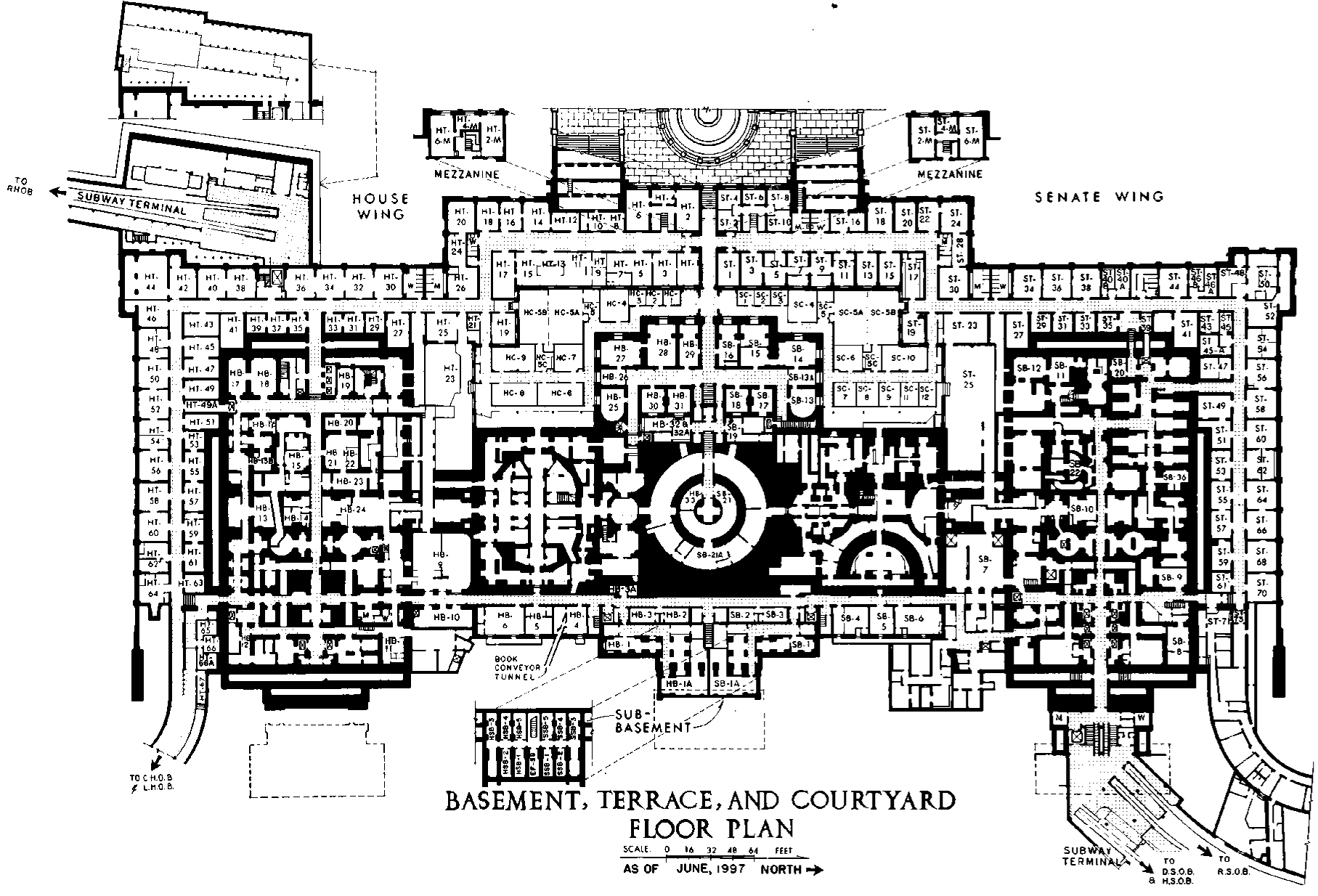
The subway system of the United States Capitol Complex in Washington, D.C., consists of three underground electric people mover systems that connect the United States Capitol to several congressional office buildings – all of the Senate buildings and one of the House buildings.
History
The original subway line was built in 1909 to link the Russell Senate Office Building to the Capitol. In 1960, an operator-controlled monorail was installed for the Dirksen Senate Office Building. A two-car subway line connecting the Rayburn House Office Building to the Capitol was built in 1965. The Dirksen monorail, which had been extended to the Hart Senate Office Building in 1982, was replaced in 1993 by an automatic train.
Network
On the Senate side, two separate subway lines exist. The first is a crewed two-track system, with a single open-topped car operating on each track, connecting the Russell Senate Office Building and the Capitol. The other is a computer-controlled system with three enclosed trains of three cars each running on a 90-second schedule, connecting the Hart Senate Office Building, the Dirksen Senate Office Building, and the Capitol. The train cars are unpowered; the train is propelled by a track-side linear motor. This line has two parallel tracks for most of its length, but at the Hart and Capitol stations the tracks converge into one, with a single side platform. This allows easy return travel on the opposite track. The Dirksen station features a side platform for Capitol-bound trains and an island platform for Hart-bound trains. All three of these stations feature platform screen doors. A small maintenance spur is located adjacent to the Hart station.
On the House side, an older, crewed two-track system, with a single open-topped car operating on each track, shuttles passengers between the Rayburn House Office Building and the Capitol. The remaining four House office buildings are not serviced by the subway system; two (Cannon and Longworth) use a shared underground footpath tunnel while the other two (Ford and O'Neill) have no underground connection to the capitol.
The House and Senate subway systems do not terminate in the same location under the Capitol, but they are connected by a labyrinth of tunnels.
Security
The public can travel on the trains — usually during a tour of the Capitol Complex — but must be escorted by a staff member with proper identification. During votes, the House subway is restricted to congressional members. The Russell subway is restricted to members and staff during Senate votes.
Since the terrorist attacks of September 11, 2001, restrictions have been placed on visitors using the Senate subway between the Hart and Dirksen buildings.
1947 shooting
Senator John W. Bricker was shot at as he entered the Capitol subway tunnel by former Capitol Police officer William Louis Kaiser on July 12, 1947. Bricker survived as the shots did not hit him.
2007 collision
A collision occurred on October 2, 2007, in the Rayburn to Capitol subway line after a car failed to slow down when it reached the end of the track line. The operator was injured and taken to a hospital for observation.
Image gallery
|File:Flickr - USCapitol - Senate Studebaker Car.jpg |Studebaker Electric subway car in 1909 |File:Monorail subway from Capitol to Senate. Construction work (cropped).jpg |Installing a monorail in 1912 |File:Monorail subway from Capitol to Senate. Car (cropped).jpg |Monorail car in 1912 |File:Monorail subway from Capitol to Senate (cropped).jpg |Monorail car in 1912 |File:Installation of the Senate Subway (8613605129) (cropped).jpg |Installation of a new subway car sometime between 1958 and 1961 |File:Flickr - USCapitol - Russell Senate Office Build Subway Tunnel.jpg |Subway car traveling to the Russell Senate Office Building in 2003 |File:Senator Joe Lieberman and his wife Hadassah on their way to the Capitol in 2011.jpg |Senator Joe Lieberman rides the subway to the Capitol with his wife Hadassah in 2011
Rolling stock
Current cars:
- Four open car sets with seating for 18 and separate cab for operator; two sets for the House and two sets for the Senate
- Three enclosed, unpowered car sets with seating for 36; automated cars
Retired cars:
- Studebaker Company built electric coach cars 1909 from Russell line
- Two electric monorail cars 1912
- Two electric monorail cars 1915 and 1920 replacing 1912 cars and retired 1961; built by Columbia Construction Company at Washington Naval Yard
- Dirksen line electric monorail 1960 retired 1993 and replaced with enclosed monorail cars
References
References
- Kessler, Ronald. (1998). "Inside Congress: The Shocking Scandals, Corruption, and Abuse of Power Behind the Scenes on Capitol Hill". [[Simon & Schuster]].
- Alexovich, Ariel. (May 31, 2006). "The not-so-seedy underworld of Capitol Hill". [[Roll Call]].
- "The Rayburn House Office Building". [[Architect of the Capitol]].
- (January 15, 1965). "Capitol Clinker".
- (August 15, 2017). "Political drama follows lawmakers underground to Capitol Hill subway". Washington Post.
- "Attacks on Congress not new: Disgruntled policeman shot at Ohio senator at Capitol in 1947".
- Yehle, Emily. (October 4, 2007). "Subway Accident Injures One". Roll Call.
- (March 7, 2016). "Behind the Scenes: Senate Subway Branch".
This article was imported from Wikipedia and is available under the Creative Commons Attribution-ShareAlike 4.0 License. Content has been adapted to SurfDoc format. Original contributors can be found on the article history page.
Ask Mako anything about United States Capitol subway system — get instant answers, deeper analysis, and related topics.
Research with MakoFree with your Surf account
Create a free account to save articles, ask Mako questions, and organize your research.
Sign up freeThis content may have been generated or modified by AI. CloudSurf Software LLC is not responsible for the accuracy, completeness, or reliability of AI-generated content. Always verify important information from primary sources.
Report