From Surf Wiki (app.surf) — the open knowledge base
United States bombing of the Chinese embassy in Belgrade
1999 bombing of a diplomatic mission

1999 bombing of a diplomatic mission
| Field | Value |
|---|---|
| partof | the NATO bombing of Yugoslavia |
| title | United States bombing of the Chinese embassy in Belgrade |
| image | Embassy of China, Belgrade, following US bombing, May 8, 1999.webp |
| caption | The Embassy building the morning following the bombing |
| map | {{Location map |
| mark | Shelling icon orange.svg |
| marksize | 14 |
| lat_deg | 44.8250 |
| lon_deg | 20.4190 |
| map_caption | Bombing location within Belgrade |
| location | Belgrade, Serbia, Yugoslavia |
| coordinates | |
| target | US claim: Yugoimport headquarters |
| China claim: Embassy of China, Belgrade | |
| date | May 7, 1999 |
| time | 23:46 CEST |
| type | Aerial bombing |
| fatalities | 3 |
| injuries | 27 |
| perps | |
| Flag of the U.S. Central Intelligence Agency.svg Central Intelligence Agency | |
| NATO (disputed) | |
| weapons | Five JDAM bombs released from one B-2 Spirit |
| motive | Disputed; |
| US claim: unintentional; | |
| see allegations of intention |
|Serbia Belgrade China claim: Embassy of China, Belgrade Flag of the U.S. Central Intelligence Agency.svg Central Intelligence Agency NATO (disputed) US claim: unintentional; see allegations of intention
The bombing of the Chinese embassy in Belgrade, also known in China as the May 8th incident, occurred May 7, 1999, during the NATO bombing of Yugoslavia, when a US B-2 Spirit dropped five Joint Direct Attack Munition satellite-guided bombs on the Embassy of China, Belgrade, FR Yugoslavia, killing three Chinese journalists and injuring twenty-seven others. According to the US, the intention had been to bomb the headquarters of Yugoslav weapons importer Yugoimport, 440 meters south on the same street. President Bill Clinton apologized for the bombing, claiming it was an accident.
Central Intelligence Agency director George Tenet later testified the bombing was the only one in the campaign organized by his agency, and that the CIA had "miscalculated" the Yugoimport coordinates from its address. The Yugoimport building was later bombed but remains standing . The US claimed its own map and satellite imagery analysis approved the target while failing to identify it as an embassy. Although extensively referenced as a NATO mission and aircraft, all B-2 strikes were targeted and flown under United States European Command alone. One CIA officer was fired following an investigation.
The Chinese government declared the bombing a "barbarian act". Anti-US and anti-NATO protests, many tens of thousands strong, swept across China. Crowds outside US and NATO missions in major cities threw rocks and destroyed vehicles, setting alight the US Consul General's residence in Chengdu. No serious injuries occurred. Around the world, Chinese students and diaspora peacefully protested at US embassies.
In October 1999, The Observer and Politiken published a joint investigation concluding that the bombing was deliberate. Believing the embassy was hosting rebroadcasting for the Yugoslav Army, NATO allegedly transferred the embassy from a prohibited target list to a designated target list. Jiang Zemin, China's paramount leader in 1999, admitted in 2011 that he allowed Yugoslav military units to operate from the embassy.{{multiref2|The article is available at no cost via the New Zealand paper The Press and is shown with PressReader. It is also available via ProQuest and with a subscription to The Times (The Times and *The Sunday Times'' are sister papers).||||||A book by David Nauta on NATO and international law also mentions this unpublished memoir.|| Full text available via Semantic Scholar.
Most Chinese people continue to believe the attack was deliberate.{{multiref2
In August 1999, the US agreed to pay $4.5 million to the victims of the bombing and their families. In December, the US agreed to compensate China $28 million for damages to the embassy, and China agreed to compensate the US $2.87 million for protestors' damages. In May, the United States–China Relations Act of 2000 paved the way for China's entry into the World Trade Organization. By June 2000, during a visit to China by US Secretary of State Madeleine Albright, both sides said that relations between them had improved. A was completed on the former embassy site in 2020.
Sequence of events
In the days before the bombing, an attack folder labelled "Belgrade Warehouse 1" was circulated for command approval. The folder originated within the CIA and described the target as a warehouse for a Yugoslav government agency suspected of arms proliferation activities. In this form, the strike was approved by President Clinton.{{cite news
It is unclear whether other NATO leaders approved the strike. A report by the French Ministry of Defense after the war said that "part of the military operations were conducted by the United States outside the strict framework of NATO" and that a dual-track command structure existed. NATO had no authority to use any B-2 stealth bomber, which was used to carry out the strike.
According to officials interviewed by The New York Times, the target was checked against a "no-strike" database of locations such as hospitals, churches, and embassies, but this raised no alarm as the embassy was listed at its old address. Officials said a similar list in the UK also had the same error.{{cite news
At 23:46 CEST on the night of May 7, the strike was carried out by a single B-2 bomber with a crew of two of the United States Air Force's 509th Bomb Wing flying directly out of Whiteman AFB, Missouri. The bomber was armed with Mark 84 2,000-pound bombs, armed with JDAM GPS guidance precision kits. The weapons were accurate to 13 m. However, the geographic coordinates provided by the CIA and programmed into the bombs were those of the Chinese embassy 440 m to the north. At around midnight local time, five bombs landed at different points on the embassy complex. The embassy had taken precautionary measures in view of the ongoing bombing campaign, sending staff home and housing others in the basement, but the attack still resulted in three fatalities: Shao Yunhuan (邵云环) who worked for the Xinhua News Agency, Xu Xinghu (许杏虎) and his wife Zhu Ying (朱颖) who worked for Guangming Daily, both Chinese state media, in addition to at least 20 people being injured.{{cite news
Chinese reaction
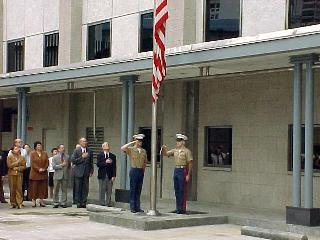
.jpg)
Government reaction
The raid caused a dramatic rise in tension between China and the United States. An official statement on Chinese television denounced what it called a "barbaric attack and a gross violation of Chinese sovereignty". China's ambassador to the UN described what he called "NATO's barbarian act" as "a gross violation of the United Nations charter, international law and the norms governing international relations" and "a violation of the Geneva convention".
At an emergency CCP Politburo meeting after the bombing, CCP General Secretary Jiang Zemin stated, "I am shocked and indignant. This event is not a trivial matter; it is absolutely critical" and that "the Chinese people cannot be bullied!" Jiang also said that had Mao Zedong and Zhou Enlai not led China to develop nuclear weapons and satellites, "I fear we would have been attacked earlier on."
On May 12, 1999, the Legislative Council of Hong Kong passed the "Condemnation of NATO" motion in a rare 54–0 bipartisan vote.* 香港立法會中文會議記錄:
- English:
On May 12, 1999, in his first public statement since the embassy bombing, Premier of China Zhu Rongji called NATO "hypocrites" and stated that the "idea of safeguarding human rights and democracy, as well as opposing ethnic cleansing which they [NATO] are chanting loudly, is only a fig leaf." He also called on the United States and NATO "to make an open and official apology to the Chinese government and the Chinese people."{{cite news
President Clinton's apologies and those of the US State Department were not initially broadcast by Chinese state-run media outlets. The demonstrations continued for four days before the Chinese government called a halt, eventually broadcasting President Clinton's apology on television and ordering the police to restrain the demonstrators.
For a week, General Secretary of the Chinese Communist Party Jiang Zemin declined phone calls from President Bill Clinton, eventually accepting a 30-minute apology call on May 14, in which Clinton expressed "regret" over the incident. Jiang had chosen to leave US-China leadership communications channels unused as he waited for the Politburo Standing Committee to reach a consensus. The time it took for the Politburo to gather necessary information and reach a decision about China's responses motivated Party leadership to revisit a proposal to establish a centralized National Security Commission, although this was ultimately not implemented at the time.
In the aftermath of the American bombing, the Chinese government ordered media outlets not to criticize the American president further and the Communist Party directed to the media to report on the United States in a less hostile manner. Generally, these limitations frustrated Chinese journalists.
Public reaction
Large and often violent anti-US and anti-NATO protests erupted across China, targeting the consular offices of the United States and other NATO countries. Large-scale protests at US offices in Beijing, Shanghai, Guangzhou, Chengdu, and Shenyang forced their temporary closure. Further protests occurred in Nanjing, Lanzhou, Hong Kong and the Portuguese territory of Macau, seven months prior to its handover to China. Student slogans included "don't take TOEFL, don't take GRE, fight wholeheartedly the American Empire".
Western media accused Chinese media of fueling the protests, pointing to its initial lack of reporting on the US apologies, and rhetoric such as a People's Daily article saying NATO had intentionally "spilled Chinese blood".
The protests continued for several days, during which tens of thousands of rock-throwing protesters kept US Ambassador James Sasser and other staff trapped in the Beijing embassy. The residence of the US Consul in Chengdu was damaged by fire, but there were no reported injuries. The Albanian embassy in Beijing was also attacked.
On May 9, 1999, then Vice President Hu Jintao delivered a national televised speech calling the act both "criminal" and "barbaric" and that it "has greatly infuriated the Chinese people." He said the unauthorized demonstrations in Beijing, Shanghai, Guangzhou, Chengdu and Shenyang reflected the anger and patriotism of the Chinese people, and which the Chinese government fully supported, but urged against extreme and illegal conduct.
Settlement
By the end of 1999, relations began to gradually improve. In August, the US government made a "voluntary humanitarian payment" of $4.5 million to the families of the three Chinese nationals who were killed and to those who were injured. On December 16, 1999, the two governments reached a settlement under which the United States agreed to pay $28 million in compensation for damage to the Chinese Embassy facility, and China agreed to pay $2.87 million in compensation for damage inflicted to the US Embassy and other diplomatic facilities in China.
Technically, although the $4.5 million paid to the victims and their families came from Department of Defense discretionary funds, the $28 million for the damage to the embassy needed to be appropriated by the United States Congress; China would receive $28m in compensation from the US for the bombing, but had to give back close to $3m for the damage to US diplomatic property in Beijing and elsewhere. The US paid another $4.5m to the families of the dead and injured.
Official investigation and reporting in the aftermath
Late on May 8, US Defense Secretary William Cohen and George Tenet issued a joint press release stating neither the aircrew involved nor the equipment were to blame for the incident. The first attempt to explain the bombing came on May 10. William Cohen told reporters "In simple terms, one of our planes attacked the wrong target because the bombing instructions were based on an outdated map". The statement made no mention of the CIA. It was subsequently revealed that the CIA possessed maps showing the embassy.
While US officials then began, on the record, to deflect questions pending the outcome of further enquiries, they continued to brief journalists off the record. For example, also on May 10, Eric Schmitt published an account with most of the elements that were to feature in Director of Central Intelligence (DCI) Tenet's later admissions. Schmitt reported that from the grainy aerial photographs that were used the two buildings looked very similar in terms of size, shape and height, and that the distance between them is about 200 yd.
Media criticism focused on the National Imagery and Mapping Agency (NIMA) which made an announcement stating that "recent news reports regarding the accuracy of NIMA maps have been inaccurate or incomplete" and that "a hard-copy map is neither intended, nor used, as the sole source for target identification and approval." CIA Director George Tenet later acknowledged that the map used should never have been used for aerial bombing target selection.
Official State Department account
In June, Under Secretary of State Thomas Pickering led a delegation to China to present the US version of events.
According to the official account, CIA analysts knew the address of the Yugoimport office to be Bulevar Umetnosti 2 (2 Boulevard of the Arts). Using this information, they attempted to pinpoint its geographic location by using the known locations and addresses of other buildings on parallel streets as reference points. (The New York Times reported that some referred to what was done as "resection and intersection" although Pickering did not use those terms in the statement.)
Parallel lines were drawn from known addresses and locations on a parallel street. With this information, it was attempted to reconstruct the pattern of street addresses on Bulevar Umetnosti, which was information unknown to the targeteers. The pattern of street addresses on Bulevar Umetnosti was not as expected, and the targeteer erroneously pinpointed the embassy "located on a small side street at some distance on Bulevar Umetnosti" from the intended target.
Multiple checks designed to prevent attacks on sensitive targets each failed as the location of the embassy had not been updated since the embassy moved to New Belgrade three years earlier. As a result, the bombers took to the air with the coordinates of the Chinese embassy programmed into the bombs on board.
Pickering said that they found no evidence that the embassy was being used to assist Serbian forces, and said that it is not conceivable that any rogue group within the US would have done such a thing. He said that, "Science has taught us that a direct explanation, backed up by full knowledge of facts obtained through a careful investigation, is always preferable to speculation and far fetched, convoluted or contrived theories with little or no factual backing."
George Tenet's statement
On July 22, George Tenet made a statement before a public hearing of the House Intelligence Committee. Covering the same ground as Under Sec. Pickering's statement in China, he additionally acknowledged the target package originated within the CIA and that it was the sole CIA-directed strike of the war, stated that he had been personally unaware that the CIA was circulating strike requests and recognized that the CIA possessed maps correctly displaying the embassy. Deputy Defense Secretary John Hamre, giving evidence the same day, stated that "NIMA is not at fault".
Repercussions for CIA employees responsible
Tenet reprimanded six CIA officers and fired one as a result of the investigation.{{cite news
Chinese reaction
Few Chinese politicians believed the US version of events, believing instead that the strike had been deliberate. Former Ambassador Li Daoyu stated "we don't say it was a decision of Clinton or the White House", but the Chinese government describes the US explanation for "the so-called mistaken bombing" as "anything but convincing" and has never accepted the US version of events.
The bombing left a toxic legacy on China-NATO relations and kept them frozen for years. In a 2011 meeting with US officials in the aftermath of the 2011 NATO attack in Pakistan, Chinese general Ma Xiaotian directly referred to the embassy bombing by asking "Were you using the wrong maps again?" Observers immediately noted the "cutting" nature of the remark, describing it as "jibing" and "priceless".
Allegations of intention
Yugoslav forces in the embassy
''The Observer''/''Politiken'' report
On October 17, 1999, The ObserverNote that the story actually appears on *The Guardian'''s website (www.theguardian.com). The Observer is published on Sundays and The Guardian is published daily and both are sister publications owned by Guardian Media Group. published an article by John Sweeney, Jens Holsoe and Ed Vulliamy stating that the bombing was deliberate. On the same day, Copenhagen-based publication *Politiken'' published a similar story in Danish saying that the bombing was deliberate, claiming the Chinese were helping the Yugoslavian forces who were engaged in ethnic cleansing and war crimes in Kosovo.
On November 28, 1999, The Observer published a follow-up piece stating that the Americans bombed the embassy due to allegations that the Chinese were helping Željko Ražnatović, a Serbian mobster, paramilitary leader, and indicted war criminal.
In the Politiken story, a source within the British Ministry of Defense is quoted as saying that the Chinese gave permission to the Yugoslavian army to use the embassy as a communications base. The British source stated the normal practice in this case would be to contact the Chinese and to ask them to stop the activity due to its violation of the Vienna Convention on Diplomatic Relations, and that they assumed that happened but did not have specific knowledge on it. Politiken also reported that British sources surmised that the Chinese did not believe NATO would dare strike the embassy.
The stories drew from anonymous sources, although in instances overall position in the hierarchy, role, and location was mentioned. One non-anonymous source was Dusan Janjic, an academic and advocate for ethnic reconciliation in Yugoslavia who testified that the military attaché at the embassy, Ren Baokai, openly spoke to him about how China was spying on the US
Madeleine Albright, US Secretary of State at the time, called the story that the bombing was deliberate "balderdash", and Robin Cook, British Foreign Secretary at the time, said, "I know not a single shred of evidence to support this rather wild story." The Chinese ambassador to Yugoslavia at the time, Pan Zhanlin, denied in a book that the embassy was being used for rebroadcasting by Yugoslavian forces.
Fairness & Accuracy In Reporting (FAIR) posts on lack of US media coverage
On October 22, 1999, media critique group Fairness & Accuracy In Reporting (FAIR) posted on the lack of US media coverage of The Observer/Politiken report and called on its supporters to contact major newspapers to ask why it was not being covered.
Andrew Rosenthal of The New York Times responded along with Douglas Stanglin of USA Today, and FAIR summarized the exchanges in a post on November 3, 1999. Rosenthal agreed that coverage should not have referred to the bombing as accidental when this was disputed; however, he said that the stories were not well sourced by their standards. He said that reporters were assigned to look into the matter, but that they were not yet ready to publish (about six months later, in April 2000, they did publish the results of an investigation, and it found no evidence that the bombing was deliberate). In the post, and in response to Rosenthal, FAIR listed the various anonymous sources in terms of general position in the command hierarchy, location, and role and said that if they had come forward publicly they could have been court martialed. FAIR also argued that the report is consistent with other information known about the bombing such as where the bombs hit the embassy, and also pointed out that The Observer/Politiken report was more widely covered internationally than in the US{{multiref2
''The Sunday Times'' report of an unpublished memoir by Jiang Zemin
In February 2011, The Sunday Times published an article stating that an unpublished memoir by former Chinese leader Jiang Zemin recounts how Serbian forces were allowed to use the Chinese embassy, and that privately, the US showed evidence of this activity to the Chinese.{{multiref2
Potential targeting of the nearby Hotel Yugoslavia
A 2000 Salon article by Laura Rozen featured an interview of Washington Post columnist and former intelligence officer William M. Arkin, who stated his belief that the bombing was accidental. Rozen reported that the Chinese embassy and the Hotel Yugoslavia are across the street from each other, and that in the Hotel Yugoslavia, Željko Ražnatović owned a casino and had a headquarters. Both the Hotel Yugoslavia and the Chinese embassy were bombed the same night of May 7.
Arkin told Rozen his belief that certain people at NATO erroneously believed that signals coming from the Hotel Yugoslavia were actually coming from the Chinese embassy saying, "I think there were communications emanating from the Hotel Yugoslavia across the street. And I think that stupid people who are leaking rumors to The Observer have made that mistake."
Chinese intelligence collection from the embassy
US officials told the New York Times that, following the bombing, they learned the embassy was China's most significant intelligence collection platform in Europe. Jens Holsøe, the journalist who wrote the Politiken article, said he directly witnessed Yugoslav military vehicles enter the Chinese embassy compound.
On 24 March 1999, ten weeks prior to the bombing, a Yugoslav Army unit successfully shot down a USAF F-117 Nighthawk, the first ever downing of a stealth aircraft. The article from The Observer in October 1999 reported that a stealth fighter had been shot down early in the air campaign and that since China lacked stealth technology, they may have been glad to trade with the Yugoslav forces. In January 2011, the Associated Press via Fox News reported that the unveiled Chinese J-20 may have been developed in part by reverse-engineering the US F-117 from parts of the wreckage that were recovered.
In May 2019, BBC News reported that, "It's widely assumed that China did get hold of pieces of the plane to study its technology." There was speculation that China had been testing, from the embassy, air defence systems, including countering the stealth technology of the US F-117 and B-2 Spirit aircraft flying over Belgrade. Serbian academic Dusan Janjic reported a conversation with the embassy's military attache Ren Baokai, who was surprisingly open that China was tracking US and NATO operations, cruise missiles, and aircraft from the embassy. Ren was in the embassy during the attack and found in a coma in the basement the next morning. He was transferred to hospital in China, where he recovered and was later given the rank of general. In 2019, he was retired, and declined an interview with the BBC.
International Criminal Tribunal for the former Yugoslavia (ICTY) investigation
A report conducted by the ICTY entitled "Final Report to the Prosecutor by the Committee Established to Review the NATO Bombing Campaign Against the Federal Republic of Yugoslavia" after the Kosovo War examined the attack on the Chinese embassy specifically and came to the conclusion that the Office of the Prosecutor should not undertake an investigation concerning the bombing. In reaching its decision, it provided the following observations:
- That the root of the failures in target location appears to stem from the land navigation techniques employed by an intelligence officer in an effort to pinpoint the location of the Yugoimport FDSP building at Bulevar Umetnosti 2. The officer used techniques known as "intersection" and "resection" which, while appropriate to locate distant or inaccessible points or objects, are inappropriate for use in aerial targeting as they provide only an approximate location. Using this process, the individual mistakenly determined that the Chinese Embassy was the Yugoimport FDSP headquarters.
- The United States has formally apologized to the Chinese Government and agreed to pay $28 million in compensation to the Chinese Government and $4.5 million to the families of those killed or injured. The CIA has also dismissed one intelligence officer and reprimanded six senior managers. The US government also claims to have taken corrective actions in order to assign individual responsibility and to prevent mistakes such as this from occurring in the future.
- The aircrew involved in the attack should not be assigned any responsibility for the fact they were given the wrong target and that it is inappropriate to attempt to assign criminal responsibility for the incident to senior leaders because they were provided with wrong information by officials of another agency.
Amnesty International report
Amnesty International examined the NATO air campaign and assessed the legality of its actions. In the case of the embassy bombing, Amnesty reported both on the official explanation and to the Observer/Politiken investigation without arbitrating as to which was true. NATO was criticized for continuing its bombing campaign uninterrupted when its safeguards to protect civilians were known to be faulty. A genuinely accidental attack would not imply legal responsibility, but the report stated that "the very basic information needed to prevent this mistake was publicly and widely available at the time" and that, "It would appear that NATO failed to take the necessary precautions required by Article 57(2) of Protocol I." Article 57(2) of Protocol I of the Geneva Conventions says that an attacker shall, "do everything feasible to verify that the objectives to be attacked are neither civilians nor civilian objects."
Aftermath
Future of the location

Marking the 10th anniversary of the bombing on May 7, 2009, Belgrade Mayor Dragan Đilas and Chinese Ambassador to Serbia Wei Jinghua dedicated a commemorative plaque at the location. The author of the plaque was Nikola Kolja Milunović. Wreaths were laid at the plaque on May 7, 2017, and also in September 2019.
During the visit of General Secretary of the Chinese Communist Party Xi Jinping to Serbia in June 2016, he and Serbian President Tomislav Nikolić visited the location, declared the nearby turnaround a Square of Serbian-Chinese Friendship and announced the construction of the on the location of the former embassy. The construction of the center began on July 20, 2017, in the presence of Mayor Siniša Mali and Chinese Ambassador Li Manchang. The center will have ten floors, two below ground and eight above, with a total floor area measuring 32,000 m2. The project will cost 45 million euros.
In 2020, the Milunović plaque was replaced by a new, "modest" square memorial. While the inscription on the original plaque explained why it had been placed there and included the date of the bombing and number of victims, the new one has a generic text in Serbian and Chinese: As a token of gratitude to PR China for support and friendship in hardest moments for the people of the Republic of Serbia, and in memory of the killed. This sparked objections by the Belgraders, who called the new memorial "a shame" and a "table which says nothing", asking for the reinstatement of the old plaque.
China-Serbia relations
In advance of a state visit to Serbia overlapping the 25th anniversary of the bombing, CCP General Secretary Xi Jinping wrote an article in the Serbian newspaper Politika in which he stated, "The friendship between China and Serbia which is soaked in blood that the two peoples spilled together has become a joint memory of the two peoples and will encourage both parties to make together huge steps forward."
Rise of anti-Western sentiment and warming of China-Russia relations
Within the United Nations, both China and Russia opposed military action against Yugoslavia. Strong cultural ties exist between Russia and Serbia, and the bombing campaign, along with the bombing of the Chinese embassy, led to an increase in anti-Western sentiment in both countries and a warming of China-Russia relations.{{multiref2
People's Liberation Army reforms
Political science scholar Fiona Cunningham has argued that the bombing was a key event in shaping the modern People's Liberation Army. The NATO campaign had already alarmed Chinese leaders, fearing that its lack of United Nations Security Council approval, recognition of a breakaway state, and humanitarian justifications, could all be used in a potential conflict against China over Taiwan, Xinjiang, or Tibet. China's military establishment searched for ways to increase its strategic threats against the United States, including the development of precision conventional missiles, and offensive cyberwarfare operations. The PLA also recognized the importance of space-based military infrastructure to the US bombing, leading it to develop a number of anti-satellite weapons. The PLA's cyber and space capabilities were consolidated into the People's Liberation Army Strategic Support Force in 2015. It also triggered some debate around potential changes to China's nuclear no first use policy, but this remained unchanged.
Notes
References
References
- (7 May 2019). "The night the US bombed a Chinese embassy". BBC News.
- (7 May 2019). "The night the US bombed a Chinese embassy". BBC News.
- Rozen, Laura. (2025-10-07). "Spooky murder in Loudoun County, VA".
- (May 10, 1999). "CNN - Clinton apologizes to China over embassy bombing - May 10, 1999".
- (May 10, 1999). "Youth Violence and Embassy Bombing Apology {{!}} C-SPAN.org".
- Dumbaugh, Kerry. (April 12, 2000). "Chinese Embassy Bombing in Belgrade: Compensation Issues".
- Schmitt, Eric. (July 23, 1999). "In a Fatal Error, C.I.A. Picked a Bombing Target Only Once: The Chinese Embassy". New York Times.
- Tenet, George. (July 22, 1999). "DCI Statement on the Belgrade Chinese Embassy Bombing House Permanent Select Committee on Intelligence Open Hearing". Central Intelligence Agency.
- (2019-05-06). "The night the US bombed a Chinese embassy". BBC News.
- "6/17/99: U/S Pickering: Accidental Bombing of The P.R.C. Embassy in Belgrade".
- "CNN - Clinton apologizes to China over embassy bombing - May 10, 1999".
- Lambeth, Benjamin S.. (2001-01-01). "NATO's Air War for Kosovo: A Strategic and Operational Assessment".
- "Chinese demand U.N. meeting after Belgrade embassy attacked". CNN.
- "Political Violence Against Americans: 1999".
- Note that the story actually appears on ''[[The Guardian]]'''s website (www.theguardian.com). ''The Observer'' is published on Sundays and ''The Guardian'' is published daily and both are sister publications owned by [[Guardian Media Group]].
- (October 17, 1999). "Nato bombed Chinese deliberately". The Observer.
- (October 17, 1999). "Kina hjalp Jugoslavien". Politiken.
- (7 May 2019). "The night the US bombed a Chinese embassy". BBC News.
- Steven Lee Myers. (April 17, 2000). "Chinese Embassy Bombing: A Wide Net of Blame". New York Times.
- Moore, Gregory J.. (2010). "Not Very Material but Hardly Immaterial: China's Bombed Embassy and Sino-American Relations". Foreign Policy Analysis.
- Moore, Gregory J.. (2010). "Not Very Material but Hardly Immaterial: China’s Bombed Embassy and Sino-American Relations". Foreign Policy Analysis.
- Chu, Henry. (July 31, 1999). "U.S. to Pay $4.5 Million for Bombing of Chinese Embassy in Yugoslavia".
- Laris, Michael. (December 16, 1999). "U.S., China Reach Deal On Embassy Payments". Washington Post.
- Rosenthal, Elisabeth. (1999-12-16). "U.S. Agrees To Pay China $28 Million For Bombing". The New York Times.
- Dumbaugh, Kerry. (April 12, 2000). "Chinese Embassy Bombing in Belgrade: Compensation Issues".
- "HR 4444 - U.S.-China Relations Act of 2000 - National Key Vote".
- (May 25, 2000). "House Passes China Trade Bill". Washington Post.
- Lardy, Nicholas R.. (May 10, 2000). "Permanent Normal Trade Relations for China".
- "China Trade bill (2000 - H.R. 4444)".
- Perlez, Jane. (June 23, 2000). "With Relations Warming, Albright Presses China on Taiwan". The New York Times.
- Whitney, Craig. (November 11, 1999). "U.S. Military Acted Outside NATO Framework During Kosovo Conflict, France Says". New York Times.
- (November 27, 1999). "Truth behind America's raid on Belgrade". The Observer.
- (October 17, 1999). "Nato bombed Chinese deliberately". The Guardian.
- (November 28, 1999). "Truth behind America's raid on Belgrade". The Observer.
- Diamond, John. (2008). "The CIA and the Culture of Failure: U.S. Intelligence from the end of the Cold War to the Invasion of Iraq". Stanford University Press.
- Diamond, John. (2008). "The CIA and the Culture of Failure: U.S. Intelligence from the end of the Cold War to the Invasion of Iraq". Stanford University Press.
- (October 17, 1999). "Nato bombed Chinese deliberately". The Guardian.
- Diamond, John. (2008). "The CIA and the Culture of Failure: U.S. Intelligence from the end of the Cold War to the Invasion of Iraq". Stanford University Press.
- Consulate General of the United States Hong Kong & Macau. (August 2, 1999). "Statements on NATO Bombing of China's Embassy in Belgrade". U.S. Department of State.
- (2007). "Apologia Politica: States and Their Apologies by Proxy". [[Lexington Books]].
- (May 8, 1999). "Nato hits Chinese embassy". BBC News.
- (May 8, 1999). "Embassy strike 'a mistake'". BBC News.
- Cunningham, Fiona S.. (2025). "Under the Nuclear Shadow: China's Information-Age Weapons in International Security". [[Princeton University Press]].
- Xinbo, Wu. (2008). "Understanding Chinese and U.S. Crisis Behavior". The Washington Quarterly.
- Dumbaugh, Kerry. (April 12, 2000). "Chinese Embassy Bombing in Belgrade: Compensation Issues".
- (15 May 1999). "JIANG FINALLY ACCEPTS CALL FROM CLINTON, GETS APOLOGY". Chicago Tribune.
- Ji, You. (March 2016). "China's National Security Commission: theory, evolution and operations". Journal of Contemporary China.
- Wang, Frances Yaping. (2024). "The Art of State Persuasion: China's Strategic Use of Media in Interstate Disputes". [[Oxford University Press]].
- (May 9, 1999). "China gives green light to embassy protests, but warns against violence". CNN.
- "1999:反美游行 民族主义新浪潮_新闻中心_新浪网".
- (May 9, 1999). "Chinese in Belgrade, Beijing protest NATO embassy bombing". CNN.
- (May 9, 1999). "Chinese Vice-President Hu: Broadcast to Nation on NATO Strike - Domestic Report.". BBC Monitoring Asia Pacific - Political.
- (May 10, 1999). "China: Vice-President's Televised Speech Widely Supported.". BBC Monitoring Asia Pacific - Political.
- (Chinese) ''[[People's Daily]]'' via [[Sina Corporation. Sina.com]] [http://news.sina.com.cn/c/2003-05-25/14421097103.shtml "资料: 1999年5月9日胡锦涛就我驻南使馆遭袭击发表讲话"] Accessed October 18, 2021
- Dumbaugh, Kerry. (April 12, 2000). "Chinese Embassy Bombing in Belgrade: Compensation Issues".
- Laris, Michael. (December 16, 1999). "U.S., China Reach Deal On Embassy Payments". Washington Post.
- Rosenthal, Elisabeth. (1999-12-16). "U.S. Agrees To Pay China $28 Million For Bombing". The New York Times.
- (7 May 2019). "The night the US bombed a Chinese embassy". BBC News.
- Schmitt, Eric. (May 10, 1999). "CRISIS IN THE BALKANS: HUMAN ERROR; Wrong Address of Embassy in Databases". New York Times.
- Cohen, William. (May 10, 1999). "Secretary of Defense Cohen's News Briefing on Chinese Embassy Bombing". US Department of Defense.
- Leopold, George. (May 21, 1999). "Human error takes rap in embassy bombing".
- (May 16, 1999). "NIMA: FOR IMMEDIATE RELEASE: Release Number 990516-2: Chinese Embassy Bombing". National Imagery and Mapping Agency.
- Pickering, Thomas R.. (July 6, 1999). "Oral Presentation to the Chinese Government Regarding the Accidental Bombing of The P.R.C. Embassy in Belgrade". US Department of State.
- bearings]] rather than street addresses.
- (July 22, 1999). "Testimony of John J. Hamre, Deputy Secretary of Defense Before the House Select Committee on Intelligence".
- Kettle, Martin. (April 10, 2000). "CIA takes rap for embassy attack".
- Peter Hays Gries. (July 2001). "Tears of Rage: Chinese Nationalist Reactions to the Belgrade Embassy Bombing". Contemporary China Center, Australian National University.
- Arkin, William M.. (November 8, 1999). "Chinese Embassy Continues to Smolder". Washington Post.
- (November 17, 2001). "Strong Protest by the Chinese Government Against The Bombing by the US-led NATO of the Chinese Embassy in the Federal Yugoslavia". Ministry of Foreign Affairs of the People's Republic of China.
- Small, Andrew. (23 May 2012). "Seizing Opportunities with a Less Reserved Beijing - German Marshall Fund Blog".
- Weitz, Richard. (2012-07-06). "China and NATO: Grappling with Beijing's Hopes and Fears". [[Jamestown Foundation]].
- (October 17, 1999). "Nato bombed Chinese deliberately". The Observer.
- (October 17, 1999). "Kina hjalp Jugoslavien". Politiken.
- (November 27, 1999). "Truth behind America's raid on Belgrade". The Observer.
- (October 17, 1999). "Kina hjalp Jugoslavien". Politiken.
- (October 17, 1999). "Kina hjalp Jugoslavien". Politiken.
- (7 May 2019). "The night the US bombed a Chinese embassy". BBC News.
- (October 17, 1999). "Nato bombed Chinese deliberately". The Guardian.
- (October 17, 1999). "Nato embassy attack 'not deliberate'". BBC News.
- (7 May 2019). "The night the US bombed a Chinese embassy". BBC News.
- (October 22, 1999). "U.S. Media Overlook Expose on Chinese Embassy Bombing". FAIR.
- (November 3, 1999). "Chinese Embassy Bombing–Media Reply, FAIR Responds". FAIR.
- Steven Lee Myers. (April 17, 2000). "Chinese Embassy Bombing: A Wide Net of Blame". New York Times.
- (November 3, 1999). "Chinese Embassy Bombing–Media Reply, FAIR Responds". FAIR.
- (November 27, 1999). "Truth behind America's raid on Belgrade". The Observer.
- Moore, Gregory J.. (2010). "Not Very Material but Hardly Immaterial: China's Bombed Embassy and Sino-American Relations". Foreign Policy Analysis.
- (October 22, 1999). "U.S. Media Overlook Expose on Chinese Embassy Bombing". FAIR.
- Rozen, Laura. (February 10, 2000). "A "Boneheaded" bombing". Salon.
- (May 8, 1999). "Morning Briefing".
- (7 May 2019). "The night the US bombed a Chinese embassy". BBC News.
- (October 17, 1999). "Nato bombed Chinese deliberately". The Guardian.
- (January 23, 2011). "China's New Stealth Fighter May Use US Technology".
- "Final Report to the Prosecutor by the Committee Established to Review the NATO Bombing Campaign Against the Federal Republic of Yugoslavia". UNICTY.
- "Final Report to the Prosecutor by the Committee Established to Review the NATO Bombing Campaign Against the Federal Republic of Yugoslavia". UNICTY.
- "Final Report to the Prosecutor by the Committee Established to Review the NATO Bombing Campaign Against the Federal Republic of Yugoslavia". UNICTY.
- "Final Report to the Prosecutor by the Committee Established to Review the NATO Bombing Campaign Against the Federal Republic of Yugoslavia". UNICTY.
- (June 5, 2000). ""COLLATERAL DAMAGE" OR UNLAWFUL KILLINGS? : Violations of the laws of war by NATO during Operation Allied Force". Amnesty International.
- (June 5, 2000). ""COLLATERAL DAMAGE" OR UNLAWFUL KILLINGS? : Violations of the laws of war by NATO during Operation Allied Force". Amnesty International.
- "Treaties, States parties, and Commentaries - Additional Protocol (I) to the Geneva Conventions, 1977".
- (May 7, 2009). "Деценија од бомбардовања кинеске амбасаде". [[Politika]].
- (May 7, 2017). "Положени венци на месту погибије троје кинеских новинара". [[Politika]].
- (September 8, 2019). "Положени венци на спомен-плочу кинеским новинарима". [[Politika]].
- Tanjug. (June 17, 2016). "Predsednik Kine stigao u trodnevnu posetu Srbiji". [[Radio Television Serbia]].
- B.H.. (July 21, 2017). "Počela gradnja prvog kineskog kulturnog centra na Balkanu". [[Politika]].
- Beta. (July 20, 2017). "Počela izgradnja Kineskog kulturnog centra na Novom Beogradu". [[N1 (television).
- Dušan. Milenković. (28 July 2020)
- Vasovic, Aleksander. (5 May 2024). "China's Xi Jinping to Visit Serbia on Anniversary of 1999 NATO Bombing". [[Reuters]].
- Dumbaugh, Kerry. (April 12, 2000). "Chinese Embassy Bombing in Belgrade: Compensation Issues".
- Snyder, Christian. (September 7, 2017). "Analysis: How a 1999 NATO operation turned Russia against the West".
- Dinic, Leonardo. (September 13, 2019). "We Remember 1999 Very Well'- The NATO Bombing of Yugoslavia and its Impacts on Sino-Russian Relations". [[China–United States Exchange Foundation]].
- Cunningham, Fiona S.. (2025). "Under the Nuclear Shadow: China's Information-Age Weapons in International Security". [[Princeton University Press]].
This article was imported from Wikipedia and is available under the Creative Commons Attribution-ShareAlike 4.0 License. Content has been adapted to SurfDoc format. Original contributors can be found on the article history page.
Ask Mako anything about United States bombing of the Chinese embassy in Belgrade — get instant answers, deeper analysis, and related topics.
Research with MakoFree with your Surf account
Create a free account to save articles, ask Mako questions, and organize your research.
Sign up freeThis content may have been generated or modified by AI. CloudSurf Software LLC is not responsible for the accuracy, completeness, or reliability of AI-generated content. Always verify important information from primary sources.
Report