From Surf Wiki (app.surf) — the open knowledge base
United States Attorney
Chief prosecutor representing the US federal government

Chief prosecutor representing the US federal government
the federal government position
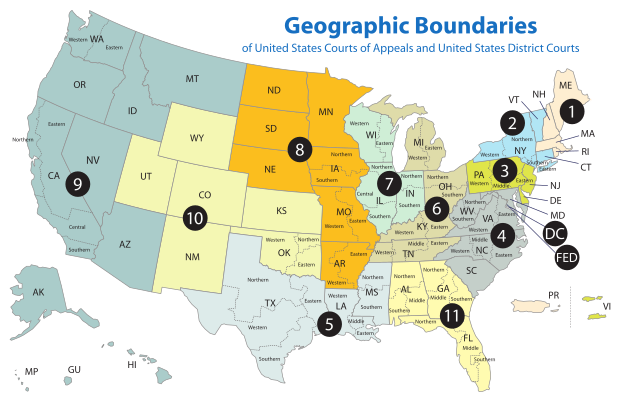
United States attorneys are officials of the U.S. Department of Justice who serve as the chief federal law enforcement officers in each of the 94 U.S. federal judicial districts. Each U.S. attorney serves as the United States' chief federal criminal prosecutor in their judicial district and represents the U.S. federal government in civil litigation in federal and state court within their geographic jurisdiction. U.S. attorneys must be nominated by the president and confirmed by the Senate, after which they serve four-year terms.
Currently, there are 89 U.S. attorneys and 4 vacancies in 94 district offices located throughout the United States, Puerto Rico, the U.S. Virgin Islands, Guam, and the Northern Mariana Islands. One U.S. attorney is assigned to each of the judicial districts, with the exception of Guam and the Northern Mariana Islands, where a single U.S. attorney serves both districts. Each U.S. attorney is the chief federal law enforcement officer within a specified jurisdiction, acting under the guidance of the United States Attorneys' Manual. They supervise district offices with as many as 350 assistant U.S. attorneys (AUSAs) and as many as 350 support personnel.
U.S. Attorney's Offices are staffed mainly by assistant U.S. attorneys (AUSA). Often colloquially called "federal prosecutors", assistant U.S. attorneys are government lawyers who act as prosecutors in federal criminal trials and as the United States federal government's lawyers in civil litigation in which the United States is a party. In carrying out their duties as prosecutors, AUSAs have the authority to investigate persons, issue subpoenas, file formal criminal charges, plea bargain with defendants, and grant immunity to witnesses and accused criminals.
U.S. attorneys and their offices are part of the Department of Justice. U.S. attorneys receive oversight, supervision, and administrative support services through the Justice Department's Executive Office for United States Attorneys. Selected U.S. attorneys participate in the Advisory Committee of U.S. Attorneys.
History and statutory authority
The Office of the United States Attorney was created by the Judiciary Act of 1789, along with the office of Attorney General and United States Marshal. The same act also specified the structure of the Supreme Court of the United States and established inferior courts making up the United States Federal Judiciary, including a district court system. Thus, the office of U.S. Attorney is older than the Department of Justice. The Judiciary Act of 1789 provided for the appointment in each judicial district of a "Person learned in the law to act as attorney for the United States...whose duty it shall be to prosecute in each district all delinquents for crimes and offenses cognizable under the authority of the United States, and all civil actions in which the United States shall be concerned..." Prior to the existence of the Department of Justice, the U.S. attorneys were independent of the attorney general, and did not come under the AG's supervision and authority until 1870, with the creation of the Department of Justice.
Appointment
U.S. attorneys are appointed by the president of the United States for a term of four years, with appointments subject to confirmation by the Senate. A U.S. attorney continues in office, beyond the appointed term, until a successor is appointed and qualified. By law, each United States attorney is subject to removal by the president. The attorney general has had the authority since 1986 to appoint interim U.S. attorneys to fill a vacancy.
United States attorneys controversy
Main article: 2006 dismissal of U.S. attorneys
The governing statute, provided, up until March 9, 2006:
(c) A person appointed as United States attorney under this section may serve until the earlier of— :(1) the qualification of a United States attorney for such district appointed by the President under section 541 of this title; or :(2) the expiration of 120 days after appointment by the Attorney General under this section. (d) If an appointment expires under subsection (c)(2), the district court for such district may appoint a United States attorney to serve until the vacancy is filled. The order of appointment by the court shall be filed with the clerk of the court.
On March 9, 2006, President George W. Bush signed into law the USA PATRIOT and Terrorism Prevention Reauthorization Act of 2005 which amended Section 546 by striking subsections (c) and (d) and inserting the following new subsection:
(c) A person appointed as United States attorney under this section may serve until the qualification of a United States Attorney for such district appointed by the President under section 541 of this title.
This, in effect, extinguished the 120-day limit on interim U.S. attorneys, and their appointment had an indefinite term. If the president failed to put forward any nominee to the Senate, then the Senate confirmation process was avoided, as the Attorney General-appointed interim U.S. attorney could continue in office without limit or further action. Related to the dismissal of U.S. attorneys controversy, in March 2007 the Senate and the House voted to re-instate the 120-day term limit on interim attorneys via the Preserving United States Attorney Independence Act of 2007. The bill was signed by President George W. Bush, and became law in June 2007.
History of interim U.S. attorney appointments
Senator Dianne Feinstein (D, California), summarized the history of interim United States Attorney appointments, on March 19, 2007 in the Senate.
Then, in 1898, a House of Representatives report explained that while Congress believed it was important to have the courts appoint an interim U.S. attorney:
"There was a problem relying on circuit courts since the circuit justice is not always to be found in the circuit and time is wasted in ascertaining his whereabouts."
Therefore, at that time, the interim appointment authority was switched to the district courts; that is, in 1898 it was switched to the district courts.
Thus, for almost 100 years, the district courts were in charge of appointing interim U.S. attorneys, and they did so with virtually no problems. This structure was left undisturbed until 1986 when the statute was changed during the Reagan administration. In a bill that was introduced by Senator Strom Thurmond, the statute was changed to give the appointment authority to the Attorney General, but even then it was restricted and the Attorney General had a 120-day time limit. After that time, if a nominee was not confirmed, the district courts would appoint an interim U.S. attorney. The adoption of this language was part of a larger package that was billed as technical amendments to criminal law, and thus there was no recorded debate in either the House or the Senate and both Chambers passed the bill by voice vote.
Then, 20 years later, in March 2006 – again without much debate and again as a part of a larger package – a statutory change was inserted into the PATRIOT Act reauthorization. This time, the Executive's power was expanded even further, giving the Attorney General the authority to appoint an interim replacement indefinitely and without Senate confirmation.}}
Role of U.S. attorneys
The U.S. attorney is both the primary representative and the administrative head of the Office of the U.S. Attorney for the district. The U.S. Attorney's Office (USAO) is the chief prosecutor for the United States in criminal law cases, and represents the United States in civil law cases as either the defendant or plaintiff, as appropriate. However, they are not the only ones that may represent the United States in Court. In certain circumstances, using an action called a qui tam, any U.S. citizen, provided they are represented by an attorney, can represent the interests of the United States, and share in penalties assessed against guilty parties.
As chief federal law enforcement officers, U.S. attorneys have authority over all federal law enforcement personnel within their districts and may direct them to engage, cease or assist in investigations. In practice, this has involved command of Federal Bureau of Investigation assets but also includes other agencies under the Department of Justice, such as the Bureau of Alcohol, Tobacco and Firearms and Drug Enforcement Administration. Additionally, U.S. attorneys cooperate with other non-DOJ law enforcement agencies – such as the United States Secret Service and Immigration and Customs Enforcement – to prosecute cases relevant to their jurisdictional areas.
The U.S. attorney for the District of Columbia has the additional responsibility of prosecuting local criminal cases in the Superior Court of the District of Columbia, the equivalent of a municipal court for the national capital. The Superior Court is a federal Article I court.
Executive Office for United States Attorneys
Main article: Executive Office for United States Attorneys
The Executive Office for United States Attorneys (EOUSA) provides the administrative support for the 93 United States attorneys (encompassing 94 United States Attorney offices, as the Guam and the Northern Mariana Islands has a single U.S. attorney for both districts), including:
- General executive assistance and direction,
- Policy development,
- Administrative management direction and oversight,
- Operational support,
- Coordination with other components of the United States Department of Justice and other federal agencies.
These responsibilities include certain legal, budgetary, administrative, and personnel services, as well as legal education.
The EOUSA was created on April 6, 1953, by Attorney General Order No. 8-53 to provide for close liaison between the Department of Justice in Washington, DC, and the 93 U.S. attorneys located throughout the 50 states, the District of Columbia, Guam, the Northern Mariana Islands, Puerto Rico, and the U.S. Virgin Islands. It was organized by Ninth Circuit Court of Appeals judge James R. Browning, who also served as its first chief.
List of current U.S. attorneys' offices
| Jurisdiction | Officeholder | Term start |
|---|---|---|
| U.S. Attorney for the Middle District of Alabama | Kevin P. Davidson^ | |
| U.S. Attorney for the Northern District of Alabama | Prim F. Escalona‡ | |
| U.S. Attorney for the Southern District of Alabama | Sean P. Costello‡ | |
| U.S. Attorney for the District of Alaska | Michael J. Heyman‡ | |
| U.S. Attorney for the District of Arizona | Timothy Courchaine‡ | |
| U.S. Attorney for the Eastern District of Arkansas | Jonathan D. Ross‡ | |
| U.S. Attorney for the Western District of Arkansas | David Clay Fowlkes‡ | |
| U.S. Attorney for the Central District of California | Bill Essayli^ | |
| U.S. Attorney for the Eastern District of California | Eric Grant‡ | |
| U.S. Attorney for the Northern District of California | Craig H. Missakian‡ | |
| U.S. Attorney for the Southern District of California | Adam Gordon‡ | |
| U.S. Attorney for the District of Colorado | Peter McNeilly‡ | |
| U.S. Attorney for the District of Columbia | Jeanine Pirro* | |
| U.S. Attorney for the District of Connecticut | David X. Sullivan‡ | |
| U.S. Attorney for the District of Delaware | ||
| U.S. Attorney for the Middle District of Florida | Gregory Kehoe‡ | |
| U.S. Attorney for the Northern District of Florida | John P. Heekin* | |
| U.S. Attorney for the Southern District of Florida | Jason A. Reding Quiñones* | |
| U.S. Attorney for the Middle District of Georgia | Will Keyes‡ | |
| U.S. Attorney for the Northern District of Georgia | Theodore S. Hertzberg‡ | |
| U.S. Attorney for the Southern District of Georgia | Meg E. Heap‡ | |
| U.S. Attorney for the Districts of Guam and the Northern Mariana Islands | Shawn N. Anderson | |
| U.S. Attorney for the District of Hawaii | Ken Sorenson‡ | |
| U.S. Attorney for the District of Idaho | Bart Davis* | |
| U.S. Attorney for the Central District of Illinois | Gregory M. Gilmore^ | |
| U.S. Attorney for the Northern District of Illinois | Andrew S. Boutros‡ | |
| U.S. Attorney for the Southern District of Illinois | Steven D. Weinhoeft‡ | |
| U.S. Attorney for the Northern District of Indiana | Scott Proctor^ | |
| U.S. Attorney for the Southern District of Indiana | Thomas E. Wheeler* | |
| U.S. Attorney for the Northern District of Iowa | Leif Olson* | |
| U.S. Attorney for the Southern District of Iowa | David Waterman* | |
| U.S. Attorney for the District of Kansas | Ryan Kriegshauser* | |
| U.S. Attorney for the Eastern District of Kentucky | Paul McCaffrey^ | |
| U.S. Attorney for the Western District of Kentucky | Kyle G. Bumgarner† | |
| U.S. Attorney for the Eastern District of Louisiana | Michael M. Simpson^ | |
| U.S. Attorney for the Middle District of Louisiana | Kurt Wall* | |
| U.S. Attorney for the Western District of Louisiana | Zachary Keller† | |
| U.S. Attorney for the District of Maine | Andrew Benson† | |
| U.S. Attorney for the District of Maryland | Kelly O. Hayes‡ | |
| U.S. Attorney for the District of Massachusetts | Leah Foley‡ | |
| U.S. Attorney for the Eastern District of Michigan | Jerome F. Gorgon Jr.* | |
| U.S. Attorney for the Western District of Michigan | Timothy VerHey† | |
| U.S. Attorney for the District of Minnesota | Daniel Rosen* | |
| U.S. Attorney for the Northern District of Mississippi | Scott Leary* | |
| U.S. Attorney for the Southern District of Mississippi | James "Baxter" Kruger* | |
| U.S. Attorney for the Eastern District of Missouri | Thomas Albus* | |
| U.S. Attorney for the Western District of Missouri | R. Matthew Price† | |
| U.S. Attorney for the District of Montana | Kurt Alme* | |
| U.S. Attorney for the District of Nebraska | Lesley A. Woods* | |
| U.S. Attorney for the District of Nevada | Sigal Chattah^ | |
| U.S. Attorney for the District of New Hampshire | Erin Creegan* | |
| U.S. Attorney for the District of New Jersey | vacant | |
| U.S. Attorney for the District of New Mexico | Ryan Ellison^ | |
| U.S. Attorney for the Eastern District of New York | Joseph Nocella Jr.‡ | |
| U.S. Attorney for the Northern District of New York | John A. Sarcone III^ | |
| U.S. Attorney for the Southern District of New York | Jay Clayton‡ | |
| U.S. Attorney for the Western District of New York | Michael DiGiacomo‡ | |
| U.S. Attorney for the Eastern District of North Carolina | William Ellis Boyle† | |
| U.S. Attorney for the Middle District of North Carolina | Dan Bishop† | |
| U.S. Attorney for the Western District of North Carolina | Russ Ferguson* | |
| U.S. Attorney for the District of North Dakota | Nicholas W. Chase* | |
| U.S. Attorney for the Northern District of Ohio | David M. Toepfer* | |
| U.S. Attorney for the Southern District of Ohio | Dominick Gerace II* | |
| U.S. Attorney for the Eastern District of Oklahoma | Christopher Wilson‡ | |
| U.S. Attorney for the Northern District of Oklahoma | Clint Johnson‡ | |
| U.S. Attorney for the Western District of Oklahoma | Robert J. Troester‡ | |
| U.S. Attorney for the District of Oregon | Scott Bradford† | |
| U.S. Attorney for the Eastern District of Pennsylvania | David Metcalf* | |
| U.S. Attorney for the Middle District of Pennsylvania | Brian D. Miller† | |
| U.S. Attorney for the Western District of Pennsylvania | vacant | |
| U.S. Attorney for the District of Puerto Rico | W. Stephen Muldrow* | |
| U.S. Attorney for the District of Rhode Island | Sara Bloom^ | |
| U.S. Attorney for the District of South Carolina | Bryan P. Stirling* | |
| U.S. Attorney for the District of South Dakota | Ron A. Parsons Jr.* | |
| U.S. Attorney for the Eastern District of Tennessee | Francis M. Hamilton III | |
| U.S. Attorney for the Middle District of Tennessee | Braden Boucek* | |
| U.S. Attorney for the Western District of Tennessee | D. Michael Dunavant* | |
| U.S. Attorney for the Eastern District of Texas | Jay R. Combs† | |
| U.S. Attorney for the Northern District of Texas | Ryan Raybould† | |
| U.S. Attorney for the Southern District of Texas | Nicholas J. Ganjei‡ | |
| U.S. Attorney for the Western District of Texas | Justin R. Simmons† | |
| U.S. Attorney for the District of Utah | Melissa Holyoak† | |
| U.S. Attorney for the District of Vermont | Michael P. Drescher^ | |
| U.S. Attorney for the District of the Virgin Islands | Adam Sleeper* | |
| U.S. Attorney for the Eastern District of Virginia | vacant | |
| U.S. Attorney for the Western District of Virginia | Robert N. Tracci^ | |
| U.S. Attorney for the Eastern District of Washington | vacant | |
| U.S. Attorney for the Western District of Washington | Charles Neil Floyd† | |
| U.S. Attorney for the Northern District of West Virginia | Matthew Harvey* | |
| U.S. Attorney for the Southern District of West Virginia | Moore Capito* | |
| U.S. Attorney for the Eastern District of Wisconsin | Brad Schimel† | |
| U.S. Attorney for the Western District of Wisconsin | Chadwick Elgersma^ | |
| U.S. Attorney for the District of Wyoming | Darin Smith† |
| Legend |
|---|
| Asterisk (*) |
| Dagger (†) |
| Double Dagger (‡) |
| Caret (^) |
Defunct U.S. attorneys' offices
- U. S. Attorney for the District of Michigan (February 24, 1863)
- U. S. Attorney for the Eastern District of South Carolina (October 2, 1965)
- U. S. Attorney for the Western District of South Carolina (October 2, 1965)
- U. S. Attorney for the Eastern District of Illinois (October 2, 1978; succeeded by the Central District of Illinois)
- U. S. Attorney for the Panama Canal Zone (March 31, 1982)
- U. S. Attorney for the District of Indiana
- U.S. Attorney for the District of Washington
- United States Attorney for the District of Arkansas
- United States Attorney for the Western District of Florida
- United States Attorney for the Eastern District of Florida
- United States Attorney for the District of Georgia
- United States Attorney for the District of Illinois
- United States Attorney for the Territory of Iowa
- United States Attorney for the District of Kentucky
- United States Attorney for the District of Louisiana
- United States Attorney for the District of Michigan
- United States Attorney for the District of Mississippi
- United States Attorney for the District of Missouri
- United States Attorney for the Territory of New Mexico
- United States Attorney for the District of New York
- United States Attorney for the District of North Carolina
- United States Attorney for the Territory of Dakota
- United States Attorney for the District of Ohio
- United States Attorney for the District of Oklahoma
- United States Attorney for the District of South Carolina
- United States Attorney for the District of Tennessee
- United States Attorney for the District of Texas
- United States Attorney for the District of Virginia
- United States Attorney for the District of West Virginia
- United States Attorney for the District of Wisconsin
- United States Attorney for the District of China (Shanghai) (1928–1937)
- United States Attorney for the District of Alaska, Sitka
- First District, Juneau (1898–1957)
- Second District, Nome (1900–1953)
- Third District, Eagle, Fairbanks, Valdez, Anchorage (1900–1960)
- Fourth District, Fairbanks (1909–1960)
Notes
References
References
- "United States Attorney Office for the District of Columbia". usdoj.gov.
- http://www.americanbar.org/publications/criminal_justice_section_archive/crimjust_standards_pinvestigate.html Standards on Prosecutorial Investigations
- (2006). "Litigation With the Federal Government". ALI-ABA (American Law Institute – American Bar Association).
- (2006). "Partial access online". Ali-Aba.
- {{usc. 28. 541(a).
- {{usc. 28. 541(b).
- {{USC. 28. 541(b)
- {{usc. 28. 541(c).
- "Pub. L. 109–177, title V, § 502". U.S. Government Publishing Office.
- "Preserving United States Attorney Independence Act of 2007".
- ''Congressional Record'', March 19, 2007, {{USCongRec. 2007. S3240 -S3241)
- see generally {{usc. 28. 547
- (November 2003). "US Attorneys' Manual. Title 1, section 1-2.500". Department of Justice.
- "William Roshko".
- (February 19, 2015). "Justice Manual, Title 3: EOUSA". justice.gov.
- (2026-01-20). "Judge bans Trump loyalist Lindsey Halligan from 'masquerading' as top federal prosecutor".
- "History of the Federal Judiciary". Federal Judicial Center.
This article was imported from Wikipedia and is available under the Creative Commons Attribution-ShareAlike 4.0 License. Content has been adapted to SurfDoc format. Original contributors can be found on the article history page.
Ask Mako anything about United States Attorney — get instant answers, deeper analysis, and related topics.
Research with MakoFree with your Surf account
Create a free account to save articles, ask Mako questions, and organize your research.
Sign up freeThis content may have been generated or modified by AI. CloudSurf Software LLC is not responsible for the accuracy, completeness, or reliability of AI-generated content. Always verify important information from primary sources.
Report