From Surf Wiki (app.surf) — the open knowledge base
United States Army Nurse Corps
Nursing service of the U.S. Army

Nursing service of the U.S. Army
| Field | Value |
|---|---|
| dates | 1901 – present day |
| unit_name | United States Army Nurse Corps |
| image | USA - Army Medical Nurse.png |
| caption | Army Nurse Corps |
| branch insignia | |
| country | United States |
| branch | United States Army |
| motto | Embrace the past – Engage the present – Envision the future |
branch insignia
The United States Army Nurse Corps (USANC) was formally established by the U.S. Congress in 1901. It is one of the six medical special branches (or "corps") of officers which – along with medical enlisted soldiers – comprise the Army Medical Department (AMEDD). The ANC is the nursing service for the U.S. Army and provides nursing staff in support of the Department of Defense medical plans. The ANC is composed entirely of Registered Nurses (RNs) and Advanced Practice Registered Nurses (APRN).
Mission
The USANC states its mission is "To provide responsive, innovative, and evidence-based nursing care integrated on the Army Medicine Team to enhance readiness, preserve life and function, and promote health and wellness for all those entrusted to our care."
Creed
My patients depend on me and trust me to provide compassionate and proficient care always. I nurture the most helpless and vulnerable and offer courage and hope to those in despair. I protect the dignity of every individual put in my charge.
I tend to physical and psychological wounds of our warriors and support the health, safety, and welfare of every retired Veteran. I am an advocate for family members who support and sustain their Soldiers during times of War. It is a privilege to care for each of these individuals and I will always strive to be attentive and respectful of their needs and honor their uniquely divine human spirit.
We are the Army Nursing Corps.
We honor our professional practice standards and live the Soldier values. We believe strength and resilience in difficult times are the cornerstone of Army Nursing. We embrace the diversity of our team and implicitly understand that we must maintain a unified, authentically positive culture and support each other's physical, social, and environmental well-being. We have a collective responsibility to mentor and foster the professional growth of our newest Team members so they may mentor those who follow.
We remember those nursing professionals who came before us and honor their legacy, determination, and sacrifice. We are fundamentally committed to providing exceptional care to past, present, and future generations who bravely defend and protect our Nation.}}
Qualifications
To qualify for the Army Nurse Corps, an applicant needs a Bachelor of Science in Nursing (BSN) from an accredited program (Active and Reserve). AR 135-100, AR 135-101, AR 601-100, and applicable ANC circulars in the DA Circular 601-FY-X series list qualifications for entry.
The ANC consists entirely of commissioned officers. Nurses who wish to serve as Army Nurses are required to hold an unrestricted Registered Nurse (RN) license prior to receiving a commission. The degree conferring school must furthermore be National League for Nursing (NLN) accredited in order for a nurse to be eligible for commissioning.--
Leadership
The Chief of the Army Nurse Corps and the FORSCOM Command Surgeon is BG James D. Burk, while the Deputy Chief is COL Jodelle Schroeder.
Specialties
;Areas of concentration (AOC) Public Health Nurse – 66B
Psychiatric-Mental Health Nurse – 66C
Peri-Operative Nurse – 66E
Certified Registered Nurse Anesthetist (CRNA) – 66F
Obstetrics-Gynecologic Nurse – 66G
Medical-Surgical Nursing – 66H
Generalist Nurse – 66N; this is used to designate positions on organizational documents but is not held by the individual.
Family Nurse Practitioner (FNP) – 66P
Additional Skill Identifiers (ASIs); designate additional areas of expertise or experience and are in addition to a basic nursing specialty.
:7T – Clinical Nurse Specialist (CNS)
:8A – Critical Care Nurse (ASI to be deleted and converted to the AOC 66S)
:8D – Nurse Midwife (Only used in conjunction with AOC 66G)
:M5 – Emergency Nurse (ASI to be deleted and converted to the AOC 66T) Stat :M8 – Psychiatric Nurse Practitioner (Only used in conjunction with AOC 66C)
:M9 – Nurse Case Manager
:N1 – Aviation Medicine Nurse Practitioner (Only used in conjunction with AOC 66P)
History
Pre-1901
Nurses served in Washington's Army during the Revolutionary War. Although the women who tended the sick and wounded during the Revolutionary War were not nurses as they are known in the modern sense, they blazed the trail for later generations. In 1873, civilian hospitals in America began operating as recognized schools of nursing.
After the Revolutionary War, Congress drastically reduced the size of the medical service. Patient care was performed by soldiers detailed from the companies. There was no centralized medical direction by a formally organized medical department until the War of 1812. The Army Medical Department was re-established by Congress under the direction of a Surgeon General, Dr. Joseph Lovell. The Army Reorganization Act of 1818 marked the beginning of the modem Medical Department of the United States Army.

Two months after the Civil War began on 12 April 1861, the Secretary of War Simon Cameron appointed Dorothea Lynde Dix as superintendent of women nurses for the Union Army. Some of the women, before reporting for assignment, received a short course in nursing under the direction of Dr. Elizabeth Blackwell, the first woman to receive a medical degree in the United States.
Some of the nurses who worked in the Union hospitals were not on the Army payroll, but were sponsored by the United States Sanitary Commission or by volunteer agencies. Their work was largely limited to preparing diets, supervising the distribution of supplies furnished by volunteer groups, and housekeeping details.

During the 1898 Spanish–American War, the Army hired female civilian nurses to help with the wounded. Dr. Anita Newcomb McGee was appointed Acting Assistant Surgeon in the U.S. Army. After the war ended, McGee pursued the establishment of a permanent nurse corps. She wrote the section of the Army Reorganization Act legislation pertaining to nursing and is now known as the founder of the Army Nurse Corps. In all, more than 1,500 women nurses worked as contract nurses during that 1898 conflict.
Race and sex played central roles. The ANC was for white women only and fought hard to exclude or minimize the number of black women until 1947. They excluded all men until the Korean War, when male doctors began to emphasize the need for nurses on the front lines, and this meant male nurses.
1901–1917
The Army Nurse Corps became a permanent corps of the Medical Department under the Army Reorganization Act (31 Stat. 753) passed by Congress on 2 February 1901.
Professionalization was a dominant theme during the Progressive Era, because it valued expertise and hierarchy over ad-hoc volunteering in the name of civic duty. The Army Nurse Corps (female) became a permanent corps of the Medical Department under the Army Reorganization Act (31 Stat. 753) on 2 February 1901. Nurses were appointed in the Regular Army for a three-year period, although nurses were not actually commissioned as officers in the Regular Army until forty-six years later-on 16 April 1947. Dita H. Kinney, was officially appointed the first Superintendent of the Corps on 15 March 1901. Kinney served as superintendent until she resigned on 31 July 1909.
The number of nurses on active duty hovered around 100 in the years after the creation of the corps, with the two largest groups serving at the general hospital at the Presidio in San Francisco and at the First Reserve Hospital in Manila.
World War I


In World War I (American participation from 1917–18), the military recruited 20,000 registered nurses (all women) for military and navy duty in 58 military hospitals. They helped staff 47 ambulance companies that operated on the Western Front. More than 10,000 served overseas, while 5,400 nurses enrolled in the Army's new School of Nursing. Key decisions were made by Jane Delano, director of the Red Cross Nursing Service, Mary Adelaide Nutting, president of the American Federation of Nurses, and Annie Goodrich, dean of the Army School of Nursing.
Interwar period
Demobilization reduced the two corps to skeleton units designed to be expanded should a new war take place. Eligibility at this time included being female, white, unmarried, a volunteer, and a graduate from a civilian nursing school.
In 1920, the Army Reorganization Act granted Army nurses relative rank, with their relative standing in the army corresponding to the standing of commissioned officers, although the nurses themselves were not commissioned officers. The “assimilated ranks” of major, lieutenant, and captain were authorized. Staff nurses were appointed as second lieutenants, the superintendent was appointed as a major, the assistant superintendent and directors were captains, and chief nurses were first lieutenants. The nurses were also authorized to wear insignia by the Act.
Flikke remained in the Army after the war. After 12 years at Walter Reed Army Hospital in Washington, D.C., she was promoted to captain and became the Assistant Superintendent of Nurses. She succeeded in creating new billets for occupational therapists and dieticians. Flikke became Superintendent, with the rank of Major, in 1938.
World War II

At the start of the war in December 1941, there were fewer than 1,000 nurses in the Army Nurse Corps and 700 in the Navy Nurse Corps. All were women.
Colonel Flikke's small headquarters in 1942, though it contained only 4 officers and 25 civilians, supervised the vast wartime expansion of nurses, in cooperation with the Red Cross. She only took unmarried women aged 22–30 who had their RN training from civilian schools. These nurses were commissioned for a term that lasted the duration of the war plus six months, but they were discharged if they married or became pregnant.
Due to the Japanese attack on Pearl Harbor on 7 December 1941, the United States entered the Pacific part of World War II. Along with this military effort was the work of the Flying Tigers in Kunming, China, under Claire Chennault. Nurses were thus needed in China to serve the U.S. Army. These nurses were recruited among the Chinese nurses residing in China, particularly the English-speaking nurses who fled Hong Kong (a British colony) to free China due to the Japanese invasion of Hong Kong on 8 December 1941. The Hong Kong nurses were trained by the Department of Medical Services (directed by Dr. Percy Selwyn Selwyn-Clarke) of the Government of Hong Kong. They took up Nursing positions at the Flying Tigers (Rebecca Chan Chung 鍾陳可慰, Daisy Pui-Ying Chan 陳培英), U.S. Army (Rebecca Chan Chung 鍾陳可慰, Daisy Chan 陳培英, Cynthia Chan 陳靜渝), Chinese Red Cross (Elsie Chin Yuen Seetoo, Irene Yu 余秀芬) and China National Aviation Corporation (Rebecca Chan Chung 鍾陳可慰, Irene Yu 余秀芬). Cynthia Chan 陳靜渝 is the elder sister of Anna Chan 陳香梅 (Mrs. Chennault).
Only a few African American nurses were admitted to the Army Nurse Corps. Mabel Keaton Staupers, who worked for the National Association of Colored Graduate Nurses with help from Eleanor Roosevelt, pressured the Army to admit African American nurses in 1941. The first black nurse admitted to the program was Della H. Raney who was commissioned as a second lieutenant in April 1941. The limit on black nurses was 48 in 1941 and they were mostly segregated from white nurses and soldiers. In 1943, the Army set a limit on black nurses to 160. That same year, the first African American medical unit, the 25th Station Hospital Unit, was deployed overseas to Liberia. Later, nurses were deployed to Burma, where they treated black soldiers. African American nurses also served in China, Australia, New Guinea, the Philippines, England and the US where they treated prisoners of war. By the end of the war, there were 476 serving in the corps.
On 26 February 1944 Congress passed a bill that granted Army and Navy Nurses actual military rank, approved for the duration of the war plus 6 months.
The Cadet Nurse Corps was created because of a nationwide shortage of nurses. With over 8 million soldiers, sailors, and airmen, the needs were more than double those of World War I. Hundreds of new military hospitals were constructed for the expected flow of casualties. Fearing a massive wave of combat casualties once Japan was invaded in late 1945, President Franklin D. Roosevelt called on Congress early in 1945 for permission to draft nurses. However, with the rapid collapse of Germany early in 1945, and the limitation of the war in the Pacific to a few islands, the draft was not needed and was never enacted.
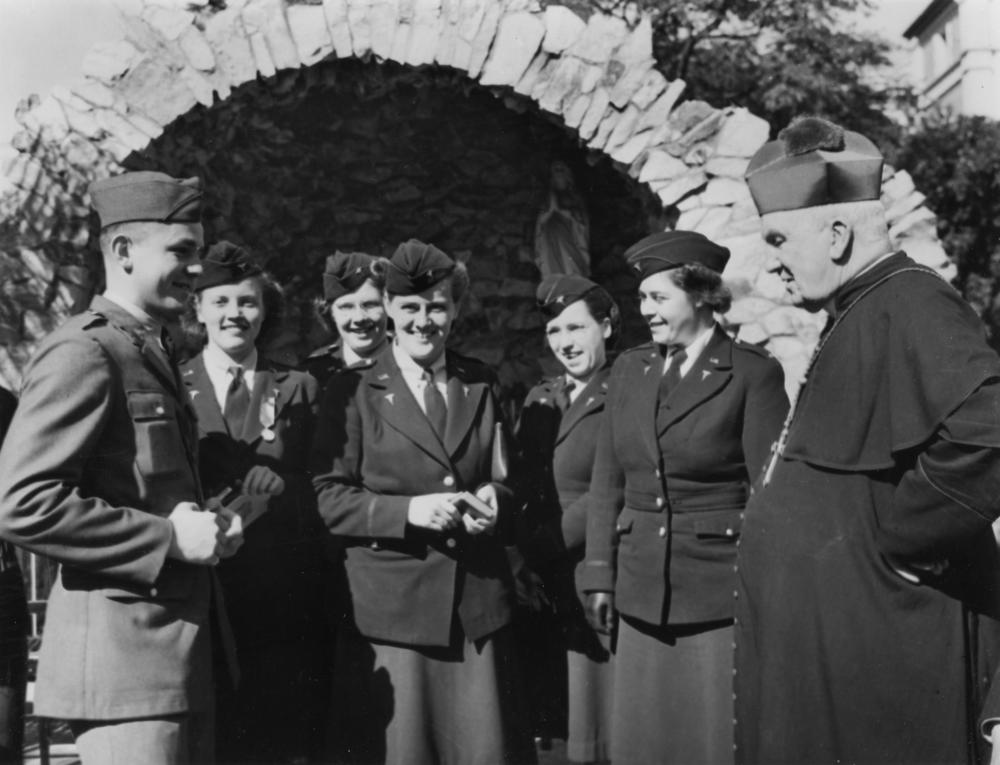
By the end of the war, the Army and Army Air Forces (AAF) had 54,000 nurses, and the Navy had 11,000—all women.

Some 217 black nurses served in all-black Army medical units. The AAF was virtually autonomous by 1942 and likewise was its Nurse Corps. Much larger numbers of enlisted men served as medics. These men were in effect practical nurses who handled routine care under the direction of nurse officers. Likewise many enlisted Wacs and Wafs served in military hospitals. Medical advances greatly increased survival rates for the wounded: 96% of the 670,000 wounded soldiers and sailors who made it to a field hospital staffed by nurses and doctors survived their injuries. Amputations were seldom necessary to combat gangrene. Penicillin and sulfa drugs proved highly successful in this regard. Nurses were deeply involved with post-operative recovery procedures, air evacuation, and new techniques in psychiatry and anesthesia.
Upon Flikke's retirement in 1943, she was succeeded by Florence A. Blanchfield, who successfully promoted new laws in 1947, that established the Army, Navy, and Air Force Nurse Corps on a permanent basis, giving the nurses regular commissions on exactly the same terms as male officers. A month before she retired in 1947, Blanchfield became the first woman to hold a regular Army commission.
Prisoners of war

Korea
During the Korean War, Army nurses would once again treat the wounded. Nurses would staff MASH units and standard emplaced hospitals in Japan and Korea. Nurses were on the forefront of battlefield medicine during the conflict, playing a major role in the treatment of the wounded U.N. forces within mere minutes or hours of the wounds being inflicted.
In September 1955, President Eisenhower suffered a heart attack while on vacation near Denver. He was hospitalized at Fitzsimons Army Medical Center. During his six weeks of recovery, Ike talked to his Army nurses. He discovered their quarters were substandard, that nurses rotated overseas more often than other soldiers and they were forced to leave the military at age fifty-five. Nurses were also promoted more slowly than other soldiers. Ike directed the corps be led by a brigadier general and that the other issues be corrected.
Vietnam
The Army Nurse Corps stopped being all-female in 1955; that year Edward L.T. Lyon was the first man to receive a commission in the Army Nurse Corps. During the Vietnam War many Army nurses would see deployment to South East Asia. Army nurses would staff all major Army hospitals in the theater, including Cam Ranh Bay, Da Nang, and Saigon. Vietnam would be the first major deployment of men as nurses into the combat theater, as men could be located in more hazardous locations than what was considered safe for women. Many Army nurses faced enemy fire for the first time due to the unconventional nature of the conflict and eight female and one male nurse would die in the conflict. 1LT Sharon Lane was the only nurse to die by enemy fire during the Vietnam War when on 8 June 1969, she was mortally wounded when a rocket hit her facility, the 312th Evacuation Hospital. On at least one occasion, the US Army hospital at Cam Ranh Bay was assaulted and severely damaged, with a loss of both patient and staff life.
Modern Nurse Corps
Army Nurses are deployed all over the world, participating in humanitarian missions, and supporting the Global War on Terror. The Nurse Corps continues to operate as a part of the Army Medical Department. Most training is conducted at Fort Sam Houston, Texas.
Insignia and badges

The Nurse Corps has a distinctive insignia, a gold color metal caduceus, bearing an 'N' in black enamel.
Superintendents and chiefs
From its founding in 1901 until after World War II in 1947, the Army Nurse Corps was led by a superintendent. Its nurses had no permanent commissioned rank. The Army-Navy Nurses Act took effect on 16 April 1947, establishing the Army Nurse Corps as a staff corps, with officers holding permanent commissioned ranks from second lieutenant to lieutenant colonel. The corps was to be led by a director holding the rank of colonel while in that position.
List of superintendents of the Army Nurse Corps
Source:
- Dita H. Kinney (March 1901 – July 1909)
- Jane A. Delano (August 1909 – March 1912)
- Isabel McIsaac (April 1912 – September 1914)
- Dora E. Thompson (September 1914 – December 1919)
- Julia C. Stimson (December 1919 – May 1937)
- Julia O. Flikke (June 1937 - June 1943)
- Florence A. Blanchfield (July 1943 – September 1947)
List of chiefs of the Army Nurse Corps
Source:
- COL Mary G. Phillips (October 1947 – September 1951)
- COL Ruby F. Bryant (October 1951 – September 1955)
- COL Inez Haynes (October 1955 – August 1959)
- COL Margaret Harper (October 1959 – August 1963)
- Mildred Irene Clark (September 1963 – August 1967)
- Anna Mae V. Hays (September 1967 – June 1970)
- BG Anna Mae V. Hayes (June 1970 – August 1971)
- BG Lillian Dunlap (September 1971 – August 1975)
- BG Madelyn N. Parks (September 1975 – August 1979)
- BG Hazel W. Johnson (September 1979 – August 1982)
- BG Connie L. Slewitzke (September 1983 – August 1987)
- BG Clara L. Adams-Ender (September 1987 – August 1991)
- BG Nancy R. Adams (November 1991 – December 1995)
- BG Bettye H. Simmons (December 1995 – January 2000)
- BG William T. Bester (May 2000 – June 2004)
- MG Gale S. Pollock (July 2004 – July 2008)
- MG Patricia D. Horoho (July 2008 – December 2011)
- MG Jimmie O. Keenan (January 2012 – November 2015)
- MG Barbara R. Holcomb (November 2015 – July 2019)
- BG Jack M. Davis (July 2019 – November 2023)
- COL(P) James D. Burk (November 2023 – Present)
Notable Army Nurse Corps officers
- Col. Ruby Bradley – one of the most decorated female officers for service in World War II and Korea.
- 1st Lt. Reba Cameron — career Army nurse, recipient of the Distinguished Service Medal for her work in World War I.
- Dorothea Dix – First Superintendent of Army Nurses.
- CPT Diane Carlson Evans – Vietnam era nurse, founder of the Vietnam Woman's Memorial Foundation.
- 1st Lt. Annie Fox – first woman to receive the Purple Heart for actions during Pearl Harbor. This award was later converted to a Bronze Star when the criteria for the Purple Heart changed.
- LT Ruth M. Gardiner - first nurse to die in action during World War II, killed in Alaska July 1943.
- Cornelia Hancock – civilian nurse serving the Union Army during the American Civil War, injured in battle.
- E. Ann Hoefly - served as a nurse in World War II and was later chief of the US Air Force Nurse Corps.
- Lt Col Rae Landy - pioneering Hadassah nurse in Palestine, career Army Nurse.
- CPT Diane Lindsay - first black women to be awarded the Soldier's Medal.
- Clara Maass – contract nurse for the Army during the Spanish–American War, died participating in an army yellow fever study.
- Anita Newcomb McGee – a physician, she became the acting assistant Army surgeon in charge of nursing during the Spanish–American War. Helped to write some of the legislation that eventually created the Army Nurse Corps.
- Anna Maxwell – instrumental in the establishment of the Army Nurse Corps.
- CPT María Inés Ortiz – first nurse to die in combat since Vietnam, killed in Iraq July 2007.
- Susie Taylor – first African American Army nurse.
- Adah Belle Thoms – instrumental in gaining the right of African American nurses to serve in Army Nurse Corps.
- Dr. Mary Edwards Walker – served as a civilian nurse during the American Civil War, became the Army's first female surgeon and Medal of Honor recipient.
- Maj. Almyra Maynard Watson – served as a nurse in World War II and the Korean War.
References
References
- "Mission & Vision".
- (December 2009). "Army Nursing Team Creed".
- (January 2003). "Is military nursing for you?". Nursing2019.
- (1 September 1994). "Appointment of Commissioned and Warrant Officers of the Army".
- (15 February 1984). "Appointment of Reserve Commissioned Officers for Assignment to Army Medical Department Branches".
- (21 November 2006). "Appointment of Commissioned and Warrant Officers in the Regular Army".
- "Nurses".
- (1 November 2023). "COL Burke".
- "Women's Service with the Revolutionary Army". The Colonial Williamsburg Foundation.
- (2016-08-15). "Records of the office of the Surgeon General (Army)".
- "National Museum of Health and Medicine (NMHM): American Angels of Mercy: Dr. Anita Newcomb McGee's Pictorial Record of the Russo-Japanese War, 1904".
- Threat, Charissa J.. (2015). "Nursing Civil Rights: Gender and Race in the Army Nurse Corps". University of Illinois Press.
- "Highlights in the History of the Army Nurse Corps".
- Gillett, Mary C.. (1995). "The Army Medical Department, 1865-1917". U.S. Army Center of Military History.
- Telford, Jennifer Casavant. (2016-12-13). "The American Nursing Shortage during World War I: The Debate over the Use of Nurses' Aids". Canadian Bulletin of Medical History.
- "The Impact of Relative Rank on Army Nurses".
- "The Army Nurse Corps". History.army.mil.
- (1942-01-12). "ARMY: She-Soldiers".
- Fabien Levy. (17 January 2012). "Congresswoman Hochul Presents Posthumous Honorable Discharge To Daughter of World War II Veteran | Congresswoman Kathy Hochul". Hochul.house.gov.
- (2012). "Piloted to Serve: Memoirs of Rebecca Chan Chung, World War II in China with Flying Tigers, U.S. Army and CNAC". Independently published.
- "The Betty H. Carter Women Veterans Historical Project - University Archives - University Libraries". Library.uncg.edu.
- "CNAC Flight Stewadress Rebecca Chan". Cnac.org.
- Bellafaire, Judith. (1993). "The Army Nurse Corps: A Commemoration of World War II Service". U.S. Army Center of Military History.
- Gregory, Ted. (28 May 2001). "Forgotten war nurses keep their story alive".
- (April 1944). "Negro Nurses". National Negro Health News.
- "Library of Congress, 78th Congress, 2nd Session".
- (28 September 1984). "Eisenhower the President". Simon & Schuster.
- "84th Congress Public Law 294".
- (2006). "Men in Nursing: History, Challenges, and Opportunities". [[Springer Publishing]].
- "The Army Nurse Corps Association (ANCA) > Fallen V".
- "Women in the Army".
- "Army Nurse Corps: More Than 100 Years of Service to Our Nation".
- "Office of Medical History - Superintendents and Chiefs of the Army Nurse Corps". History.amedd.army.mil.
- (2022). "Major General Barbara R. Holcomb 25th Chief, Army Nurse Corps". e-anca.org.
- "Army Nurse Corps - Leadership".
- (18 April 2024). "COL Burke".
- "Brigadier General E. Ann Hoefly".
This article was imported from Wikipedia and is available under the Creative Commons Attribution-ShareAlike 4.0 License. Content has been adapted to SurfDoc format. Original contributors can be found on the article history page.
Ask Mako anything about United States Army Nurse Corps — get instant answers, deeper analysis, and related topics.
Research with MakoFree with your Surf account
Create a free account to save articles, ask Mako questions, and organize your research.
Sign up freeThis content may have been generated or modified by AI. CloudSurf Software LLC is not responsible for the accuracy, completeness, or reliability of AI-generated content. Always verify important information from primary sources.
Report