From Surf Wiki (app.surf) — the open knowledge base
United Nations Disengagement Observer Force
Peacekeeping mission overseeing Israeli–Syrian ceasefire

Peacekeeping mission overseeing Israeli–Syrian ceasefire
| Field | Value |
|---|---|
| image | UNDOF emblem.png |
| image_size | 120px |
| map | UNDOF deployment September 2014.svg |
| map_caption | UNDOF deployment |
| name | United Nations Disengagement Observer Force |
| type | Peacekeeping mission |
| abbreviation | UNDOF |
| leader_title | Head |
| leader_name | Anita Asmah |
| status | Active (occupied by Israel) |
| formation | 31 May 1974 |
| headquarters | Camp Faouar, Syria |
| website | |
| parent_organization | UN Security Council |
The United Nations Disengagement Observer Force (UNDOF) is a United Nations peacekeeping mission tasked with maintaining the ceasefire between Israel and Syria in the aftermath of the 1973 Yom Kippur War. The mission was established by United Nations Security Council Resolution 350 on 31 May 1974, to implement Resolution 338 (1973) which called for an immediate ceasefire and implementation of United Nations Security Council Resolution 242.
The resolution was passed on the same day as the Agreement on Disengagement. It was signed by Israeli and Syrian forces on the Golan Heights, finally establishing a ceasefire to end the war. From 1974 to 2012, UNDOF performed its functions with the full cooperation of both sides. Since 1974 its mandate has been renewed every six months. The United Nations Truce Supervision Organization (UNTSO) and UNDOF operate in the UNDOF Zone, a demilitarized zone between the two sides and continue to supervise the ceasefire.
Before the Syrian Civil War, the situation in the Israel-Syria ceasefire line had remained quiet and there had been few serious incidents. During the Syrian Civil War, clashes in Quneitra spilt into the buffer zone between Israeli and Syrian forces, forcing many UN observer force-contributing nations to reconsider their mission due to safety issues. Following this, a number of troop-contributing countries withdrew their troops from UNDOF, resulting in a reorganization of the force.
After the fall of the Assad regime in December 2024, Israel invaded the buffer zone. , UNDOF forces remain at their pre-invasion positions and call for a "return to full mandate implementation", but acknowledge the IDF as the "de facto authorities". UNDOF has reported the IDF searches, arrests, and roadblocks to their activities during the occupation. Israel has called its occupation "indefinite".
Background
On 6 October 1973, in a surprise joint attack, Egypt attacked Israeli forces on the Suez Canal and in the Sinai while Syria attacked Israeli forces on the Golan Heights. Israel eventually repulsed the Syrian operation, and crossed the Suez Canal through a gap between Egyptian forces. Israeli forces then pushed further into Syria, and encircled elements of the Egyptian 3rd Army. Fighting continued until 22 October 1973, when United Nations Security Council Resolution 338 called for a ceasefire. The next day the ceasefire was violated and fighting resumed, resulting in United Nations Security Council Resolution 339. Resolution 339 primarily reaffirmed the terms outlined in Resolution 338 (itself based on Resolution 242). It required the forces of both sides to return to the position they held when the initial ceasefire came into effect, and requested the United Nations Secretary-General to undertake measures toward the placement of observers to supervise the ceasefire.
This second ceasefire was violated as well; United Nations Security Council Resolution 340 ended the conflict on October 25, 1973. The conflict is known as the Yom Kippur War. The United Nations Emergency Force II (UNEF II) moved into place between Israeli and Egyptian armies in the Suez Canal area, stabilizing the situation.
Tension remained high on the Israel-Syria front, and during March 1974 the situation became increasingly unstable. The United States undertook a diplomatic initiative, which resulted in the signing of the "Agreement on Disengagement" (S/11302/Add.1, annexes I and II) between Israeli and Syrian forces. The Agreement provided for a buffer zone and for two equal areas of limitation of forces and armaments on both sides of the area. It also called for the establishment of a United Nations observer force to supervise its implementation. The Agreement was signed on 31 May 1974 and, on the same day, the UN Security Council adopted Resolution 350 to set up UNDOF.
Brigadier General Gonzalo Briceno Zevallos from Peru was appointed as UNDOF's first commander. On 3 June 1974, he arrived at the headquarters of the United Nations Truce Supervision Organization (UNTSO) Israel/Syria Mixed Armistice Commission (ISMAC) House in Damascus and assumed operational command of 90 UNTSO observers detailed to UNDOF. The first phase of the operation was manning the observation posts. The UNTSO observers were transferred to UNDOF, and were joined by advanced parties from both Austria and Peru on 3 June, with Canadian and Polish personnel transferred from UNEF II to the UNDOF Area of Responsibility.
From 6 June 1974 to 25 June 1974, the second phase, which included the physical disengagement of Syrian and Israeli forces, was initiated. According to Canadian veteran Frank Misztal, "the Austrians and Polish shared a base camp at Kanikir near the town of Sassa. The Peruvians were deployed south of Quneitra near Ziouani. The Canadian logistics company and signal element were situated in Ziouani near Quneitra. The force headquarters remained in Damascus".
History

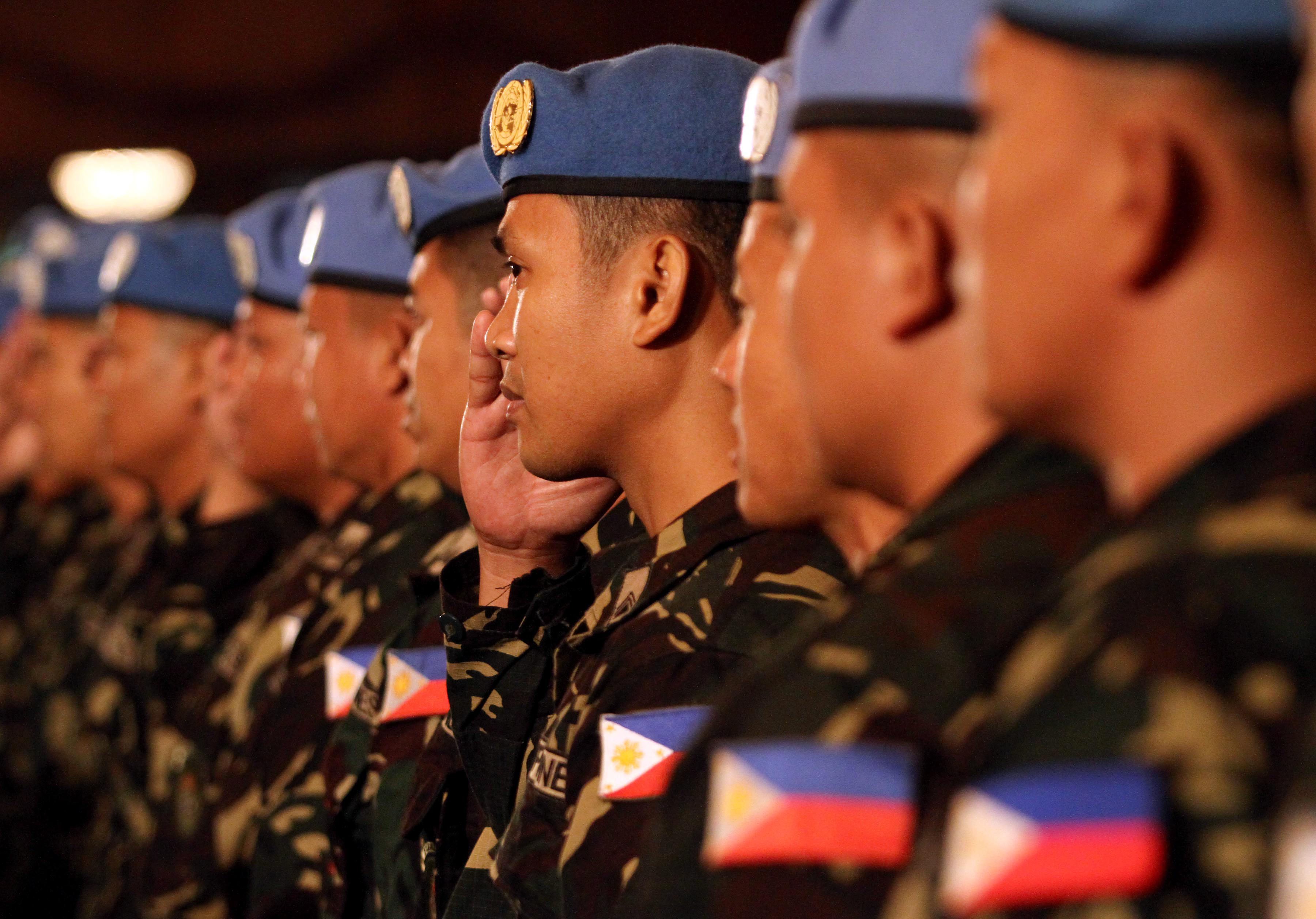
The initial composition of UNDOF in 1974 was of personnel from Austria, Peru, Canada and Poland, and later contingents have come from Iran, Finland, Slovenia, Japan, Croatia, India and the Philippines. On 9 August 1974, a Canadian Buffalo transport aircraft (Buffalo 461) was on a routine re-supply flight, from Beirut to Damascus for Canadian peacekeepers in the Golan Heights. Flight 51 was carrying five crew members and four passengers: Capt G.G Foster, Capt K.B. Mirau, Capt R.B. Wicks, MWO G. Landry, A/MWO C.B. Korejwo, MCpl R.C Spencer, Cpl M.H.T. Kennington, Cpl M.W. Simpson and Cpl B.K. Stringer. All were members of the Canadian Forces. At 11:50, while on final approach into Damascus, the aircraft was shot down over the outskirts of the Syrian town of Ad Dimas, killing all on board. This remains the largest single-day loss of life in Canada's peace-keeping history.
Between September 1975 and August 1979, an Iranian battalion was assigned to UNDOF, having replaced the original Peruvian contingent. The Iranians were then replaced by a Finnish battalion. The Finns were then replaced by a Polish battalion in December 1993 after the Poles concluded their initial mission in October of that year. the Austrian base camp. A logistics battalion was formed in 1996, when the Japanese deployed a contingent to bolster the Canadian element. The Canadians remained until 2006 when they were replaced by a contingent from India. A Slovakian infantry company arrived in 1998, replacing the third company of the Austrian battalion; the Slovakians remained until 2008 when a Croatian company assumed the same role within the Austrian battalion. The following year, the Polish battalion was replaced by a contingent from the Philippines.
The fighting between Syrian Army and Syrian Opposition around Quneitra came to international attention when in March 2013, the al-Qaeda affiliated group al-Nusra Front took 21 Filipino UN Disengagement Observer Force personnel hostage in the neutral buffer zone. According to a UN official, the personnel were taken hostage near Observation Post 58, which had sustained damage and been evacuated the previous weekend, following heavy combat nearby at Al Jamla. The personnel were eventually released, and returned to their base via Jordan and Israel on 12 March.
On 10 May 2013, the Philippine Secretary of Foreign Affairs, Albert del Rosario announced his intentions to pull out their contingent of UN peacekeepers from the UNDOF zone. He suggested the risks in the area had gone "beyond tolerable limits". The announcement followed the kidnapping of four peacekeepers, shown on video to be kept as human shields by the Yarmouk Martyrs Brigade. The total Philippine contingent numbered 342, approximately one third of the UN contingent at the time. On 6 June 2013, the Austrian chancellor Werner Faymann and Austrian foreign minister Michael Spindelegger announced that Austria would withdraw its troops from the UNDOF mission. This decision was made after Syrian rebels had attacked and temporarily captured the border crossing at Quneitra. A Filipino peacekeeper was wounded in the fighting. The Japanese and Croatians also withdrew around this time.
To replace the Austrians, a contingent of Nepalese troops, some 130 strong, were redeployed from Lebanon where they had formed part of the United Nations Interim Force in Lebanon; the Fijians also deployed 170 more troops. Ireland also deployed 115 peacekeepers to serve with UNDOF in September 2013, based at Camp Faouar. The Irish peacekeepers were attacked by Syrian rebels on 29 November 2013. The Irish convoy came under small arms fire and was hit with an explosion before the rebels retreated.
.jpg)
In August 2014, Syrian rebels captured Fijian peacekeepers and surrounded Filipinos manning two separate UN posts.{{cite news |title=Philippine troops 'attacked in Syria's Golan Heights'
On 13 October 2017, Major General Francis Vib-Sanziri of Ghana was appointed as Head of Mission and Force Commander of UNDOF. He succeeded Major General Jai Shanker Menon of India, whose assignment ended on 30 September 2017.
UNDOF's budget is approved on an annual basis by the UN General Assembly. Its budget for July 2017 – June 2018 was US$57,653,700, representing less than 1% of the UN peacekeeping budget. , there have been 58 fatalities, including one civilian staff, since 1974.

As of March 2021, UNDOF consisted of 1,096 troops provided by Nepal, India, Uruguay, Fiji, Ireland, Ghana, the Czech Republic and Bhutan. The troops are assisted by military observers from UNTSO's Observer Group Golan, along with international and local civilian staff.
On 7 December 2024 armed individuals penetrated UNDOF position 10A near Hader, exchanged fire with peacekeepers and looted equipment, which was partially recovered afterwards.
After the fall of the Assad regime on 8 December 2024, Israel launched an invasion into the Quneitra Governorate, advancing into the UNDOF buffer zone. , UNDOF forces remain at their pre-invasion positions and call for a "return to full mandate implementation", but acknowledge the IDF as the "de facto authorities". UNDOF has reported the IDF searches, arrests, and roadblocks to their activities during the occupation. In February 2025, Israeli Defense Minister Israel Katz said that Israeli forces would remain in southern Syria "for an indefinite period of time to protect our communities and thwart any threat."
Mandate and tasks
Upon establishment, UNDOF's mandate was as follows:
- Maintain the ceasefire between Israel and Syria;
- Supervise the disengagement of Israeli and Syrian forces; and
- Supervise the areas of separation and limitation, as provided in the May 1974 Agreement on Disengagement.
On 27 June 2024 the Security Council extended the mandate of the United Nations Disengagement Observer Force (UNDOF) in the Golan for six months until 31 December 2024.
In recommending the current extension of the mandate, UN Secretary-General Ban Ki-moon observed that despite the present calm in the Israeli-Syrian ceasefire line, the situation in the Middle East was likely to remain tense. Until a comprehensive settlement was reached, the Secretary-General considered the continued presence of UNDOF in the area to be essential.
Since its inception, UNDOF's tasks have included:
- Overall supervision of the buffer zone
- Monitoring of Syrian and Israeli military presence in the area (from permanent observation posts and by patrols day and night, on foot and motorized)
- Intervention in cases of entry to the separation area by military personnel from either side, or attempted operations
- Bi-weekly inspections of 500 Israeli and Syrian military locations in the areas of limitation on each side to ensure agreed limits of equipment and forces are being followed
- Assistance to the International Committee of the Red Cross (ICRC) in the passing of mail and people through the area, and in the provision of medical services
- Identifying and marking of minefields
- Promotion of minefield awareness amongst civilians and support of the United Nations Children's Fund activities in this area
- Work to protect the environment and to minimize the impact of UNDOF on the area.
Operations
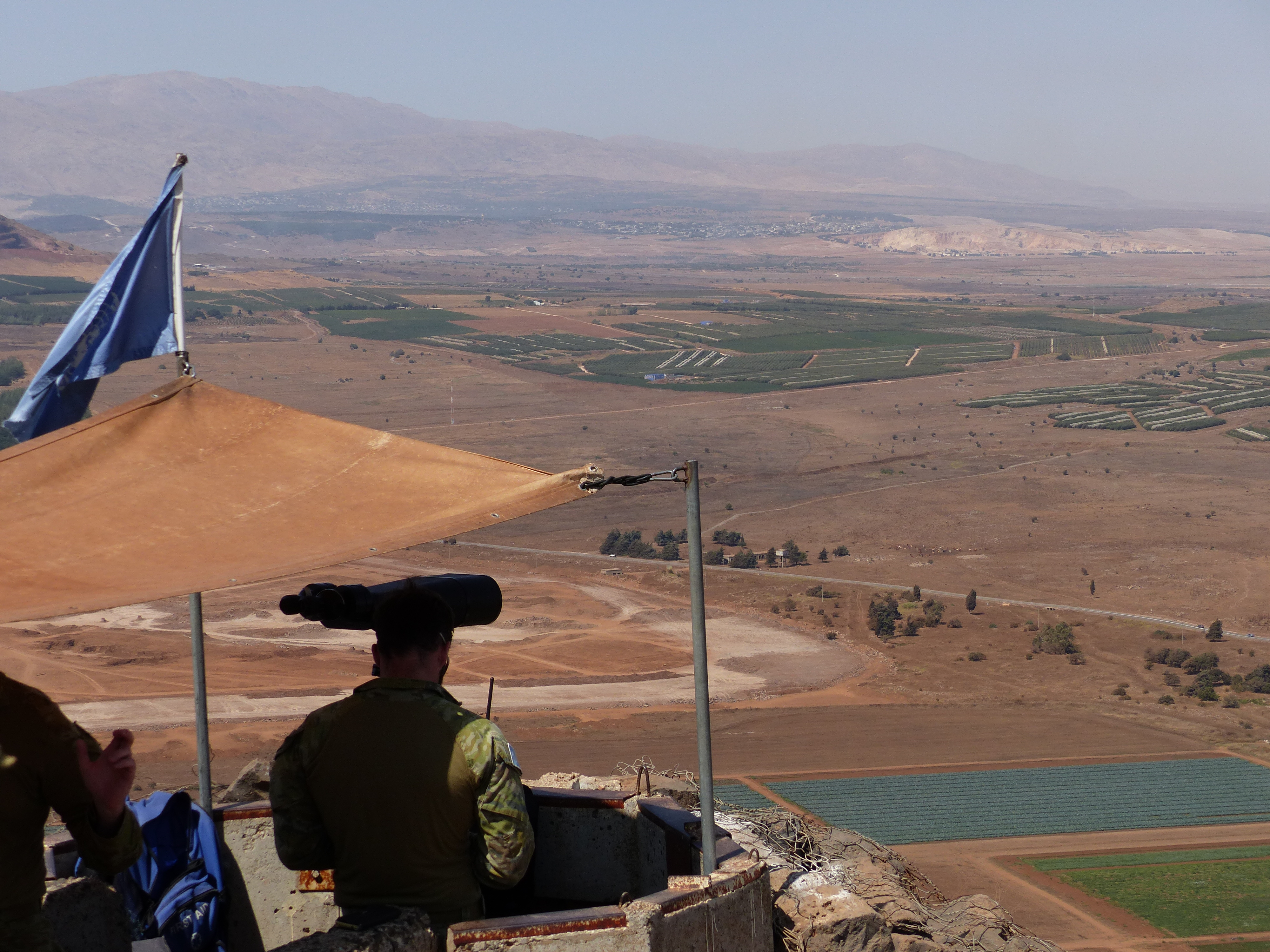
The UNDOF Zone of operation straddles the Purple Line, separating the Israeli-occupied portion of the Golan Heights and the rest of Syria, where the west line is known as "Alpha", and the east line as "Bravo". The zone also borders the Lebanon Blue Line to the north and forms a border of less than 1 km with Jordan to the south.
Operationally, the Alpha Line was drawn in the west, not to be crossed by Israeli Forces, and the Bravo Line in the east, not to be crossed by Syrian Forces. Between these lines lies the Area of Separation (AOS) which is a buffer zone. Extending 25 km to either side is the Area of Limitation (AOL) where UNDOF, and Observer Group Golan (OGG) observers under its command, supervise the number of Syrian and Israeli troops and weapons. Inside the AOS, UNDOF operates with checkpoints and patrols. Previously two line-battalions operated in this area; one, in the northern part (previously AUSBATT) from the Mount Hermon massif to the region of Quneitra, and another (previously POLBATT) in the south down to the Jordanian border. As of 2020, Nepalese troops, including a mechanized company have taken over northern and central sectors.
According to former Chief of Staff, Colonel Andreas Stupka, "between Israel and Syria there is no official border crossing, but for the UN one crossing point exists near Quneitra, called "The A-Gate". Although the line battalions and HQ operate on the Syrian side",
UNDOF is deployed within and close to the zone with two base camps, 44 permanently staffed positions and 11 observation posts. The operation headquarters are located at Camp Faouar and an office is maintained at Damascus. The Uruguayan battalion is deployed in the south with its base camp in Camp Ziouani, in the same area that the Polish battalion previously occupied. The Indian and Japanese logistic units perform second-line general transport tasks, rotation transport, control and management of goods received by the Force, and maintenance of heavy equipment. According to UNDOF's website, "first-line logistic support is internal to the contingents and includes transport of supplies to the positions".
Equipment
- 28 x RG-31 Nyala, refurbished and taken over from UNIFIL.
- 4 x M113 armored personnel carriers, shipped to UNDOF in 1996 from UNAMIR.
- 20 x Sisu Pasi
- 3 x RG-32
1177 peacekeepers
| Country | Troops | Description | Note(s) |
|---|---|---|---|
| Argentina | 2 | ||
| Australia | 4 | ||
| Bhutan | 2 | ||
| Czech Republic | 4 | ||
| Fiji | 148 | ||
| Ghana | 15 | ||
| India | 2 | ||
| Ireland | 3 | ||
| Kazakhstan | 143 | ||
| Nepal | 439 | ||
| South Korea | 1 | ||
| Uruguay | 215 | ||
| Zambia | 4 |
Former contributors
| Country | Date of Withdrawal | Description | Note(s) |
|---|---|---|---|
| Austria | 2013 | ||
| Canada | 2006 | ||
| Croatia | 2013 | ||
| Finland | 2018 | ||
| Iran | 1979 | ||
| Japan | 2013 | ||
| Peru | 1975 | ||
| Philippines | 2015 | ||
| Poland | 2009 | ||
| Slovakia | 2008 |
--
Commanders of the force
| Start date | End date | Name | Country | Source | |||||
|---|---|---|---|---|---|---|---|---|---|
| June 1974 | December 1974 | General de brigada Gonzalo Brinceno | Peru | url=https://undof.unmissions.org/sites/default/files/40%20years%20anniversary.pdf | publisher=United Nations Disengagement Observer Force | title=UNDOF Force Commanders since 1974 | pages=16–17 | date=June 2014 | access-date=2 March 2021}} |
| December 1974 | May 1979 | Generalmajor Hannes Philipp | Austria | ||||||
| May 1979 | February 1981 | Generalmajor Günther Greindl | Austria | ||||||
| March 1981 | April 1982 | Kenraalimajuri Erkki Kaira | Finland | ||||||
| June 1982 | May 1985 | Generalmajor Carl-Gustaf Ståhl | Sweden | ||||||
| June 1985 | 31 May 1986 | Kenraalimajuri Gustav Hägglund | Finland | url=https://undocs.org/pdf?symbol=en/S/18453 | publisher=United Nations Security Council | title=Report of the Secretary-General on the United Nations Disengagement Observer Force | page=3 | date=12 November 1986 | access-date=3 March 2021}} |
| 1 June 1986 | 30 June 1986 | W. A. D. Yuill (acting) | Canada | ||||||
| 1 July 1986 | September 1988 | Generalmajor Gustaf Welin | Sweden | ||||||
| September 1988 | September 1991 | Generalmajor Adolf Radauer | Austria | ||||||
| September 1991 | November 1994 | Generał dywizji Roman Misztal | Poland | ||||||
| January 1995 | May 1997 | Generaal-majoor J.C. Kosters | Netherlands | ||||||
| May 1997 | August 1998 | Maor-ghinearál David Stapleton | Ireland | ||||||
| October 1998 | July 2000 | Major-general H. Cameron Ross | Canada | ||||||
| August 2000 | August 2003 | Generalmajor Bo Wranker | Sweden | ||||||
| August 2003 | January 2004 | Generał dywizji Franciszek Gągor | Poland | ||||||
| January 2004 | January 2007 | Lieutenant general Bala Nanda Sharma | Nepal Nepal | ||||||
| January 2007 | March 2010 | Generalmajor Wolfgang Jilke | Austria | ||||||
| March 2010 | August 2012 | Major general Natalio Ecarma III | Philippines | ||||||
| August 2012 | January 2015 | Lieutenant general Iqbal Singh Singha | India | ||||||
| January 2015 | 2016 | Purna Chandra Thapa | Nepal | ||||||
| 2016 | 30 September 2017 | Jai Shanker Menon | India | ||||||
| 2017 | 19 April 2019 | Francis Sanziri | Ghana | ||||||
| June 2019 | October 2019 | Shivaram Kharel (acting) | Nepal | ||||||
| 10 July 2020 | September 2022 | Ishwar Hamal | Nepal | ||||||
| September 2022 | December 2024 | Nirmal Kumar Thapa | Nepal | ||||||
| December 2024 | Present | Anita Asmah | Ghana |
UNDOF Zone
The UNDOF Zone is about 80 km long, and between 0.5 and 10 km wide, forming an area of 235 km2. The zone straddles the Purple Line, separating the Israeli-occupied portion of the Golan Heights and the rest of Syria, where the west line is known as "Alpha", and the east line as "Bravo". The zone also borders the Lebanon Blue Line to the north and forms a border of less than 1 km with Jordan to the south.
References
References
- (2025-01-25). "What's UNDOF? Why UN peacekeepers patrol the Israel-Syria border {{!}} UN News".
- Mohr, Charles. (26 October 1973). "Trapped Egyptian Force Seen at Root of Problem". New York Times.
- (5 November 1973). "Egyptians in Maneuver to Break Encirclement of Third Army". Jewish Telegraphic Agency.
- ''Israel Fights for her life and wins'' (Film Documentary)
- {{UN document. (1970). (22 October 1970)
- {{UN document. (1973). (23 October 1973)
- Brogan, Patrick. (1990). "The Fighting Never Stopped: A Comprehensive Guide to World Conflict Since 1945". Vintage Books.
- {{UN document. link. (1973). (25 October 1973)
- Urquhart, Brian. (1995). "The United Nations in the Middle East: A 50-Year Retrospective". The Middle East Journal.
- {{UN document. (-1). (30 May 1970)
- {{UN document. (1971). (31 May 1971)
- (17 November 2016). "UNDOF: Background". United Nations.
- Theobald, Andrew. (2015). "Oxford Handbook of United Nations Peacekeeping Operations". Oxford University Press.
- "Middle East – UNEF II: Background". United Nations.
- Misztal, Frank. "United Nations Disengagement Observer Force Headquarters". Peacekeeper.ca.
- "UNDOF — 40 Years in the Service of Peace". United Nations Disengagement Observer Force.
- (10 August 1974). "9 Killed in U.N. Plane Downed in Syria". The New York Times.
- (July–September 2004). "Canadian Remember Lost Peacekeepers". Golan: The UNDOF Journal.
- "National Peacekeepers' Day". Veterans' Affairs Canada.
- "Report of the Secretary-General on the United Nations Disengagement Observer Force (for the period 23 November 1993 to 22 May 1994)". United Nations.
- Stupka, Andreas. "Austrian Armed Forces in UNDOF". Austrian Armed Forces.
- Holmes, Oliver. (6 March 2013). "Syrian rebels seize U.N. peacekeepers near Golan Heights". [[Reuters]].
- (8 March 2013). "UN Expects to Free Hostages in Syria Saturday". Voice of America.
- (10 March 2013). "UN peacekeepers freed after Syria captivity".
- (12 March 2013). "UN peacekeepers held in Syria 'reach Israel'". Irish Times.
- (10 March 2013). "Philippines eyes Golan peacekeeper pull-out after abductions". BBC News.
- (6 June 2013). "Österreich zieht seine Blauhelme von umkämpften Golanhöhen ab". [[Der Standard]].
- (6 June 2013). "Austria to withdraw Golan Heights peacekeepers over Syrian fighting". [[The Guardian]].
- Zeiger, Asher. (17 July 2013). "Nepal moving peacekeepers from Lebanon to Golan". Times of Israel.
- "Irish troops fired on by Syrian rebel units". irishtimes.com.
- (31 August 2014). "U.N., Fiji say no word on location of peacekeepers abducted in Golan Heights". Reuters.
- (11 September 2014). "Syria conflict: Rebels release Fijian UN peacekeepers". BBC.
- (13 October 2017). "Secretary-General Appoints Francis Vib-Sanziri of Ghana to Head United Nations Disengagement Observer Force". [[United Nations]].
- (30 June 2017). "Approved resources for peacekeeping operations for the period from 1 July 2017 to 30 June 2018". [[United Nations]].
- (18 November 2016). "Facts and Figures {{!}} UNDOF". [[United Nations]].
- United Nations. "UNDOF Fact Sheet".
- (14 November 2017). "UNTSO Operations". United Nations.
- "Daily Press Briefing by the Office of the Spokesperson for the Secretary-General {{!}} Meetings Coverage and Press Releases".
- (8 December 2024). "Watching with trepidation and glee, Netanyahu orders military to seize Syria buffer zone". CNN.
- (2024-12-08). "Israel PM says ordered military to 'seize' Syria buffer zone".
- (February 23, 2025). "Netanyahu says Israel won't allow Syrian forces 'south of Damascus'". VOA News.
- (17 November 2016). "UNDOF Mandate". United Nations.
- (27 June 2024). "Security Council Extends Mandate of United Nations Observer Force in Golan for Six Months, Unanimously Adopting Resolution 2737 (2024)". United Nations.
- Welch, James P.. (September 2011). "An Analysis of The UNDOF Peacekeeping Mission". Rabdan Academy.
- (April–June 2009). "35 Years of UNDOF: History of UNDOF". Golan: The UNDOF Journal.
- "UNDOF Background". United Nations Department of Peacekeeping Operations.
- "UNDOF deployment map as at January 2021". United Nations.
- "UNDOF deployment map as for December 2008". United Nations.
- (18 November 2016). "UNDOF: Operations". United Nations.
- Annan, Kofi. (30 June 2003). "Performance report on the budget of the United Nations Disengagement Observer Force for the period from 1 July 2002 to 30 June 2003". [[United Nations Information System on the Question of Palestine]] (UNISPAL).
- Advisory Committee on Administrative and Budgetary Questions. (20 April 2006). "Financial performance report for the period from 1 July 2004 to 30 June 2005 and proposed budget for the period from 1 July 2006 to 30 June 2007 of the United Nations Disengagement Observer Force". [[United Nations General Assembly]].
- Chief Procurement Officer, [[United Nations Secretariat]]. (4 June 2012). "Shipment of Eighteen Armored Personnel Carriers and Two Containers door-to-port from Camp Ziouan ...". United Nations Global Marketplace.
- "Bundesheer - Truppendienst - Ausgabe 6/2004 - Fernmelde- und IT-Einsatz auf den Golan-Höhen (II)".
- (July 2011). "With the Force HQ-Company on night patrol". GOLAN, the UNDOF Journal.
- "The Last of Austrians". UNDOF.
- "UNIFIL's Armenian peacekeepers rotate". Peacekeeping.un.org.
- "UNIFIL's Armenian peacekeepers rotate". Peacekeeping.un.org.
- link. "". UNDOF
- link. "". UNDOF
- link. "". UNDOF
- link. "". UNDOF
- link. "". UNDOF
- link. "". UNDOF
- link. "". UNDOF
- link. "". UNDOF
- link. "". UNDOF
- link. "". UNDOF
- "The Last of Austrians". UNDOF.
- "United Nations Disengagement Observer Force (UNDOF)". canada.ca.
- "Croatian Contingent leaves UNDOF". UNDOF.
- "Finland’s participation in the UNDOF mission ends". Puolustuvoimat.
- link. "". UNDOF
- "Japanese troops say Good Bye forever". UNDOF.
- "133: Reports by the Secretary General of the United Nations on UNDOF, 24 and 28 November 1975". GOV.il.
- link. "". UNDOF
- "Przedstawiciele Wojska Polskiego w Siłach Organizacji Narodów Zjednoczonych do Obserwacji Rozdzielenia Wojsk (1974-2009).". Wojsko Polskie.
- link. "". UNDOF
- (June 2014). "UNDOF Force Commanders since 1974". United Nations Disengagement Observer Force.
- (12 November 1986). "Report of the Secretary-General on the United Nations Disengagement Observer Force". [[United Nations Security Council]].
- (13 October 2017). "Major General Francis Vib-Sanziri of Ghana – Head of Mission and Force Commander of the United Nations Disengagement Observer Force (UNDOF)". [[United Nations]].
- (30 July 2019). "Israel names street after Maj Gen Franics Vib-Sanziri". Ghana News Agency.
- (13 October 2017). "Secretary-General Appoints Francis Vib-Sanziri of Ghana Head United Nations Disengagement Observer Force". Targeted News Service.
- (2020-02-24). "Major General Ishwar Hamal of Nepal – Head of Mission and Force Commander of the United Nations Disengagement Observer Force". [[United Nations]].
- (13 March 2015). "Leadership". United Nations Disengagement Observer Force.
- (2022-12-01). "Leadership". United Nations Disengagement Observer Force.
- "Major-General Anita Asmah of Ghana appointed as UN's first African woman Force Commander".
This article was imported from Wikipedia and is available under the Creative Commons Attribution-ShareAlike 4.0 License. Content has been adapted to SurfDoc format. Original contributors can be found on the article history page.
Ask Mako anything about United Nations Disengagement Observer Force — get instant answers, deeper analysis, and related topics.
Research with MakoFree with your Surf account
Create a free account to save articles, ask Mako questions, and organize your research.
Sign up freeThis content may have been generated or modified by AI. CloudSurf Software LLC is not responsible for the accuracy, completeness, or reliability of AI-generated content. Always verify important information from primary sources.
Report