From Surf Wiki (app.surf) — the open knowledge base
United Grand Lodge of England
Freemason lodge in England
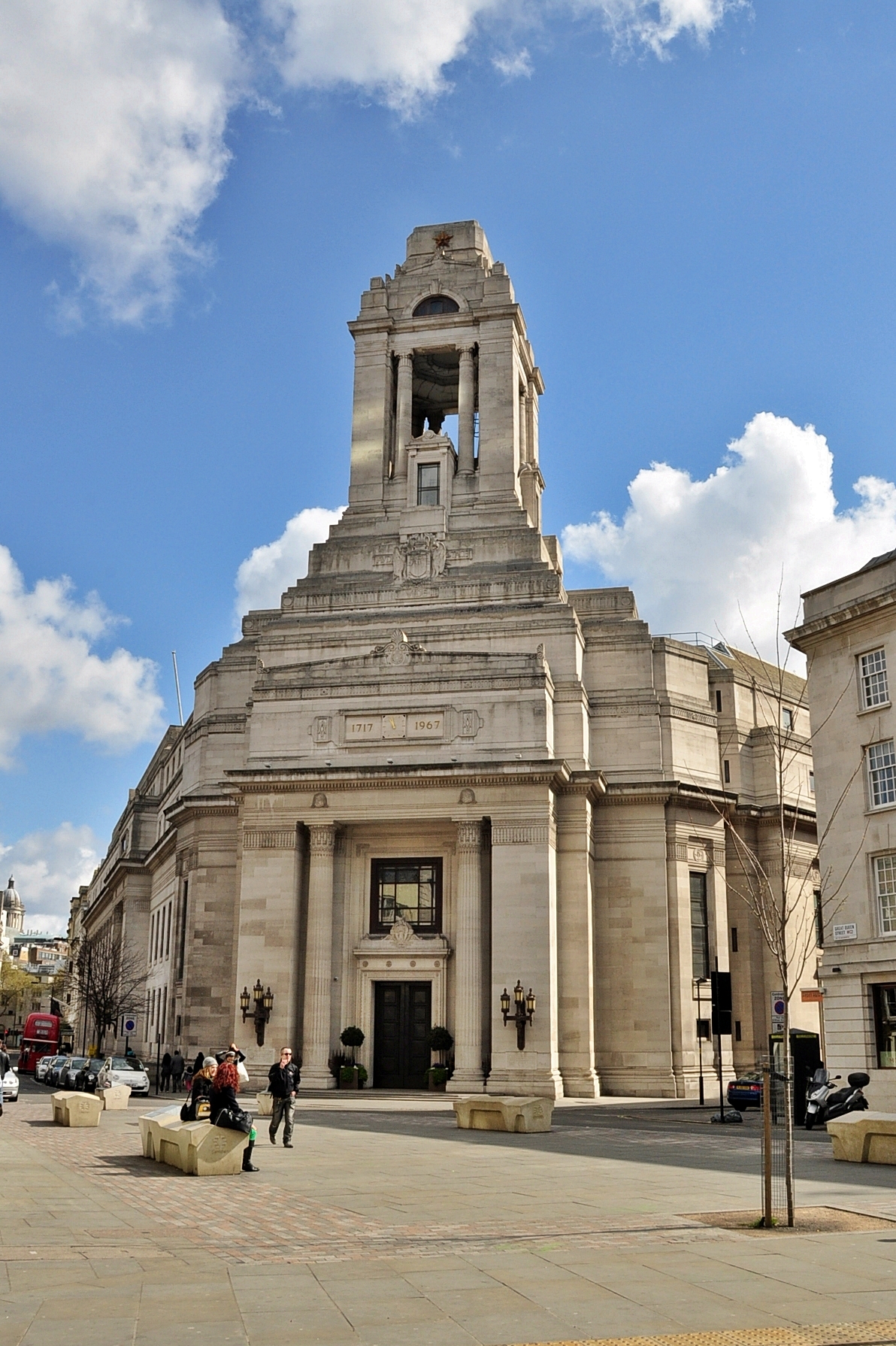
Freemason lodge in England
| Field | Value |
|---|---|
| name | United Grand Lodge of England |
| image | United Grand Lodge of England logo.png |
| caption | Coat of arms of the United Grand Lodge of England |
| established | |
| jurisdiction | England and Wales |
| location | London, |
| grand_master | Prince Edward, Duke of Kent |
| website |
The United Grand Lodge of England (UGLE) is the governing Masonic lodge for the majority of freemasons in England, Wales, and the Commonwealth of Nations. Claiming descent from the Masonic Grand Lodge formed 24 June 1717 at the Goose & Gridiron Tavern in London, it is considered to be the oldest Masonic Grand Lodge in the world, together with the Grand Lodge of Scotland, and the Grand Lodge of Ireland.
History
Main article: History of Freemasonry
Moderns and Ancients in English Freemasonry
Main article: Premier Grand Lodge of England, Antient Grand Lodge of England
Prior to 1717 there were Freemasons' lodges in England, Scotland, and Ireland, with the earliest known admission of non-operative masons being in Scotland. On St John's Day, 24 June 1717, three existing London lodges and a Westminster lodge held a joint dinner at the Goose and Gridiron alehouse in St Paul's Churchyard, elected Anthony Sayer to the chair as Grand Master, and called themselves the Grand Lodge of London and Westminster. The City of London Corporation has erected a Blue Plaque near the location. Little is known of Sayer save that he was described as a Gentleman (a man of independent means) when he became Grand Master, but later fell on hard times, receiving money from the Grand Lodge charity fund.
Historian Marsha Keith Schuchard notes that the Whig administration of England organised the Grand Lodge as a Hanoverian-loyalist counter to the Jacobite rising of 1715, since the Whigs were concerned at the previous Jacobite influence in Freemason lodges. The Freemasonry that predominated in Hanoverian England was hence closely linked with Whiggism.
In 1718 Sayer was succeeded by George Payne, a successful Civil Servant. The society then passed into the care of John Theophilus Desaguliers, a scientist and clergyman, then back to Payne. In 1721, the Grand Lodge managed to obtain a nobleman, the Duke of Montagu to preside as Grand Master, and so was able to establish itself as an authoritative regulatory body, and began meeting on a quarterly basis. This resulted in lodges outside London becoming affiliated, accepting sequentially numbered warrants conferring seniority over later applicants.
In 1723, by authority of the Grand Lodge, James Anderson published the Constitutions of Masonry for the purposes of regulating the craft and establishing the Grand Lodge's authority to warrant Lodges to meet. The book includes a fanciful history of the Craft, which nevertheless contains much interesting material.
Throughout the early years of the new Grand Lodge there were any number of Masons and lodges that never affiliated with the new Grand Lodge. These unaffiliated Masons and their Lodges were referred to as "Old Masons", or "St John Masons", and "St John Lodges".
During the 1730s and 1740s antipathy increased between the London Grand Lodge and the Grand Lodges of Ireland and Scotland. Irish and Scots Masons visiting and living in London considered the London Grand Lodge to have deviated substantially from the ancient practices of the Craft. As a result, these Masons felt a stronger kinship with the unaffiliated London Lodges. The aristocratic nature of the London Grand Lodge and its members alienated other Masons causing them also to identify with the unaffiliated Lodges.
On 17 July 1751, representatives of five Lodges gathered at the Turk's Head Tavern, in Greek Street, Soho, London and formed a rival Grand Lodge: "The Grand Lodge of England According to the Old Institutions". They considered that they practised a more ancient and therefore purer form of Masonry, and called their Grand Lodge The Ancients' Grand Lodge. They called those affiliated to the Premier Grand Lodge, by the pejorative epithet The Moderns. These two unofficial names stuck.
The creation of Lodges followed the development of the Empire, with all three home Grand Lodges warranting Lodges around the world, including the Americas, India and Africa, from the 1730s.
Formation of the United Grand Lodge of England
In 1809 the Moderns appointed a "Lodge of Promulgation" to return their own ritual to regularity with Scotland, Ireland and especially the Ancients. In 1811 both Grand Lodges appointed Commissioners; and over the next two years, articles of Union were negotiated and agreed upon. In January 1813 the Duke of Sussex became Grand Master of the Moderns on the resignation of his brother, the Prince Regent; and in December 1813 another brother, Duke of Kent became Grand Master of the Antients. On 27 December 1813 the United Grand Lodge of England ("UGLE") was constituted at Freemasons' Hall, London with the Duke of Sussex (younger son of King George III) as Grand Master. A Lodge of Reconciliation was formed to reconcile the rituals worked under the two former Grand Lodges.
The new Grand Master had high hopes for Freemasonry, having a theory that it was pre-Christian and could serve the cause of humanity as a universal religion. However, his autocratic dealings with ordinary lodges won him few friends outside London, and sparked open rebellion and a new Grand Lodge of Wigan in the North West. Within Grand Lodge, opposition centred on Masonic Charity. Robert Crucefix launched the Freemason's Quarterly Review to promote charity to keep Freemasons from the workhouse, and to engage masons in the broader argument for social reform. The Earl of Zetland's complacent and inept management of Grand Lodge played into the hands of the reformers, and by the end of the 1870s English Freemasonry had become a perfect expression of the aspirations of the enlightened middle classes.
Freemasonry in contemporary times
In response to conspiracy theories about Freemasons and generally hostile views gaining new life, due to the works of Stephen Knight and Martin Short, the United Grand Lodge of England began to change the way it dealt with the general public and the media from the mid-1990s, emphasizing a new "openness."
Today, the United Grand Lodge of England or Grand Lodge currently has over 200,000 members meeting in over 6,800 Lodges, organised into a number of subordinate Provincial Grand Lodges which are approximately equivalent to the historic counties of England.
- Lodges meeting in London (an area generally within a 10-mile radius of Freemasons’ Hall) are, with six exceptions, administered by the Metropolitan Grand Lodge of London, headed by the Metropolitan Grand Master.
- Lodges meeting outside London, and within England, Wales, the Isle of Man and the Channel Islands, are grouped into 48 Provincial Grand Lodges (UGLE), each headed by a Provincial Grand Master.
- Lodges that meet outside England, Wales, the Isle of Man and the Channel Islands are grouped into 33 District Grand Lodges, each headed by a District Grand Master.
- Five Groups (i.e.: currently too small to make up a District), each headed by a Grand Inspector.
- Six Lodges in London and 12 Lodges abroad that are directly administered by Freemasons' Hall.
Grand Masters

- Prince Augustus Frederick, Duke of Sussex (1813–1843)
- Thomas Dundas, 2nd Earl of Zetland (1844–1870)
- George Robinson, 3rd Earl de Grey and 2nd Earl of Ripon (1st Marquess of Ripon from 1871) (1870–1874)
- Albert Edward, Prince of Wales (King of Great Britain and Ireland as Edward VII from 1901) (1874–1901)
- Prince Arthur, Duke of Connaught and Strathearn (1901–1939)
- Prince George, Duke of Kent (1939–1942)
- Henry Lascelles, 6th Earl of Harewood (1942–1947)
- Edward Cavendish, 10th Duke of Devonshire (1947–1950)
- Roger Lumley, 11th Earl of Scarbrough (1951–1967)
- Prince Edward, Duke of Kent (1967–present)
Pro Grand Masters
When the Grand Master is a member of the royal family it is customary to appoint a Pro Grand Master. The Pro Grand Master fills the role of the Grand Master when he is not available due to his royal duties. It is distinct from the Deputy Grand Master who acts as the Grand Master's deputy rather than as acting Grand Master.
;Albert Edward, Prince of Wales
- Henry Herbert, 4th Earl of Carnarvon (1874–1890)
- Edward Bootle-Wilbraham, 1st Earl of Lathom (1891–1898)
- William Amherst, 3rd Earl Amherst (1898–1901)
;Prince Arthur, Duke of Connaught and Strathearn
- William Amherst, 3rd Earl Amherst (1901–1908)
- Oliver Russell, 2nd Baron Ampthill (1908–1935)
;Prince Edward, Duke of Kent
- Roger Lumley, 11th Earl of Scarbrough (1967--1969)
- William Cadogan, 7th Earl Cadogan (1969–1982)
- Fiennes Cornwallis, 3rd Baron Cornwallis (1982–1991)
- Barry Maxwell, 12th Baron Farnham (1991–2001)
- Spencer Compton, 7th Marquess of Northampton (2001–2009)
- Peter Lowndes (2009–2022)
- Jonathan Spence, DL (2022–present)
Grand Secretaries
- 1813–1838 William Henry White and Edward Harper (Joint Secretaries)
- 1838–1857 William Henry White
- 1880–1891 Colonel Shadwell Henry Clerke
- 1891–1917: Sir Edward Letchworth
- 1917–1937: Sir Philip Colville Smith, CVO
- 1937–1958: Sir Sydney Arthur White, KCVO
- 1958–1980: Sir James Wilfrid Stubbs, KCVO, TD
- 1980–1998: Commander Michael Bernard Shepley Higham, CVO
- 1998–2002: Jim Daniel
- 2002–2006: Robert Morrow
- 2007–2016: Nigel Brown
- 2016–2018: Brigadier Willie Shackell, CBE
- 2018–2022: David Staples
- 2022–present: Adrian Marsh
Media and communications

- Shaun Butler, Director of Membership & Communications at UGLE
- Stephen Whatley, District Grand Communications Officer in the District of Gibraltar
- James Dalton, Provincial Deputy Grand Director of Ceremonies in the Province of Warwickshire
Opposition
Politics
In English politics, freemasonry has often been criticised by those associated with the Labour Party and trade unionism, because of a perception that freemasonry is aligned with the Conservative Party.
Despite the creation of the New Welcome Lodge, there remained an element of hostility to Masonry within the Labour Party. As well as the alleged Tory connections, they accused Freemasonry of having unaccountable influence within the judicial system. This issue was brought to the forefront of English politics in the 1990s when Jack Straw, Home Secretary in the Tony Blair government attempted to force all Freemasons who worked as police officers,
Conspiracy theories

As with freemasonry in other countries, the United Grand Lodge of England has featured as the subject of Masonic conspiracy theories; the most persistent of these attempts to link freemasonry to a "cover-up" or whitewash of the Jack the Ripper case (in some cases, conspiracy theorists have claimed that the killings were masonic ritual murder), the inquiry into the Sinking of the RMS Titanic (though Lord Mersey, Sydney Buxton and Lord Pirrie), and Bloody Sunday (though Lord Widgery).
In the Ripper case, Stephen Knight's Jack the Ripper: The Final Solution (1976) attempted to implicate freemasonry and the British royal family in the murders through the personage of the Duke of Clarence and Avondale. Elements of this theory, through the novel of Alan Moore and Eddie Campbell, even made its way into a major American film, From Hell (2001). The Hughes Brothers who produced the film, even approached the United Grand Lodge of England to get the "masonic bits" right, but, they were rebuffed due to the anti-masonic nature of the storyline.
Some native proponents of more generic anti-masonic conspiracy theories involving the Illuminati (based on John Robison and Augustin Barruel) have typically sought to implicate only Continental Freemasonry as a subversive force, while claiming to not be attacking the United Grand Lodge of England itself or British freemasonry more generally.
Coat of Arms
King George V granted UGLE the following coat of arms through Royal Warrant:{{Infobox COA wide|name=United Grand Lodge of England|image=File:United Grand Lodge of England logo.png|imagesize=220|bannerimage=|badgeimage=|coronet=|torse=|escutcheon=Per pale gules and quarterly azure and Or, dexter on a chevron between three castles argent a pair of compasses extended of the third, sinister a cross quarterly of the fourth and vert between in the first quarter a lion rampant of the third, in the second an ox passant sable, in the third a man with hands elevated proper vested of the fifth the robe crimson lined with ermine, and in the fourth an eagle displayed also of the third; the whole within a bordure of the first charged with eight lions passant guardant of the third.|supporters=On either side a cherub proper.|motto=Audi, vide, tace|orders=|banner=|badge=|symbolism=The arms of the Grand Lodge are partially based on the arms granted to the Masons' Company in 1472. The other half of the shield shows the arms of the Atholl Masons. The Atholl Masons were a fraction of Masons, which became part of the Grand Lodge. The Atholl Masons made use of the emblems of the four Evangelists :
- Mark: a lion - indicative of one who, prior to this contact with Christianity, was weak but later became strong. It symbolically expresses resurrection and courage.
- Luke : a bull - an animal used for sacrifice - symbolic of sacrifice and renunciation.
- Matthew : a man - symbolic of incarnation.
- John : an eagle - the Ascension of Christ - symbolic of immortality. Between the four Evangelists stands the Cross.
The bordure shows the tincture and lions of England.
The crest is a combination of the motto of the Atholl masons and an Ark, a reference to the Mosaic antiquity of the Craft. The cherubs face one another (Exodus 25:20) and guarded and denoted Divinity. They were also used in the decoration of King Solomon's Temple.|year_granted=Royal Warrant 19 July 1919; Exemplified 29 July 1919|crest=On a wreath of the colours, A representation of an Ark supported on either side by a cherub proper, with the motto over in Hebrew characters "Holiness to the Lord".}}
References
Footnotes
Bibliography
References
- "UGLE Governance | United Grand Lodge of England".
- (2011). "Emanuel Swedenborg, Secret Agent on Earth and in Heaven Jacobites, Jews and Freemasons in Early Modern Sweden". BRILL.
- "Anderson's Constitutions".
- Ars Quatuor Coronatorum, passim
- Coil, Henry W. (1961). Two articles: "England, Grand Lodge of, According to the Old Institutions," pp. 237–240; and "Saints John," pp. 589–590. Coil's Masonic Encyclopedia. (rev. ed. 1996). Richmond, Va: Macoy Publ. & Masonic Supply Co. Inc.
- Jones, Bernard E. (1950). Freemasons' Guide and Compendium, (rev. ed. 1956) London: Harrap Ltd.
- Batham, Cyril N. (1981). "The Grand Lodge of England According to the Old Institutions, otherwise known as The Grand Lodge of the Antients." The Collected Prestonian Lectures, 1975–1987, Vol. Three. London (1988): Lewis Masonic.
- (2008-10-09). "Masonic Education — Lodges of Instruction".
- Andrew Prescott, ''A History of British Freemasonry 1425–2000'', CRFF Working paper series 1, University of Sheffield, 2008
- [http://www.ugle.org.uk/about About UGLE] {{Webarchive. link. (12 June 2017 , retrieved 21 July 2016)
- "PRO GRAND MASTER".
- "https://masonicshop.com/encyclopedia/topics/entry/?i=957"
- "The Late Grand Secretary", "The Freemason", 2 January 1892, pp. 1-4 masonicperiodicals.org
- "Two Hundred Years of Masonry", ''The Times'' (London), 25 June 1917, p. 9. {{Gale. CS152373465.
- "Sir E. Letchworth", ''The Times'' (London), 9 October 1917, p. 11. {{Gale. CS185665865
- [https://www.ukwhoswho.com/view/10.1093/ww/9780199540891.001.0001/ww-9780199540884-e-217282 "Smith, Sir Philip (Colville)"], ''[[Who's Who (UK). Who Was Who]]'' (online ed., [[Oxford University Press]], 2021). Retrieved 20 July 2021.
- [https://www.ukwhoswho.com/view/10.1093/ww/9780199540891.001.0001/ww-9780199540884-e-244403 "White, Sir Sydney (Arthur)"], ''[[Who's Who (UK). Who Was Who]]'' (online ed., [[Oxford University Press]], 2021). Retrieved 20 July 2021.
- [https://www.ukwhoswho.com/view/10.1093/ww/9780199540891.001.0001/ww-9780199540884-e-182192 "Stubbs, Sir James (Wilfrid)"], ''[[Who's Who (UK). Who Was Who]]'' (online ed., [[Oxford University Press]], 2021). Retrieved 20 July 2021.
- [https://www.ukwhoswho.com/view/10.1093/ww/9780199540884.001.0001/ww-9780199540884-e-20109 "Higham, Commander Michael Bernard Shepley"] {{Webarchive. link. (20 July 2021 , ''[[Who's Who (UK)). Who Was Who]]'' (online ed., [[Oxford University Press]], 2021). Retrieved 20 July 2021.
- "Stuck with the Sussex Fudge: A piece by Jim Daniel". United Grand Lodge of England.
- "An opportunity to fix the Sussex Fudge". The Square Magazine.
- Barkham, Patrick. (2006-05-04). "Masons in turmoil as sacking at top shocks secret brotherhood". The Guardian.
- (2016-06-06). "Freemasonry Today - Summer 2016 - Issue 34 by UGLE - Issuu".
- Hodapp, Christopher. (2016-04-21). "Freemasons For Dummies: UGLE Grand Secretary Nigel Brown Retiring".
- "The interview: Dr David Staples".
- Hodapp, Christopher. (2022-04-27). "Freemasons For Dummies: David Staples Resigning as U.G.L.E.'s CEO and Grand Secretary".
- (2018-06-19). "Freemasonry Today - Summer 2018 - Issue 42 by UGLE - Issuu".
- "UGLE Governance". United Grand Lodge of England.
- (9 September 2022). "Appointment of the Grand Secretary and Grand Scribe E". Provincial Grand Lodge of Middlesex.
- "Conversations on the Craft | United Grand Lodge of England".
- Briggs, Geoffrey. (1971). "Civic & corporate heraldry: a dictionary of impersonal arms of England, Wales, & N. Ireland". (10 Beauchamp Place, S.W.3), Heraldry Today.
- Rothwell, L.E.. (1955). "The arms of the United Grand Lodge of Ancient Free and Accepted Masons of England.". Coat of Arms.
This article was imported from Wikipedia and is available under the Creative Commons Attribution-ShareAlike 4.0 License. Content has been adapted to SurfDoc format. Original contributors can be found on the article history page.
Ask Mako anything about United Grand Lodge of England — get instant answers, deeper analysis, and related topics.
Research with MakoFree with your Surf account
Create a free account to save articles, ask Mako questions, and organize your research.
Sign up freeThis content may have been generated or modified by AI. CloudSurf Software LLC is not responsible for the accuracy, completeness, or reliability of AI-generated content. Always verify important information from primary sources.
Report