From Surf Wiki (app.surf) — the open knowledge base
Unison
Musical parts sounding at the same pitch
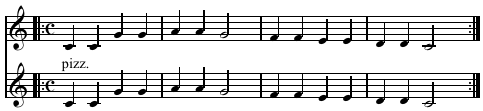
Musical parts sounding at the same pitch
| Field | Value |
|---|---|
| main_interval_name | unison |
| inverse | octave |
| complement | unison |
| other_names | perfect unison, prime, perfect prime |
| abbreviation | P1 |
| semitones | 0 |
| interval_class | 0 |
| just_interval | 1:1 |
| cents_equal_temperament | 0 |
| cents_just_intonation | 0 |
\override Score.TimeSignature#'stencil = ##f \relative c' { \clef treble \time 4/4 \key c \major 1 } }
Definition
Divisi
Unison or perfect unison (also called a prime, or perfect prime) may refer to the (pseudo-) interval formed by a tone and its duplication (in German, Unisono, Einklang, or Prime), for example C–C, as differentiated from the second, C–D, etc. In the unison the two pitches have the ratio of 1:1 or 0 half steps and zero cents. Although two tones in unison are considered to be the same pitch, they are still perceivable as coming from separate sources, whether played on instruments of a different type: ; or of the same type: . This is because a pair of tones in unison come from different locations or can have different "colors" (timbres), i.e. come from different musical instruments or human voices. Voices with different colors have, as sound waves, different waveforms. These waveforms have the same fundamental frequency but differ in the amplitudes of their higher harmonics. The unison is considered the most consonant interval while the near unison is considered the most dissonant. The unison is also the easiest interval to tune. The unison is abbreviated as "P1".
However, the unison was questioned by Zarlino as an interval for lacking contrast and compared to a point in geometry:
Performance ensembles
"In unison"
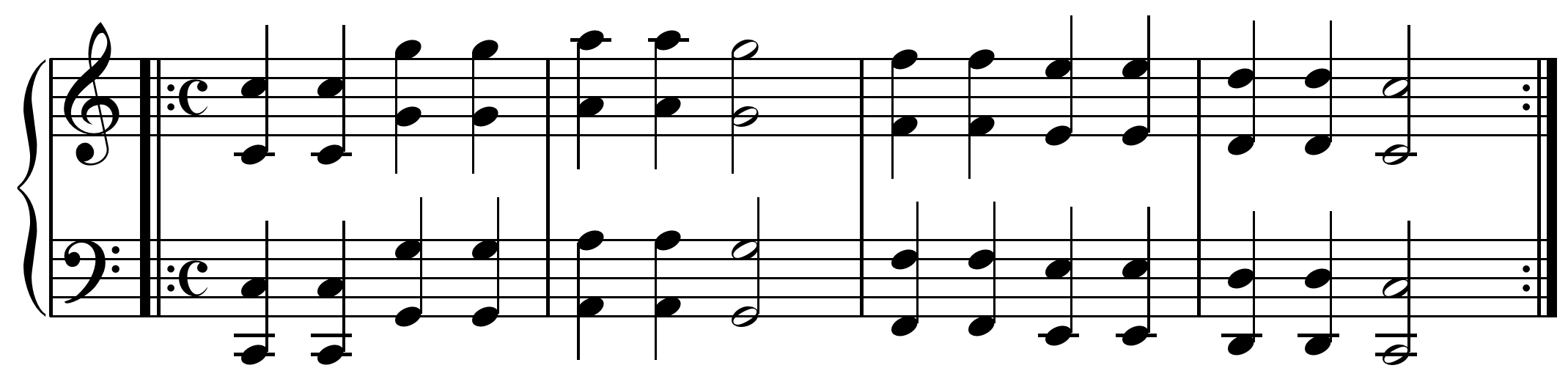
In orchestral music unison can mean the simultaneous playing of a note (or a series of notes constituting a melody) by different instruments, either at the same pitch; or in a different octave, for example, cello and double bass (all'unisono). Typically a section string player plays unison with the rest of the section. Occasionally the Italian word divisi (meaning divided, abbrev. div.) marks a point where an instrumental section, typically the first violins, is to be divided into two groups for rendering passages that might, for example, include full chords. Thus, in the divisi first violins the "outside" players (nearer the audience) might play the top note of the chord, while the "inside" seated players play the middle note, and the second violins play the bottom note. At the point where the first violins no longer play divisi, the score may indicate this with unison (abbrev. unis.).
When an entire choir sings the main melody, the choir usually sings in unison. Music in which all the notes sung are in unison is called monophonic. In a choir with two or more sections, such as for different vocal ranges, each section typically sings in unison. Part singing is when two or more voices sing different notes. Homophony is when choir members sing different pitches but with the same rhythm. Polyphony is when the chorus sings multiple independent melodies.
References
References
- Rushton, Julian. "Unison [prime]". Oxford University Press.
- Benward, Bruce, and Marilyn Nadine Saker (2003). ''Music: In Theory and Practice'', Vol. I, seventh edition, p. 364. Boston: McGraw-Hill. {{ISBN. 978-0-07-294262-0.
- Benward & Saker (2003), p. 53.
- Thomas Street Christensen (2004). ''Rameau and Musical Thought in the Enlightenment'', p. 76. {{ISBN. 978-0-521-61709-3.
This article was imported from Wikipedia and is available under the Creative Commons Attribution-ShareAlike 4.0 License. Content has been adapted to SurfDoc format. Original contributors can be found on the article history page.
Ask Mako anything about Unison — get instant answers, deeper analysis, and related topics.
Research with MakoFree with your Surf account
Create a free account to save articles, ask Mako questions, and organize your research.
Sign up freeThis content may have been generated or modified by AI. CloudSurf Software LLC is not responsible for the accuracy, completeness, or reliability of AI-generated content. Always verify important information from primary sources.
Report