From Surf Wiki (app.surf) — the open knowledge base
Union-Castle Line
Former British shipping line

Former British shipping line
| Field | Value |
|---|---|
| name | Union-Castle Mail SS Co. Ltd |
| logo | Union-Castle Line house flag.svg |
| logo_caption | House flag |
| image | Union-Castle liners in the East India Docks.jpg |
| image_size | 280px |
| image_caption | Union-Castle liners in East India Docks, London in 1902 |
| trade_name | Union-Castle Line |
| industry | Shipping |
| predecessors | |
| successor | British and Commonwealth Shipping |
| founded | in United Kingdom |
| founder | |
| defunct | |
| hq_location_country | United Kingdom |
| num_locations_year | |
| area_served | London and Southampton to Cape Town |
| key_people | *Donald Currie |
| production_year | |
| services | Passenger, cargo and mail transport |
| revenue_year | |
| income_year | |
| net_income | |
| net_income_year | |
| aum | |
| assets_year | |
| equity_year | |
| owner | |
| members_year | |
| num_employees_year | |
| slogan | |
| module | |
| intl |
- Sir Francis Vernon Thompson
The Union-Castle Line was a British shipping line that operated a fleet of passenger liners and cargo ships between Europe and Africa from 1900 to 1977. It was formed from the merger of the Union Line and Castle Shipping Line.
It merged with Bullard King and Clan Line in 1956 to form British & Commonwealth Shipping, and then with South African Marine Corporation (commonly referred to as Safmarine) in 1973 to create International Liner Services, but maintained its separate identity throughout. Its shipping operations ceased in 1977.
Predecessor lines
.jpg)


The Union Line was founded in 1853 as the Southampton Steam Shipping Company to transport coal from South Wales to Southampton. It was renamed the Union Steam Collier Company and then the Union Steamship Company. In 1857, renamed the Union Line, it won a contract to carry mail to South Africa, mainly the Cape Colony. The inaugural sailing of Dane left Southampton on 15 September.
Meanwhile, Donald Currie had built up the Castle Packet Co. which traded to Calcutta round the Cape of Good Hope. This trade was substantially curtailed by the opening of the Suez Canal in 1869, and the Castle Line started to run to South Africa instead, later becoming the Castle Mail Packet Company.
In 1872 the Cape Colony gained responsible government and its first Prime Minister, John Molteno, ordered a re-negotiation of the country's mail services. In 1876, keen to avoid either of the two main companies gaining a monopoly on the country's shipping, he awarded the South African mail contract jointly to both the Castle Mail Packet Company and the Union Line. The contract included a condition that the two companies would not amalgamate, as well as other clauses to promote competition, such as alternating services and speed premiums. This competition led to their shipping services running at unprecedented speed and efficiency. The contract was eventually to expire however, and the period of intense competition was later to give way to co-operation, including transporting troops and military equipment during the Boer War. Finally, on 8 March 1900, the Union Line and Castle Shipping Line merged, creating the Union-Castle Mail Steamship Company, Ltd, with Castle Shipping Line taking over the fleet.
Union-Castle Line


.jpg)


.jpg)
.jpg)
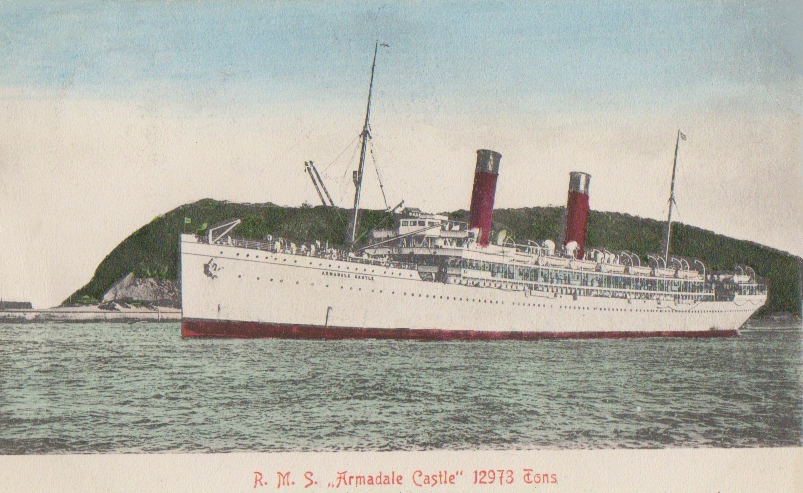
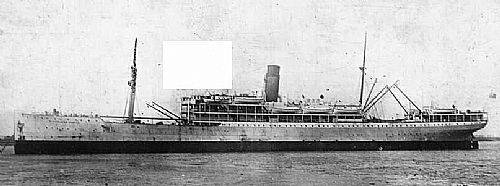
Union-Castle named most of their ships with the suffix "Castle" in their names; the names of several inherited from the Union Line were changed to this scheme (for example, Galician became ) but others (such as ) retained their original name. They were well known for the lavender-hulled liners with red funnels topped in black, running on a rigid timetable between Southampton and Cape Town. Every Thursday at 4pm a Union-Castle Royal Mail Ship would leave Southampton bound for Cape Town. At the same time, a Union-Castle Royal Mail Ship would leave Cape Town bound for Southampton. In 1922 the line introduced its Round Africa service, a nine-week voyage calling at twenty ports en route. Alternate sailings travelled out via the Suez Canal and out via West Africa.
The combined line was sold to the Royal Mail Line in 1911, but continued to operate as Union-Castle. Many of the line's vessels were requisitioned for service as troop ships or hospital ships in the First World War, and eight were sunk by mines or German U-boats. The Royal Mail Line ran into financial difficulties in the 1930s, culminating in the prosecution of its director Lord Kylsant, and Union-Castle Line became an independent company again with Vernon Thomson as Managing Director. Many vessels were again requisitioned in the Second World War. Three – , Carnarvon Castle, Dunvegan Castle became armed merchant cruisers. (1939) was also first requisitioned as an armed merchant cruiser, but later served as an escort carrier.
After the war the line made good use of its three ships converted to troop transports to facilitate carrying the vast number of emigrants seeking new lives in East and South Africa. When they ran out of berths the line set up its own internal travel agency to book passages on other lines and even air services. The mail service to South Africa, curtailed during hostilities, recommenced with the sailing of Roxburgh Castle from Southampton on 2 January 1947.
British & Commonwealth, and International Liner Services
.jpg)

The company took over the King Line in 1949, and merged with Bullard King and Clan Line in 1956 to form British & Commonwealth Shipping. It merged with South African Marine Corporation in 1973 to create International Liner Services, but competition with air travel adversely affected its shipping activities, and cargo shipping rapidly became containerised. The final South African mail service arrived in Southampton on 24 October 1977, and International Liner Services withdrew from shipping in 1982. British & Commonwealth continued in other fields, and acquired Atlantic Computers in 1989, but accounting problems soon became apparent and British & Commonwealth was liquidated in 1990.
In the 1950s and 60s the line operated a fleet of fifteen ships, eight on the principal weekly mail run from Southampton to Cape Town. Each ship could carry an average of two hundred First Class passengers and four hundred and fifty in Tourist Class. Six of the remaining ships operated the monthly Round Africa service, sailing both clockwise and anti-clockwise round the continent. The remaining ship operated a service carrying up to 750 Tourist Class passengers to Beira and back via the West Coast route every three months.
In December 1999 the Union-Castle name was revived for a millennium cruise; the P&O ship was chartered for a 60-day cruise around Africa, and had its funnel repainted for the occasion.
The last few surviving Union-Castle Line ships were scrapped in the early 21st century, the former Kenya Castle in 2001, the former in 2003, the former Dunnottar Castle in 2004, and finally in 2005.
Ships
.jpg)
The initial Union fleet consisted of the colliers Union, Briton, Saxon, Norman and Dane. In 1860 this was augmented by the much larger Cambrian.
At the time of the merger in 1900, the Union fleet included: :Arab (1879–1900), Briton (1897–1926), Falcon (1896–1942), Gaika (1896–1926), (1899–1916), Galician (1900-1918), (1897–1928), Gaul (1893–1906), German (2) (1898–1930), Goorkka (1897-1926), Goth (1893–1913), Greek (1893–1906), Guelph (1894–1913), Mexican (1883–1900), Moor (1881-1901), Norman (2) (1894–1926), Sabine (1895–1921), (1900–1935), Scot (1891–1905), Spartan (1881–1900), Susquehanna (1896–1926), and Trojan (1880–1900), with Celt on order (renamed before it came into service) and the Castle Line fleet included: :Arundel Castle (3) (1894–1905), Avondale Castle (1897–1912), Braemar Castle (1) (1898–1924), Carisbrook Castle (1898–1922), Doune Castle (1890–1904), Dunolly Castle (1897–1905), (1890–1913), Dunvegan Castle (1896–1923), Garth Castle (1880–1901), Harlech Castle (1894–1904), Hawarden Castle (1883–1904), (1899–1931), Kinfauns Castle (2) (1899–1927), Lismore Castle (1891–1904), (1883–1903), (2) (1883–1906), Raglan Castle (1897–1905), Roslin Castle (2) (1883–1904), Tantallon Castle (2) (1894–1901), Tintagel Castle (1) (1896–1912){{refn|It was on the Tintagel Castle in 1900 that Ernest Shackleton met Cedric, the son of Lieutenant-Colonel Llewellyn Longstaff, the principal financial backer of Scott’s Discovery Expedition, that meeting led to Shackleton obtaining a place on The Discovery Expedition of 1901–1904.{{cite book | author-link = Roland Huntford | url-access = registration
| Ship | Built | Tonnage | Notes and references | ||||||||
|---|---|---|---|---|---|---|---|---|---|---|---|
| {{RMS | Alnwick Castle | 2}} | 1901 | 5,893 | |||||||
| {{SS | Armadale Castle | 2}} | 1903 | 12,973 | |||||||
| {{SS | Aros Castle | 2}} | 1901 | 4,460 | |||||||
| Arundel Castle | 1894 | 4,588 | Passenger ship built by Fairfield Shipbuilding and Engineering Company, launched 1895, sold to the Danish East Asiatic Company in 1905 and renamed Birma | ||||||||
| {{RMS | Arundel Castle | 2}} | 1921 | 19,023 | |||||||
| Athlone Castle | 1936 | 25,564 | Passenger ship built by Harland and Wolff, launched 28 November 1935, completed 13 May 1936, maiden voyage 22 May 1936, scrapped 1965 | ||||||||
| Balmoral Castle | 1910 | 13,361 | 1939 scrapped | ||||||||
| Balmoral Castle | 1965 | 7,952 | ex-Clan Robertson | ||||||||
| Bampton Castle | 1920 | 6,698 | 1932 sold to Greece, renamed Atlantis | ||||||||
| Banbury Castle | 1918 | 6,430 | ex-Glenstrae | ||||||||
| Berwick Castle | 1902 | 5,883 | 1919 burnt out at Mombasa, sold to Italy | ||||||||
| {{MV | Bloemfontein Castle | 2}} | 1950 | 18,400 | |||||||
| {{HMHS | Braemar Castle | 2}} | 1898 | 6,318 | |||||||
| Braemar Castle | 1943 | 7,067 | ex-Empire Duchess | ||||||||
| Braemar Castle | 1952 | 17,029 | 1966 scrapped | ||||||||
| Bratton Castle | 1920 | 6,696 | 1931 sold to Greece, renamed Proteus | ||||||||
| {{RMS | Capetown Castle | 2}} | 1938 | 27,000 | |||||||
| Carlisle Castle | 1913 | 4,325 | Steamer | ||||||||
| Carlow Castle | 1917 | 5,833 | 1930 sold to Mitchell, Cotts & Co., renamed Cape St. Columba | ||||||||
| Carnarvon Castle | 1926 | 20,122 | Passenger ship built by Harland and Wolff, launched 14 January 1926, completed 26 June 1926, maiden voyage 16 July 1926, scrapped 1963 | ||||||||
| Cawdor Castle | 1902 | 6,235 | 1926 went ashore South West Africa and declared a total loss | ||||||||
| Chepstow Castle | 1913 | 7,494 | ex-Anglo-Brazilian | ||||||||
| Cluny Castle | 1903 | 5,147 | 1924 transferred to Bullard King, renamed Umkuzi | ||||||||
| Comrie Castle | 1903 | 5,173 | Passenger steamer | ||||||||
| Corfe Castle | 1901 | 4,592 | 1927 sold to W. Schuchmann, Hamburg, renamed Ostee | ||||||||
| Crawford Castle | 1910 | 4,264 | ex-Hova | ||||||||
| 1904 | 8,271 | Hospital ship | |||||||||
| Dover Castle | 1964 | 7,950 | ex-Clan Ranald | ||||||||
| Drakensberg Castle | 1945 | 9,905 | ex-Empire Allenby | ||||||||
| Dromore Castle | 1919 | 5,242 | Cargo ship | ||||||||
| Dunbar Castle | 1883 | 2,837 | Steamship | ||||||||
| Dunbar Castle | 1930 | 10,002 | Passenger ship built by Harland and Wolff, completed 20 May 1930, struck a mine off North Foreland, Kent and sank on 9 January 1940 | ||||||||
| Dundrum Castle | 1919 | 5,259 | Cargo ship built by Harland and Wolff, completed 31 December 1919, caught fire and sank in Red Sea 2 April 1943 | ||||||||
| Dunluce Castle | 1904 | 8,114 | Passenger ship built by Harland and Wolff, completed 15 September 1904, sold for scrapping in 1939 but purchased by the Admiralty for use as accommodation ship | ||||||||
| {{RMS | Dunottar Castle | 2}} | 1890 | 5,625 | |||||||
| {{MS | Dunnottar Castle | 2}} | 1936 | 15,002 | |||||||
| Dunvegan Castle | 1936 | 15,007 | Passenger ship built by Harland and Wolff, launched 26 March 1936, completed 27 August 1936, requisitioned by Admiralty in 1940 as an armed merchant cruiser and renamed HMS Dunvegan Castle, torpedoed and sunk off Ireland by on 27 August 1940 | ||||||||
| Durban Castle | 1938 | 17,382 | 1962 scrapped. In 1947 it was the crime scene of the Porthole Murder Case | ||||||||
| {{RMS | Durham Castle | 2}} | 1904 | 8,217 | |||||||
| Edinburgh Castle | 1910 | 13,326 | Passenger ship built by Harland and Wolff, launched 27 January 1910, completed 28 April 1910, maiden voyage May 1910. | ||||||||
| Fitted with 6-inch guns and operated as armed merchant cruiser during First World War. Requisitioned in Second World War and moored in Freetown as accommodation ship. Judged not worth returning to UK and sunk as a target by gunfire November 1945. | |||||||||||
| Edinburgh Castle | 1947 | 28,700 | 1976 scrapped | ||||||||
| Edinburgh Universal | 1979 | 9,996 | ex-Polar Honduras (Hamburg-Sud) | ||||||||
| 1981 leased from Barclays Mercantile Finance Co renamed Edinburgh Universal | |||||||||||
| Eider | 1900 | 1,236 | 1926 purchased from Royal Mail SP Co., for the Southampton – Bremen – Hamburg feeder service | ||||||||
| Galway Castle | 1911 | 7,988 | Passenger ship built by Harland & Wolff, torpedoed by U-82 160 nmi SW of Fastnet Rock, Ireland on 12 September 1918. Taken under tow but sank on 15 September. | ||||||||
| Garth Castle | 1910 | 7,612 | year=1910 | title=Launches and Trial Trips | journal=International Marine Engineering & Naval Architect | volume=32 | issue=February | pages=284 | publisher=Marine Engineering, Inc., New York—London | url=https://archive.org/stream/marineengineer32londuoft#page/284/mode/1up/search/Esturia | access-date=2 February 2018}} 1939 scrapped |
| {{HMHS | Glenart Castle | 2}} | 1900 | 6,807 | |||||||
| Glengorm Castle | 1898 | 6,763 | Formerly Union Line German | ||||||||
| 1911 | 7,999 | Hospital ship | |||||||||
| Good Hope Castle | 1945 | 9,905 | ex-Empire Life | ||||||||
| Good Hope Castle | 1965 | 10,500 | 1978 sold to Italy, renamed Franca C | ||||||||
| Gordon Castle | 1901 | 4,408 | 1924 scrapped | ||||||||
| Grantully Castle | 1909 | 7,612 | Launched 14 October 1909. 1939 scrapped | ||||||||
| Guildford Castle | 1911 | 7,995 | 1 June 1933 beached after collision in Elbe with Blue Funnel Line's Stentor. Total loss | ||||||||
| Hansa | 1904 | 880 | 1907 transferred from Liverpool-Hamburg Line | ||||||||
| Helius | 1888 | 4,579 | ex-Dresden, (North German Lloyd) | ||||||||
| Incomati | 1920 | 340 | 1924 purchased from Portuguese Government, East Africa feeder service | ||||||||
| Iolaire | 1902 | 999 | Sir Donald Currie's yacht, used as officer cadet training ship | ||||||||
| 1904 | 12,975 | Passenger ship built by Harland and Wolff, launched 15 December 1903, completed 19 May 1904, scrapped 1936 | |||||||||
| Kenilworth Castle | 1944 | 9,916 | ex-Empire Wilson | ||||||||
| Kenya Castle | 1951 | 17,040 | 1967 sold to Greece, renamed Amerikanis | ||||||||
| Kinnaird Castle | 1956 | 7,718 | ex-Clan Ross | ||||||||
| Kinpurnie Castle | 1954 | 8,121 | ex-Clan Stewart, ex-South African Sculptor | ||||||||
| Kinpurnie Castle | 1966 | 7,950 | ex-Clan Ross | ||||||||
| {{SS | Leasowe Castle | 2}} | 1917 | 8,106 | |||||||
| ** | 1926 | 10,786 | Passenger liner/troop transport | ||||||||
| {{HMHS | Llandovery Castle | 2}} | 1914 | 11,423 | |||||||
| Llandovery Castle | 1925 | 10,640 | 1953 scrapped | ||||||||
| {{MV | Llangibby Castle | 2}} | 1929 | 11,951 | |||||||
| Llanstephan Castle | 1914 | 11,348 | operated as troop transport. Converted to Landing Ship, Infantry. Scrapped 1952. | ||||||||
| Lochgair | 1888 | 111 | 1901 acquired as tender at Port Elizabeth | ||||||||
| Newark Castle | 1902 | 6,224 | Passenger/cargo steamer | ||||||||
| {{RMS | Pendennis Castle | 2}} | 1958 | 28,582 | |||||||
| Polglass Castle | 1903 | 4,631 | ex-Reichenfels, (Hansa Line) | ||||||||
| Warwick Castle | 1939 | 17,383 | Requisitioned in October 1939, fitted with 6-inch guns and operated as armed merchant cruiser by RN. 1942 sold to Admiralty and rebuilt as an escort carrier | ||||||||
| Pretoria Castle | 1948 | 28,705 | 1966 transferred to South African Marine Corp., renamed S.A.Oranje | ||||||||
| 1956 | 20,263 | Purchased from ex-Pacific Steam Nav. Co, | |||||||||
| Rhodesia Castle | 1951 | 17,041 | 1967 scrapped | ||||||||
| Richmond Castle | 1938 | 7,798 | Cargo ship | ||||||||
| Richmond Castle | 1944 | 7,971 | 1971 scrapped | ||||||||
| Riebeeck Castle | 1946 | 8,322 | 1971 scrapped | ||||||||
| Ripley Castle | 1917 | 7,521 | ex-War Soldier | ||||||||
| Rochester Castle | 1937 | 7,795 | 1970 sold to Cyprus, renamed Glenda and scrapped | ||||||||
| Roslin Castle | 1935 | 7,016 | Refrigerated cargo ship built by Harland and Wolff, completed 4 May 1935, scrapped 1967 | ||||||||
| Rosyth Castle | 1918 | 4,328 | ex-War Earl | ||||||||
| Rotherwick Castle | 1959 | 9,650 | 1975 sold to Liberia, renamed Sea Fortune | ||||||||
| Rothesay Castle | 1935 | 7,016 | Refrigerated cargo ship built by Harland and Wolff, completed 11 May 1935, went ashore on Scottish Island of Islay, total loss 5 January 1940 | ||||||||
| Rothesay Castle | 1960 | 9,650 | 1975 sold to Uruguay, renamed Laura | ||||||||
| Rowallan Castle | 1939 | 7,798 | 1942 bombed by German aircraft and sunk in Mediterranean | ||||||||
| Rowallan Castle | 1943 | 7,950 | 1971 scrapped | ||||||||
| Roxburgh Castle | 1937 | 7,801 | Cargo ship | ||||||||
| Roxburgh Castle | 1944 | 8,003 | 1971 scrapped | ||||||||
| Rustenberg Castle | 1946 | 8,322 | 1971 scrapped | ||||||||
| Sandgate Castle | 1922 | 7,607 | 1937 caught fire and sank NE of Bermuda | ||||||||
| Sandown Castle | 1921 | 7,607 | 1950 scrapped | ||||||||
| Southampton Castle | 1965 | 10,538 | 1978 sold to Italy, renamed Paola C | ||||||||
| {{MV | Stirling Castle | 2}} | 1936 | 25,554 | |||||||
| Stirling Universal | 1979 | 9,065 | ex-Hilco Speedster (Larsen. Oslo) | ||||||||
| Tantallon Castle | 1953 | 7,448 | 1971 sold to Cyprus, renamed Aris II | ||||||||
| Tintagel Castle | 1954 | 7,447 | 1971 sold to Cyprus, renamed Armar | ||||||||
| {{RMS | Transvaal Castle | 2}} | 1961 | 32,697 | |||||||
| Ulundi | 1927 | 97 | Sold to SA Railways and Harbors in 1935, museum ship in Durban | ||||||||
| 1936 | 906 | 1941 Southampton – Bremen – Hamburg feeder service | |||||||||
| Warwick Castle | 1930 | 20,445 | Passenger ship/troop transport built by Harland & Wolff, launched 29 April 1930, completed 16 January 1931, maiden voyage 30 January 1931, torpedoed and sunk by {{GS | U-413 | |||||||
| Winchester Castle | 1930 | 20,109 | Passenger ship built by Harland and Wolff, launched 19 November 1929, completed 11 October 1930, maiden voyage 24 October 1930, scrapped 1960 | ||||||||
| Winchester Castle | 1964 | 7,950 | ex-Clan Ramsey | ||||||||
| 1921 | 18,967 | Ocean liner | |||||||||
| 1960 | 37,640 | 1977 sold to Yiannis Latsis, Piraeus, renamed Margarita L (Panama flag). | |||||||||
| York Castle | 1901 | 5,517 | 1924 sold to Italy, renamed San Terenzo |
References
References
- {{harvnb. Damant. 1977. (January 2018)
- [[Encyclopædia Britannica]], ed.1911, vol. 24, pg. 889, Plate VIII.
- {{harvnb. Gardiner. 1980{{page needed. (January 2018)
- (10 January 2008). "The porthole murder".
- (1910). "Launches and Trial Trips". Marine Engineering, Inc., New York—London.
This article was imported from Wikipedia and is available under the Creative Commons Attribution-ShareAlike 4.0 License. Content has been adapted to SurfDoc format. Original contributors can be found on the article history page.
Ask Mako anything about Union-Castle Line — get instant answers, deeper analysis, and related topics.
Research with MakoFree with your Surf account
Create a free account to save articles, ask Mako questions, and organize your research.
Sign up freeThis content may have been generated or modified by AI. CloudSurf Software LLC is not responsible for the accuracy, completeness, or reliability of AI-generated content. Always verify important information from primary sources.
Report