From Surf Wiki (app.surf) — the open knowledge base
Uniformed and Overseas Citizens Absentee Voting Act
US law on elections and voting rights
US law on elections and voting rights
| Field | Value |
|---|---|
| shorttitle | Uniformed and Overseas Citizens Absentee Voting Act |
| longtitle | An Act to consolidate and improve provisions of law relating to absentee registration and voting in elections for Federal office by members of uniformed services and persons who reside overseas. |
| nickname | Uniformed and Overseas Citizens Absentee Voting Act of 1986 |
| enacted by | 99th |
| effective date | August 28, 1986 |
| public law url | https://www.gpo.gov/fdsys/pkg/STATUTE-100/pdf/STATUTE-100-Pg924.pdf |
| cite public law | 99-410 |
| cite statutes at large | |
| title amended | 42 U.S.C.: Public Health and Social Welfare transferred to 52 U.S.C.: Voting and Elections |
| sections created | § 1973ff et seq. transferred to |
| leghisturl | http://thomas.loc.gov/cgi-bin/bdquery/z?d099:HR04393:@@@R |
| introducedin | House |
| introducedbill | |
| introducedby | Al Swift (D–WA) |
| introduceddate | March 12, 1986 |
| committees | House Administration |
| passedbody1 | House |
| passeddate1 | August 12, 1986 |
| passedvote1 | Passed Voice Vote |
| passedbody2 | Senate |
| passedas2 | |
| passeddate2 | August 16, 1986 |
| passedvote2 | Passed Voice Vote |
| agreedbody3 | |
| agreeddate3 | |
| agreedvote3 | |
| agreedbody4 | |
| agreeddate4 | |
| agreedvote4 | |
| signedpresident | Ronald Reagan |
| signeddate | August 28, 1986 |
| unsignedpresident | |
| unsigneddate | |
| vetoedpresident | |
| vetoeddate | |
| overriddenbody1 | |
| overriddendate1 | |
| overriddenvote1 | |
| overriddenbody2 | |
| overriddendate2 | |
| overriddenvote2 |
| cite statutes at large = The Uniformed and Overseas Citizens Absentee Voting Act (UOCAVA), P.L. 99-410, , , , is a United States federal law dealing with elections and voting rights for United States citizens residing overseas. The act requires that all U.S. states, the District of Columbia, Puerto Rico, Guam, American Samoa, and the U.S. Virgin Islands allow certain U.S. citizens to register to vote and to vote by absentee ballot in federal elections.{{Cite web |access-date=2010-12-18 |archive-url=https://web.archive.org/web/20080717085438/http://www.fvap.gov/laws/uocavalaw.html |archive-date=2008-07-17
Groups of people covered under the act are:
- Members of the then-seven (now eight) Uniformed Services
- Members of the U.S. Merchant Marine
- Eligible family members of the above
- U.S. citizens employed by the federal government residing outside the U.S.
- Other private U.S. citizens residing outside the United States
The act provides for an emergency back-up ballot, the Federal Write-In Absentee Ballot (FWAB), which can be cast by voters who "have made a timely application for but have not received their regular ballot from the state or territory, subject to certain conditions."
The act does not apply to non-federal elections, although most states also let citizens covered by the UOCAVA register and vote in state and local elections. Before 1986 there had been some access to voting from abroad, but it varied.
FVAP
The Federal Voting Assistance Program (FVAP), part of the Department of Defense, is the program that administers the UOCAVA as well as the National Voter Registration Act of 1993 on behalf of the Secretary of Defense. The FVAP states its goals as to "inform and educate U.S. citizens worldwide of their right to vote; facilitate voting participation; and protect the integrity of, and simultaneously enhance, the electoral process at the Federal, State and local levels."
Voting methods
UOCAVA lets uniformed service members request absentee ballots as early as they wish in an election year. Any time after that request they may send the Federal Write-In Absentee Ballot from outside the US, so they can vote even if they are on extended missions without communication, if they can send it from outside the US.
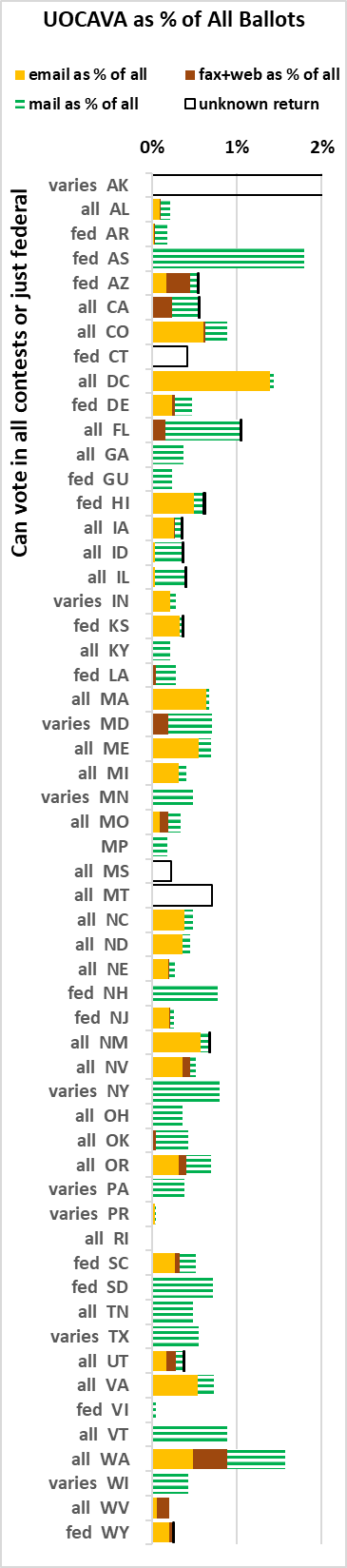
UOCAVA lets covered groups get ballots electronically (email, fax, or web site) from all states. Some states transmit ballots electronically to other groups.
Twenty states require ballots to be returned by mail.
Four states allow ballot submission through secure web sites: AZ, CO (if needed), MO, and WV. In 2019-2020 researchers found insecurities in online voting systems used for UOCAVA from Voatz and Democracy Live.
The four states allowing online voting and the remaining 27 states have a mix of rules allowing email or fax to return ballots: AK, CA, DE, DC, FL, HI, IN, IA, KS, LA, ME, MA, MS, MT, NE, NV, NJ, NM, NC, MD, OK, OR, RI, SC, TX (for danger, combat zones or space), UT, and WA.
Maine and Rhode Island tabulate all votes cast in elections based on rules set out by UOCAVA in a single total at the bottom of the states official election result reports (such reports are officially posted in a csv file structure document) instead of separately tabulating such votes in the same category as all other votes cast in their home towns.
Executive Order 12642
An executive order issued by President Reagan on June 9, 1988, designated the Secretary of Defense as the presidential designee responsible for administering the act and authorizes the Secretary of Defense to delegate the responsibilities under the act and executive order to any person or persons within the Department of Defense.{{Cite web |access-date=2007-12-03
The act was amended by the Help America Vote Act (2002) and the National Defense Authorization Acts in 2002 and 2005.
Relevance to District of Columbia voting rights
The Uniformed and Overseas Citizens Absentee Voting Act allows U.S. citizens to vote from overseas, even if they have permanently left the United States. Since these citizens are no longer residents of a U.S. State but maintain their right to vote, legal scholars have therefore argued that United States Congress also has the authority to grant voting rights to residents of the District of Columbia.
Relevance to Puerto Rico voting rights
The Uniformed and Overseas Citizens Absentee Voting Act has also been challenged in federal court by U.S. citizens living in Puerto Rico. Plaintiffs in the case of Igartua de la Rosa v. United States claimed that the Act is unconstitutional because it allows U.S. citizens who move abroad to vote in federal elections, but not if they relocate to Puerto Rico. The challenge was dismissed by the courts. However, in his dissent, Judge Juan R. Torruella argued that the United States Constitution neither denies citizens of Puerto Rico the right to vote for members of the United States House of Representatives nor imposes a limitation on the federal government's authority to extend federal voting rights to territorial residents under other constitutional powers.
References
References
- Coleman, Kevin J. [http://www.fas.org/sgp/crs/misc/RS20764.pdf "Uniformed and Overseas Citizens Absentee Voting Act: Background and Issues."] Congressional Research Service, 2014.
- "Section 703: Nonprofit Standard Mail and Other Unique Eligibility". United States Postal Service.
- [http://www.fvap.gov/vao/vag Federal Voting Assistance Program]
- (2024). "2024-25 Voting Assistance Guide".
- Rynerson, R. W.. (November 1970). "U.S. Election Night – 1970 – Berlin 1969". KLC Radio, Lewis & Clark College.
- "52 USC 20306".
- "52 USC 20303(b)(2)".
- "Electronic Transmission of Ballots".
- Zetter, Kim. (2020-02-13). "'Sloppy' Mobile Voting App Used in Four States Has 'Elementary' Security Flaws". VICE.
- Specter, Michael A., James Koppel, Daniel Weitzner. (2020-02-12). "The Ballot is Busted Before the Blockchain: A Security Analysis of Voatz, the First Internet Voting Application Used in U.S. Federal Elections".
- Halper, Evan. (2019-05-16). "The vote-by-phone tech trend is scaring the life out of security experts". San Diego Union Tribune.
- Appel, Andrew. (2020-06-08). "Democracy Live internet voting: unsurprisingly insecure, and surprisingly insecure".
- Parks, Miles. (2020-02-28). "States Expand Internet Voting Experiments Amid Pandemic, Raising Security Fears". National Public Radio.
- (2 November 2010). "Astronauts beam votes home". CNN.
- James, Kate. (2 November 2010). "Astronauts Cast Vote From Space Thanks to 1997 Texas Law". Gather.com.
- (2007-03-12). "25 Legal Scholars Support Constitutionality of DC Voting Rights".
- Román, José D.. (April 2002). "Trying to Fit an Oval Shaped Island into a Square Constitution: Arguments for Puerto Rican Statehood". Fordham Urban Law Journal.
- [https://caselaw.findlaw.com/us-1st-circuit/1545899.html GREGORIO IGARTÚA ET AL v. UNITED STATES OF AMERICA ET AL (IGARTUA IV)]
This article was imported from Wikipedia and is available under the Creative Commons Attribution-ShareAlike 4.0 License. Content has been adapted to SurfDoc format. Original contributors can be found on the article history page.
Ask Mako anything about Uniformed and Overseas Citizens Absentee Voting Act — get instant answers, deeper analysis, and related topics.
Research with MakoFree with your Surf account
Create a free account to save articles, ask Mako questions, and organize your research.
Sign up freeThis content may have been generated or modified by AI. CloudSurf Software LLC is not responsible for the accuracy, completeness, or reliability of AI-generated content. Always verify important information from primary sources.
Report