From Surf Wiki (app.surf) — the open knowledge base
Undertow (water waves)
Return flow below nearshore water waves
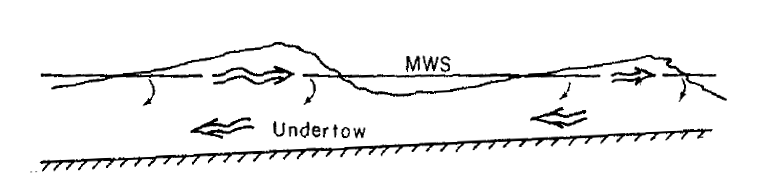
Return flow below nearshore water waves
undertow beneath water waves
an offshore current under all near-shore waves
In physical oceanography, undertow is the undercurrent that moves offshore while waves approach the shore. Undertow is a natural and universal feature for almost any large body of water; it is a return flow compensating for the onshore-directed average transport of water by the waves in the zone above the wave troughs. The undertow's flow velocities are generally strongest in the surf zone, where the water is shallow and the waves are high because of shoaling.
In popular usage, the word undertow is often misapplied to rip currents. An undertow occurs everywhere, underneath the shore-approaching waves, whereas rip currents are localized narrow offshore currents occurring at certain locations along the coast and most forceful by the water's surface.
Oceanography
An "undertow" is a steady, offshore-directed compensation flow, which occurs below waves near the shore. Physically, nearshore, the wave-induced mass flux between wave crest and trough is onshore directed. This mass transport is localized in the upper part of the water column, i.e. above the wave troughs. To compensate for the amount of water being transported towards the shore, a second-order (i.e. proportional to the wave height squared), offshore-directed mean current takes place in the lower section of the water column. This flow – the undertow – affects the nearshore waves everywhere, unlike rip currents localized at certain positions along the shore.
The term undertow is used in scientific coastal oceanography papers.

Seaward mass flux
An exact relation for the mass flux of a nonlinear periodic wave on an inviscid fluid layer was established by Levi-Civita in 1924. In a frame of reference according to Stokes' first definition of wave celerity, the mass flux M_w of the wave is related to the wave's kinetic energy density E_k (integrated over depth and thereafter averaged over wavelength) and phase speed c through:
:M_w = \frac{2E_k}{c}.
Similarly, Longuet Higgins showed in 1975 that – for the common situation of zero mass flux towards the shore (i.e. Stokes' second definition of wave celerity) – normal-incident periodic waves produce a depth- and time-averaged undertow velocity:
:\bar{u} = - \frac{2 E_k}{\rho c h},
with h the mean water depth and \rho the fluid density. The positive flow direction of \bar{u} is in the wave propagation direction.
For small-amplitude waves, there is equipartition of kinetic (E_k) and potential energy (E_p):
:E_w = E_k + E_p \approx 2 E_k \approx 2 E_p,
with E_w the total energy density of the wave, integrated over depth and averaged over horizontal space. Since in general the potential energy E_p is much easier to measure than the kinetic energy, the wave energy is approximately {E_w\approx\tfrac18\rho g H^2} (with H the wave height). So
:\bar{u}\approx -\frac18 \frac{g H^2}{ c h }.
For irregular waves the required wave height is the root-mean-square wave height H_\text{rms}\approx\sqrt{8};\sigma, with \sigma the standard deviation of the free-surface elevation. The potential energy is E_p=\tfrac12\rho g \sigma^2 and E_w\approx\rho g \sigma^2.
The distribution of the undertow velocity over the water depth is a topic of ongoing research.
Confusion with rip currents
Main article: Rip current
In contrast to undertow, rip currents are responsible for the great majority of drownings close to beaches. When a swimmer enters a rip current, it starts to carry them offshore. The swimmer can exit the rip current by swimming at right angles to the flow, parallel to the shore, or by simply treading water or floating until the rip releases them. However, drowning can occur when swimmers exhaust themselves by trying unsuccessfully to swim directly against the flow of a rip.
On the United States Lifesaving Association website, it is noted that some uses of the word "undertow" are incorrect:
In some regions, rip currents are referred to by other, incorrect terms such as "rip tides" and "undertow". We encourage exclusive use of the correct term—rip currents. Use of other terms may confuse people and negatively impact public education efforts.}}
References
Notes
Other
References
- Svendsen, I. A.. (1984). "Mass flux and undertow in a surf zone". [[Coastal Engineering Journal]].
- "Rip Current Characteristics".
- (2008). "Observations and a Model of Undertow over the Inner Continental Shelf". Journal of Physical Oceanography.
- (2000). "Undertow over a barred beach". Journal of Geophysical Research.
- (1994). "Vertical structure of mean cross-shore currents across a barred surf zone". Journal of Geophysical Research.
- (2004). "Vertical flow structure during Sandy Duck: Observations and modeling". Coastal Engineering.
- Longuet-Higgins, M.S.. (1983). "Wave set-up, percolation and undertow in the surf zone". Proceedings of the Royal Society of London A.
- Levi-Civita, T.. (1924). "Questioni di meccanica classica e relativista". N. Zanichelli.
- Longuet-Higgins, M.S.. (1975). "Integral properties of periodic gravity waves of finite amplitude". Proceedings of the Royal Society of London A.
- (1985). "Calibration and verification of a dissipation model for random breaking waves". Journal of Geophysical Research.
- "United States Lifesaving Association Rip Current Survival Guide". [[United States Lifesaving Association]].
This article was imported from Wikipedia and is available under the Creative Commons Attribution-ShareAlike 4.0 License. Content has been adapted to SurfDoc format. Original contributors can be found on the article history page.
Ask Mako anything about Undertow (water waves) — get instant answers, deeper analysis, and related topics.
Research with MakoFree with your Surf account
Create a free account to save articles, ask Mako questions, and organize your research.
Sign up freeThis content may have been generated or modified by AI. CloudSurf Software LLC is not responsible for the accuracy, completeness, or reliability of AI-generated content. Always verify important information from primary sources.
Report