From Surf Wiki (app.surf) — the open knowledge base
Umbra, penumbra and antumbra
Distinct parts of a shadow

Distinct parts of a shadow

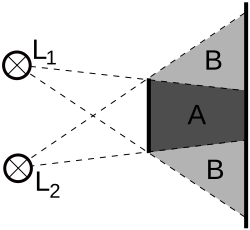
The umbra, penumbra and antumbra are three distinct parts of a shadow, created by any light source after impinging on an opaque object of lesser size. In cases of equal or smaller impinging objects, only an umbra and penumbra are generated. Assuming no diffraction, for a collimated beam (such as a point source) of light, only the umbra is cast.
These phenomena are generally observed within solar systems, as the size of the stars within the system are larger than the orbiting satellites, hence these terms are most often used for the shadows cast by celestial bodies, though they are sometimes used to describe levels of darkness, such as in sunspots.
Umbra

The umbra () is the innermost and darkest part of a shadow, where the light source is completely blocked by the occluding body. An observer within the umbra experiences a total occultation. The umbra of a round body occluding a round light source forms a right circular cone. When viewed from the cone's apex, the two bodies appear the same size.
The distance from the Moon to the apex of its umbra is roughly equal to that between the Moon and Earth: 384402 km. Since Earth's diameter is 3.7 times the Moon's, its umbra extends correspondingly farther: roughly 1.4 e6km.
Penumbra
The penumbra () is the region in which only a portion of the light source is obscured by the occluding body, and an observer in the penumbra experiences a partial eclipse.
An alternative definition is that the penumbra is the region where some or all of the light source is obscured (i.e., the umbra is a subset of the penumbra). For example, NASA's Navigation and Ancillary Information Facility defines that a body in the umbra is also within the penumbra.
.png)

Antumbra

The antumbra () is the region from which the occluding body appears entirely within the disc of the light source. An observer in this region experiences an annular eclipse, in which a bright ring is visible around the eclipsing body. If the observer moves closer to the light source, the apparent size of the occluding body increases until it causes a full umbra.
References
References
- "umbra".
- Pogge, Richard. "Lecture 9: Eclipses of the Sun & Moon". [[Ohio State University]].
- [http://naif.jpl.nasa.gov/pub/naif/misc/toolkit_docs_N0061/Tutorials/pdf/individual_docs/45_event_finding_preview.pdf ''Event Finding Subsystem Preview''] Navigation and Ancillary Information Facility.
- "Eclipses: What Is the Antumbra?". timeanddate.com.
This article was imported from Wikipedia and is available under the Creative Commons Attribution-ShareAlike 4.0 License. Content has been adapted to SurfDoc format. Original contributors can be found on the article history page.
Ask Mako anything about Umbra, penumbra and antumbra — get instant answers, deeper analysis, and related topics.
Research with MakoFree with your Surf account
Create a free account to save articles, ask Mako questions, and organize your research.
Sign up freeThis content may have been generated or modified by AI. CloudSurf Software LLC is not responsible for the accuracy, completeness, or reliability of AI-generated content. Always verify important information from primary sources.
Report