From Surf Wiki (app.surf) — the open knowledge base
Ulu
Traditional all-purpose knife of Inuit, Yupik and Aleut women
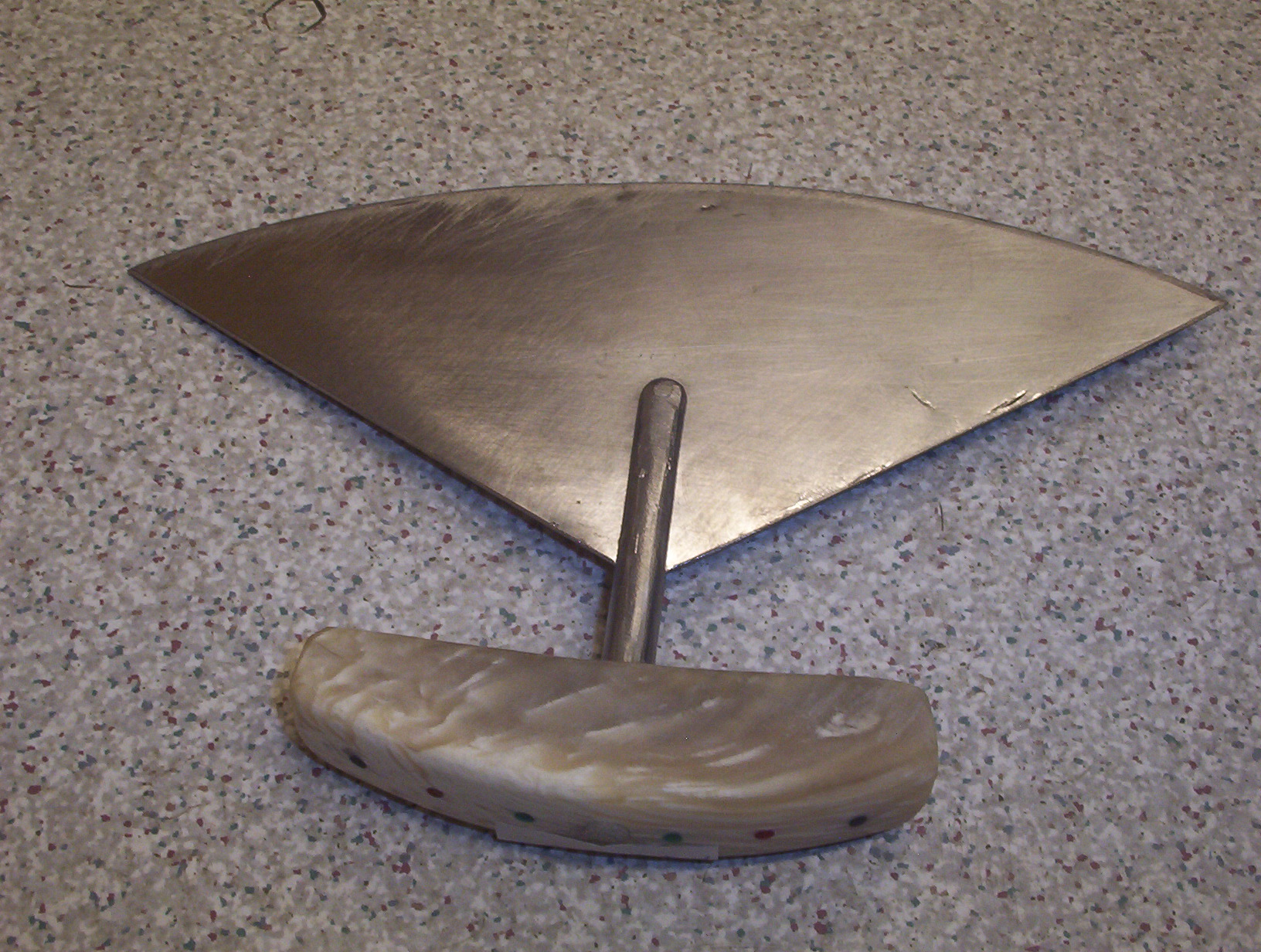
Traditional all-purpose knife of Inuit, Yupik and Aleut women
an all-purpose knife
An ulu (; plural: uluit; sometimes referred to as 'woman's knife') is an all-purpose knife traditionally used by Inuit, Iñupiat, Yupik, and Aleut women. It is used in applications as diverse as skinning and cleaning animals, cutting a child's hair, cutting food, and sometimes even trimming blocks of snow and ice used to build an igloo. They are widely sold as souvenirs in Alaska.
Name
In the Nunatsiavummiutut variety of Inuttitut, which is spoken in Nunatsiavut (Northern Labrador), the word is spelled uluk, and in Tunumiisut (East Greenlandic) it is sakiaq or saakiq.
The following chart lists both Eskaleut terms as well as two terms for the same tool in Athabaskan languages, which are an unrelated language family spoken by non-Inuit-Iñupiat-Aleut Alaska Natives.
| language | singular | dual | plural |
|---|---|---|---|
| Yukon-Kuskokwim Yup'ik | uluaq | uluak | uluat |
| Chevak Cup'ik (a Yupik language) | kegginalek | kegginalgek | kegginalget |
| Nunivak Cup'ig (a Yupik language) | ulluar | ||
| Iñupiaq language | ulu ~ uluuraq | ||
| Inuinnaqtun / Inuvialuktun (Central / Western Canadian Inuit language) | ulu | ||
| Inuktitut (Eastern Canadian Inuit language) | ulu (ᐅᓗ) | uluuk (ᐅᓘᒃ) | uluit (ᐅᓗᐃᑦ) |
| Inuttitut (an Eastern Canadian Inuit language) | uluk | ulok | uluit |
| Greenlandic (Western Greenlandic Inuit language) | ulu | ulut | |
| Tunumiisut (East Greenlandic Inuit Language) | sakiaq ~ saakiq | ||
| Koyukon (an Athabaskan language) | tlaabaas | ||
| Holikachuk (an Athabaskan language) | tthamas |
Materials
Traditionally the ulu was made with a caribou antler, muskox horn, or walrus ivory handle and slate cutting surface, due to the lack of metal smelting technology in the Arctic. The handle could also be carved from bone, and wood was sometimes used when it was available. In certain areas, such as Ulukhaktok ("where there is material for ulus"), Northwest Territories, copper was used for the cutting surface.
The modern ulu is still often made with a caribou antler handle but the blade is usually made of steel. The steel is often obtained by purchasing a hand saw or wood saw and cutting the blade to the correct shape. A hardwood called sisattaq is also used for handles. Uluit are often home made, but there is also an industry of commercially produced uluit, sometimes made with a plastic handle and complete with a cutting board.
The Copper Inuit of Victoria Island used copper they mined to make ulu blades. When slate and copper were scarce, some Inuit turned to whale baleen or ivory for the blades.
Usage and styles
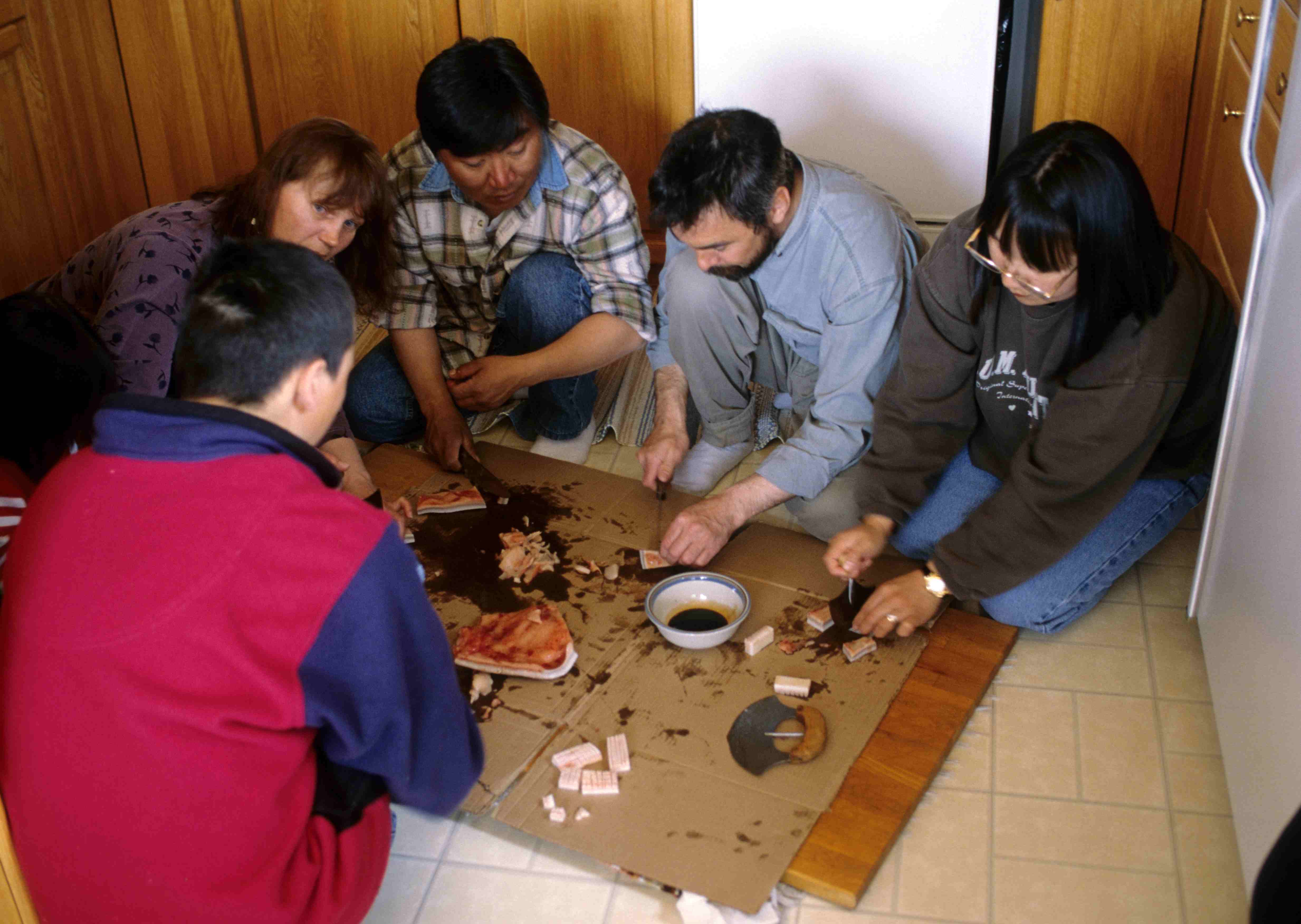
The ulu comes in four distinct styles, the Iñupiat (or Alaskan), Canadian, Kalaallit (West Greenlandic) and Tunumiit (East Greenlandic). With the Iñupiat style ulu, the blade has a centre piece cut out and both ends of the blade fit into the handle. In Canada, the blade more often is attached to the handle by a single stem in the centre. In the western areas of the Canadian Arctic, the blade of the ulu tends to be of a triangular shape, while in the eastern Arctic, the ends of the blade tend to be more pointed.
The shape of the ulu ensures that the force is centred more over the middle of the blade than with an ordinary knife. This makes the ulu easier to use when cutting hard objects such as bone. Because the rocking motion used when cutting on a plate or board with an ulu pins down the food being cut, it is also easier to use an ulu one-handed (a typical steak knife, in contrast, requires a fork).
Uluit are sometimes used for purposes other than their original intent. Because of their cultural symbolism throughout the Arctic, they are sometimes presented to people who have accomplished significant achievements in fields such as sports or education. Specifically, the Arctic Winter Games presents ulu-shaped medals to successful athletes, acting in place of a regular medal.
Uluit are also used as an educational resource, as they can useful in teaching geometry, the history of circumpolar peoples, the role of Inuit women, an understanding Inuit culture, and traditional tool use.
History
Uluit have been found that date back to as early as 2500 BCE.
Blades of the first uluit were made out of stone, but after making contact with whalers in the 19th century, the material used for blades changed quickly to steel. By the 1880s in Alaska, the Iñupiat began to frequently transform steel saw blades into ulu blades.
In the early 20th century ulu collections were displayed to the American public, lending support to an interest in Arctic exploration and in studying the culture of indigenous people of the north. Later, the uluit were also produced as souvenirs for the exchange of goods with sailors, and could often have no utilitarian value.
Since 1970, in the Arctic Winter Games small ulu-shaped medals have been given to the winners. There are gold and silver ulu medals, as well as bronze ones, which replaced the formerly used copper ulu medals.
In 2019 Robin Anna Smith won third place in The Peggy Willis Lyles Haiku Awards for 2019 of The Heron's Nest magazine, with an English-language haiku about an ulu: carving the snow ulu moon.
Ulu knives are widely sold to tourists as souvenirs throughout Alaska.
Legality
Some countries, including Canada, prohibit the possession or carrying of knives where the blade is perpendicular to the handle (intended to limit the use of so-called "push daggers"). However, regulations passed under the Criminal Code specifically exempt the "aboriginal 'ulu' knife" from this prohibition.
In the United States uluit are not allowed on commercial airline flights as carry-on luggage, though they can be in checked baggage.
Gallery
File:West_Greenlandic_Ulo.jpg|West Greenlandic (Kalaallit) ulu File:East_Greenlandic_Ulo.jpg|East Greenlandic (Tunumiit) ulu File:Un_ulu_d'Alaska_sur_fond_bleu.JPG|A souvenir ulu from Alaska File:Mannaia_tritacarne_-Musei_del_cibo-Prosciutto-_0032.tif|19th century Italian knife for meat (mannaia tritacarne), resembling an ulu and having a similar function
References
References
- (8 February 2019). "The Ulu: Chemistry and Inuit women's culture".
- "Hafted Scraper".
- Jacobson, Steven A.. (2012). "Yup'ik Eskimo Dictionary, Vol. 1". [[Alaska Native Language Center]], [[University of Alaska Fairbanks]].
- MacLean, Edna Ahgeak. (1981). "Abridged lnupiaq and English Dictionary". [[Alaska Native Language Center]], [[University of Alaska Fairbanks]].
- (2012). "Inuinnaqtun English Dictionary". Inhabit Media Inc..
- "Inuktut Glossary {{!}} Inuktut Tusaalanga".
- "Inuttut-English Dictionary".
- "Greenlandic-English Dictionary (2018) – The University of Chicago & Oqaasileriffik".
- Mennecier, Philippe. (1995). "Le Tunumiisut, dialecte Inuit du Groenland oriental. Description et analyse". Klincksieck.
- Jones, Eliza. (1978). "Junior Dictionary for Central Koyukon Athabaskan". National Bilingual Materials Development Center, Rural Education, University of Alaska.
- "35. Artifacts {{!}} The Nick Newbery Photo Collection".
- "ulu {{!}} British Museum".
- "1190 – Ulu handle for a slate/flint blade".
- "Civilization.ca – Nadlok – Glossary – Ulu". civilization.ca.
- (13 October 2023). "Hooper Bay's dunes, home to the community's cultural history, are slipping into the sea".
- "Northwest Territories Official Community Names and Pronunciation Guide". Education, Culture and Employment, Government of the Northwest Territories.
- "Ulu with a musk ox horn handle".
- Ulu Factory. "Specializing in the Manufacture of Ulu Knives, Handle Assembling & Packaging for Distribution".
- Morrison, David A.. (January 1987). "Thule and Historic Copper Use in the Copper Inuit Area". [[American Antiquity]].
- Abdullah. (3 February 2023). "7 Detailed Ulu Knife Uses{{!}}Types, Steps, History & Guidance (2023)".
- "Ulu Knife crafted by Northern Alaska Native Artists".
- "External image on the Inuipat style ulu".
- "Civilization.ca – Nadlok – Artifacts – Ulus". civilization.ca.
- "Ulu – Contemporary Canadian Native, Inuit & Aboriginal Art – Bearclaw Gallery".
- Sun, Xuemei. (15 February 2021). "What is the Ulu used for?".
- (31 January 2023). "Arctic Winter Games: Tuesday, January 31 – Team Alaska collects 8 ulu medals".
- Lynch, Matthew. (4 September 2023). "Unleashing the Educational Potential of the Ulu".
- Library and Archives Canada Blog. (25 February 2019). "The Inuit Ulu – Diverse, Strong, Spiritual".
- "Alutiiq Museum : Word of the Week : Ulu [AM888.444]".
- Button Kambic, Emily. (2015). "The Changing Lives of Women's Knives: 'Ulus', Travel, and Transformation". Historical Archaeology.
- Button Kambic, Emily. (2015). "The Changing Lives of Women's Knives: 'Ulus', Travel, and Transformation". Historical Archaeology.
- Button Kambic, Emily. (2015). "The Changing Lives of Women's Knives: 'Ulus', Travel, and Transformation". Historical Archaeology.
- Adderley, Jack. (9 March 1970). "We're going to have a Winner". The Ulu News.
- (13 March 2006). "Arctic Winter Games 2006: Medal standings".
- (1970). "Arctic Winter Games". Arctic Winter Games Corporation.
- "The Heron's Nest – Awards & Contests, 2019".
- Spray, Zona. (2001). "Food and the Memory: Proceedings of the Oxford Symposium on Food and Cookery, 2000". [[Prospect Books]].
- Branch, Legislative Services. (22 June 2023). "Consolidated federal laws of Canada, Criminal Code".
- Branch, Legislative Services. (1 May 2020). "Consolidated federal laws of Canada, Regulations Prescribing Certain Firearms and Other Weapons, Components and Parts of Weapons, Accessories, Cartridge Magazines, Ammunition and Projectiles as Prohibited or Restricted".
- (18 May 2014). "Souvenir ulus among items most caught at TSA checkpoint in Fairbanks". Fairbanks Daily News-Miner.

This article was imported from Wikipedia and is available under the Creative Commons Attribution-ShareAlike 4.0 License. Content has been adapted to SurfDoc format. Original contributors can be found on the article history page.
Ask Mako anything about Ulu — get instant answers, deeper analysis, and related topics.
Research with MakoFree with your Surf account
Create a free account to save articles, ask Mako questions, and organize your research.
Sign up freeThis content may have been generated or modified by AI. CloudSurf Software LLC is not responsible for the accuracy, completeness, or reliability of AI-generated content. Always verify important information from primary sources.
Report