From Surf Wiki (app.surf) — the open knowledge base
Ultrabook
High-end, lightweight laptop
High-end, lightweight laptop
| Field | Value |
|---|---|
| name | Ultrabook |
| image | Asus x21 ultrabook.jpg |
| release_date | 2011 |
| developer | Intel Corporation |
| type | Laptop platform |
| caption | Asus Zenbook UX21, an ultra thin laptop marketed as an Ultrabook |
| predecessor | Intel Centrino (2003-2010) Intel Common Building Block |
| successor | Intel Evo |
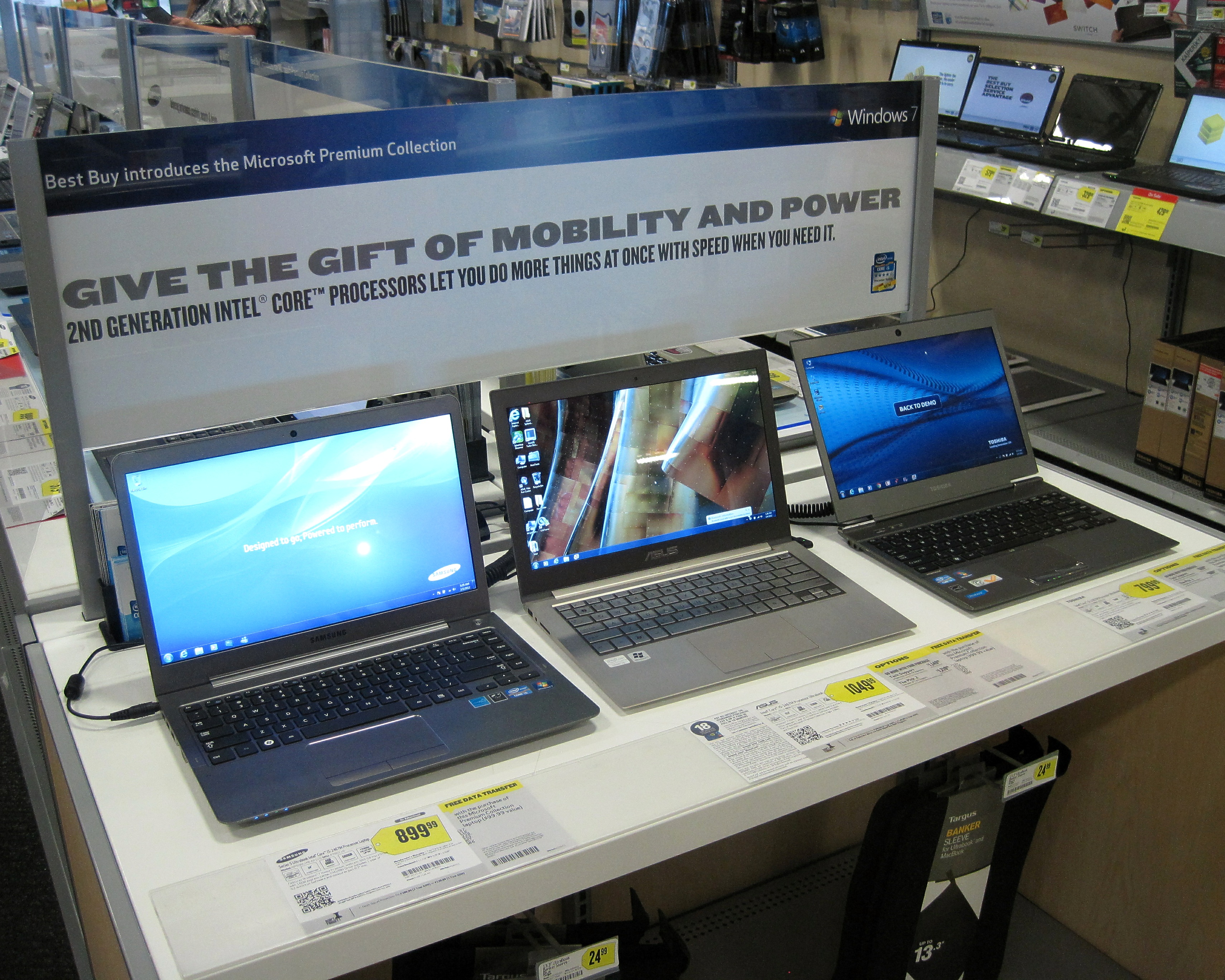
Ultrabook is a class of premium consumer-grade notebook computers. The term was originated by and is trademarked by Intel, replacing the earlier Centrino mobile platform. Introduced in 2011, they were originally marketed as featuring ultra thin form factor and light weight design without compromising battery life or performance, running on Intel Core processors.
When newly introduced, Ultrabooks were generally small enough compared to average laptop models to qualify as subnotebooks. As ultrabook features became more mainstream in the mid-late 2010s, explicitly branding laptop models as "ultrabooks" became much less frequent. As of 2021, while Intel maintains the Ultrabook trademark, it is rarely used for new models and has been superseded in Intel's own marketing by the Intel Evo branding.
History
In 2011, Intel Capital press officer Jordan Balk Schaer announced a new fund to support startups working on technologies in line with the company's concept for next generation notebooks. The company set aside a $300 million fund to be spent over the next three to four years in areas related to Ultrabooks.) notebook that utilized Intel processors, and would emphasize portability and a longer battery life than other laptops and tablet computers, which are typically powered by competing ARM-based processors. Ultrabooks competed against other subnotebooks, including Apple’s MacBook Air, which has similar form specifications and was powered until 2020 by Intel CPUs, but was not advertised under the Ultrabook brand.
At the Intel Developer Forum in 2011, four Taiwan ODMs showed prototype Ultrabooks that used Intel's Ivy Bridge chips. Intel plans to reduce power consumption of its chips for Ultrabooks, like Ivy Bridge processors, which will feature 17 W default thermal design power.
At a presentation at the Consumer Electronics Show, an Intel manager stated that market analysis revealed that screen size motivated some of the reluctance to switch to 13" Ultrabooks. As a result, Intel planned to ensure, through cooperation with manufacturers, a 14 or 15-inch screen on 50% of the 75 Ultrabook models that would likely come to market in 2012.[[File:Lenovo ThinkPad X260 with Ultrabook branding.jpg|alt=|thumb|Lenovo [[ThinkPad]] X260, released in 2016, with Ultrabook branding]]IHS iSuppli had originally forecast that 22 million Ultrabooks would be shipped by the end of 2012, and 61 million would be shipped in 2013. By October 2012, IHS had revised its projections down significantly, to 10 million units sold in 2012 and 44 million for 2013. Most Ultrabooks were too expensive for wide adoption. In addition Intel's constant changing of Ultrabook specifications caused confusion among consumers; and this was compounded by OEMs that released slim/"sleek" or "Sleekbook" laptops (e.g. Hewlett-Packard Pavilion TouchSmart 15z-b000 Sleekbook, Samsung Ativ Book 9 Lite) that are cheaper AMD-powered variants of their more expensive Intel-equipped Ultrabooks. Overall there was a shift in the market away from PCs as a whole (including Ultrabooks) and towards smartphones and tablet computers as the personal computing devices of choice.
Intel banked on the release of Windows 8 as well as new form factors, such as "convertible" laptops with touchscreens and tablets with keyboard docks ("detachable"), and features (accelerometers and gyroscopes for touchscreens, hand-gesture recognition) to build demand for Ultrabooks. was intended to prevent "game-playing" and market confusion from OEMs, who had offered low-end products with touchscreens but not Ultrabooks.
Specifications
Intel required that OEMs meet certain specifications to market a laptop as an Ultrabook. These requirements changed with each release of Intel's Centrino mobile platform.
| Platform | Huron River | Chief River | Shark Bay | ||||||||||
|---|---|---|---|---|---|---|---|---|---|---|---|---|---|
| Release date | October 2011 | June 2012 | June 2013 | ||||||||||
| Processor | Sandy Bridge microarchitecture | ||||||||||||
| Intel Core models | |||||||||||||
| CULV (17 W TDP) | Ivy Bridge microarchitecture | ||||||||||||
| Intel Core models | |||||||||||||
| CULV (17 W TDP) | Haswell microarchitecture | ||||||||||||
| SiP (11.5 or 15 W TDP) | |||||||||||||
| Height (maximum) | url=http://www.digitimes.com/news/a20110804PD217.html | title=Intel reportedly releasing reference BOM for ultrabooks | author=Monica Chen | author2=Steve Shen | date=5 August 2011 | publisher=Digitimes | access-date=19 February 2012 | url-status=live | archive-url=https://web.archive.org/web/20130729140202/http://www.digitimes.com/news/a20110804PD217.html | archive-date=29 July 2013 }} | 18 mm for 13.3" and smaller displays | ||
| 21 mm for 14.0" and larger displays | |||||||||||||
| 23 mm for convertible tablets | url=http://download.intel.com/newsroom/kits/ultrabook/pdfs/Ultrabook_FactSheet_2013.pdf | title=Ultrabook™ Vision Realized with New 2-in-1s Based on 4th Generation Intel® Core™ Processor Family | date=4 June 2013 | publisher=Intel Corporation | access-date=27 November 2013 | url-status=live | archive-url=https://web.archive.org/web/20130919114959/http://download.intel.com/newsroom/kits/ultrabook/pdfs/Ultrabook_FactSheet_2013.pdf | archive-date=19 September 2013}} | |||||
| Battery life (minimum) | 5 hours | 5 hours | url=https://arstechnica.com/gadgets/2013/06/the-u-is-for-ultrabook-intels-low-power-dual-core-haswell-cpus-unveiled/ | title=The U is for Ultrabook: Intel's low-power, dual-core Haswell CPUs unveiled | last=Cunningham | first=Andrew | date=3 June 2013 | website=Ars Technica | publisher=Condé Nast | access-date=6 July 2013 | url-status=live | archive-url=https://web.archive.org/web/20130710031927/http://arstechnica.com/gadgets/2013/06/the-u-is-for-ultrabook-intels-low-power-dual-core-haswell-cpus-unveiled/ | archive-date=10 July 2013 }} |
| Resume from hibernation (maximum) | url=http://www.pcworld.com/article/246691/ultrabooks_laptops_as_light_as_air.html | title=Ultrabooks: Laptops as Light as Air | first=Jason | last=Cross | date=26 December 2011 | publisher=PCWorld | access-date=19 February 2012 | url-status=live | archive-url=https://web.archive.org/web/20120218013425/http://www.pcworld.com/article/246691/ultrabooks_laptops_as_light_as_air.html | archive-date=18 February 2012 }} | 7 seconds | 3 seconds | |
| Storage | no requirements | 80 MB/s transfer rate (minimum) | url=http://wccftech.com/idf-2012-intels-4th-generation-haswell-ultrabook-details-revealed/ | title=Intel's 4th Generation Haswell Ultrabook Details Revealed | first=Hassan | last=Mujtaba | date=11 September 2012 | publisher=WCCF | access-date=23 September 2012 | url-status=live | archive-url=https://web.archive.org/web/20120915012357/http://wccftech.com/idf-2012-intels-4th-generation-haswell-ultrabook-details-revealed/ | archive-date=15 September 2012 }} | |
| I/O | no requirements | USB 3.0 or Thunderbolt | Intel Wireless Display | ||||||||||
| touchscreen | |||||||||||||
| voice command | |||||||||||||
| sensors/context aware (convertibles only) | |||||||||||||
| Software and firmware | Intel Management Engine 7.1 (or higher) | ||||||||||||
| Intel Anti-Theft Technology | |||||||||||||
| Intel Identity Protection Technology | Intel Management Engine 8.0 (or higher) | ||||||||||||
| Intel Anti-Theft Technology | |||||||||||||
| Intel Identity Protection Technology | Anti-virus, anti-malware | ||||||||||||
| Intel Anti-Theft Technology | |||||||||||||
| Intel Identity Protection Technology |
List of models
Main article: List of Ultrabook models
References
References
- (2012-01-26). "Ultrabook shipments could hit 178 million by 2016 {{!}} IT Business".
- "Trademark Usage Guidelines for Ultrabook™".
- "Intel® Evo™ Platform Brand".
- Merritt, Rick. (August 10, 2011). "Intel Capital launches $300M ultrabook fund". EE Times.
- Burt, Jeffrey. (September 20, 2011). "Intel Ultrabook Partners Look for Cut in Chip Prices". eWeek.
- "Intel Ultrabooks offer more choice, better value than MacBook Air or iPad". PC World.
- Bright, Peter. (2011-09-06). "Ultrabook: Intel's $300 million plan to beat Apple at its own game". Ars Technica.
- "Ultrabooks threaten MacBook Air". Gulf News.
- (2012-02-10). "MacBook Air with MS Windows 7: the Ultrabook to rule them all". The Verge.
- "PC Mag".
- Merritt, Rick. (September 14, 2011). "Intel shows progress on ultrabook vision". EE Times.
- Hugosson, Jacob. (September 2025). "Intel Ivy Bridge variable TDP detailed". NordicHardware.
- (2012-01-09). "Intel: 75-plus Ultrabooks coming in 2012, 50 percent of them will have 14- and 15-inch screens". Engadget.
- "CES: Intel's New Ultrabooks Line-Up". YouTube.
- "Ultrabook Sales Underwhelm Initially". Information week.
- (12 July 2012). "Why Ultrabook Sales Have Flopped So Far". PCWorld.
- Ashraf Eassa. (28 October 2013). "Intel's Ultrabook: Right Idea, Wrong Price". fool.com.
- "The top ultrabook alternatives you should consider". ultrabookreview.com.
- Scott Stein. (26 September 2013). "Samsung Ativ Book 9 Lite review - CNET". CBS Interactive.
- "Remember ultrabooks? Yeah, no one else does either". CNet News.
- Jaroslovsky, Rich. (June 2021). ["MS Windows 8's mutant spawn invade laptop market"](https://www.washingtonpost.com/business/windows-8s-mutant-spawn-invade-laptop-market-rich-jaroslovsky/2013/01/06/e7bd3df0-552f-11e2-89de-76c1c54b1418_story.html}}{{dead link).
- "Windows 8 spawns new mutant laptop hybrids".
- "Intel Conducts Study to See if Touchscreen Laptops are wanted".
- Ultrabook Reviews, Ultrabook Reviews. "Ultrabook Reviews". Ultrabook Reviews.
- Anton Shilov. (10 November 2011). "Intel Readies Single-Chip Haswell Platform for Ultrabooks". X-bit labs.
- Monica Chen. (5 August 2011). "Intel reportedly releasing reference BOM for ultrabooks". Digitimes.
- (4 June 2013). "Ultrabook™ Vision Realized with New 2-in-1s Based on 4th Generation Intel® Core™ Processor Family". [[Intel.
- Cunningham, Andrew. (3 June 2013). "The U is for Ultrabook: Intel's low-power, dual-core Haswell CPUs unveiled". Condé Nast.
- Cross, Jason. (26 December 2011). "Ultrabooks: Laptops as Light as Air". PCWorld.
- Mujtaba, Hassan. (11 September 2012). "Intel's 4th Generation Haswell Ultrabook Details Revealed". WCCF.
- Cooper, Daniel. (8 January 2013). "Kirk Skaugen reveals why Intel made touch mandatory for Haswell Ultrabooks". AOL.
This article was imported from Wikipedia and is available under the Creative Commons Attribution-ShareAlike 4.0 License. Content has been adapted to SurfDoc format. Original contributors can be found on the article history page.
Ask Mako anything about Ultrabook — get instant answers, deeper analysis, and related topics.
Research with MakoFree with your Surf account
Create a free account to save articles, ask Mako questions, and organize your research.
Sign up freeThis content may have been generated or modified by AI. CloudSurf Software LLC is not responsible for the accuracy, completeness, or reliability of AI-generated content. Always verify important information from primary sources.
Report