From Surf Wiki (app.surf) — the open knowledge base
Ulmus laevis
Species of tree
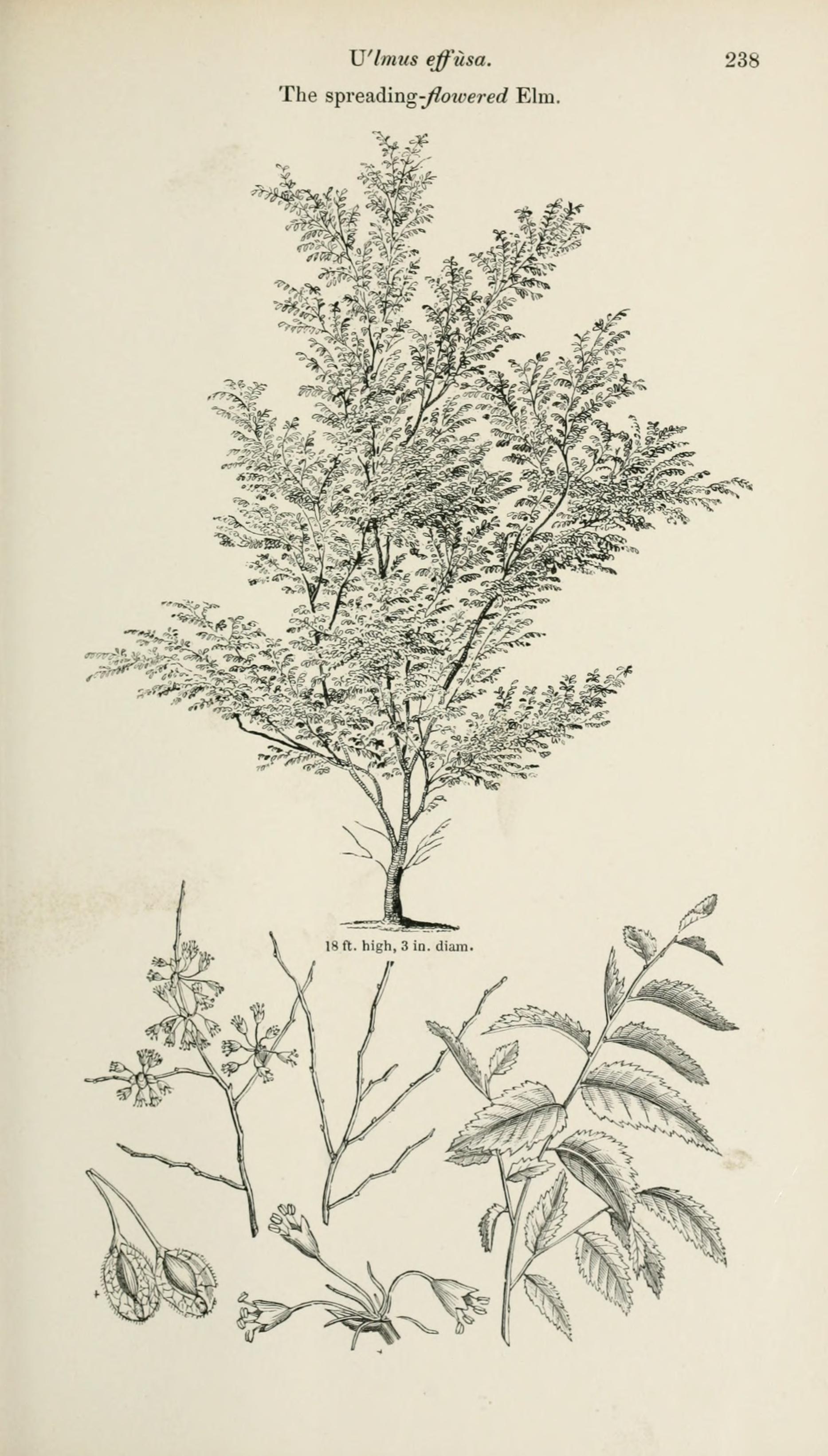
Species of tree
- Ulmus acuta Dumrt.
- Ulmus ciliata Ehrh.
- Ulmus effusa Willd., Loudon, Willkomm, Fliche
- Ulmus laevis var. celtidea Rogowicz
- Ulmus laevis var. simplicidens (E. Wolf) Grudz.
- Ulmus octandra Schkuhr
- Ulmus pedunculata Foug.
- Ulmus petropolitana Gand.
- Ulmus racemosa Borkh.
- Ulmus reticulata Dumrt.
- Ulmus simplicidens E. Wolf
Ulmus laevis Pall., variously known as the European white elm, fluttering elm, spreading elm, stately elm and, in the United States, the Russian elm, is a large deciduous tree native to Europe, from France northeast to southern Finland, east beyond the Urals into Kyrgyzstan and Kazakhstan, and southeast to Bulgaria and the Crimea; there are also disjunct populations in the Caucasus and Spain, the latter now considered a relict population rather than an introduction by man, and possibly the origin of the European population. U. laevis is rare in the UK, although its random distribution, together with the absence of any record of its introduction, has led at least one British authority to consider it native. NB: The epithet 'white' elm commonly used by British foresters alluded to the timber of the wych elm.
The species was first identified, as Ulmus laevis, by Pallas, in his Flora Rossica published in 1784. The tree is allogamous and is most closely related to the American elm U. americana.
Endemic to alluvial forest, U. laevis is rarely encountered at elevations above 400 m. Most commonly found along rivers such as the Volga and Danube, it is one of very few elms tolerant of prolonged waterlogged, anoxic ground conditions. The species is threatened by habitat destruction and disturbance in some countries, notably Spain. Flood control schemes are particularly harmful, as seed dispersion is reliant on floods, while abstraction from aquifers lowering ground water levels has compromised the development of the trees.
Although not possessed of an innate genetic resistance to Dutch elm disease, the species is rarely infected in western Europe.
Description
Ulmus laevis is similar in stature to the wych elm, if rather less symmetric, with a looser, untidy, branch structure and less neatly rounded crown. The tree typically reaches a height and breadth of 30 m, with a trunk
The tree is most reliably distinguished from other European elms by its long flower stems, averaging 20 mm. Moreover, the apetalous wind-pollinated flowers are distinctively cream-coloured, appearing before the leaves in early spring in clusters of 15-30; they are 3–4 mm across. The fruit is a winged samara
Although the species is protandrous, levels of self-pollination can be high The tree can grow very rapidly; where planted in persistently moist soil, trunk width of 13-year-old trees increased by 4 cm per annum at breast height (d.b.h.).Brookes, A. H. (2020). Disease-resistant elm cultivars. Butterfly Conservation, Lulworth, England. http://www.hantsiow-butterflies.org.uk/downloads/Disease%20resistant%20elm%20cultivars%202020.pdf The species differs from its closest relative, the American elm, mainly in the irregular crown structure and frequent epicormic shoots, features which also give the tree a distinctive winter silhouette. The American elm also has less acute leaf buds, longer petioles, narrower leaves, and a deeper apical notch in the samara which reaches the seed. File:Wych elm flower.jpg|U. laevis flowers; note long stems File:Ulmus laevis flowers - Keila.jpg|Flowers and bud File:Ulmus laevis samarae 1.jpg|Samarae, April; note ciliate margins File:HW laevis leaf.jpg|Ulmus laevis leaf File:U laevis leaf underside.jpg|Leaf underside; note undivided venation beyond lobe File:Бял бряст - листа (есен).jpg|U. laevis autumn colour File:Ulmus laevis bark Ada Ciganlija.jpg|Bark in early maturity File:Ulmus laevis bark Eibergen.jpg|Bark at maturity (age 100) File:Fladderiep te Heure bij Borculo.jpg|Bole of old tree File:Ulmus laevis. Inverleith Park (opposite Inverleith Place), Edinburgh (1).jpg|Typical epicormic shoots and dense branching File:Ulmus laevis, incipient buttressing.jpg|Incipient buttressing, 20-year-old tree File:Ulmus laevis bole, Sutton Veny, UK.jpg|Bole of ancient tree, showing buttressing and epicormic brush File:UlmusBrettwurzel.jpg|U. laevis buttresses File:Ulmus laevis root structure.jpg|Surface root structure exposed by bank erosion File:Hortus Haren (Groningen) 13-12-2025. (actm.) 06.jpg|Typical rootstock of a Ulmus laevis (European white elm.)
Pests and diseases
Like other European elms, natural populations of the European white elm have little innate resistance to Dutch elm disease. In a study in France, losses to DED amounted to 28% over a 10 year period. However, research by Irstea has isolated clones able to survive injection with the causal fungus, initially losing
The tree is not favoured by the vector bark beetles, which colonize it only when there are no other elm alternatives available, an uncommon situation in western Europe. Indeed, in a study of elm in Flanders, not one example of U. laevis was found to be afflicted by Dutch elm disease. Research in Spain has indicated that it is the presence of an antifeedant triterpene, alnulin, at a concentration of 200 μg/g {dried bark} which renders the tree unattractive to the beetles. Ergo: the tree's decline in western Europe has been chiefly owing to woodland clearance in river valleys, and river management systems eliminating flooding, not disease. However, in 2020, it was noted by the Dutch forestry commission that many laevis, but only in Zeeland, were succumbing to Dutch elm disease for reasons unclear.
It was noted by Jouin at Metz, Research in Germany has established that the tree is also eschewed by the Zig Zag sawfly Aproceros leucopoda.{{cite journal|last1=Blank|first1=S|last2=Kohler|first2=T|last3=Pfannenstill|first3=T|last4=Liston|first4=A|journal=Journal of Hymenoptera Research|title=Zig-zagging across Central Europe: recent range extension, dispersal speed and larval hosts of Aproceros leucopoda (Hymenoptera, Argidae) in Germany
Elwes observed that trees planted at Ugbrooke in Devon were infested with Cacopsylla ulmi, which he had never found on any other elm in Britain, an affliction confirmed many years later by Richens, who discovered the specimens of U. laevis grown at Kew were the only elms in the Gardens afflicted by the louse, and the aphid Tinocallis platani.
The species has a slight to moderate susceptibility to elm yellows.
Cultivation
U. laevis is essentially a riparian tree, able to withstand over 100 days of continual flooding, although it is intolerant of saline conditions http://www.tela-botanica.org/bdtfx-nn-70308-repartition# Spanish trees were found to be calcifuge, preferring slightly acid, siliceous soils, and also drought-intolerant, their xylem vessels prone to drought-stress cavitation. In England, the tree failed to prosper in chalk stream valleys, where the soil was predominantly black peat, named 'Adventurers' for the Adventurers' Land SSSI in Cambridgeshire, owing to dehydration in summer. Trees planted in dry ground are notoriously short-lived.
U. laevis is comparatively weak-wooded, much more so than field elm Ulmus minor, and thus an inappropriate choice for exposed locations. In trials in southern England by Butterfly Conservation, young trees of The species was never widely introduced to the United States, but is represented at several arboreta. Ulmus effusa, supplied by the Späth nursery of Berlin, was planted at the Dominion Arboretum, Ottawa, Canada, in 1896, as U. pedunculata. In the Far East, the tree has been planted in Xinjiang province and elsewhere in northern China; planting in Tongliao City is known to have been particularly successful. White elm is also known to have been introduced to Australia.
Since the beginning of the 21st century, the tree has enjoyed a small renaissance in England. A popular larval host plant of the white-letter hairstreak Satyrium w-album butterfly across Europe, the elm is now being planted by Butterfly Conservation and other groups to restore local populations decimated by the effects of Dutch elm disease on native or archaeophytic elms. The Cheshire Wildlife Trust, for example, planted numerous white elms on its reserves in the former Vale Royal district of the county. File:Ulmus laevis (haaksbergseweg eibergen) 080211a.jpg|U. laevis 'Helena' as street trees, Eibergen, Netherlands File:Seattle - Roanoke Park Ulmis laevis 01.jpg|U. laevis, Roanoke Park, Capitol Hill, Seattle, US (planted 1910) File:Ulmen sachsenplatz dresden 2019-05-07 -5.jpg|Trimmed U. laevis, Sachsenplatz, Dresden (2019) File:Windblown laevis on chalk of Salisbury Plain, UK, 2km from Stonehenge.jpg|Windblown laevis on chalk, Salisbury Plain, UK File:WP U. laevis on chalk.jpg|U. laevis slow growth on chalk, 4 m in 15 years
Introduction to the UK and Ireland
U. laevis is probably not native to the United Kingdom despite its random occurrence in the countryside, although the date and circumstances of its introduction have not survived. The earliest published references to the tree (as U. effusa, citing Willdenow) were in Sibthorp's Flora Oxoniensis (1794), and (as U. effusa Willd. but without description) in Miller's posthumously revised Gardener's and Botanist's Dictionary (1807). The first specimen to be reported in cultivation, in 1838, was at Whiteknights Park, Reading, which featured an elm grove; the tree measured 63 ft in height, suggesting it had been planted at the end of the 18th century. However, the authenticity of the Whiteknights tree is a matter of contention; it flowered but did not set fertile seed, which suggested to Loudon that it might be U. campestris (U. minor 'Atinia'), or, on account of it not producing suckers, possibly U. montana (:U. glabra). which is not known to have stocked U. laevis. A tree at Syon Park identified by Elwes & Henry as U. laevis was later considered by Bean as more closely resembling U. americana by dint of its symmetrical branch arching.
It is possible the tree's distribution was associated with Capability Brown (1716–1783), known to have favoured U. laevis, which he listed among his preferred "native" (sic) trees. This could explain the existence of the seven old specimens discovered by Elwes in 1908 on Mount Pleasant within Ugbrooke Park, Devon, Ugbrooke is four miles from Mamhead Park, which had earlier been planted with numerous exotic trees, notably holm oak, collected by its owner, merchant Thomas Ball ( d. 1749) during his commercial travels in Europe. Ball's introductions were known to have been marketed by his head gardener William Lucombe, who in 1720 founded the first commercial nursery in the south-west at Exeter, though an account of trees growing at Mamhead by Pince (grandson of Lucombe) in 1835 makes no mention of U. laevis nor of any other elms. None of Lucombe's early catalogues are known to survive, and thus the introduction of U. laevis through south Devon cannot be confirmed. However, the tree does not feature in any of the surviving arboreta accessions lists, or catalogues of the larger, nationally famous, nurseries of the day, and its earliest-known mention in commerce remains in the south-west, in the catalogue of the Ford & Please nursery (as U. pedunculata) at Exeter circa 1836. but by 1846 was 'becoming available in (UK) nurseries'.
U. laevis, obtained from the Späth nursery of Berlin as U. effusa, was planted in Kew Gardens (1895), and, re-propagated, in Cambridge University Botanic Garden (1909). Evidently the tree did not gain in popularity, and was overlooked or ignored by some authors of popular guides to trees in Britain during the 20th century, notably Mabey in his Flora Britannica. The tree is also omitted from Keble-Martin's comprehensive Flora of Devon. Mitchell included it in his field guides, but noted its rarity and poor growth in Britain's climate.
It is not known whether U. laevis was introduced to Scotland before the early 20th century. Two of the three specimens supplied by the Späth nursery, Berlin, to the Royal Botanic Garden Edinburgh in 1902 as U. effusa may survive in Edinburgh, as it was the practice of the garden to distribute trees about the city; the third specimen was in the garden itself. Other examples can be found in the city, notably in Fettes College grounds opposite Inverleith Allotments, and at the entrance to North Merchiston Cemetery. In Wales, two mature trees with numerous seedlings occur in a small wood at Rhydyfelin near Aberystwyth, while another grows at Llandegfan, Anglesey. In Ireland, the tree is represented (2025) by a line of four at the Old Rectory, Kells Road, Ardee, County Louth (22 m, girth 3 m, October 2009), and in the Channel Islands, by a clump near the well at La Seigneurie (Le Manoir), Sark. File:Ulmus laevis at Ugbrooke.jpg|U. laevis, Ugbrooke, Devon, 1908 File:Lewisham Dutch Elm.jpg|U. laevis, Ladywell Fields, Lewisham, London, 2023, locally misidentified as a 'Klemmer' Dutch elm File:Lewisham elm 1.jpg|U. laevis, Ladywell Fields, Lewisham, London, 2018 File:Hebden U. laevis 2.jpg|U. laevis, Hebden, Yorkshire Dales File:Llandegfan Elm tree.jpg|U. laevis, Llandegfan, Anglesey File:Sutton Veny elm 3.6.jpg|U. laevis, Sutton Veny, Wiltshire File:Sutton Veny elm 4.2.jpg|U. laevis, Sutton Veny, Wiltshire
Notable trees
The tallest known is at Schwabwiller, Haguenau, Bas-Rhin, France, at 39.4 m tall; two others at the same site are 38.8 m and 36.2 m tall. Trees of 35 m or over are also known from Hungary, Poland, and Germany.
The two largest known trees in Europe are at Gülitz in Germany (3.1 m d.b.h.), and at Komorów in Poland (2.96 m d.b.h. in 2011), known as the Witcher. Other veterans survive at Casteau, Belgium (bole-girth 5.15 m), in Rahnsdorf near Berlin (bole-girth 4.5 m) and in Ritvala, Finland (bole-girth 4.49 m). A lane of Ulmus laevis is found at Eibergen, Netherlands (see Gallery below), while a large, mature specimen is found within the Alhambra, Granada.
Ulmus laevis has very occasionally been planted as an ornamental tree in the UK, and even more randomly in countryside hedgerows. The UK Champion is at Ferry Farm, on the banks of the Tamar at Harewood, Cornwall (27 m high, 1.8 m d.b.h. in 1997). Other examples are few and far between though sometimes of considerable age, surviving amid diseased native elm in Cornwall at Torpoint, and Pencalenick (21 m high, d.b.h. 1.75 m), and near Over Wallop in Hampshire (16 m high, d.b.h. 1.3 m 2016) The largest-known aggregation in England is the ring of 50 trees planted circa 1950 within a ring of common lime around a former ammunition dump on the elevated chalk of Salisbury Plain at Hexagon Wood, Larkhill, about 2 km north of Stonehenge.
In the United States, a tree of 31.4 m (103 ft) in height (2015) grows at 3331 NE Hancock Street in Portland, Oregon; its age is not known. File:Ulmus laevis JPG1b.jpg|U. laevis, Casteau, Belgium File:Bole of ancient Ulmus laevis in hedgerow near Over Wallop, England.jpg|Bole of coppiced U. laevis, girth 410 cm, Over Wallop, UK File:Бял бряст (стар).JPG|Burrs and epicormic shoots on old U. laevis File:Kopeci szil 2011.11.28..jpg|U. laevis, Căpeni, Romania (2011)
Uses
In Finland, young European white elm trees were traditionally grown for the raw material of shaft bows. It's leathery bark was also used in tough bindings.
The density of the timber is significantly lower than that of other European elms. However, owing to its rapid growth, tolerance of soil compaction, air pollution and de-icing salts, the tree has long been used for amenity planting in towns and along roadsides.
Propagation
U. laevis is easily grown from seed sown on ordinary compost and kept well-watered. However, viability can vary greatly from year to year, while the seed is remarkably short-lived. Germination should occur within one week even without heat, the best seedlings attaining as much as half a metre in their first year. Softwood cuttings taken in June is also a reliable method; the cuttings strike very quickly, well within a fortnight, rapidly producing a dense matrix of roots. Image:Ulmus laevis seedlings.jpg|U. laevis seedlings Image:White Elm rooted cutting.jpg|A rooted cutting of European white elm
Subspecies and varieties
Several putative varieties have been identified. A var. celtidea from Ukraine was reported by Rogowicz in the middle of the 19th century, but no examples are known to survive. Another, var. parvifolia, has been reported from Serbia. A third, var. simplicidens, is very rare; the only example known to survive is at the National Botanic Garden of Latvia in Salaspils. Kew had a grafted var. glabra in the early 20th century (provenance unknown), a clone of which is present at Wakehurst Place.
Cultivars
Compared with the other European species of elm, U. laevis has received scant horticultural attention, there being only nine recorded cultivars: In Russia other ornamental forms are recognized: f. argentovariegata, f. rubra, and f. tiliifolia. A pyramidal form was reported in 1888 from the Fredericksfelde cemetery in Berlin by Bolle. A line of similar monopodial trees grows (2019) on the island in the Lot at Entraygues, France. File:Barjols2013 007.jpg|Columnar form, Entraygues, France
Hybrids
U. laevis does not hybridize naturally, in common with the American elm (U. americana) to which it is closely related. However, in experiments at the Arnold Arboretum, it was successfully crossed with U. thomasii and U. pumila; no such crosses have ever been released to commerce.
Accessions

Europe
- Arboretum de La Petite Loiterie, Monthodon, France. No details available
- Arboretum Freiburg-Günterstal, Germany, no details available
- Brighton & Hove City Council, UK, NCCPG Elm Collection. Ten trees at Hove Recreation Ground, Hove.
- Copenhagen University Botanic Garden, Denmark. No details available.
- ELTE Botanic Garden, Budapest, Hungary. Acc. nos. 1998-0718, 1998-0719.
- Grange Farm Arboretum, Sutton St. James, Spalding, Lincolnshire, UK. Acc. no. 502.
- Great Fontley Butterfly Conservation Elm Trials plantation, UK. Two planted 2003, grown from cuttings of specimen at RBG Wakehurst Place.
- Hortus Botanicus Nationalis, Salaspils, Latvia. Acc. nos. 18136, 18140.
- Linnaean Gardens of Uppsala, Sweden. Acc. no. 1930-1014.
- Royal Botanic Garden Edinburgh, UK. Acc. no. 20070643, from seed wild collected in Val d'Allier, France.
- Royal Botanic Gardens Kew, UK. Acc. nos. 1969-17302, 1973-11712.
- Royal Botanic Gardens, Wakehurst Place, UK. Acc. no. 1973-21048.
- Sir Harold Hillier Gardens, Romsey, Hampshire. UK. Acc. no. 2016.0385
- Tallinn Botanic Garden, Estonia. No accession details available.
- Thenford House arboretum, Northamptonshire, UK. No details available.
- 'The Leys', University Parks, Oxford, UK. Acc. no. 02678.
- Westonbirt Arboretum, UK. Tetbury, Glos., UK. Acc. no. 1995/322
- Wijdemeren City Council, Netherlands. Elm Collection. Planted 1990 Tjalk, Loosdrecht; 2007 Hinderdam, Nederhorst den Berg; elm lane De Kwakel, Kortenhoef in 2009.
North America
- Arnold Arboretum, US. Acc. nos. 17910, 637-79, 6951, 753-80.
- Brenton Arboretum, Dallas Center, Iowa, US. No details available.
- Brooklyn Botanic Garden, New York City, US. Acc. no. X02589.
- Dominion Arboretum, Canada. No details available
- Longwood Gardens, US. Acc. nos. 1964-0568, 1964-1119.
- Morton Arboretum, Illinois, US. Acc. nos. 1302-27, 446-48, 492-64, 27-98.
Nurseries
- Arboretum Waasland, Nieuwkerken-Waas, Belgium
- Boomkwekerij Oirschot, Oirschot, Netherlands
- Landford Trees, Salisbury, UK.https://landfordtrees.co.uk
- Lorenz von Ehren, Hamburg, Germany. https://shop.lve-baumschule.de/laubgehoelze/?p=31
- Noordplant, Glimmen, Netherlands
- Pan-Global Plants, Frampton-on-Severn, Gloucestershire, UK
- UmbraFlor, Spello, Italy
- Van Den Berk (UK) Ltd., https://www.vdberk.co.uk/trees/?search=ulmus&sort=0&page=2, London, UK
References
References
- Barstow, M. & Harvey-Brown, Y. 2017. Ulmus laevis. The IUCN Red List of Threatened Species 2017: e.T61967009A61967013. https://dx.doi.org/10.2305/IUCN.UK.2017-3.RLTS.T61967009A61967013.en. Downloaded on 12 April 2021.
- {{BSBI 2007
- Photographs of ''U. laevis'' (''L'Orme lisse'') in France: in the Forêt du Romersberg, Moselle, [http://krapooarboricole.wordpress.com/category/arbres-coup-de-coeur/ormes/page/2/] (bottom of page), and near Walbourg, Bas-Rhin,[http://krapooarboricole.wordpress.com/category/arbres-coup-de-coeur/ormes/page/3/] (top of page); Archive Krapo arboricole
- Fuentes-Utrilla, P., Squirrell, J., Hollingsworth, P. M. & Gil, L. (2006). ''Ulmus laevis (Pallas) in the [[Iberian Peninsula]]. An introduced or relict tree species? New data from [[cpDNA]] analysis.'' Genetics Society, Ecological Genetics Group conference, University of Wales Aberystwyth 2006.
- Medhurst, J. (2013). ''Archive for the tree detail text Category'', p30. [https://web.archive.org/web/20170202020612/http://www.johnmedhurstlandscape.co.uk/category/tree-detail-text/page/30/]
- Edlin, H. L. (1947). ''British Woodland Trees'', p.26. 3rd. edition. London: B. T. Batsford Ltd.
- Pallas, P. S. (1784). ''Flora Rossica''. i.75, t.48, f.F.
- Collin, E.. (2003). "EUFORGEN Technical Guidelines for genetic conservation and use for European white elm (Ulmus laevis)". IPGRI.
- Girard, S. (2007). Dossier: L'orme: nouveaux espoirs? ''Forêt entreprise'' No. 175, Juillet 2007, Institut pour le developpement forestier, Paris.
- Elwes & Henry (1913), Mitchell (1974), Phillips (1978), Bean (1981).
- {{Royal Botanic Garden Edinburgh
- Harris, E.. (1996). "The European White Elm in Britain". Royal Forestry Society.
- Stilinović, S. (1985): ''Semenarstvo šumskog i ukrasnog drveća i žbunja''. Univerzitet u Beogradu - Šumarski fakultet, Beograd: 1-399/Seed science of forest and decorative trees and bushes, University of Belgrade– Faculty of Forestry, Belgrade: 1-399/
- (1981). "Compatibility and Crossability Studies in Ulmus". Silvae Genetica.
- (1913). ["The Trees of Great Britain & Ireland"](https://archive.org/stream/treesofgreatbrit07elweuoft#page/1851/mode/2up}} Republished 2004 Cambridge University Press, {{ISBN).
- Bean, W. J. (1981). ''Trees and shrubs hardy in Great Britain'', 7th edition. Murray, London.
- Chater, A. O. (1996).'Ulmus laevis naturalized in Cards, VC46'. ''BSBI News 75'' p.63. Botanical Society of Britain & Ireland. [http://archive.bsbi.org.uk/BSBINews75.pdf#page=63]
- (2015). "Implementing the dynamic conservation of elm genetic resources in Europe: Case studies and perspectives". IForest - Biogeosciences and Forestry.
- Solla et al. (2005). Screening European Elms for Resistance to Ophiostoma novo-ulmi. ''Forest Science'', 134–141. 51 (2) 2005. Society of American Foresters.
- Collin, E., Bilger, I., Eriksson, G., & Turok, J. (2000). The conservation of elm genetic resources in Europe. In Dunn, C. P. (Ed.) (2000). ''The elms: breeding, conservation & disease management''. Kluwer Academic Publishers, Boston.
- Vander Mijnsbrugge, K., Vanden Broeck, A., & Van Slycken, J. (2005). A study of Ulmus laevis in Flanders (Northern Belgium). ''Belgian Journal of Botany'', Vol. 138, No. 2 (2005), 199–204. Royal Botanical Society of Belgium.
- (2005). "Triterpenes in elms in Spain". Can. J. For. Res..
- Calle, J., Calle, L., Kopinga, J., Meffert, J. (2020). Nu ook iepziekte in fladderiep. ('Now also elm disease in White Elm'). ''Natuur Bos Landschap'', 164–168, October 2020.
- (2004). "The history of elm breeding". Investigacion Agraria: Sistemas y Recursos Forestales.
- Jerinić-Prodanović, D. (2006). A new jumping louse, Cacopsylla ulmi Förster (Homoptera, Psyllidae) on elm in Serbia. ''Acta entomologica serbica''. 2006, 11 (1/2): 11–18. [http://www.eds.org.rs/AES/Vol11/02.pdf]
- Richens, R. H. (1983). ''Elm''. p.64. Cambridge University Press. {{ISBN. 9780521249164
- Spohn, M. (2008). ''Trees of Britain & Europe'' (Black's Nature Guides), 256 p. A & C Black, {{ISBN. 978-140810152-0
- Venturas, M. ''et al.'' (2013). Ulmus laevis Pall. a native elm in the Iberian peninsula: a multidisciplinary approach. ''Abstracts. 3rd International Elm Conference 2013. The elm after 100 years of Dutch elm disease.'' Florence 2013. p.48.
- Pokorny, J. (1974). ''Colour Guide to Familiar Trees, Leaves, Bark and Fruit''. Octopus, Czechoslovakia. {{ISBN. 9780706402889
- [http://vplants.org/portal/collections/individual/index.php?occid=15185406 ''Ulmus effusa'' at Ottawa, from Späth; New York Botanical Garden herbarium specimen 02465976, vplants.org]
- (1899). "Catalogue of the trees and shrubs in the arboretum and botanic gardens at the central experimental farm". Ottawa.
- Spencer, R., Hawker, J. and Lumley, P. (1991). ''Elms in Australia'', Royal Botanic Gardens, Melbourne, Australia. {{ISBN. 0-7241-9962-4
- Sibthorp, John. (1794). "Flora Oxoniensis".
- Miller, P. (1807). [https://books.google.com/books?id=reFBAQAAMAAJ&pg=RA3-PA86 ''The Gardener's and Botanist's Dictionary'']. Revised by Thomas Martyn, Regius Professor of Botany, University of Cambridge.
- Hofland, Mrs. (1819). ''A descriptive account of the mansion and gardens of White-Knights: a seat of His Grace the Duke of Marlborough'' Private publication, London.[http://www.bobins.splrarebooks.com/collection/view/descriptive-account-of-the-mansion-and-gardens-of-white-knights-a-seat-of-h].
- Loudon, John Claudius. (1838). "Arboretum et fruticetum Britannicum".
- (1833). "White Knights". The Gardener's Magazine and Register of Rural & Domestic Improvement.
- The species was not reported from the wild until 1943, with the discovery of a tree in a [[Surrey]] hedgerow.[https://web.archive.org/web/20181111000021/http://www.brc.ac.uk/plantatlas/index.php?q=node/151 ''Online Atlas of the British & Irish Flora'']
- Ignatieva, M. E. and Stewart, G. H. 'Homogeneity of urban biotopes and similarity of landscape design language in former colonial cities', in: McDonnell, M., Hahs, A., & Breuste, J. (eds.) (2009). ''Ecology of Cities and Towns: A comparative approach.'' Part III, 23, p. 409. Cambridge. {{ISBN. 978-0521678339
- Britton, J. & Brayley, E. W. (1803). [https://archive.org/stream/beautiesofenglan04brit#page/99/mode/1up ''Beauties of England & Wales'']. Vol. 4, Devon & Cornwall, Devonshire, p 99. Various publishers.
- {{NHLE
- Harvey, J. (1975). ''Early Nurserymen''. Phillimore, Chichester, UK.
- (1835). "An account of some remarkable trees now growing at Mamhead". The Gardener's Magazine and Register of Rural & Domestic Improvement.
- (1839). "The Forest Planter and Pruner's Assistant". Ridgway.
- (1847). "The Forest Planter and Pruner's Assistant". Ridgway.
- (c. 1920). "Ryston Hall Arboretum catalogue".
- Books on trees in Britain in the 20th century: Trimble, L. J. F. (1946) ''Trees in Britain'', Macmillan, London. Step, E. (1904). ''Wayside And Woodland Trees. A Pocket Guide To The British Sylva''. Frederick Warne & Co., London. Gurney, R. (1958). ''Trees of Britain''. Faber & Faber, London. Mabey, R. (1998) ''Flora Britannica''. Chatto & Windus, London. {{ISBN. 978-0701167318
- Keble-Martin, W., and Fraser, G. (1939). ''Flora of Devon''. Buncle, Arbroath.
- Mitchell, A. F. (1974). ''A Field Guide to the Trees of Britain and Northern Europe''. Collins {{ISBN. 0-00-212035-6
- Mitchell, A. F. (1982). ''The Trees of Britain and Northern Europe''. Collins {{ISBN. 0-00-219037-0
- (1902). "Accessions book". Royal Botanic Garden Edinburgh.
- Tree C2711, RBGE Cultivated herbarium accession book, 1958 Melville annotations
- ''U. laevis'' in Edinburgh: East Fettes Avenue [https://commons.wikimedia.org/wiki/File:Ulmus_laevis._East_Fettes_Avenue,_Edinburgh.jpg], North Merchiston Cemetery [https://commons.wikimedia.org/wiki/File:Ulmus_laevis._North_Merchiston_Cemetery,Edinburgh.jpg], Leith Links [https://commons.wikimedia.org/wiki/File:Ulmus_laevis(small_leaves)._Seafield_Place,_Leith_Links,_Edinburgh.jpg].
- (2010). "Flora of Cardiganshire".
- [https://web.archive.org/web/20180928200704/https://treecouncil.ie/treeregisterofireland/494.htm Tree Register of Ireland (Tree Council of Ireland)]
- [http://archive.bsbi.org.uk/Wats23p553.pdf Watsonia (2001). p557]
- Johnson, O. (2011). ''Champion Trees of Britain & Ireland'', Kew Publishing, Kew, London. {{ISBN. 9781842464526.
- "The thickest, tallest, and oldest European White Elms (''Ulmus laevis'')".
- [https://web.archive.org/web/20031217042502/http://www.bemerkenswerte-baeume.de/baum/baum_portraits/Rahnsdorf_Ulme.html Rahnsdorf_Ulme.html]
- "Einzelbäume in Treptow-Köpenick / Land Berlin". Berlin.de.
- "European white elm on the estate Oitti in Ritvala". MonumentalTrees.com.
- Harris, E. M. H. (1997). "Ulmus laevis - European white-elm".
- "What types of elms are found in Cornwall?". Cornwall.gov.uk.
- ''Tree Register of the British Isles''.
- BSBI, (2016). ''BSBI records for north Hampshire, vc. 12''. Botanical Society of Britain & Ireland, Shirehampton, Bristol.
- "Google Maps". Google.co.uk.
- "Ulmus laevis {{!}} Heritage Trees by Species {{!}} The City of Portland, Oregon".
- . (10 August 2023). ["Ulmus laevis - Russian, fluttering, or European white elm"](http://www.mustila.fi/en/plants/ulmus_laevis_russian_fluttering_or_european_white_elm).
- Harris, E. (2017). The European White Elm, Ulmus laevis Pall. ''Quarterly Journal of Forestry'', Vol. 111, No. 4, October 2017. p.261. Royal Forestry Society.
- Jovanović, B. & Radulović, S. (1980). Ulmus laevis var. parvifolia. ''Glasn. Prir. Muz. u Beogradu''. (''Bulletin of the Natural History Museum, Belgrade''). 35 : 32, 38 (1980). [[Belgrade]], Serbia.
- [https://bioportal.naturalis.nl/en/specimen/L.1581966 Herbarium specimen labelled ''U. pedunculata'' Foug. var. ''glabra'', Kew; bioportal.naturalis.nl, specimen L.1581966]
- ''Ulmus pedunculata (: laevis)'' var. ''glabra'': Trautvetter; '' Bulletin de la Classe physico-mathématique de l'Académie impériale des sciences de Saint-Pétersbourg'', xv. 349 1857
- Royal Botanic Gardens Wakehurst Place, ''U. laevis'' var. ''glabra'', Acc. no. 1973-21047
- (1888). "Ulmus effusa". The Garden and Forest Publishing Co..
- "Arboretum de La Petite Loiterie - Un parc pédagogique". Free.fr.
- "REIBURG-GÜNTERSTAL ARBORETUM at the Municipal Forest District of Freiburg". Uni-Ulm.de.
- "Contact the National Arboreta".
- "Brooklyn Botanic Garden". BBG.org.
- "Russian Elm - Ulmus laevis". CirrusImage.com.
- "English.htm". Arboretum-Waasland.be.
- [http://www.plantago.nl/plantindex/index.htm Plantago - Plantindex] {{Webarchive. link. (2007-07-29)
- "Home - Noordplant Kwekerijen - Glimmen". Noordplant.nl.
- "Pan-global Plants - Specialist plant nursery in Gloucestershire". PanglobalPlants.com.
- "UmbraFlor srl - Azienda vivaistica regionale". UmbraFlor.it.

._Accessions_book_pages_45,47.jpg)
This article was imported from Wikipedia and is available under the Creative Commons Attribution-ShareAlike 4.0 License. Content has been adapted to SurfDoc format. Original contributors can be found on the article history page.
Ask Mako anything about Ulmus laevis — get instant answers, deeper analysis, and related topics.
Research with MakoFree with your Surf account
Create a free account to save articles, ask Mako questions, and organize your research.
Sign up freeThis content may have been generated or modified by AI. CloudSurf Software LLC is not responsible for the accuracy, completeness, or reliability of AI-generated content. Always verify important information from primary sources.
Report