From Surf Wiki (app.surf) — the open knowledge base
Ukulele
Musical instrument of the guitar family
Musical instrument of the guitar family
| Field | Value |
|---|---|
| image | Ukulele1_HiRes.jpg |
| image_capt | Martin 3K ʻUkulele |
| background | string |
| classification | Stringed instrument (plucked, nylon-stringed instrument usually played with the bare thumb and/or fingertips, or a felt pick) |
| hornbostel_sachs | 321.322 |
| hornbostel_sachs_desc | Composite chordophone |
| developed | 19th century in Hawaiʻi (introduced by the Portuguese) |
| range | C4–A5 (C6 tuning) |
| related | *Bowed and plucked stringed instruments, in particular the cavaquinho |
| sound sample | [[File:Ukulele playing.ogg]] |
| Soprano ʻukulele |
Soprano ʻukulele The ukulele ( ; ), also called a uke (informally), is a member of the lute (ancient guitar) family of instruments. The ʻukulele is of Portuguese origin and was popularized in Hawaiʻi. The tone and volume of the instrument vary with size and construction. ʻUkuleles commonly come in four sizes: soprano, concert, tenor, and baritone.
ʻUkuleles generally have four nylon strings tuned to GCEA (except baritone, which is normally tuned DGBE). They have 16–22 frets depending on the size.
History
Developed in the 1880s, the ʻukulele is based on several small, guitar-like instruments of Portuguese origin, the machete, cavaquinho and rajão, introduced to the Hawaiian Islands by Portuguese immigrants from Madeira, the Azores, and Cape Verde.{{cite book
| url-status = usurped | archive-url = https://web.archive.org/web/20040803005054/http://www.ukuleleguild.org/history.php | archive-date = 2004-08-03
One of the most important factors in establishing the ʻukulele in Hawaiian music and culture was the ardent support and promotion of the instrument by King Kalākaua. A patron of the arts, he incorporated it into performances at royal gatherings.
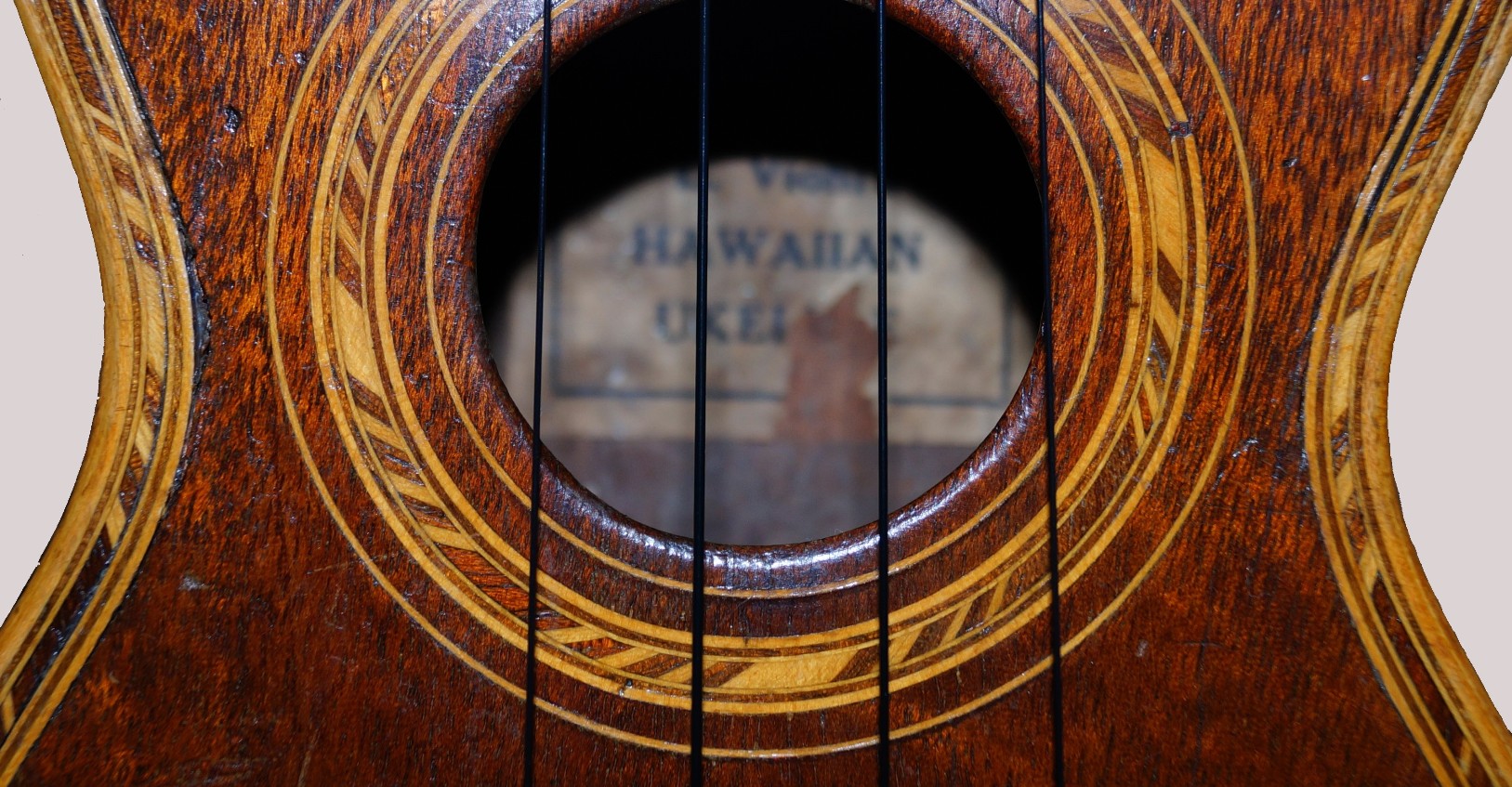
In the Hawaiian language the word ʻukulele roughly translates as 'jumping flea', perhaps because of the movement of the player's fingers. Legend attributes it to the nickname of Englishman Edward William Purvis, one of King Kalākaua's officers, because of his small size, fidgety manner, and playing expertise. One of the earliest appearances of the word ʻukulele in print (in the sense of a stringed instrument) is in the Metropolitan Museum of Art's Catalogue of the Crosby Brown Collection of Musical Instruments of All Nations published in 1907. The catalog describes two ʻukuleles from Hawaiʻi—one that is similar in size to a modern soprano ʻukulele, and one that is similar to a tenor (see ).
Canada
In the 1960s, educator J. Chalmers Doane dramatically changed school music programs across Canada, using the ʻukulele as an inexpensive and practical teaching instrument to foster musical literacy in the classroom.{{cite encyclopedia | access-date = 2008-06-09}} At its peak, 50,000 schoolchildren and adults learned the ʻukulele through the Doane program. "Ukulele in the Classroom", a revised program created by James Hill and Doane in 2008, is a staple of music education in Canada.
Japan
The ʻukulele arrived in Japan in 1929 after Hawaiʻi-born Yukihiko Haida returned to the country upon his father's death and introduced the instrument. Haida and his brother Katsuhiko formed the Moana Glee Club, enjoying rapid success in an environment of growing enthusiasm for Western popular music, particularly Hawaiian and jazz. During World War II, authorities banned most music from the West, but fans and players kept it alive in secret, and it resumed popularity after the war. In 1959, Haida founded the Nihon Ukulele Association. Japan has since become a second home for Hawaiian musicians and ʻukulele virtuosos.
United Kingdom
British singer and comedian George Formby was a ʻukulele player, though he often played a banjolele, a hybrid instrument consisting of an extended ʻukulele neck with a banjo resonator body. Demand surged in the new century because of its relative simplicity and portability. Another British ʻukulele player was Tony Award-winner Tessie O'Shea, who appeared in numerous movies and stage shows, and was twice on The Ed Sullivan Show, including the night The Beatles debuted in 1964.{{cite book The Ukulele Orchestra of Great Britain tours globally, and the George Formby Society, established in 1961, continues to hold regular conventions.
George Harrison, Paul McCartney, and John Lennon all played the ʻukulele. Harrison, who was a Formby fan, was a great lover of the instrument and often gave them to friends, including Tom Petty, whom he taught to play.
United States mainland
Pre–World War II
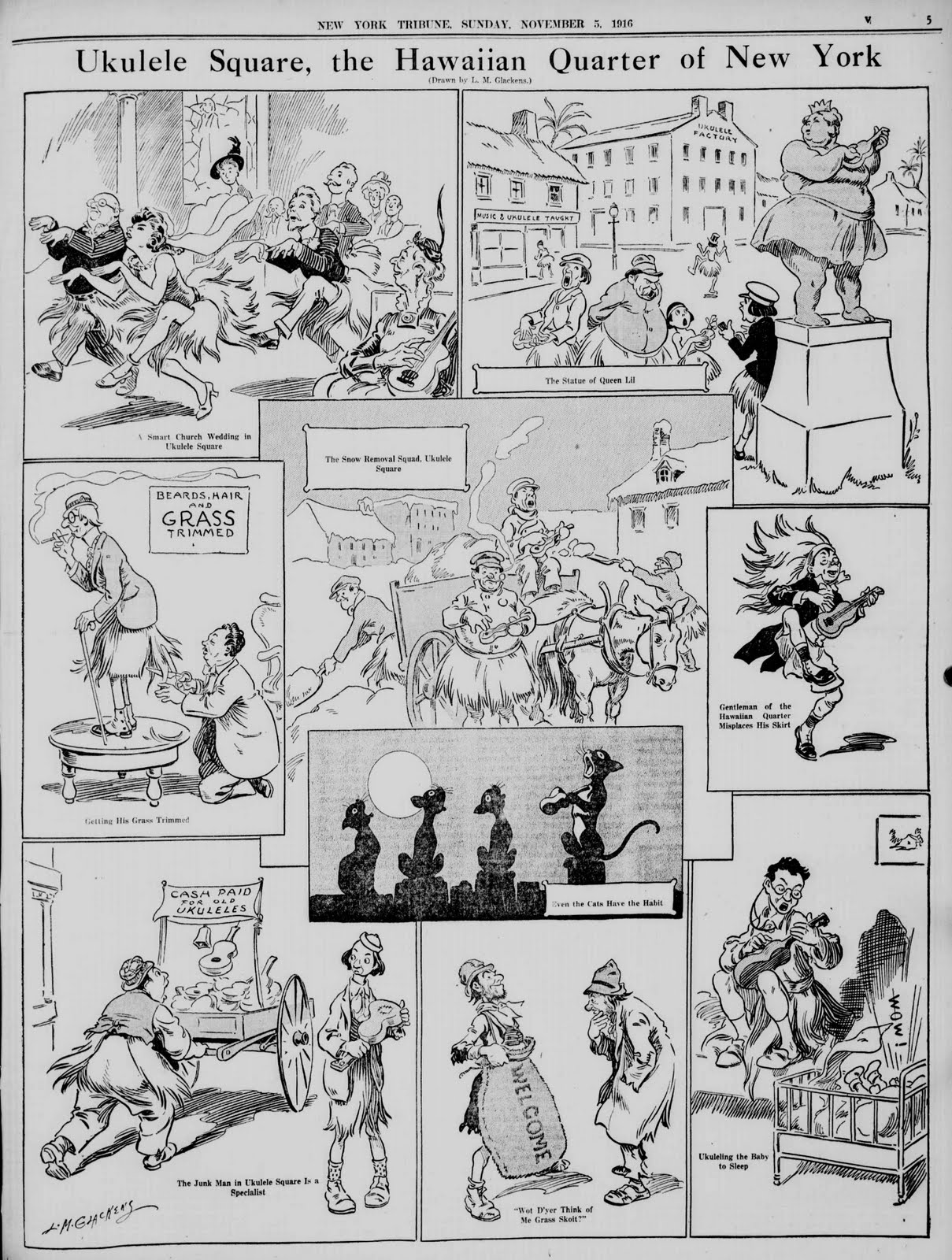
The ʻukulele was popularized for a stateside audience during the Panama–Pacific International Exposition, held from spring to autumn of 1915 in San Francisco.{{cite book | access-date = 2008-06-02}} The popularity of the ensemble with visitors launched a fad for Hawaiian-themed songs among Tin Pan Alley songwriters.{{cite book | url-access = limited
The ʻukulele soon became an icon of the Jazz Age.{{cite book | url-access = registration
The ʻukulele also made inroads into early country music or old-time music parallel to the then-popular mandolin. It was played by Jimmie Rodgers and Ernest V. Stoneman, as well as by early string bands, including Cowan Powers and his Family Band, Da Costa Woltz's Southern Broadcasters, Walter Smith and Friends, The Blankenship Family, The Hillbillies, and The Hilltop Singers.
Post–World War II


From the late 1940s to the late 1960s, plastics manufacturer Mario Maccaferri turned out about 9 million inexpensive ʻukuleles.{{cite web |access-date = 2008-06-02 |url-status = dead |archive-url = https://web.archive.org/web/20090625165925/http://www.vguitar.com/features/brands/details.asp?AID=1071 |archive-date = 2009-06-25 |access-date = 2011-09-15 |url-status = dead |archive-url = https://web.archive.org/web/20111103171108/http://www.peterboroughmusicltd.com/ukulele.irs |archive-date = 3 November 2011 | access-date = 2008-06-02 | archive-date = 2015-05-08 | archive-url = https://web.archive.org/web/20150508003707/http://www.ukulele.org/?Inductees%3A2000-2001%3AArthur_Godfrey | url-status = dead
The ʻukulele had what is considered a hibernation period from the 1960s, as the small acoustic instrument was unable to compete with the big, popular sound of rock 'n' roll.
The Ukulele Revival
The Ukulele Orchestra of Great Britain are widely thought to be behind the so called ʻUkulele Revival. Formed in 1985 by George Hinchcliffe and Kitty Lux, this group began to prove that the ʻukulele could be more than just a toy, even performing intricate guitar solos and unexpected tunes. From then and into the late 1990s, interest in the instrument reawakened. During the 1990s, new manufacturers began producing ʻukuleles and a new generation of musicians took up the instrument. Jim Beloff set out to promote the instrument in the early 1990s and created over two dozen ʻukulele music books featuring modern music and classic ukulele pieces.
All-time best-selling Hawaiian musician Israel Kamakawiwoʻole helped repopularize the instrument, in particular with his 1993 reggae-rhythmed medley of "Over the Rainbow" and "What a Wonderful World", used in films, television programs, and commercials. The song reached number 12 on *Billboard'''s Hot Digital Tracks chart the week of January 31, 2004.
The creation of YouTube helped revive the popularity of the ʻukulele. One of the first videos to go viral was Jake Shimabukuro's ʻukulele rendition of George Harrison's "While My Guitar Gently Weeps". The video quickly went viral, and as of September 2020, had received over 17 million views.
In recent years, the ʻukulele has also been used increasingly in music education, sometimes replacing the recorder as first musical instrument. The ʻukulele is used both as a solo instrument and also in ensemble pieces for two or more instruments, such as Markus Rathey's song arrangements for three ʻukuleles.
Construction
The ʻukulele is generally made of wood, though variants have been composed partially or entirely of plastic or other materials. Cheaper ʻukuleles are generally made from plywood or laminated woods, in some cases with a soundboard of a tonewood such as spruce. More expensive ʻukuleles are made of solid hardwoods such as mahogany. The traditionally preferred wood for ʻukuleles is a type of acacia endemic to Hawaiʻi, called koa.
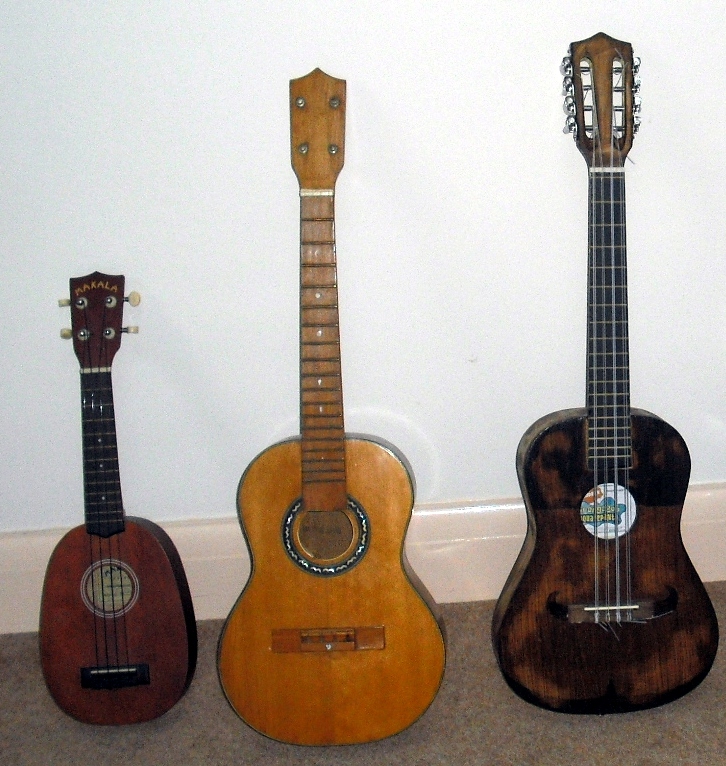
Typically, ʻukuleles have a figure-eight body shape similar to that of a small acoustic guitar. They are also often seen in nonstandard shapes, such as cutaway and oval, usually called a "pineapple" ʻukulele (see image below), invented by the Kamaka Ukulele company, or a boat-paddle shape, and occasionally a square shape, often made out of an old wooden cigar box.
These instruments usually have four strings; some strings may be paired in courses, giving the instrument a total of six or eight strings (primarily for greater strumming volume.) The strings themselves were originally made of catgut. Modern ʻukuleles use strings made from nylon polymers, synthetic gut, or fluorocarbon or wound strings composed of a (typically) nylon core wound with metal or polymers, including aluminium and silver-plated copper.
Instruments with six or eight strings in four courses are often called taropatches, or taropatch ʻukuleles. They were once common in the concert size, but now the tenor size is more common for six-string taropatch ʻukuleles. The six-string, four-course version, has two single and two double courses, and is sometimes called a lili‘u, though this name also applies to the eight-string version. Eight-string baritone taropatches exist, and 5-string tenors have also been made.
Size and range
Common types of ʻukuleles include soprano (standard ʻukulele), concert, tenor, and baritone. Less common are the sopranino (also called piccolo, bambino, or "pocket uke"), bass, and contrabass ʻukuleles. Other types of ʻukuleles include banjo ʻukuleles and electric ʻukuleles. Of the standard ʻukuleles, the soprano, often called "standard" in Hawaiʻi, is the second smallest and was the original size. The concert size was developed in the 1920s as an enhanced soprano, slightly larger and louder with a deeper tone. Shortly thereafter, the tenor was created, having more volume and a deeper bass tone. The baritone (resembling a smaller tenor guitar) was created in the 1940s, and the contrabass and bass are recent innovations (2010 and 2014, respectively).
| Type | Alternate | |||||||||||||
|---|---|---|---|---|---|---|---|---|---|---|---|---|---|---|
| names | Typical | |||||||||||||
| length | Scale | |||||||||||||
| length | Frets | Range | Common | |||||||||||
| tuning | Alternate | |||||||||||||
| tunings | Soprano | Concert | Tenor | Baritone | Bass | Contrabass | ||||||||
| piccolo, sopranino, sopranissimo | 16 in | 11 in | 10–12 | G4–D6 (E6) | D5 G4 B4 E5 | C5 F4 A4 D5 | ||||||||
| standard, ʻukulele | 21 in | 13 in | 12–15 | C4–A5 (C6) | last=Tamberino | first=Philip | title=Uke can do it! Developing your school ukulele program | publisher=Rowman & Littlefield | year=2014 | isbn=9781475804164}} | A4 D4 F4 B4 | |||
| G3 C4 E4 A4 | ||||||||||||||
| alto | 23 in | 15 in | 15–18 | C4–C6 (D 6) | G4 C4 E4 A4 | G3 C4 E4 A4 | ||||||||
| taro patch, Liliʻu | 26 in | 17 in | 17–19 | G3–D6 (E6) | G4 C4 E4 A4 ("High G") | |||||||||
| G3 C4 E4 A4 ("Low G") | D4 G3 B3 E4 | |||||||||||||
| A3 D4 F4 B4 | ||||||||||||||
| D3 G3 B3 E4 | ||||||||||||||
| bari, bari uke, taropatch | 29 in | 19 in | 18–21 | D3–A5 (C 6) | D3 G3 B3 E4(Guitar tuning) | C3 G3 B3 E4 | ||||||||
| 30 in | 20 in | 16–18 | E2–B4 | E2 A2 D3 G3 | ||||||||||
| U-Bass, Rumbler | 32 in | 21 in | 16 | E1–B3 | E1 A1 D2 G2 | D1 A1 D2 G2 ("Drop D") |

The following chart shows the range of notes of standard ʻukulele types. Note that the range varies with the tuning and size of the instruments. The examples shown in the chart reflect the range of each instrument from the lowest standard tuning to the highest fret in the highest standard tuning.
ImageSize = width:700 height:250 PlotArea = left:0 right:0 top:0 bottom:20 AlignBars = justify
Colors = id:legend value:gray(0.94) # background of top and bottom legend bars id:legendtext value:gray(0.1) # text in top and bottom legend bars id:sp value:gray(1) # spacer between bars and content id:h1 value:rgb(0.99,0.2,0.90) # light violet = top of hierarchy id:h2 value:rgb(0.99,0.1,0.1) # light red-violet id:h3 value:rgb(0.99,0.2,0.30) # light red id:h4 value:rgb(0.99,0.4,0.30) # light red-orange id:h5 value:rgb(0.99,0.6,0.20) # light orange id:h6 value:rgb(0.99,0.75,0.60) # light yellow-orange, bottom of hierarchy id:gridlines value:gray(0.7) # vertical gridlines
BarData = bar:pitch bar:Hz barset:ranges bar:pitch2 bar:Hz2
Period = from:0 till:651 ScaleMajor = increment:72 start:2 gridcolor:gridlines TimeAxis = orientation:horizontal
- positions points used by the bars
- Cx4 = middle C
- Cs4 = middle C sharp Define $Cx0 = 6 # 16.35Hz Define $Cs0 = 12 # 17.32Hz Define $Dx0 = 18 # 18.35Hz Define $Ds0 = 24 # 19.45Hz Define $Ex0 = 30 # 20.6Hz Define $Fx0 = 36 # 21.83Hz Define $Fs0 = 42 # 23.12Hz Define $Gx0 = 48 # 24.5Hz Define $Gs0 = 54 # 25.96Hz Define $Ax0 = 60 # 27.5Hz Define $As0 = 66 # 29.14Hz Define $Bx0 = 72 # 30.87Hz Define $Cx1 = 78 # 32.7Hz Define $Cs1 = 83 # 34.65Hz Define $Dx1 = 89 # 36.71Hz Define $Ds1 = 95 # 38.89Hz Define $Ex1 = 101 # 41.2Hz Define $Fx1 = 107 # 43.65Hz Define $Fs1 = 113 # 46.25Hz Define $Gx1 = 119 # 49Hz Define $Gs1 = 125 # 51.91Hz Define $Ax1 = 131 # 55Hz Define $As1 = 137 # 58.27Hz Define $Bx1 = 143 # 61.74Hz Define $Cx2 = 149 # 65.41Hz Define $Cs2 = 155 # 69.3Hz Define $Dx2 = 161 # 73.42Hz Define $Ds2 = 167 # 77.78Hz Define $Ex2 = 173 # 82.41Hz Define $Fx2 = 179 # 87.31Hz Define $Fs2 = 185 # 92.5Hz Define $Gx2 = 191 # 98Hz Define $Gs2 = 197 # 103.8Hz Define $Ax2 = 203 # 110Hz Define $As2 = 209 # 116.5Hz Define $Bx2 = 215 # 123.5Hz Define $Cx3 = 221 # 130.8Hz Define $Cs3 = 227 # 138.6Hz Define $Dx3 = 233 # 146.8Hz Define $Ds3 = 239 # 155.6Hz Define $Ex3 = 244 # 164.8Hz Define $Fx3 = 250 # 174.6Hz Define $Fs3 = 256 # 185Hz Define $Gx3 = 262 # 196Hz Define $Gs3 = 268 # 207.7Hz Define $Ax3 = 274 # 220Hz Define $As3 = 280 # 233.1Hz Define $Bx3 = 286 # 246.9Hz Define $Cx4 = 292 # 261.6Hz Define $Cs4 = 298 # 277.2Hz Define $Dx4 = 304 # 293.7Hz Define $Ds4 = 310 # 311.1Hz Define $Ex4 = 316 # 329.6Hz Define $Fx4 = 322 # 349.2Hz Define $Fs4 = 328 # 370Hz Define $Gx4 = 334 # 392Hz Define $Gs4 = 340 # 415.3Hz Define $Ax4 = 346 # 440Hz Define $As4 = 352 # 466.2Hz Define $Bx4 = 358 # 493.9Hz Define $Cx5 = 364 # 523.3Hz Define $Cs5 = 370 # 554.4Hz Define $Dx5 = 376 # 587.3Hz Define $Ds5 = 382 # 622.3Hz Define $Ex5 = 388 # 659.3Hz Define $Fx5 = 394 # 698.5Hz Define $Fs5 = 400 # 740Hz Define $Gx5 = 406 # 784Hz Define $Gs5 = 411 # 830.6Hz Define $Ax5 = 417 # 880Hz Define $As5 = 423 # 932.3Hz Define $Bx5 = 429 # 987.8Hz Define $Cx6 = 435 # 1047Hz Define $Cs6 = 441 # 1109Hz Define $Dx6 = 447 # 1175Hz Define $Ds6 = 453 # 1245Hz Define $Ex6 = 459 # 1319Hz Define $Fx6 = 465 # 1397Hz Define $Fs6 = 471 # 1480Hz Define $Gx6 = 477 # 1568Hz Define $Gs6 = 483 # 1661Hz Define $Ax6 = 489 # 1760Hz Define $As6 = 495 # 1865Hz Define $Bx6 = 501 # 1976Hz Define $Cx7 = 507 # 2093Hz Define $Cs7 = 513 # 2217Hz Define $Dx7 = 519 # 2349Hz Define $Ds7 = 525 # 2489Hz Define $Ex7 = 531 # 2637Hz Define $Fx7 = 537 # 2794Hz Define $Fs7 = 543 # 2960Hz Define $Gx7 = 549 # 3136Hz Define $Gs7 = 555 # 3322Hz Define $Ax7 = 561 # 3520Hz Define $As7 = 567 # 3729Hz Define $Bx7 = 572 # 3951Hz Define $Cx8 = 578 # 4186Hz Define $Cs8 = 584 # 4435Hz Define $Dx8 = 590 # 4699Hz Define $Ds8 = 596 # 4978Hz Define $Ex8 = 602 # 5274Hz Define $Fx8 = 608 # 5588Hz Define $Fs8 = 614 # 5920Hz Define $Gx8 = 620 # 6272Hz Define $Gs8 = 626 # 6645Hz Define $Ax8 = 632 # 7040Hz Define $As8 = 638 # 7459Hz Define $Bx8 = 644 # 7902Hz Define $max = 650
PlotData= align:center textcolor:black fontsize:10 mark:(line,black) width:16 shift:(0,-4) barset:ranges
color:h1 from:$Dx2 till:$Cx6 text:classical guitar color:h3 from:$Ex1 till:$Ex6 text:all ukuleles color:h6 from:$Gx4 till:$Ex6 text:sopranino color:h5 from:$Cx4 till:$Cx6 text:soprano color:h6 from:$Cx4 till:$Ex6 text:concert color:h5 from:$Gx3 till:$Ex6 text:tenor color:h6 from:$Dx3 till:$Cs6 text:baritone color:h5 from:$Ex2 till:$Cs5 text:bass color:h6 from:$Ex1 till:$Bx3 text:contrabass
color:legend textcolor:legendtext align:left fontsize:7 mark:(line,white) width:12 shift:(3,-4)
bar:pitch from:0 till:$max at:$Cx0 text:C0 at:$Cx1 text:C1 at:$Cx2 text:C2 at:$Cx3 text:C3 at:$Cx4 text:C4 (middle C) at:$Cx5 text:C5 at:$Cx6 text:C6 at:$Cx7 text:C7 at:$Cx8 text:C8
bar:Hz from:0 till:$max at:23 text:20 Hz at:65 text:30 at:105 text:44 at:153 text:70 at:190 text:100 at:232 text:150 at:262 text:200 at:304 text:300 at:344 text:440 at:392 text:700 at:430 text:1000 at:472 text:1500 at:502 text:2000 at:544 text:3000 at:583 text:4400 Hz
bar:pitch2 # exact copy of bar:pitch from:0 till:$max at:$Cx0 text:C0 at:$Cx1 text:C1 at:$Cx2 text:C2 at:$Cx3 text:C3 at:$Cx4 text:C4 (middle C) at:$Cx5 text:C5 at:$Cx6 text:C6 at:$Cx7 text:C7 at:$Cx8 text:C8
bar:Hz2 # exact copy of bar:Hz from:0 till:$max at:23 text:20 Hz at:65 text:30 at:105 text:44 at:153 text:70 at:190 text:100 at:232 text:150 at:262 text:200 at:304 text:300 at:344 text:440 at:392 text:700 at:430 text:1000 at:472 text:1500 at:502 text:2000 at:544 text:3000 at:583 text:4400 Hz
Tuning==


One of the most common tunings for the standard or soprano ʻukulele is C6 tuning: G4–C4–E4–A4, which is often remembered by the notes in the "My dog has fleas" jingle (see sidebar). The G string is tuned an octave higher than might be expected, so this is often called "high G" tuning. This is known as a "reentrant tuning"; it enables uniquely close-harmony chording.
More rarely used with the soprano ʻukulele (but more common on larger sizes) is C6 linear tuning, or "low G" tuning, which has the G in sequence an octave lower: G3–C4–E4–A4, which is equivalent to playing the top four strings (DGBE) of a guitar with a capo on the fifth fret.
Another common tuning for the soprano ʻukulele is the higher string-tension D6 tuning (or simply D tuning), A4–D4–F4–B4, one step higher than the G4–C4–E4–A4 tuning. Once considered standard, this tuning was commonly used during the Hawaiian music boom of the early 20th century, and is often seen in sheet music from this period, as well as in many method books through the 1980s. D6 tuning is said by some to bring out a sweeter tone in some ukuleles, generally smaller ones. D6 tuning with a low fourth string, A3–D4–F4–B4, is sometimes called "Canadian tuning" after its use in the Canadian school system, mostly on concert or tenor ʻukuleles, and extensive use by James Hill and J. Chalmers Doane.
Whether C6 or D6 tuning should be the "standard" tuning is a matter of long and ongoing debate. There are historic and popular ukulele methods that have used each.
For the concert and tenor ʻukuleles, both reentrant and linear C6 tunings are standard; linear tuning in particular is widely used for the tenor ukulele, more so than for the soprano and concert instruments.
The baritone ʻukulele usually uses linear G6 tuning: D3–G3–B3–E4, the same as the highest four strings of a standard 6-string guitar.
Bass ʻukuleles are tuned similarly to the bass guitar and double bass: E1–A1–D2–G2 for U-Bass style instruments (sometimes called contrabass), or an octave higher, E2–A2–D3–G3, for ʻOhana type metal-string basses.
Sopranino ʻukulele tuning is less standardized. They are usually tuned re-entrant, but frequently at a higher pitch than C; for example, re-entrant G6 tuning: D5–G4–B4–E5.
As is commonly the case with string instruments, other tunings may be preferred by individual players. For example, special string sets are available to tune the baritone ʻukulele in linear C6. Some players tune ukuleles like other four-string instruments such as the mandolin,{{cite web | access-date=19 November 2019}} Venezuelan cuatro,{{cite web |archive-url=https://ghostarchive.org/varchive/youtube/20211211/KHF_g96Es3Q| archive-date=2021-12-11 |url-status=live| title=Cuatro Tuning On a Ukulele | access-date=19 November 2019 |archive-url=https://ghostarchive.org/varchive/youtube/20211211/Fyr1iT27MzE| archive-date=2021-12-11 |url-status=live| title=Ukulele Dotara Style Tuning – ইউকালেলি দোতারা স্টাইল টিউনিং | access-date=24 April 2017
Audio samples
Ukelele - Kailimai's hene - Ukepedia.ogg|"Hene", song by Henry Kailimai Ukulele_chords.ogg|G-minor chord C Major Scale Ukulele.ogg|C major scale Bassukuleleeddieihmself.ogg|Major scale performed on a bass ʻukulele with a felt plectrum (first) and fingers Ukulele M5 Core 2 tuning.ogg|Frequencies for tuning soprano ʻukulele
References
Bibliography
- {{cite book | orig-year = 1997
- {{cite book
References
- Erich M. von Hornbostel & Curt Sachs, "Classification of Musical Instruments: Translated from the Original German by Anthony Baines and Klaus P. Wachsmann." ''The Galpin Society Journal'' 14, 1961: 3–29.
- "Ukulele".
- {{OED. ukulele
- Rathey, Markus. (2024). "Ukulele Harmony: Learn Ukulele in 10 Songs". Beachland Press.
- Tranquada and King. (2012). "The Ukulele, A History". Hawaii University Press.
- (2008). "David Kalakaua (1836–1891), Inaugural Hall of Fame Inductee, 1997". Ukulele Hall of Fame Museum.
- {{harvnb. Beloff. 2003
- (1907). "Catalogue of the Crosby Brown Collection of Musical Instruments of All Nations". [[Metropolitan Museum of Art]].
- {{harvnb. Beloff. 2003
- "Our Story — Ukulele in the Classroom".
- {{harvnb. Beloff. 2003
- Fladmark, Judy. (2010-02-19). "Ukulele sends UK crazy". BBC News.
- Jackson, Blair. (August 5, 2021). "How The Beatles' George Harrison Turned His Love of Ukulele into a Personal Crusade".
- Whatley, Jack. (April 20, 2020). "The Beatles' George Harrison believed everyone should have a ukulele".
- "Famous Ukulele songs".
- Rev, Lil'. ""Just a few penny dreadfuls": the Ukulele and Old-Time Country Music".
- Tranquada, Jim. (2012-05-31). "The Ukulele". University of Hawai'i Press.
- Lusher, Adam. (2008-11-08). "The great ukulele revival".
- "The Sharon {{!}} Events – The Villages Sharon L. Morse Performing Arts Center".
- John Shepherd. (27 February 2003). "Continuum encyclopedia of popular music of the world: VolumeII: Performance and production". Continuum International Publishing Group.
- ''[[Mighty Uke]]'', Interview with Jim Beloff, 2010
- ''Billboard'', for the survey week ending January 18, 2004.
- Catholic Laitinen. (6 September 2020). "Ukulele weeps by Jake Shimabukuro".
- National Association for Music Education. "Why try the Ukulele in Schools".
- Rathey, Markus. (2024). "Three Ukuleles around the Christmas Tree: 10 Christmas Carols for Ukulele Ensemble". Beachland Press.
- Rathey, Markus. (2024). "Two Ukes and a Baritone: 14 Song Arrangements for Ukulele Ensemble". Beachlan Press.
- Jeppson, Mim. (2021). "The ukulele owner's manual". String Letter Publishing, Inc..
- "Ukulele Strings". C.F. Martin & Co..
- "Ukulele".
- "Kamaka Baritone 8 String HF-48".
- "Kala -KA-ATP-CTG Solid Cedar Top Tenor Slothead -Gloss Finish".
- "Ukulele Facts".
- (7 January 2015). "The story behind the wildly popular Kala U-Bass".
- "Uke Baritone Bass w/Preamp Tattoo". Luna Guitars.
- The "scale" is the length of the playable part of the strings, from the nut at the top to the bridge at the bottom.
- Exact range depends on the tuning and the number of frets.
- On the soprano, concert, and tenor instruments, the most common tuning results in a "bottom" string that is ''not'' the lowest in ''pitch'', as it is tuned a 5th higher than the next string (and a major 2nd below the "top" string). This is called ''[[re-entrant tuning]]''.
- Tamberino, Philip. (2014). "Uke can do it! Developing your school ukulele program". Rowman & Littlefield.
- Tenor ʻukuleles exist in a variety of styles, with 4, 5, 6, and 8 strings. What the tenor is called depends on which style it has been designed in.
- Eight-string "taropatch" baritone ʻukuleles have been made; however, they are very rare. See, for example, the Kamaka HF-48
- See the Luna Uke Bass and the Kala U-Bass
- ''U-Bass'' and ''Rumbler'' are trade names of the Kala ʻukulele company
- "Ukulele in the Classroom".
- "FAQ". James Hill Music.
- Tranquada, J.; ''The Ukulele: A History''; University of Hawaii Press; Honolulu: 2012. 0824-83634-0 According to Tranquanda, "This is an old and seemingly never-ending argument. While the pioneering methods of Kaai (1906) and Rollinson (1909) both use C tuning, a sampling of the methods that follow give a sense of the unresolved nature of the debate: Kealakai (1914), D tuning; Bailey (1914), C tuning; Kia (1914), D tuning; Kamiki (1916), D tuning; Guckert (1917), C tuning; Stumpf (1917), D tuning."
- University of the South Pacific. Institute of Pacific Studies. (2003). "Cook Islands culture". Institute of Pacific Studies in Association with the Cook Islands Extension Centre, University of the South Pacific, the Cook Islands Cultural and Historic Places Trust, and the Ministry of Cultural Development.
- Jeremy Wallach. (22 October 2008). "Modern Noise, Fluid Genres: Popular Music in Indonesia, 1997–2001". University of Wisconsin Press.
This article was imported from Wikipedia and is available under the Creative Commons Attribution-ShareAlike 4.0 License. Content has been adapted to SurfDoc format. Original contributors can be found on the article history page.
Ask Mako anything about Ukulele — get instant answers, deeper analysis, and related topics.
Research with MakoFree with your Surf account
Create a free account to save articles, ask Mako questions, and organize your research.
Sign up freeThis content may have been generated or modified by AI. CloudSurf Software LLC is not responsible for the accuracy, completeness, or reliability of AI-generated content. Always verify important information from primary sources.
Report