From Surf Wiki (app.surf) — the open knowledge base
Uitlander
Migrant worker in the Transvaal Republic, South Africa

Migrant worker in the Transvaal Republic, South Africa
An uitlander, Afrikaans for "foreigner" (), was a foreign (mainly British) migrant worker during the Witwatersrand Gold Rush in the independent Transvaal Republic following the discovery of gold in 1886. The limited rights granted to this group in the independent Boer Republics was one of the contributing factors behind the Second Boer War.
Second Boer War

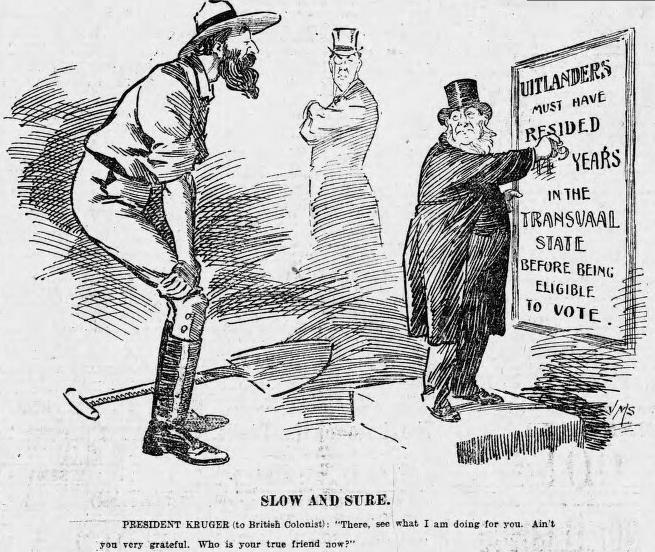
The vast Witwatersrand gold fields were discovered in 1886, and within ten years the uitlander (English) population of the Transvaal was thought to be double that of the ethnic Boer Transvaalers. These workers were primarily concentrated around the Johannesburg area.
The Transvaal government, under President Paul Kruger, were concerned as to the effect this large influx could have on the independence of the Transvaal. The uitlanders were almost entirely British subjects. Therefore enfranchising the uitlanders, at a time when the Crown was keen to consolidate its colonial hold in South Africa, risked creating a powerful fifth column that could ultimately lead to a power shift and the Transvaal passing into British hands, eventually turning it into a British colony. As a result, beginning in 1890 the Transvaal government passed a series of laws refusing voting rights and citizenship to immigrants who had not both resided in the republic for fourteen years and were over forty years of age. This successfully disenfranchised the uitlanders from any meaningful political role. This attitude was called, "Krugerism".
This policy, together with high taxation, gave rise to considerable discontent. Their treatment served as the pretext for the Jameson Raid in 1895; Cecil Rhodes planned an invasion of the Transvaal to coincide with an uprising of the uitlanders in Johannesburg. Dr Jameson's force invaded, but the expected uprising never took place; the invading force were quickly overpowered and arrested.
From 1897 onwards, the High Commissioner for South Africa, Sir Alfred Milner, and the Colonial Secretary, Joseph Chamberlain, used the denial of rights to the uitlanders as their main point of attack against the Transvaal. They encouraged uitlander agitation and pressed uitlander claims, with veiled threat of war, upon Kruger's government.
In the end, British insistence and Kruger's intransigence led to the outbreak of the Second Boer War in 1899.
Upon its defeat in 1902, the Transvaal became a British colony. All residents of the Transvaal thereafter became British subjects and so the term uitlander lost prominence.
With the election of a liberal government in Britain, everything was returned to the Boers in 1906.
Notes
References
Bibliography
References
- Exact figures are uncertain, as the first census of the Transvaal was not taken until April 1904. The Transvaal government made policy on the assumption that there were 60,000 uitlanders to 30,000 burghers (these figures refer to adult males only). This was a conservative estimate, others claimed the ratio to be 4:1 or even 10:1. Despite these figures, subsequent scholarship has suggested that there was in fact parity between the burgher and uitlander populations, although given the nature of mining there may have been more uitlander males. See JS Marias, The Fall of Kruger's Republic, p2)
- James Percy Fitzpatrick. (July 1899). "The Transvaal from Within". William Heinemann, London.
This article was imported from Wikipedia and is available under the Creative Commons Attribution-ShareAlike 4.0 License. Content has been adapted to SurfDoc format. Original contributors can be found on the article history page.
Ask Mako anything about Uitlander — get instant answers, deeper analysis, and related topics.
Research with MakoFree with your Surf account
Create a free account to save articles, ask Mako questions, and organize your research.
Sign up freeThis content may have been generated or modified by AI. CloudSurf Software LLC is not responsible for the accuracy, completeness, or reliability of AI-generated content. Always verify important information from primary sources.
Report