From Surf Wiki (app.surf) — the open knowledge base
UEFA Women's Euro 2013
2013 edition of the UEFA Women's Euro
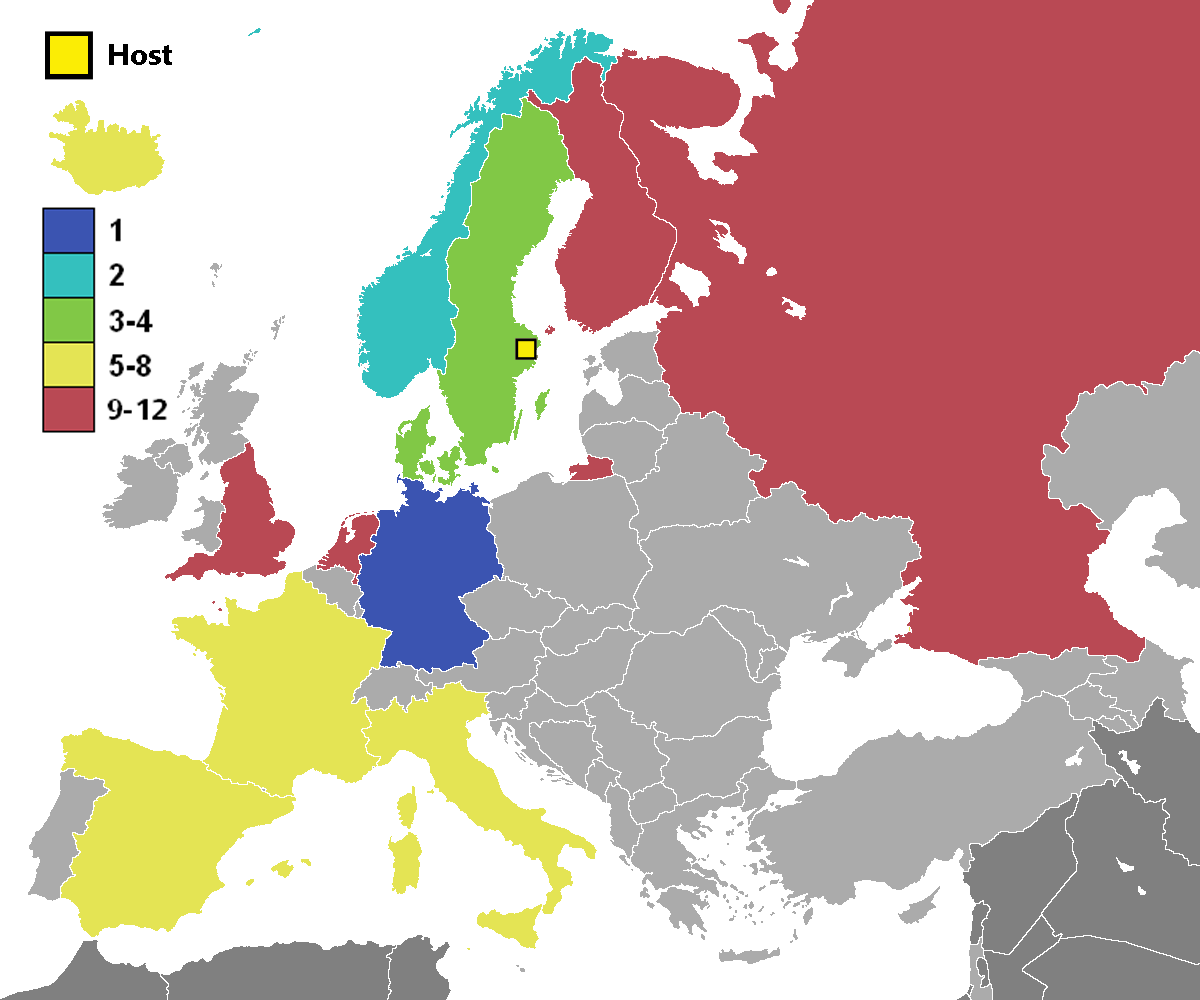
2013 edition of the UEFA Women's Euro
| Field | Value |
|---|---|
| tourney_name | UEFA Women's Euro 2013 |
| other_titles | Europamästerskapet i fotboll för damer 2013 |
| image | UEFA Women's Euro 2013 logo.jpg |
| size | 250px |
| country | Sweden |
| dates | 10–28 July |
| num_teams | 12 |
| venues | 7 |
| cities | 7 |
| champion_other | |
| count | 8 |
| second_other | |
| matches | 25 |
| goals | 56 |
| attendance | 216888 |
| top_scorer | Lotta Schelin (5 goals) |
| player | Nadine Angerer |
| prevseason | 2009 |
| nextseason | 2017 |
The 2013 UEFA Women's Championship, commonly referred to as the 2013 Women's Euros or just the 2013 Euros, was the 11th European Championship for women's national football teams organised by UEFA. The final tournament, held in Sweden from 10 to 28 July 2013, became the most-watched in the history of the Women's Euros. It concluded with Germany, the defending champions, winning their sixth consecutive and record-extending eighth overall Women's Euro title after defeating Norway in the final.
Sweden was selected as hosts by UEFA's Executive Committee in 2010, meaning their team automatically qualified for the final tournament. The other eleven finalists were decided by a qualifying competition, featuring 44 teams, staged between March 2011 to October 2012. It was the last time the finals featured twelve teams, as from 2017 onwards they would be expanded to include sixteen teams.
Host selection
Sweden was awarded the hosting of the tournament on 4 October 2010 at a meeting of the UEFA Executive Committee in Minsk, Belarus. The only rival host bid came from the Netherlands. Several other European national associations, including Switzerland, Bulgaria and Poland, had shown interest in staging the tournament but did not submit final applications. Sweden had previously co-hosted the tournament in 1997 alongside Norway.
Qualification
Main article: UEFA Women's Euro 2013 qualifying
A total of 44 teams entered the qualification process to compete for the eleven available places in the final tournament, alongside host nation Sweden, who qualified automatically. Six teams were firstly eliminated during an eight-team preliminary round staged in Macedonia and Malta on 3–8 March 2011.
On 14 March 2011 38 teams – the 36 top-ranked nations (according to their UEFA coefficient) and the two teams advancing from the preliminary round – were then drawn into seven qualifying groups at a draw in Nyon, Switzerland. Matches in these qualifying groups began in September 2011 and concluded a year later. The seven group winners automatically qualified for the final tournament along with the best-ranked runners-up. The remaining six runners-up entered into two-legged play-offs held in October 2012 to determine the final line-up. The following twelve teams participated in the final tournament:
| Team | Method of | |||||
|---|---|---|---|---|---|---|
| qualification | Date of | |||||
| qualification | Finals | |||||
| appearance | Last | |||||
| appearance | Previous best | |||||
| performance | FIFA ranking | |||||
| at start of event | ||||||
| Hosts | 2009 | (1984) | 5 | |||
| Group 1 winner | 2009 | (1993, 1997) | 12 | |||
| Group 2 winner | 2009 | (1989, 1991, 1995, 1997, 2001, 2005, 2009) | 2 | |||
| Group 3 winner | 2009 | (1987, 1993) | 11 | |||
| Group 4 winner | 2009 | (2009) | 6 | |||
| Group 5 winner | 2009 | (2005) | 21 | |||
| Group 6 winner | 2009 | (1984, 2009) | 7 | |||
| Group 7 winner | 2009 | (1984, 1991, 1993, 2001) | 13 | |||
| Best runner-up | 2009 | (2009) | 14 | |||
| Play-off winner | 1997 | (1997) | 18 | |||
| Play-off winner | 2009 | (1997, 2001, 2009) | 22 | |||
| Play-off winner | 2009 | (2009) | 15 |
Venues
The tournament was staged at seven venues in seven different towns with each group being staged at two different venues. At some venues, the capacity was reduced during the championship.
| Gothenburg | Solna | Norrköping | Linköping | Kalmar | Halmstad | Växjö | |||
|---|---|---|---|---|---|---|---|---|---|
| Gamla Ullevi | Friends Arena | Nya Parken | |||||||
| Capacity: 16,600 | Capacity: 50,000 | Capacity: 10,500 | |||||||
| 3 group matches, 1 semi-final | Final | 3 group matches, 1 semi-final | |||||||
| [[File:Gamla Ullevi inside.JPG | 200px]] | [[File:Friends Arena from inside.jpg | 200px]] | [[File:Nyaparken.jpg | 200px]] | ||||
| Linköping Arena | Guldfågeln Arena | ||||||||
| Capacity: 7,300 | Capacity: 10,900 | ||||||||
| 3 group matches, 1 quarter-final | 3 group matches, 1 quarter-final | ||||||||
| [[File:Linköpings Arena.jpg | 200px]] | [[File:Goldenbird arena1.png | 190px]] | ||||||
| Örjans Vall | Myresjöhus Arena | ||||||||
| Capacity: 7,500 | Capacity: 10,000 | ||||||||
| 3 group matches, 1 quarter-final | 3 group matches, 1 quarter-final | ||||||||
| [[File:HBK-Gefle.JPG | 200px]] | [[File:Myresjöhus Arena 120903 OIF-VMO 1-1 210337 4677.jpg | 200px]] |
Final draw
The final draw for the tournament group stage took place on 9 November 2012 at the Swedish Exhibition & Congress Centre in Gothenburg. The ceremony was conducted by the UEFA General Secretary Gianni Infantino, with the teams drawn out by tournament ambassadors Patrik Andersson and Steffi Jones.
As hosts, Sweden were automatically placed in the top-seeded pot, though they would have been in any case owing to their UEFA coefficient ranking. The eleven qualifiers were placed into the three final draw pots according to their UEFA coefficient ranking. It was decreed in advance the groups into which the three top-seeded teams would be placed.
Seedings
| Team | Coeff | Rank |
|---|---|---|
| H (A1) | 42,503 | 2 |
| TH (B1) | 43,460 | 1 |
| (C1) | 40,251 | 3 |
| Team | Coeff | Rank |
|---|---|---|
| 38,903 | 4 | |
| 37,193 | 5 | |
| 37,057 | 6 |
| Team | Coeff | Rank |
|---|---|---|
| 34,971 | 7 | |
| 34,524 | 8 | |
| 34,436 | 9 | |
| 33,697 | 10 | |
| 33,661 | 11 | |
| 32,999 | 12 |
Match officials
Twelve referee trios were announced by the UEFA on 19 June 2013. All officials were based in Jönköping.
- FIN Kirsi Heikkinen (Finland)
- GER Bibiana Steinhaus (Germany)
- HUN Katalin Kulcsár (Hungary)
- ITA Silvia Spinelli (Italy)
- ROU Teodora Albon (Romania)
- ROU Cristina Dorcioman (Romania)
- SWE Jenny Palmqvist (Sweden)
- SUI Esther Staubli (Switzerland)
- UKR Kateryna Monzul (Ukraine)
- CZE Lucie Ratajová (Czech Republic)
- ENG Sian Massey (England)
- FIN Tonja Paavola (Finland)
- GER Marina Wozniak (Germany)
- HUN Judit Kulcsár (Hungary)
- ITA Romina Santuari (Italy)
- NOR Hege Steinlund (Norway)
- ROU Petruţa Iugulescu (Romania)
- SVK Maria Lisická (Slovakia)
- ESP Maria Villa Gutiérrez (Spain)
- SWE Helen Karo (Sweden)
- UKR Natalia Rachynska (Ukraine)
- ITA Carina Vitulano (Italy)
- MLT Esther Azzopardi (Malta)
- POL Monika Mularczyk (Poland)
Squads
Main article: UEFA Women's Euro 2013 squads
The twelve national teams involved in the tournament were required to register a squad of 23 players by 3 June 2013 at the latest. Only players in these squads were eligible to take part in the tournament.
Results
The final match schedule for the tournament was confirmed on 6 December 2012. All twelve finalists began the tournament at the group stage, with those not eliminated then advancing to the knockout stage.
Group stage
The group winners and runners-up would qualify for the knockout stage, along with the best two third-placed teams; the remaining four teams would be eliminated.
Tie-breaking criteria
If two or more teams were equal on points on completion of the group matches, the following tie-breaking criteria were applied:
- Higher number of points obtained in the matches played between the teams in question;
- Superior goal difference resulting from the matches played between the teams in question;
- Higher number of goals scored in the matches played between the teams in question;
- Superior goal difference in all group matches;
- Higher number of goals scored in all group matches;
- Position in the UEFA national team coefficient ranking system as at the final draw;
However, the normal tiebreaking rules do not apply if two teams tie (following the application of tiebreakers 1–5) after having met in their final fixture of the group stage, then their ranking will be determined by penalty shoot-out;
Notes
Group A
Main article: UEFA Women's Euro 2013 Group A
Mauro Asllani Schelin
Schelin Öqvist
Group B
Main article: UEFA Women's Euro 2013 Group B
Okoyino da Mbabi
Group C
Main article: UEFA Women's Euro 2013 Group C
Le Sommer Bassett Hermoso Putellas
Nécib Renard
Ranking of third-placed teams
The best two third-placed teams advanced to the knockout stage, with teams being ranked using points as the only criterion. UEFA introduced this principle to avoid teams entering their final matches and "playing on" the previous results, and also to negate the factor of the potentially different strengths of the groups by eliminating goal difference from the calculation. As both Denmark and Russia finished with two points, in accordance with the regulations, UEFA conducted a drawing of lots on 18 July following the completion of the group matches to determine which of these two teams would advance: Denmark was selected and so advanced.
Knockout stage
Main article: UEFA Women's Euro 2013 knockout stage
The eight advancing teams entered the knockout stage to compete in a single-elimination style tournament. In the knockout stage (including the final), if a match was level at the end of 90 minutes, extra time of two periods (15 minutes each) was played. If the score was still level after extra time, the match was decided by a penalty shootout. All times are local (UTC+2)
Quarter-finals
Öqvist Schelin
Paredes Hegerberg
Thiney Le Sommer Delannoy Rydahl Nadim Nielsen Arnth
Semi-finals
Dekkerhus Mjelde Rønning Nielsen Nadim Brogaard
Final
Main article: UEFA Women's Euro 2013 final
Statistics
Main article: UEFA Women's Euro 2013 statistics
Goalscorers
;5 goals
- SWE Lotta Schelin
;3 goals
- SWE Nilla Fischer
;2 goals
- DEN Mia Brogaard
- DEN Mariann Gajhede Knudsen
- FRA Marie-Laure Delie
- FRA Eugénie Le Sommer
- FRA Louisa Nécib
- FRA Wendie Renard
- GER Célia Okoyino da Mbabi
- ITA Melania Gabbiadini
- NOR Solveig Gulbrandsen
- ESP Verónica Boquete
- ESP Jennifer Hermoso
- SWE Josefine Öqvist
;1 goal
- DEN Johanna Rasmussen
- ENG Eniola Aluko
- ENG Laura Bassett
- ENG Toni Duggan
- FIN Annica Sjölund
- GER Simone Laudehr
- GER Lena Lotzen
- GER Dzsenifer Marozsán
- GER Anja Mittag
- ISL Dagný Brynjarsdóttir
- ISL Margrét Lára Viðarsdóttir
- ITA Ilaria Mauro
- NOR Marit Fiane Christensen
- NOR Ada Hegerberg
- NOR Kristine Wigdahl Hegland
- NOR Ingvild Isaksen
- RUS Nelli Korovkina
- RUS Elena Morozova
- RUS Elena Terekhova
- ESP Alexia Putellas
- SWE Kosovare Asllani
- SWE Marie Hammarström
;Own goal
- ITA Raffaella Manieri (playing against Sweden)
- ESP Irene Paredes (playing against Norway)
Awards
;UEFA Squad of the Tournament |
- GER Nadine Angerer
- NOR Ingrid Hjelmseth
- DEN Stina Lykke Petersen |
- GER Saskia Bartusiak
- FRA Laure Boulleau
- NOR Marit Fiane Christensen
- SWE Nilla Fischer
- GER Annike Krahn
- NOR Maren Mjelde
- FRA Wendie Renard |
- GER Lena Goeßling
- NOR Solveig Gulbrandsen
- GER Dzsenifer Marozsán
- FRA Louisa Nécib
- DEN Katrine Søndergaard Pedersen
- SWE Caroline Seger
- SWE Josefine Öqvist |
- ESP Verónica Boquete
- ITA Melania Gabbiadini
- FRA Eugénie Le Sommer
- GER Célia Okoyino da Mbabi
- SWE Lotta Schelin
- FRA Gaëtane Thiney
;Golden Boot | SWE Lotta Schelin 5 goals 2 assists | SWE Nilla Fischer 3 goals 0 assists | FRA Louisa Nécib 2 goals 2 assists
Miscellany
Anthem

The official anthem of the tournament was "Winning Ground", composed by Stefan Örn and performed by Swedish pop star Eric Saade. The title of the song was also the slogan of the final tournament. The song was presented on 27 May 2013 at the Friends Arena in an event also featuring Tyresö players Lisa Dahlkvist of Sweden, Denmark's Line Røddik Hansen, Spain's Verónica Boquete and the Netherlands' Kirsten van de Ven.
Tickets
Tickets for the finals were released on 14 February 2013, available to buy via UEFA's online sales portal or from the Ticnet agency in Sweden. The pricing structure was the same for all venues: SEK 200 (approximately €23.50) for Category 1 matches, SEK 150 (≈€17.60) for Category 2 and SEK 100 (≈€11.75) for Category 3. Youth tickets, for those aged up to 16, cost SEK 50 (≈€5.85) for all categories. A so-named Follow Your Team Ticket which gave entrance to all three group matches of a selected team was also sold.
The tournament soon surpassed the previous ticket sales record of 129,000 set in 2009, which prompted the organisers to open up the entire 50,000 seats of the Friends Arena for the final, in contrast to the original plan to place only 30,000 tickets on sale. The final set a new attendance record for a Women's Euros fixture (41,301) and helped bring the total number of tickets sold for the tournaments to 216,888. In addition to attending the matches, the tournament became the first Women's Euros event to feature fan zones where fans could gather together to view matches on big screens.
References and notes
References
- (30 July 2013). "Germany No1 Angerer heads up all-star squad". Union of European Football Associations.
- "UEFA Women's Euro 2013 Match Schedule". Union of European Football Associations.
- (13 July 2013). "Women's EURO ticket sales record broken". Union of European Football Associations.
- (28 July 2013). "Angerer the hero as Germany make it six in a row". [[UEFA]].
- (8 December 2011). "Women's EURO and U17s expanded". Union of European Football Associations.
- (4 October 2010). "Sweden awarded UEFA Women's EURO 2013". Union of European Football Associations.
- (17 November 2009). "SvFF visar intresse för dam-EM 2013". Swedish Football Association.
- (5 October 2010). "Hosts Sweden at forefront of women's game". Union of European Football Associations.
- (3 December 2010). "Preliminary round draw made". Union of European Football Associations.
- (14 March 2011). "Women's EURO draw matches Germany with Spain". Union of European Football Associations.
- (19 September 2012). "Norway, Denmark, England, Netherlands through". Union of European Football Associations.
- (21 September 2012). "Iceland and Ukraine meet in play-offs". Union of European Football Associations.
- "UEFA Dam-EM 2013". Swedish Football Association.
- (8 November 2012). "UEFA Women's EURO 2013 draw live on Friday". Union of European Football Associations.
- (9 November 2012). "Familiar path for Germany at Women's EURO 2013". Union of European Football Associations.
- "UEFA Women's National Team Coefficient Ranking". Union of European Football Associations.
- (19 June 2013). "Women's EURO referee workshop". Union of European Football Associations.
- (3 July 2013). "Women's EURO squads confirmed". Union of European Football Associations.
- (6 December 2012). "Women's EURO schedule in Sweden set". Union of European Football Associations.
- "Regulations of the UEFA European Women's Football Championship 2011–13". Union of European Football Associations.
- "Principles for determining the best third-placed teams". Union of European Football Associations.
- (18 July 2013). "Denmark complete quarter-final lineup". Union of European Football Associations.
- "Regulations of the UEFA European Women's Football Championship 2011–13". Union of European Football Associations.
- (28 July 2013). "Sweden's Schelin wins Golden Boot". Union of European Football Associations.
- (27 May 2013). "Women's EURO anthem launched". Union of European Football Associations.
- (9 July 2013). "Organisers thrilled by Women's EURO interest". Union of European Football Associations.
- (14 February 2013). "UEFA Women's EURO 2013 tickets go on sale". Union of European Football Associations.
- (22 July 2013). "More final tickets go on sale". Union of European Football Associations.
- (29 July 2013). "Sixth maybe the best for Germany". Union of European Football Associations.
- (11 July 2013). "Fan zone first for UEFA Women's EURO 2013". Union of European Football Associations.
This article was imported from Wikipedia and is available under the Creative Commons Attribution-ShareAlike 4.0 License. Content has been adapted to SurfDoc format. Original contributors can be found on the article history page.
Ask Mako anything about UEFA Women's Euro 2013 — get instant answers, deeper analysis, and related topics.
Research with MakoFree with your Surf account
Create a free account to save articles, ask Mako questions, and organize your research.
Sign up freeThis content may have been generated or modified by AI. CloudSurf Software LLC is not responsible for the accuracy, completeness, or reliability of AI-generated content. Always verify important information from primary sources.
Report