From Surf Wiki (app.surf) — the open knowledge base
UEFA Euro 2000
11th European association football championship
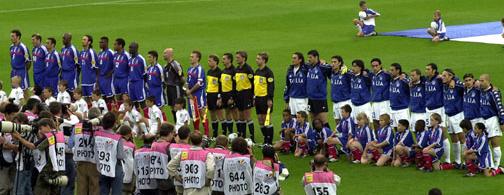
11th European association football championship
| Field | Value |
|---|---|
| tourney_name | UEFA Euro 2000 |
| other_titles | Europees Voetbalkampioenschap |
| België/Nederland 2000 | |
| Championnat d'Europe de football | |
| Belgique/Pays-Bas 2000 | |
| Fußball-Europameisterschaft | |
| Belgien/Niederlande 2000 | |
| image | UEFA Euro 2000 logo.svg |
| size | 120px |
| caption | Football without frontiers |
| country | Belgium |
| country2 | Netherlands |
| dates | 10 June – 2 July |
| num_teams | 16 |
| venues | 8 |
| cities | 8 |
| champion | FRA |
| champion-flagvar | 1974 |
| count | 2 |
| second | ITA |
| matches | 31 |
| goals | 85 |
| attendance | 1122833 |
| top_scorer | Savo Milošević |
| Patrick Kluivert | |
| (5 goals each) | |
| player | Zinedine Zidane |
| prevseason | 1996 |
| nextseason | 2004 |
the sporting event
België/Nederland 2000 Championnat d'Europe de football Belgique/Pays-Bas 2000 Fußball-Europameisterschaft Belgien/Niederlande 2000 | champion-flagvar = 1974 Patrick Kluivert (5 goals each)
The 2000 UEFA European Football Championship, also known as Euro 2000, was the 11th UEFA European Championship, a football tournament held every four years and organised by UEFA, the sport's governing body in Europe.
The finals tournament was played between 10 June and 2 July 2000, and co-hosted by Belgium and the Netherlands, the first time the tournament had been held in more than one nation. Spain and Austria also bid to host the event. The finals tournament was contested by 16 nations; with the exception of the hosts, Belgium and the Netherlands, the finalists had to go through a qualifying tournament to reach the final stage. France won the tournament by defeating Italy 2–1 in the final, via a golden goal. Germany were defending champions but were eliminated in the Group Stage.
The finals saw the first major UEFA competition contested in the King Baudouin Stadium (formerly the Heysel Stadium) since the events of the 1985 European Cup final and the Heysel Stadium disaster, with the opening game being played in the rebuilt stadium.
A high-scoring championship with many exciting matches and an elite standard of play, Euro 2000 is often labelled by football writers as one of the greatest international tournaments of all time.
Bid process
Belgium and the Netherlands were selected as co-hosts on 14 July 1995 by the UEFA Executive Committee at a meeting in Geneva, Switzerland.
Hooliganism concerns
Football hooliganism was a significant problem in the Netherlands in the 1990s, especially the fierce rivalry between Ajax and Feyenoord. There were concerns that hooliganism would overshadow the finals. Many instances of violence occurred, including several football riots in Rotterdam between 1995 and 1999, which would host the Euro 2000 final. One of the most infamous incidents was the Battle of Beverwijk in 1997. Although the violence is normally associated with domestic clubs, there were concerns that it could attach to the Dutch national team.
Violence did eventually occur during the Euro 2000 finals, albeit not involving the Dutch team. On 17 June, 174 England fans were arrested in Brussels, Belgium, following violence with Germans and local Turkish groups ahead of an England v Germany match.
Summary
One of the biggest surprises of the tournament was Portugal, winning Group A with three wins, including a 3–0 victory against Germany, with Sérgio Conceição scoring a hat-trick, and a 3–2 victory against England, in which they came back from 2–0 down. Romania was the other qualifier from the group, beating England with a late penalty in their last group game.
Belgium had a surprise exit in the group stage, winning the tournament's first game against Sweden, but losing to Turkey and Italy. They finished third in Group B, behind Italy and Turkey. The other co-host and favourite, the Netherlands, progressed as expected from Group D, along with World Cup winners France. The Netherlands won the group, by beating France in their last group match. Also in Group D, Denmark's three losses with eight goals conceded and none scored set a new record for the worst team performance in the group stages of a Euros. Group C was memorable for the match between FR Yugoslavia and Spain. Spain needed a win to ensure progression, but found themselves trailing 3–2 after Slobodan Komljenović scored in the 75th minute. The Spanish side rescued their tournament by scoring twice in injury time to record a 4–3 victory. FR Yugoslavia managed to go through as well, despite losing because Norway and Slovenia played to a draw.
Italy and Portugal maintained their perfect records in the quarter-finals, beating Romania and Turkey, respectively, and the Netherlands started a goal-avalanche against FR Yugoslavia, winning 6–1. Spain fell 2–1 to France; Raúl missed a late penalty that ended Spanish hopes.
Italy eliminated the Netherlands in the semi-finals, despite going down to ten men and facing two penalty kicks. Italian goalkeeper Francesco Toldo, who had been drafted into the starting XI as Gianluigi Buffon missed the tournament through injury, made two saves in the penalty shootout – apart from his penalty save in normal time – to carry the Italians to the final.
In the other semi-final, Portugal lost in extra time to France after Zinedine Zidane converted a controversial penalty kick. Several Portuguese players challenged the awarding of the penalty for a handball and were given lengthy suspensions for shoving the referee. France won the tournament, defeating Italy 2–1 in the final with a golden goal by David Trezeguet after equalising with a last-minute goal, and became the first team to win the European championship while being world champion.
In Britain, Match of the Day named Stefano Fiore's goal against Belgium the Goal of the Tournament, ahead of Patrick Kluivert's against France and Zinedine Zidane's against Spain.
Qualification
Main article: UEFA Euro 2000 qualifying
Qualification for the tournament took place throughout 1998 and 1999. Forty-nine teams were divided into nine groups and each played the others in their group, on a home-and-away basis. The winner of each group and the best runner-up qualified automatically for the final tournament. The eight other runners-up played an additional set of play-off matches to determine the last four qualifiers. Belgium and the Netherlands automatically qualified for the tournament as co-hosts. Notably, this was the only European Championship Belgium appeared in between 1984 and 2016.
As of 2024, this was the only time Norway qualified for the European Championship finals, the last time they qualified for a major tournament until the 2026 FIFA World Cup as well as the only time that Croatia failed to qualify for the European Championship finals since gaining independence.
Qualified teams
Final draw
The finals draw took place 15:00 CET on 12 December 1999, at the Brussels Expo in Belgium; and was streamed live on UEFA's official website.
The composition of pots 1 to 4 was based on the teams' UEFA national team coefficient ranking at the end of 1999, with the exception of pot 1 automatically top seeding Germany as holders along with co-hosts Belgium and Netherlands.
| Team | Coeff | Rank |
|---|---|---|
| (holders) | 2.278 | 7 |
| (co-hosts) | 2.375 | 5 |
| (co-hosts) | 2.250 | 8 |
| 2.611 | 1 |
|
| Team | Coeff | Rank |
|---|---|---|
| 2.600 | 2 | |
| 2.500 | 3 | |
| 2.389 | 4 | |
| 2.300 | 6 |
|
| Team | Coeff | Rank |
|---|---|---|
| 2.222 | 9 | |
| 2.100 | 11 | |
| 2.100 | 12 | |
| 2.063 | 13 |
|
| Team | Coeff | Rank |
|---|---|---|
| 2.000 | 15 | |
| 1.938 | 18 | |
| 1.938 | 19 | |
| 1.000 | 37 |
|}
Prior to the draw, the seeded teams in Pot 1 were assigned positions: Germany (defending champion) to A1, Belgium (co-host) to B1, Spain (highest coefficient) to C1, and the Netherlands (co-host) to D1. Teams were drawn consecutively from Pots 2 to 4 into a group, with each team then being assigned a specific position (for the purposes of determining the match schedules in each group).
The draw resulted in the following groups:
| Team |
|---|
|
| Team |
|---|
|
| Team |
|---|
|
| Team |
|---|
|}
Venues
Capacity figures are those for matches at UEFA Euro 2000 and are not necessarily the total capacity that the stadium is capable of holding.
| Belgium | Netherlands | Brussels | Bruges | Amsterdam | Rotterdam | {{Location map+ | Belgium | float=center | width=410 | caption= | places= | {{Location map+ | Netherlands | float=center | width=317 | caption= | places= | Liège | Charleroi | Eindhoven | Arnhem |
|---|---|---|---|---|---|---|---|---|---|---|---|---|---|---|---|---|---|---|---|---|---|
| King Baudouin Stadium | Jan Breydel Stadium | Amsterdam Arena | Feijenoord Stadion | ||||||||||||||||||
| Capacity: 50,000 | Capacity: 30,000 | Capacity: 52,000 | Capacity: 51,000 | ||||||||||||||||||
| [[File:Stade Roi Baudouin.JPG | 200px]] | [[File:Bruges Jan Breydel Stadium 1.jpg | alt= | 200x200px]] | [[File:Amsterdam Arena Roof Open.jpg | 200px]] | [[File:Rotterdam De Kuip 2.jpg | alt= | 200x200px]] | ||||||||||||
| Stade Maurice Dufrasne | Stade du Pays de Charleroi | Philips Stadion | GelreDome | ||||||||||||||||||
| Capacity: 30,000 | Capacity: 30,000 | Capacity: 33,000 | Capacity: 30,000 | ||||||||||||||||||
| [[File:Standard liege kaerjeng02.jpg | 200px]] | [[File:Stade du pays de Charleroi 1.jpg | 200px]] | [[File:Philips Stadion.jpg | alt= | 200x200px]] | [[File:Gelredome Binnenkant.jpg | alt= | 200x200px]] |
Team base camps
The 16 national teams each stayed in their own "team base camp" during the tournament.
| Team | Base camp | Ref. | |||||||||||
|---|---|---|---|---|---|---|---|---|---|---|---|---|---|
| Belgium | Lichtaart | ||||||||||||
| Czech Republic | Knokke-Heist | ||||||||||||
| Denmark | Brunssum | ||||||||||||
| England | Spa/Waterloo | title=English 'hooligans' refused entry | url=http://news.bbc.co.uk/2/hi/euro2000/teams/england/780981.stm | website=BBC News | publisher=BBC | date=7 June 2000 | access-date=25 June 2016}} | ||||||
| FR Yugoslavia | Edegem | title=Boškov i dalje optimista | trans-title=Boškov still optimistic | url=http://www.arhiva.srbija.gov.rs/vesti/2000-06/07/20052.html | publisher=Government of Serbia | date=7 June 2000 | access-date=25 June 2016 | language=sr}} | |||||
| France | Genval | ||||||||||||
| Germany | Vaals | ||||||||||||
| Italy | Grobbendonk | ||||||||||||
| Netherlands | Hoenderloo | first=Willem | last=Vissers | title=Onneembare veste voor gewone stervelingen | trans-title=Impregnable fortress for mere mortals | url=http://www.volkskrant.nl/sport/onneembare-veste-voor-gewone-stervelingen~a578246/ | website=De Volkskrant | date=7 June 2000 | access-date=25 June 2016 | language=nl}} | |||
| Norway | Knokke-Heist | first=Dag Vidar | last=Hanstad | title=Norge på plass i Belgia | trans-title=Norway in place in Belgium | url=http://www.aftenposten.no/nyheter/sport/em2000/d144415.htm | url-status=dead | newspaper=Aftenposten | date=7 June 2000 | access-date=25 June 2016 | language=no | archive-url=https://web.archive.org/web/20000819150855/http://www.aftenposten.no/nyheter/sport/em2000/d144415.htm | archive-date=19 August 2000}} |
| Portugal | Ermelo | title=Portugese voetballers tijdens EK in Ermelo | url=http://snv.courant.nu/issue/SNA/2000-01-10/edition/0/page/7 | newspaper=Schilders Dagblad | date=10 January 2000 | access-date=25 June 2016 | language=nl}} | ||||||
| Romania | Grimbergen/Arnhem | ||||||||||||
| Slovenia | Soestduinen | ||||||||||||
| Spain | Tegelen | ||||||||||||
| Sweden | Oisterwijk | ||||||||||||
| Turkey | Delden |
Squads
Main article: UEFA Euro 2000 squads
Each national team had to submit a squad of 22 players, three of whom had to be goalkeepers.
Match officials
On 15 February 2000, UEFA appointed 12 referees, 16 assistant referees and four fourth officials for the competition, including a referee and an assistant referee from the Confederation of African Football. The event saw assistant referees being allowed to intervene an ongoing game, in particular to help the match official apply the 10-metre rule when deciding free-kicks – as well as warn the referee instantly if he had booked or ejected the wrong player, something that was not possible in previous tournaments. Also, fourth officials were given a larger role in assisting to take command of the match if any decisions are gone unnoticed by the referee or an assistant referee.
The German referee Markus Merk was selected to referee the opening game between Belgium and Sweden.
| Referees | Assistant referees | Fourth officials |
|---|---|---|
| Günter Benkö | Yuri Dupanov | Michel Piraux |
| Kim Milton Nielsen | Roland Van Nylen | Kyros Vassaras |
| Gamal Al-Ghandour | Ivan Lekov | Terje Hauge |
| Graham Poll | Jens Larsen | Ľuboš Micheľ |
| Gilles Veissière | Philip Sharp | |
| Markus Merk | Jacques Poudevigne | |
| Pierluigi Collina | Kurt Ertl | |
| Dick Jol | Sergio Zuccolini | |
| Vítor Melo Pereira | Dramane Dante | |
| Hugh Dallas | Emanuel Zammit | |
| José María García-Aranda | Jaap Pool | |
| Anders Frisk | Eddie Foley | |
| Urs Meier | Nicolae Grigorescu | |
| Igor Šramka | ||
| Carlos Martín Nieto | ||
| Leif Lindberg | ||
| Turgay Güdü |
Group stage
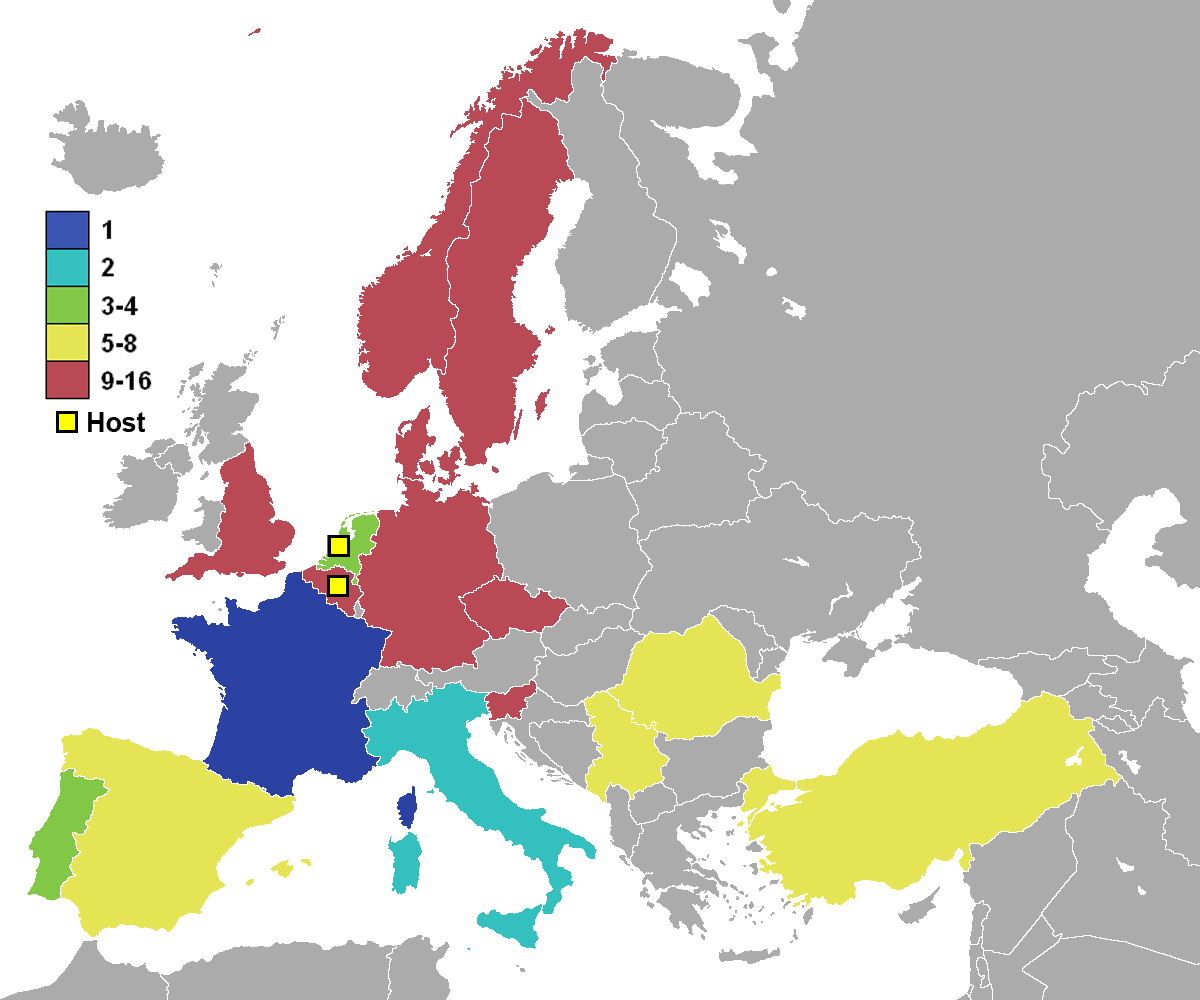
The teams finishing in the top two positions in each of the four groups progress to the quarter-finals, while the bottom two teams in each group were eliminated.
All times are local, CEST (UTC+2).
Tiebreakers
If two or more teams finished level on points after completion of the group matches, the following tie-breakers were used to determine the final ranking:
- greater number of points in the matches between the teams in question;
- greater goal difference in matches between the teams in question;
- greater number of goals scored in matches between the teams in question;
- greater goal difference in all group games;
- greater number of goals scored in all group games;
- higher coefficient derived from Euro 2000 and 1998 World Cup qualifiers (points obtained divided by number of matches played);
- fair play conduct in Euro 2000;
- drawing of lots.
Group A
Main article: UEFA Euro 2000 Group A
Group B
Main article: UEFA Euro 2000 Group B
Group C
Main article: UEFA Euro 2000 Group C
Group D
Main article: UEFA Euro 2000 Group D
Knockout stage
Main article: UEFA Euro 2000 knockout stage
The knockout stage was a single-elimination tournament with each round eliminating the losers. Any game that was undecided by the end of the regular 90 minutes, was followed by up to thirty minutes of extra time. For the second time the golden goal system was applied, whereby the first team to score during the extra time would become the winner. If no goal was scored there would be a penalty shoot-out to determine the winner. For the second time the final was won by a golden goal.
As with every tournament since UEFA Euro 1984, there was no third place play-off.
All times are local, CEST (UTC+2).
Bracket
Quarter-finals
Semi-finals
Final
Main article: UEFA Euro 2000 final
Statistics
Main article: UEFA Euro 2000 statistics
Goalscorers
Awards
;UEFA Team of the Tournament
| Goalkeepers | Defenders | Midfielders | Forwards |
|---|---|---|---|
| Fabien Barthez | |||
| Francesco Toldo | Laurent Blanc | ||
| Marcel Desailly | |||
| Lilian Thuram | |||
| Fabio Cannavaro | |||
| Paolo Maldini | |||
| Alessandro Nesta | |||
| Frank de Boer | Patrick Vieira | ||
| Zinedine Zidane | |||
| Demetrio Albertini | |||
| Edgar Davids | |||
| Rui Costa | |||
| Luís Figo | |||
| Pep Guardiola | Savo Milošević | ||
| Thierry Henry | |||
| Francesco Totti | |||
| Patrick Kluivert | |||
| Nuno Gomes | |||
| Raúl |
Golden Boot
- Patrick Kluivert (5 goals)
- Savo Milošević (5 goals)
UEFA Player of the Tournament
- Zinedine Zidane
Prize money
| Rank | Team | CHFMillion |
|---|---|---|
| 1 | 14.4 | |
| 2 | 13.2 | |
| 3 | ||
| 10.2 | ||
| 5 | ||
| 7.8 | ||
| 9 | ||
| 5.4 | ||
| 13 | ||
| 4.8 |
A sum of CHF120 million was awarded to the 16 qualified teams in the competition. France, the winners of the tournament, received a total prize money of CHF14.4 million. Below is a complete list of the allocations:
Extra payment based on teams performances:
- Winner: CHF14.4 million
- Runner-up: CHF13.2 million
- Semi-finals: CHF10.2 million
- Quarter-finals: CHF7.8 million
- Group stage:
- Third place: CHF5.4 million
- Fourth place: CHF4.8 million
On 9 July 2000, UEFA refused to hand FR Yugoslavia their prize money of CHF7.8 million, because of alleged ties between the Football Association of FR Yugoslavia and Slobodan Milošević's government. However, no connections were found and the Football Association of FR Yugoslavia later received their money with an additional bonus.
Marketing
Slogan and theme song
The slogan of the competition was "Football without frontiers". "Campione 2000" by E-Type was the official anthem of the event.
Match ball

The Adidas Terrestra Silverstream was unveiled as the official match ball of the competition on 13 December 1999 at Constant Vanden Stock Stadium, Anderlecht's home arena by Alessandro Del Piero, Edwin van der Sar, Zinedine Zidane and Luc Nilis.
Mascot

The official mascot for the tournament was Benelucky (a pun on Benelux), a lion-devil hybrid with its mane having the flag colours of both host nations. The lion is the national football emblem of the Netherlands and a devil is the emblem of Belgium (the team being nicknamed "the Red Devils").
Sponsorships
| title=Sponsors | url=http://www.euro2000.org/en/hosts/sponsors/0%2C1068%2C%2C00.html | url-status=dead | website=UEFA | access-date=8 April 2024 | archive-url=https://web.archive.org/web/20001216152900/http://www.euro2000.org/en/hosts/sponsors/0,1068,,00.html | archive-date=16 December 2000}} | Official Suppliers |
|---|
Broadcasting
Main article: UEFA Euro 2000 broadcasting rights
Notes
References
References
- "Policing Euro 2000".
- Dietrich Schulze-Marmeling: Die Geschichte der Fußball-Europameisterschaft, Verlag Die Werkstatt, {{ISBN. 978-3-89533-553-2
- (2 July 2000). "France add Europe to the world". [[The Guardian]].
- Delaney, Miguel. (2 June 2012). "The debate: was Euro 2000 the greatest international tournament ever?".
- Lipton, Martin. "Soccernet.com Euro 2000 News: So, is this the best tournament we've ever seen?". [[ESPN]].
- McNulty, Paul. (10 June 2016). "A Personal Account of Possibly The Best European Championships of All".
- Smyth, Rob. (27 June 2008). "The Joy of Six: great international tournaments". The Guardian.
- (15 July 1995). "EK zorgt voor economische impuls". [[Provinciale Zeeuwse Courant]].
- (15 July 1995). "Nederland en België hopen quitte te spelen bij EK". [[De Volkskrant]].
- (2 May 1999). "Holland's hooligan horror". The Guardian.
- Brown, Sean. (13 September 2013). "Football Fans Around the World: From Supporters to Fanatics". Routledge.
- (17 June 2000). "Fans battle with Belgian police". [[BBC]].
- (20 June 2000). "Holders Germany suffer heavy defeat". British Broadcasting Corporation.
- (13 June 2000). "England crushed in five-goal classic". BBC.
- (20 June 2000). "Late penalty breaks English hearts". BBC.
- (10 June 2000). "Belgium kick off with fine win". BBC.
- (19 June 2000). "Turks through as Belgium crash out". BBC.
- (14 June 2000). "Italy head for quarter-finals". BBC.
- (21 June 2000). "Group D goes Dutch". BBC.
- (21 June 2000). "Spain survive in seven-goal classic". BBC.
- (21 June 2000). "Norway crash out after Slovenia draw". BBC.
- (2 July 2000). "UEFA suspends Portuguese trio". BBC.
- (3 July 2000). "Golden goal gives France victory in Euro 2000". [[The Daily Telegraph]].
- (18 June 2024). "'I was on the pitch for Portugal's Euros meltdown – they wanted to fight'".
- (1 July 2000). "Fiore strike scoops top spot". BBC.
- (21 December 2001). "UEFA European National Team Ranking Table 1999". England Football Online.
- (19 November 1999). "England sent to the bottom of Euro 2000 class". Independent Print.
- (10 December 1999). "Blow for England's Euro hopes". BBC.
- (10 December 1999). "UEFA detail EURO 2000 Final Tournament draw procedure".
- (14 December 1999). "Big names thrown in deep end".
- "EURO 2000™ final tournament draw".
- "Venues prepare for summer drama".
- (6 June 2000). "Euro 2000 hopefuls arriving at respective bases". [[New Straits Times]].
- (6 June 2000). "Lichtaart livre ses premiers secrets d'alcôve Nos bons petits Diables ont bon pied bon oeil " Physiquement, on récupère bien "".
- (5 June 2000). "Echte kampioenen logeren in Chateau du Lac". [[De Volkskrant]].
- (7 June 2000). "Čeští fotbalisté se ubytovali v belgickém městečku Knokke-Heist".
- (5 June 2000). "Landsholdet ankommet til Holland". [[Danish Football Union]].
- (7 June 2000). "English 'hooligans' refused entry". BBC.
- (7 June 2000). "Boškov i dalje optimista". [[Government of Serbia]].
- (22 May 2000). "Lemerre stands by heroes of '98". New Straits Times.
- Weber-Klüver, Katrin. (8 June 2000). "Trainingsquartier: "Hoch soll'n sie leben"".
- (5 May 2000). "Calcio: Azzurri a Geel durante Euro 2000".
- Curro, Enrico. (6 June 2000). "Europei, allarme hooligans". [[La Repubblica]].
- Vissers, Willem. (7 June 2000). "Onneembare veste voor gewone stervelingen".
- Hanstad, Dag Vidar. (7 June 2000). "Norge på plass i Belgia". [[Aftenposten]].
- (10 January 2000). "Portugese voetballers tijdens EK in Ermelo". Schilders Dagblad.
- "Delegatia Romaniei".
- (6 June 2000). "National team arrived to the Netherlands".
- (9 January 2000). "Soestduinen baza slovenskih nogometašev".
- Torres, Diego. (5 June 2000). "Llegada al cuartel general". [[El País]].
- (21 June 2000). "Från förväntan – till förtvivlan". [[Dagens Nyheter]].
- (30 May 2000). "Yolculuk bugün".
- (15 February 2000). "Referees for Euro 2000 Final Tournament appointed".
- Hooper, Andy. (13 April 2000). "Six-second rule hits Euro 2000 keepers". ESPN.
- (10 June 2000). "German referee takes charge of opening game".
- "Tournament rules".
- "UEFA Euro 2008 Information". UEFA.
- (6 July 2000). "Euro 2000 finalists to share 120 million francs".
- (20 January 2000). "Major financial rewards for finals participants".
- (9 July 2000). "Swiss blocking Yugoslav Euro 2000 income says official". Yahoo.
- (9 July 2000). "Swiss release Yugoslav payments". BBC.
- Fanning, Dion. (4 June 2000). "Portugal can rise above the gloom". Irish Independent.
- (8 June 2000). "Openingsceremonie Euro 2000 wordt groots spektakel". [[Gazet van Antwerpen]].
- (3 July 2000). "The A to Z of Euro 2000™".
- "Soccer – New Adidas ball for Euro 2000 – Adidas Terrestra Silverstream".
- Lambaerts, Geert. (14 December 1999). "Alessandro Del Piero: "België wordt sterkste tegenstander"". [[De Standaard]].
- (16 September 1999). "Euro 2000 mascot named".
- Kell, Tom. (6 December 2010). "Euro 2012 mascots have big shoes to fill".
- "Sponsors".
This article was imported from Wikipedia and is available under the Creative Commons Attribution-ShareAlike 4.0 License. Content has been adapted to SurfDoc format. Original contributors can be found on the article history page.
Ask Mako anything about UEFA Euro 2000 — get instant answers, deeper analysis, and related topics.
Research with MakoFree with your Surf account
Create a free account to save articles, ask Mako questions, and organize your research.
Sign up freeThis content may have been generated or modified by AI. CloudSurf Software LLC is not responsible for the accuracy, completeness, or reliability of AI-generated content. Always verify important information from primary sources.
Report