From Surf Wiki (app.surf) — the open knowledge base
UEFA Euro 1992
9th European association football championship
9th European association football championship
| Field | Value |
|---|---|
| tourney_name | UEFA European Football Championship |
| year | 1992 |
| other_titles | Europamästerskapet i fotboll |
| Sverige 1992 | |
| image | UEFA Euro 1992 logo.svg |
| size | 200px |
| caption | Small is Beautiful |
| country | Sweden |
| dates | 10–26 June |
| num_teams | 8 |
| venues | 4 |
| cities | 4 |
| champion | DEN |
| count | 1 |
| second | GER |
| matches | 15 |
| goals | 32 |
| attendance | 430111 |
| top_scorer | Henrik Larsen |
| Karl-Heinz Riedle | |
| Dennis Bergkamp | |
| Tomas Brolin | |
| (3 goals each) | |
| prevseason | 1988 |
| nextseason | 1996 |
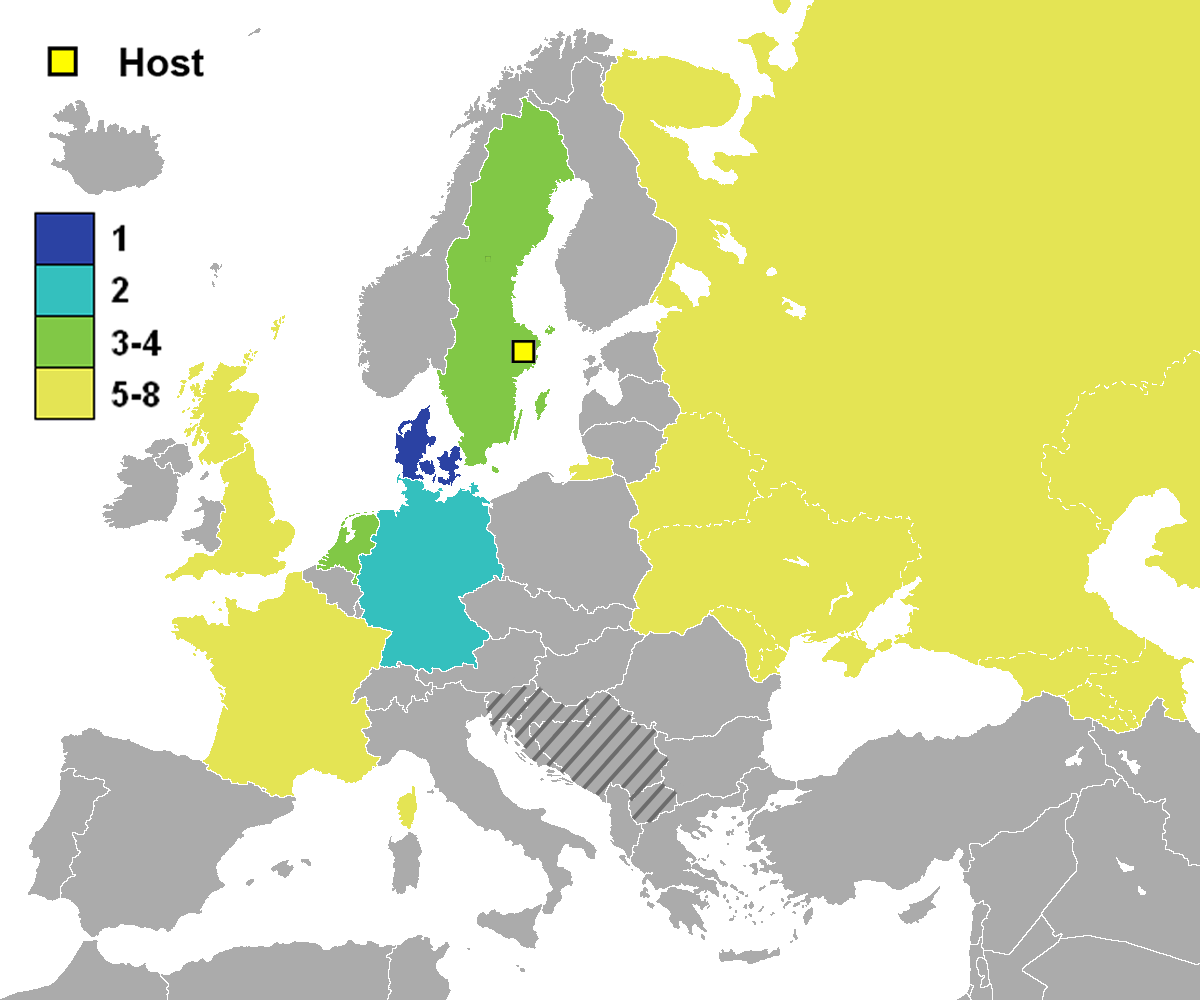
Sverige 1992 Karl-Heinz Riedle Dennis Bergkamp Tomas Brolin (3 goals each) The 1992 UEFA European Football Championship was hosted by Sweden between 10 and 26 June 1992. It was the ninth UEFA European Championship, which is held every four years and supported by UEFA.
Denmark won the 1992 championship, having been invited as qualifiers runners-ups only after Yugoslavia was disqualified as a result of the breakup of the country and the ensuing warfare there. Eight national teams contested the final tournament.
The CIS national football team (Commonwealth of Independent States), representing the recently dissolved Soviet Union, whose national team had qualified for the tournament, were present at the tournament. It was also the first major tournament in which the reunified Germany (who were beaten 2–0 by Denmark in the final) had competed.
It was the last tournament with only eight participants, to award the winner of a match with only two points, and before the introduction of the back-pass rule, the latter of which was brought in immediately after the tournament was completed. When the next competition was held in 1996, 16 teams were involved and were awarded three points for a win.
Bid process
On 16 December 1988, following a decision made by the UEFA Executive Committee, Sweden was chosen over Spain to host the event. Spain was at a disadvantage as they had already been chosen to host the EXPO 1992 in Seville and the 1992 Summer Olympics in Barcelona.
Summary
Seven of the eight teams had to qualify for the final stage; Sweden qualified automatically as hosts of the event. The Soviet Union qualified for the final tournament shortly before the break-up of the country, and took part in the tournament under the banner of the Commonwealth of Independent States (CIS), before the former Soviet republics formed their own national teams after the competition. The CIS team represented the following former Soviet nations: Russia, Ukraine, Belarus, Kazakhstan, Uzbekistan, Turkmenistan, Kyrgyzstan, Armenia, Azerbaijan, Moldova, and Tajikistan. Four out of 15 ex-republics were not members of the CIS: Estonia, Latvia and Lithuania did not send their players; Georgia was not a member of the CIS at the time, but Georgian Kakhaber Tskhadadze was a part of the squad.
Originally, Yugoslavia qualified for the final stage and were about to participate as FR Yugoslavia, but due to the Yugoslav Wars, the team was disqualified and Denmark, as the runners-up from Yugoslavia's qualifying group, was invited to take part instead. After a draw with England and a loss to host nation Sweden, Denmark beat France in their final group match to qualify for the semi-finals, where they faced the reigning European champions, the Netherlands. Denmark led 2–1 going into the last five minutes, but a Frank Rijkaard equaliser meant the game went to a penalty shoot-out; Danish goalkeeper Peter Schmeichel saved Marco van Basten's kick, giving Denmark a 5–4 win on penalties and a place in the final against the reigning world champions, Germany. Denmark won the final 2–0 with goals from John Jensen and Kim Vilfort in either half to claim their first European title.
Qualification
Main article: UEFA Euro 1992 qualifying
Scotland and the hosts Sweden made their respective debuts despite having already made many appearances at the World Cup. France qualified for the first Euro in which they were not the hosts. They played after missing the previous tournament.
As of 2024, this was the last time that the Czech Republic (then Czechoslovakia), Italy, Portugal, and Spain failed to qualify for the European Championship finals.
Qualified teams
Final draw
The draw for the final tournament took place on 17 January 1992 in Gothenburg. Only two teams were seeded: Sweden (as hosts) and the Netherlands (as holders). The remaining six teams were all unseeded and could be drawn in any group. Months after the draw, Yugoslavia was banned from participating and replaced by Denmark, which had come second in the qualifying group.
In the draw procedure, the unseeded teams were drawn one by one. The first two were placed in position 4 of each group, the next two in position 3, and the last two in position 2. The two seeded teams were then drawn and placed consecutively into position 1 of the groups.
| Pot 1: Seeded teams | Pot 2: Unseeded teams |
|---|
The draw resulted in the following groups:
|
|}
Venues
| Gothenburg | {{Location map+ | Sweden | float=center | width=215 | caption= | places= | Stockholm | Malmö | Norrköping |
|---|---|---|---|---|---|---|---|---|---|
| Ullevi | Råsunda Stadium | ||||||||
| Capacity: 44,000 | Capacity: 40,000 | ||||||||
| [[File:Nyaullevi.jpg | 200px]] | [[File:Råsunda Stadium.jpg | 200px]] | ||||||
| Malmö Stadion | Idrottsparken | ||||||||
| Capacity: 30,000 | Capacity: 23,000 | ||||||||
| [[File:Sweden malmö stadion sweden.jpg | 200px]] | [[File:Norrkopings idrottspark.jpg | 200px]] |
Squads
Main article: UEFA Euro 1992 squads
Each national team had to submit a squad of 20 players.
Match ball
Adidas Etrusco Unico was used as the official match ball of the tournament. The ball was previously used in the 1990 FIFA World Cup.
Match officials
| Country | Referee | Linesmen | Matches refereed |
|---|---|---|---|
| Hubert Forstinger | Johann Möstl | Alois Pemmer | |
| Guy Goethals | Pierre Mannaerts | Robert Surkijn | |
| Alexey Spirin | Victor Filippov | Andrei Butenko | |
| Peter Mikkelsen | Arne Paltoft | Jørgen Ohmeyer | |
| Gérard Biguet | Marc Huguenin | Alain Gourdet | |
| Aron Schmidhuber | Joachim Ren | Uwe Ennuschat | |
| Sándor Puhl | László Varga | Sándor Szilágyi | |
| Pierluigi Pairetto | Domenico Ramicone | Maurizio Padovan | |
| Tullio Lanese | Sweden 2–3 Germany (Semi-final) | ||
| John Blankenstein | Jan Dolstra | Robert Overkleeft | |
| José Rosa dos Santos | Valdemar Aguiar Pinto Lopes | Antonio Guedes Gomes De Carvalho | |
| Emilio Soriano Aladrén | Francisco García Pacheco | José Luis Iglesia Casas | |
| Bo Karlsson | Lennart Sundqvist | Bo Persson | |
| Kurt Röthlisberger | Zivanko Popović | Paul Wyttenbach | |
| Bruno Galler | Denmark 2–0 Germany (Final) |
;Fourth officials
| Country | Fourth officials |
|---|---|
| Gerhard Kapl | |
| Frans van den Wijngaert | |
| Vadim Zhuk | |
| Kim Milton Nielsen | |
| Rémi Harrel | |
| Karl-Josef Assenmacher | |
| Sándor Varga | |
| Mario van der Ende | |
| Jorge Emanuel Monteiro Coroado | |
| Leif Sundell |
Group stage
The teams finishing in the top two positions in each of the two groups progress to the semi-finals, while the bottom two teams in each group were eliminated from the tournament.
All times are local, CEST (UTC+2).
Tiebreakers
If two or more teams finished level on points after completion of the group matches, the following tie-breakers were used to determine the final ranking:
- Goal difference in all group matches
- Greater number of goals scored in all group matches
- Drawing of lots
Group 1
Main article: UEFA Euro 1992 Group 1
Group 2
Main article: UEFA Euro 1992 Group 2
Knockout stage
Main article: UEFA Euro 1992 knockout stage
In the knockout phase, extra time and a penalty shoot-out were used to decide the winner if necessary. As with every tournament after UEFA Euro 1980, there was no third place play-off.
All times are local, CEST (UTC+2).
Bracket
Semi-finals
Final
Main article: UEFA Euro 1992 final
Statistics
Main article: UEFA Euro 1992 statistics
Goalscorers
Awards
;UEFA Team of the Tournament
| Goalkeeper | Defenders | Midfielders | Forwards |
|---|---|---|---|
| Peter Schmeichel | Jocelyn Angloma | ||
| Laurent Blanc | |||
| Andreas Brehme | |||
| Jürgen Kohler | Brian Laudrup | ||
| Stefan Effenberg | |||
| Thomas Häßler | |||
| Ruud Gullit | Dennis Bergkamp | ||
| Marco van Basten |
Marketing
Slogan and theme song
Small is Beautiful was the official slogan of the contest. The official anthem of the tournament was "More Than a Game", performed by Towe Jaarnek and Peter Jöback.
Logo and identity
It was the last tournament to use the UEFA plus flag logo, and before the tournament was known as "Euro" (it is known as "Euro 1992" only retrospectively). It was also the first major football competition in which the players had their names printed on their backs, around the time that it was becoming a trend in club football across Europe.
Mascot
The official mascot of the competition was a rabbit coincidentally named Rabbit, dressed in a Swedish football jersey, as well as head and wristbands.
Sponsorship
| Global sponsors | Swedish sponsors |
|---|
References
References
- Chowdhury, Saj. (12 May 2012). "Euro 1992: Denmark's fairytale". [[BBC]].
- (18 December 1988). "Sweden to host 1992 Euro finals". New Straits Times.
- (2007). "Dietrich Schulze-Marmeling: Die Geschichte der Fußball-Europameisterschaft". Verlag Die Werkstatt.
- Hughes, Rob. (16 October 1991). "Now, the going gets tough". [[The New York Times]].
- Hughes, Rob. (10 June 1992). "Confidence and flair: Dutch favored in Euro 92". The New York Times.
- (1 June 1992). "Yugoslav athletes banned". The New York Times.
- Thomsen, Ian. (23 June 1992). "Danes upset Dutch in penalty shoot-out, advance to final". The New York Times.
- Thomsen, Ian. (27 June 1992). "Upstart Danes upend Germany, 2–0, in soccer final". The New York Times.
- (19 December 1991). "Duitsland speelt met Luxemburg". [[Provinciale Zeeuwse Courant]].
- (13 January 1992). "Liedholm verricht loting". [[Provinciale Zeeuwse Courant]].
- (30 May 1992). "United Nations Security Council Resolution 757 (Implementing Trade Embargo on Yugoslavia)". United Nations.
- (18 January 1992). "Nederland weer tegen Duitsland". [[Provinciale Zeeuwse Courant]].
- (17 October 2011). "1992 team of the tournament".
- Kell, Tom. (1 February 2013). "The weird and wonderful world of Euro mascots".
This article was imported from Wikipedia and is available under the Creative Commons Attribution-ShareAlike 4.0 License. Content has been adapted to SurfDoc format. Original contributors can be found on the article history page.
Ask Mako anything about UEFA Euro 1992 — get instant answers, deeper analysis, and related topics.
Research with MakoFree with your Surf account
Create a free account to save articles, ask Mako questions, and organize your research.
Sign up freeThis content may have been generated or modified by AI. CloudSurf Software LLC is not responsible for the accuracy, completeness, or reliability of AI-generated content. Always verify important information from primary sources.
Report