From Surf Wiki (app.surf) — the open knowledge base
Udmurtia
First-level administrative division of Russia
First-level administrative division of Russia
| Field | Value |
|---|---|
| en_name | Udmurt Republic |
| ru_name | Удмуртская Республика |
| loc_name1 | Удмурт Элькун |
| loc_lang1 | Udmurt |
| image_map | Map of Russia (2014–2022) - Udmurtia.svg |
| pushpin_map | European Russia |
| pushpin_relief | 1 |
| mapframe | yes |
| mapframe-wikidata | yes |
| mapframe-zoom | 4 |
| mapframe-height | 250 |
| mapframe-stroke-width | 1 |
| coordinates | |
| image_coa | Coat of arms of Udmurtia.svg |
| image_flag | Flag of Udmurtia.svg |
| anthem | National Anthem of the Udmurt Republic |
| political_status | Republic |
| political_status_link | Republics of Russia |
| federal_district | Volga |
| economic_region | Ural |
| adm_ctr_type | Capital |
| adm_ctr_name | Izhevsk |
| official_lang_list | Udmurt |
| official_lang_ref | |
| pop_2021census | 1452914 |
| pop_2021census_rank | 32nd |
| urban_pop_2021census | 65.7% |
| rural_pop_2021census | 34.3% |
| pop_2021census_ref | |
| area_km2 | 42061 |
| established_date | November 4, 1920 |
| established_date_ref | |
| license_plates | 18 |
| ISO | RU-UD |
| leader_title | Head |
| leader_title_ref | |
| leader_name | Aleksandr Brechalov |
| legislature | State Council |
| legislature_ref | |
| website | http://www.udmurt.ru/en/ |
| mapframe-wikidata = yes | mapframe-zoom = 4 | mapframe-height = 250 | mapframe-stroke-width = 1
Udmurtia, officially the Udmurt Republic, is a republic of Russia located in Eastern Europe. It is administratively part of the Volga Federal District. Its capital is the city of Izhevsk.
It was established as the Udmurt (until 1931 — Votskaya) Autonomous Region on November 4, 1920.
Name
The name Udmurt comes from odo-mort ('meadow people'), where the first part represents the Permic root od or odo ('meadow, glade, turf, greenery'). This is supported by a document dated 1557, in which the Udmurts are referred to as ru ('meadow people'), alongside the traditional Russian name ru.
The second part murt means 'person' (cf. Komi kv, Mari chm). It is probably an early borrowing from a Scythian language: mertä or martiya ('person, man'; Sanskrit: Manus or Manushya), which is thought to have been borrowed from the Indo-Aryan term maryá- ('man, mortal, one who is bound to die'. cf. Old Indic sa ('young warrior') and sa ('chariot warrior'), both connected specifically with horses and chariots. The Indo-Europeanists T. Gamkrelidze and V. Ivanov associate this word with horse-riding Altaic tribes in the Bronze Age.
On the other hand, in the Russian tradition, the name 'meadow people' refers to the inhabitants of the left bank of river in particular. Recently, the most relevant is the version of V. V. Napolskikh and S. K. Belykh. They suppose that ethnonym was borrowed either from Indo-Iranian *anta 'outside, close, last, edge, limit, boundary' or Turkic-Altaic *anda/*ant 'oath (in fidelity), comrade, friend'.
History
On November 4, 1920, the Votyak Autonomous Oblast was formed. On January 1, 1932, it was renamed Udmurt Autonomous Oblast, which was then reorganized into the Udmurt ASSR on December 28, 1934. During World War II, many industrial factories were evacuated from the Ukrainian SSR and western borderlands to Udmurtia.
On October 11, 1991, the Supreme Council of the Udmurt ASSR adopted a law according to which the Udmurt ASSR acquired a new name — the Udmurt Republic.
Geography
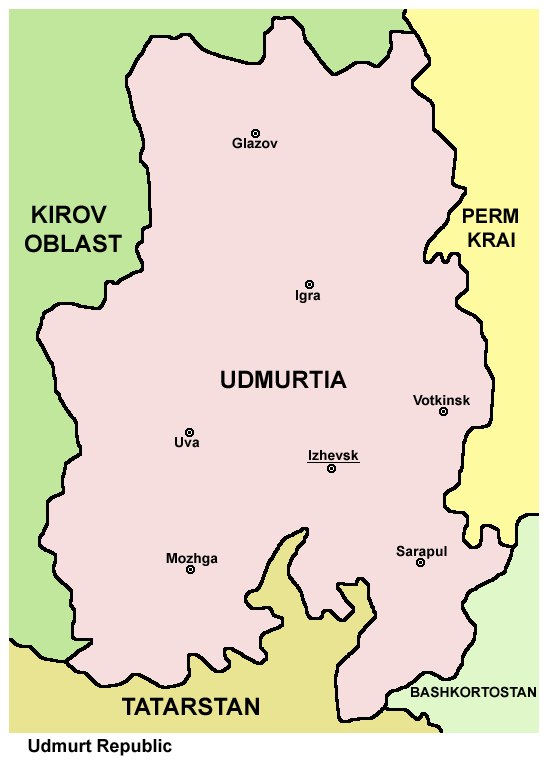
The republic is located to the west of the Ural Mountains and borders Kirov, Perm, Bashkortostan, and Tatarstan.
Udmurtia is a republic in the Russian Federation, located in Central Russia between the branches of the rivers Kama and its right tributary the Vyatka.
The city of Izhevsk is the administrative, industrial, and cultural center of Udmurtia. Geographically, it is located not far from Moscow, the capital and largest city of the Russian Federation. The city has a well-developed transport system (including air, land, and water).
Udmurtia borders Kirov Oblast to the west and north, Perm Oblast to the east, and the Bashkortostan and Tatarstan Republics to the south.
Climate
The republic has a moderate continental climate, with warm summers and cold, snowy winters. Annual precipitation averages 400–600 mm.
| Month | Average temperature |
|---|---|
| January | -14.5 C |
| July | +18.3 C |
Administrative divisions
Main article: Administrative divisions of Udmurtia
Demographics
Population:
Although as of 2007 the population was declining, the decline was stabilizing and was more pronounced in urban areas. Out of the 19,667 births reported in 2007, 12,631 were in urban areas (11.86 per 1,000) and 7,036 were in rural areas (14.88 per 1,000). Birth rates for rural areas are 25% higher than that of urban areas. Of the total of 21,727 deaths, 14,366 were reported in urban areas (13.49 per 1,000) and 7,361 were in rural areas (15.56 per 1,000). Natural decline of the population was measured at −0.16% for urban areas and an insignificant −0.07% for rural areas (the average for Russia was −0.33% in 2007).
Settlements
Vital statistics
Source
| Average population (× 1,000) | Live births | Deaths | Natural change | Crude birth rate (per 1,000) | Crude death rate (per 1,000) | Natural change (per 1,000) | Total fertility rate |
|---|---|---|---|---|---|---|---|
| 1970 | 1,421 | 23,286 | 13,265 | 10,021 | 16.4 | 9.3 | 7.1 |
| 1975 | 1,459 | 26,497 | 14,666 | 11,831 | 18.2 | 10.1 | 8.1 |
| 1980 | 1,508 | 27,601 | 16,862 | 10,739 | 18.3 | 11.2 | 7.1 |
| 1985 | 1,562 | 29,343 | 17,553 | 11,790 | 18.8 | 11.2 | 7.5 |
| 1990 | 1,614 | 24,345 | 15,816 | 8,529 | 15.1 | 9.8 | 5.3 |
| 1991 | 1,619 | 22,213 | 16,002 | 6,211 | 13.7 | 9.9 | 3.8 |
| 1992 | 1,623 | 20,074 | 18,063 | 2,011 | 12.4 | 11.1 | 1.2 |
| 1993 | 1,622 | 17,126 | 21,923 | −4,797 | 10.6 | 13.5 | −3.0 |
| 1994 | 1,619 | 16,874 | 24,183 | −7,309 | 10.4 | 14.9 | −4.5 |
| 1995 | 1,615 | 15,484 | 22,445 | −6,961 | 9.6 | 13.9 | −4.3 |
| 1996 | 1,610 | 14,877 | 20,641 | −5,764 | 9.2 | 12.8 | −3.6 |
| 1997 | 1,606 | 15,368 | 19,881 | −4,513 | 9.6 | 12.4 | −2.8 |
| 1998 | 1,603 | 16,130 | 19,080 | −2,950 | 10.1 | 11.9 | −1.8 |
| 1999 | 1,598 | 15,793 | 20,745 | −4,952 | 9.9 | 13.0 | −3.1 |
| 2000 | 1,592 | 16,256 | 21,852 | −5,596 | 10.2 | 13.7 | −3.5 |
| 2001 | 1,583 | 16,636 | 22,810 | −6,174 | 10.5 | 14.4 | −3.9 |
| 2002 | 1,572 | 17,746 | 24,520 | −6,774 | 11.3 | 15.6 | −4.3 |
| 2003 | 1,561 | 17,982 | 24,571 | −6,589 | 11.5 | 15.7 | −4.2 |
| 2004 | 1,552 | 18,238 | 23,994 | −5,756 | 11.7 | 15.5 | −3.7 |
| 2005 | 1,543 | 17,190 | 24,006 | −6,816 | 11.1 | 15.6 | −4.4 |
| 2006 | 1,535 | 17,480 | 22,011 | −4,531 | 11.4 | 14.3 | −3.0 |
| 2007 | 1,529 | 19,667 | 21,727 | −2,060 | 12.9 | 14.2 | −1.3 |
| 2008 | 1,525 | 20,421 | 21,436 | −1,015 | 13.4 | 14.1 | −0.7 |
| 2009 | 1,523 | 21,109 | 20,227 | 882 | 13.9 | 13.3 | 0.6 |
| 2010 | 1,522 | 21,684 | 21,100 | 584 | 14.3 | 13.9 | 0.4 |
| 2011 | 1,519 | 21,905 | 20,358 | 1,547 | 14.4 | 13.4 | 1.0 |
| 2012 | 1,518 | 23,225 | 19,526 | 3,699 | 15.3 | 12.9 | 2.4 |
| 2013 | 1,517 | 22,138 | 19,332 | 2,806 | 14.6 | 12.7 | 1.9 |
| 2014 | 1,517 | 22,060 | 19,461 | 2,599 | 14.5 | 12.8 | 1.7 |
| 2015 | 1,517 | 22,195 | 19,533 | 2,662 | 14.6 | 12.9 | 1.7 |
| 2016 | 1,517 | 21,024 | 19,090 | 1,934 | 13.8 | 12.6 | 1.2 |
| 2017 | 1,515 | 17,954 | 18,130 | −176 | 11.9 | 12.0 | -0.1 |
TFR source
Ethnic groups
According to the 2021 Census, Russians make up 67.7% of the republic's population, while the ethnic Udmurts make up only 24.1%. Other groups include Tatars (5.5%), Mari (0.5%), Ukrainians (0.3%), and a host of smaller groups, each accounting for less than 0.5% of the republic's total population.
| Ethnic | |||||||||||||||||||||
|---|---|---|---|---|---|---|---|---|---|---|---|---|---|---|---|---|---|---|---|---|---|
| group | 1926 Census | 1970 Census | 1979 Census | 1989 Census | 2002 Census | 2010 Census | 2021 Census | Number | % | Number | % | Number | % | Number | % | Number | % | Number | % | Number | % |
| Udmurts | 395,607 | 52.3% | 484,168 | 34.2% | 479,702 | 32.1% | 496,522 | 30.9% | 460,584 | 29.3% | 410,584 | 28.0% | 299,874 | 24.1% | |||||||
| Besermyan | 9,200 | 1.2% | 2,998 | 0.2% | 2,111 | 0.1% | 1,903 | 0.2% | |||||||||||||
| Russians | 327,493 | 43.3% | 809,563 | 57.1% | 870,270 | 58.3% | 945,216 | 58.9% | 944,108 | 60.1% | 912,539 | 62.2% | 841,581 | 67.7% | |||||||
| Tatars | 17,135 | 2.3% | 87,150 | 6.1% | 99,139 | 6.6% | 110,490 | 6.9% | 109,218 | 7.0% | 98,831 | 6.7% | 67,964 | 5.5% | |||||||
| Others | 6,781 | 0.9% | 36,794 | 2.6% | 43,061 | 2.9% | 53,435 | 3.3% | 53,408 | 3.4% | 42,558 | 2.9% | 31,540 | 2.5% | |||||||
| 1 210,052 people were registered from administrative databases, and could not declare an ethnicity. It is estimated that the proportion of ethnicities in this group is the same as that of the declared group. |
Over two-thirds of the world population of Udmurts live in the republic.
Religious groups
According to a 2012 survey, 33.1% of the population of Udmurtia adheres to the Russian Orthodox Church, 5% are unaffiliated generic Christians, 2% are Eastern Orthodox Christian believers without belonging to any church or members of other Eastern Orthodox churches, 4% are Muslims, 2% of the population adheres to the Slavic native faith (Rodnovery) or to Udmurt Vos (Udmurt native faith), 1% adheres to forms of Protestantism, and 1% of the population are Old Believers. In addition, 29% of the population declares to be "spiritual but not religious," 19% is atheist, and 3.9% follows other religions or did not give an answer to the question.
The local Russian Orthodox Church is the Metropolitanate of Udmurtia, comprising the Eparchy of Izhevsk (founded 1927) under Bishop and Metropolitan Viktorin (Kostenkov) (2015), the Eparchy of Glazov (founded 1889) under Bishop Viktor (Sergeyev), and the Eparchy of Sarapul (founded 1868) under Bishop Anthony (Prostikhin) (2015).
Jews
Udmurt Jews are a special territorial group of the Ashkenazi Jews, which started to be formed in the residential areas of mixed Turkic-speaking (Tatars, Kryashens, Bashkirs, Chuvash people), Finno-Ugric-speaking (Udmurts, Mari people) and Slavic-speaking (Russians) population. The Ashkenazi Jews on the territory of the Udmurt Republic first appeared in the 1830s. The Udmurt Jewry had formed the local variety on the base of the Yiddish of Udmurtia till the 1930s and features of Yiddish of migrants "joined" into it (in the 1930s and 1940s); as a result up to the 1970s and 1980s the Udmurt variety of Yiddish (Udmurtish) was divided into two linguistic subgroups: the central subgroup (with centers Izhevsk, Sarapul, and Votkinsk) and the southern subgroup (with centers Kambarka, Alnashi, Agryz, and Naberezhnye Chelny). One of the characteristic features of the Udmurtish is a noticeable number of Udmurt and Tatar loan words.
Culture
Udmurt folklore is understood both in a broad sense (udm, udm, udm - folk knowledge, folk wisdom), and in a narrower one (udm, udm - folk poetry, oral poetry). In everyday life, folklore is not divided into genres, it is perceived in unity with material culture, with religious, legal, and ethical aspects. Popular terms-definitions have incorporated the ritual action (udm, udm, udm, udm, udm, udm, udm), symbolically figurative and magically forming words (udm, udm, udm, udm), musical and choreographic behavior (udm, udm, udm, udm, udm).
Notes
References
Sources
- {{Cite Russian law
- "СССР. Административно-территориальное деление союзных республик. 1987." (USSR. Administrative-Territorial Structure of the Union Republics. 1987) / Составители В. А. Дударев, Н. А. Евсеева. — М.: Изд-во «Известия Советов народных депутатов СССР», 1987. — 673 с.
References
- Constitution, Article 8
- {{Ru-pop-ref. 2021census
- Constitution, Article 9.1
- "Государственная автоматизированная система Российской Федерации «Правосудие» (17 марта 2010)".
- "уд | это... Что такое уд?". Словари и энциклопедии на Академике.
- A.G. Ivanov, "Udmurty – 'Lugovye lyudi'", ''Linguistica Uralica'' Vol. 27, No. 3 (1991), pp. 188–92.
- Christopher I. Beckwith. Empires of the Silk Road: A History of Central Eurasia from the Bronze Age to the Present. Princeton: Princeton University Press. 2009. Page 397.
- R. Matasović (2009): Etymological Dictionary of Proto-Celtic, p. 257.
- T. Gamkrelidze & V. Ivanov (1995): Indo-European and the Indo-Europeans, p. 472-473.
- "Этноним удмурт: исчерпаны ли альтернативы?".
- ''Administrative-Territorial Structure of the Union Republics. 1987.'', p. 57
- Новости, Р. И. А.. (October 31, 2019). "Удмуртская Республика".
- (July 2025). ["Время перемен: Верховный Совет Удмуртии в эпоху девяностых"](https://udmurt.media/rubrics/obshchestvo/93166-vremya_peremen_verkhovnyy_sovet_udmurtii_v_epokhu_devyanostykh_/?ysclid=lyo465ow7r288034001 }}{{Dead link).
- Robert W. Orttung. (2000). "The Republics and Regions of the Russian Federation: A Guide to Politics, Policies and Leaders". [[EastWest Institute]].
- "Главная::Федеральная служба государственной статистики".
- "Каталог публикаций::Федеральная служба государственной статистики".
- "БГД".
- "Национальный состав населения". [[Federal State Statistics Service (Russia).
- "Всесоюзная перепись населения 1926 года. Национальный состав населения по регионам РСФСР".
- "Всесоюзная перепись населения 1970 года. Национальный состав населения по регионам России".
- "Всесоюзная перепись населения 1979 года. Национальный состав населения по регионам России".
- "Всесоюзная перепись населения 1989 года. Национальный состав населения по регионам России".
- "Всероссийская перепись населения 2002 года. Национальный состав населения по регионам России".
- "ВПН-2010".
- "General Information". Udmurtia Official.
- [http://sreda.org/en/arena "Arena: Atlas of Religions and Nationalities in Russia"]. Sreda, 2012.
- [http://c2.kommersant.ru/ISSUES.PHOTO/OGONIOK/2012/034/ogcyhjk2.jpg 2012 Arena Atlas Religion Maps]. "Ogonek", № 34 (5243), 27/08/2012. Retrieved 21/04/2017. [https://web.archive.org/web/20170421154615/http://c2.kommersant.ru/ISSUES.PHOTO/OGONIOK/2012/034/ogcyhjk2.jpg Archived].
- Шумилов Е.Ф., "Евреи: элита инженерная, торговая, медицинская..." Свое дело. 2001. №11. С. 18. {{in lang. ru
- "В ОКРЕСТНОСТЯХ ХАИМГРАДА".
- "Евреи на Ижевском оружейном заводе".
- Ренев Е.,"[http://invozho.ru/archive/2012/08 Шалом. Народ Торы в старом Ижевске.] {{Webarchive. link. (September 25, 2015 Инвожо. 2012. № 8. С. 47. {{in lang). ru
- Altyntsev A.V., "The Concept of Love in Ashkenazim of Udmurtia and Tatarstan", Nauka Udmurtii. 2013. no. 4 (66), p. 131. (Алтынцев А.В., [http://snioo.ru/images/stories/nu-print/nu4662013.pdf "Чувство любви в понимании евреев-ашкенази Удмуртии и Татарстана".] Наука Удмуртии. 2013. №4. С. 131: Комментарии.) {{in lang. ru
- Goldberg-Altyntsev A.V., [http://files.literjewsudmurtia.webnode.ru/200000026-c8fefc9fbc/A.%20Goldberg-Altyntsev%20-%20A%20short%20ethnographic%20overview%20of%20the%20Ashkenazic%20Jews%20group%20in%20Alnashsky%20District%20of%20Udmurt%20Republic.pdf "A short ethnographic overview of the Ashkenazic Jews' group in Alnashsky District of Udmurt Republic".] {{Webarchive. link. (August 7, 2020 Die Sammlung der wissenschaftlichen Arbeiten der jungen jüdischen Wissenschaftler. Herausgegeben von Artur Katz, Yumi Matsuda und Alexander Grinberg. München, Dachau, 2015. S. 51.)
- [http://files.literjewsudmurtia.webnode.ru/200000031-6b7256d64f/%D0%9A%D1%80%D0%B0%D1%82%D0%BA%D0%B8%D0%B9%20%D1%8D%D1%82%D0%BD%D0%BE%D0%B3%D1%80%D0%B0%D1%84%D0%B8%D1%87%D0%B5%D1%81%D0%BA%D0%B8%D0%B9%20%D0%BE%D0%B1%D0%B7%D0%BE%D1%80%20%D0%B3%D1%80%D1%83%D0%BF%D0%BF%D1%8B%20%D0%B0%D1%88%D0%BA%D0%B5%D0%BD%D0%B0%D0%B7%D1%81%D0%BA%D0%B8%D1%85%20%D0%B5%D0%B2%D1%80%D0%B5%D0%B5%D0%B2%20%D0%B2%20%D0%90%D0%BB%D0%BD%D0%B0%D1%88%D1%81%D0%BA%D0%BE%D0%BC%20%D1%80%D0%B0%D0%B9%D0%BE%D0%BD%D0%B5%20%D0%A3%D0%B4%D0%BC%D1%83%D1%80%D1%82%D1%81%D0%BA%D0%BE%D0%B9%20%D0%A0%D0%B5%D1%81%D0%BF%D1%83%D0%B1%D0%BB%D0%B8%D0%BA%D0%B8.pdf Гольдберг-Алтынцев А.В., "Краткий этнографический обзор группы ашкеназских евреев в Алнашском районе Удмуртской Республики / пер. с англ. яз. А.Й. Каца."] {{Webarchive. link. (August 7, 2020 Jewish studies in the Udmurt Republic: Online. Part 1. Edited by A. Greenberg. February 27, 2015 published. P. 3. {{in lang). ru
- "Удмуртский фольклор - ТАНГЫРА".
This article was imported from Wikipedia and is available under the Creative Commons Attribution-ShareAlike 4.0 License. Content has been adapted to SurfDoc format. Original contributors can be found on the article history page.
Ask Mako anything about Udmurtia — get instant answers, deeper analysis, and related topics.
Research with MakoFree with your Surf account
Create a free account to save articles, ask Mako questions, and organize your research.
Sign up freeThis content may have been generated or modified by AI. CloudSurf Software LLC is not responsible for the accuracy, completeness, or reliability of AI-generated content. Always verify important information from primary sources.
Report