From Surf Wiki (app.surf) — the open knowledge base
UA2 experiment
Particle physics experiment at CERN
Particle physics experiment at CERN
Background
Around 1968 Sheldon Glashow, Steven Weinberg, and Abdus Salam came up with the electroweak theory, which unified electromagnetism and weak interactions, and for which they shared the 1979 Nobel Prize in Physics. The theory postulated the existence of W and Z bosons, and the pressure on the research community to prove the existence of these particles experimentally was substantial. During the 70s it was established that the masses of the W and Z bosons were in the range of 60 to 80 GeV (W boson) and 75 to 92 GeV (Z boson) — energies too large to be accessible by any accelerator in operation at that time. In 1976, Carlo Rubbia, Peter McIntyre and David Cline proposed to modify a proton accelerator — at that time a proton accelerator was already running at Fermilab and one was under construction at CERN (SPS) — into a proton–antiproton collider, able to reach energies large enough to produce W and Z bosons. The proposal was adopted at CERN in 1978, and the Super Proton Synchrotron (SPS) was modified to occasionally operate as a proton-antiproton collider (SpS).
History
On 29 June 1978 the UA1 experiment was approved. Two proposals for a second detector, with the same purpose as UA1, were made the same year. On 14 December 1978, the proposal of Pierre Darriulat, Luigi Di Lella and collaborators, was approved. Like UA1, UA2 was a moveable detector, custom built around the beam pipe of the collider, which searched proton–antiproton collisions for signatures of the W and Z particles. The UA2 experiment began operating in December 1981. The initial UA2 collaboration consisted of about 60 physicists from Bern, CERN, Copenhagen, Orsay, Pavia and Saclay.
From 1981 to 1985, the UA1 and UA2 experiments collected data corresponding to an integrated luminosity of approximately . From 1985 to 1987 the SpS was upgraded, and the luminosity of the machine increased by a factor 10 compared to the previous performance. The UA2 sub-detectors were also upgraded, making the detector hermetic, which increased its ability to measure missing transverse energy.
The second experimental phase ran from 1987 to 1990. Groups from Cambridge, Heidelberg, Milano, Perugia and Pisa joined the collaboration, which grew to about 100 physicists. During this phase, UA2 accumulated data corresponding to an integrated luminosity of in three major running periods. After nearly ten years of operation, the UA2 experimental program stopped running at the end of 1990.
Components and operation

The UA1 and UA2 experiments recorded data during proton–antiproton collision operation and moved back after periods of data taking, so that the SPS could revert to fixed-target operation. UA2 was moved on air cushions when removed from the beam pipe of the SpS.
Construction
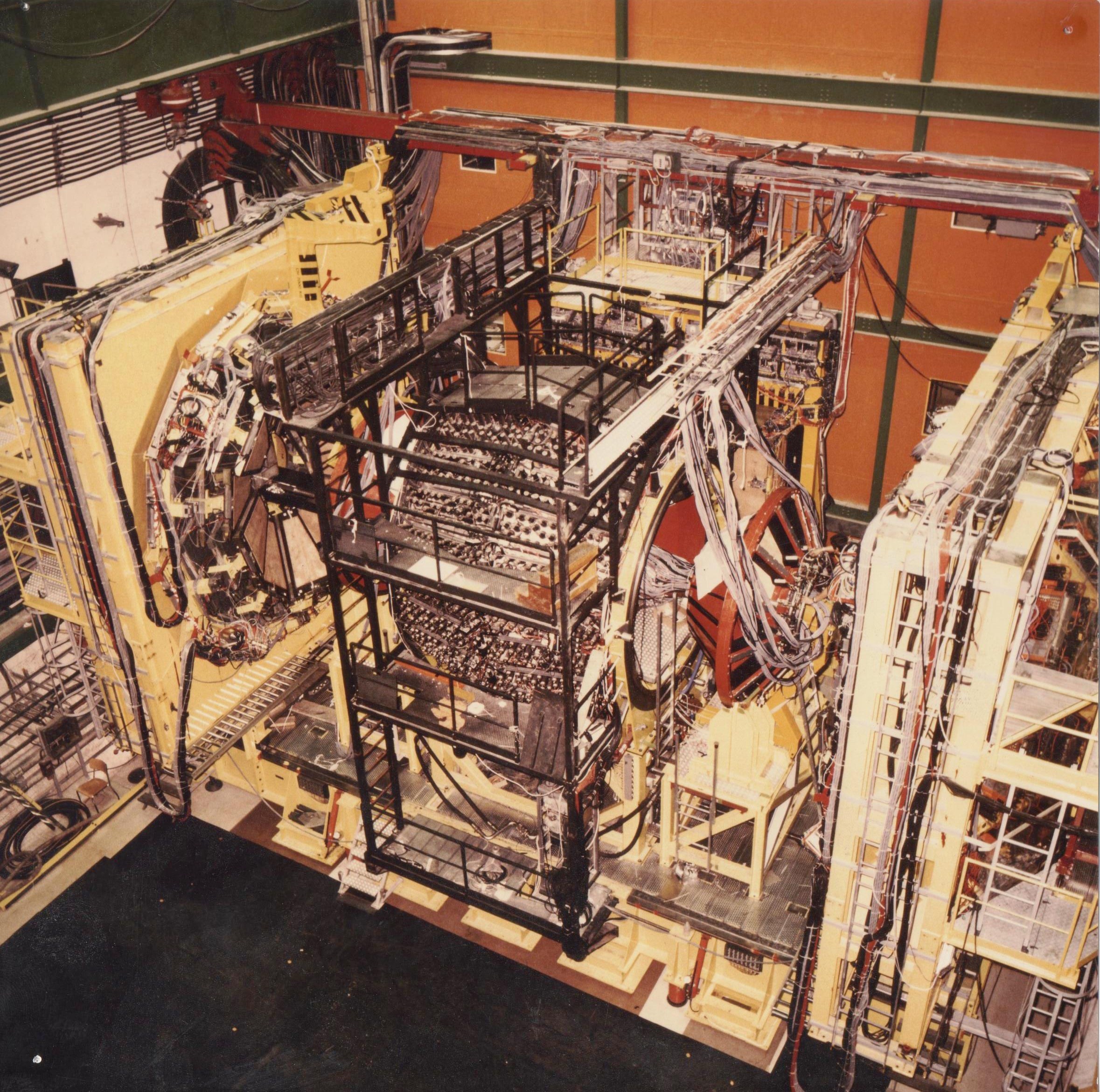
The UA2 experiment was located some 50 meters underground, in the ring of the SPS/SpS accelerator, and was housed in a big cavern. The cavern was large enough to house the detector, provide room for it to be assembled in a "garage position" without shutting down the accelerator and to where it was also moved back after periods of data taking. The accelerator could therefore revert to fixed-target operation, after periods of operating as a collider.
Detectors
The UA1 and the UA2 experiments had many things in common; they were both operating on the same accelerator and both had the same objective (to discover the W and Z bosons). The main difference was the detector design; UA1 was a multipurpose detector, while UA2 had a more limited scope. Energy measurements were performed in the calorimeters. Unlike UA1, UA2 had no muon detector.

The calorimeter had 24 slices, each weighing 4 tons. These slices were arranged around the collision point like segments of an orange. Particles ejected from the collision produced showers of secondary particles in the layers of heavy material. These showers passed through layers of plastic scintillators, generating light which was read with photomultiplier by the data collection electronics. The amount of light was proportional to the energy of the original particle. Accurate calibration of the central calorimeter allowed the W and Z masses to be measured with a precision of about 1%.{{cite web |url= http://cern-discoveries.web.cern.ch/cern-discoveries/Story/UA2.html|title=The UA2 detector |date=2003
Upgrades of the detector
The 1985-1987 upgrade of the detector was aimed at two aspects: full calorimeter coverage and better electron identification at lower transverse momenta. The first aspect was addressed by replacing the end-caps with new calorimeters that covered the regions 6°-40° with respect to the beam direction, thereby hermetically sealing the detector. The end-cap calorimeters consisted of lead/scintillator samplings for the electromagnetic part, and iron/scintillator for the hadronic part. The performance and granularity of the new calorimeters were set to match the central calorimeter, which was of importance for the triggering system.
The electron identification was improved by the use of a completely new central tracking detector assembly, partly consisting of a pioneering silicone-pad detector. In 1989, the collaboration pushed this concept even further by developing a Silicon Pad Detector (SPD) with finer pad segmentation to be placed directly around the collision region beam pipe. This detector was built as a cylinder, closely surrounding the beam pipe. The detector had to fit into the available space of less than 1 cm. It was therefore necessary to miniaturize the components of the detector. This was achieved with two brand new technologies: the silicon sensor and the application-specific integrated circuit (ASIC). Existing electronics were too bulky, and therefore a novel ASIC had to be developed. This was the first silicon tracker adapted to a collider experiment, a technology prior to the present silicon detectors.
Results

Hadronic jets at high transverse momentum
The very first result of the UA2 collaboration, published on 2 December 1982, was the first unambiguous observation of hadronic jet production at high transverse momentum from hadronic collisions. Observations of hadronic jets confirmed that the theory of quantum chromodynamics could describe the gross features of the strong parton interaction.
Discovery of the W and Z bosons
The UA2 and UA1 collaboration chose to search for the W boson by identifying its leptonic decay, because the hadronic decays, although more frequent, have a larger background.
The next step was to track down the Z boson. However, the theory said that the Z boson would be ten times rarer than the W boson. The experiments therefore needed to collect several times the data collected in the 1982 run that showed the existence of the W boson. With improved techniques and methods, the luminosity was increased substantially. These efforts were successful, and on 1 June 1983, the formal announcement of the discovery of the Z boson was made at CERN.
Search for the top quark
Throughout the runs with the upgraded detector, the UA2 collaboration was in competition with experiments at Fermilab in the US in the search for the top quark. Physicists had anticipated its existence since 1977, when its partner — the bottom quark — was discovered. It was felt that the discovery of the top quark was imminent.
During the 1987-1990 run UA2 collected 2065 W \rightarrow e \nu decays, and 251 Z decays to electron pairs, from which the ratio of the mass of the W boson and the mass of the Z boson could be measured with a precision of 0.5%.
References
References
- "UA2". CERN.
- . (15 October 1979). ["The Nobel Prize in Physics 1979"](http://www.nobelprize.org/nobel_prizes/physics/laureates/1979/).
- (2015). "60 Years of CERN Experiments and Discoveries". World Scientific.
- (8 June 1976). "Producing Massive Neutral Intermediate Vector Bosons with Existing Accelerators".
- (1996). "History of CERN. Volume III". North-Holland.
- (31 January 1978). "Proposal to Study Antiproton-Proton Interactions at 540 GeV CM Energy". SPS Committee.
- (1994). "The physics results of the UA2 experiment at the CERN p{{overline". [[International Journal of Modern Physics A]].
- [[Peter Jenni]] on behalf of the UA2 Collaboration. (17 July 1982). "Status and First Results from the UA2 Experiment".
- . (3 August 2015). ["Family reunion for the UA2 calorimeter"](https://cds.cern.ch/journal/CERNBulletin/2015/32/News%20Articles/2038517?ln=en). *CERN*.
- (1989). "Proton-Antiproton Collider Physics". World Scientific Publishing.
- (2017). "Technology Meets Research: 60 years of CERN Technology - Selected Highlights". World Scientific.
- (2 December 1982). "Observation of very large transverse momentum jets at the CERN ppbar collider". Phys. Lett. B.
- O'Luanaigh, Cian. (12 March 2015). "Carrying the Weak Force: Thirty Years of the W boson". CERN.
- (1983). "The experiments". CERN Courier, CERN Discoveries.
- "Thirty years of the Z boson {{!}} CERN".
- S. Abachi. (1995). "Search for High Mass Top Quark Production in {{SubatomicParticle". [[Physical Review Letters]].
This article was imported from Wikipedia and is available under the Creative Commons Attribution-ShareAlike 4.0 License. Content has been adapted to SurfDoc format. Original contributors can be found on the article history page.
Ask Mako anything about UA2 experiment — get instant answers, deeper analysis, and related topics.
Research with MakoFree with your Surf account
Create a free account to save articles, ask Mako questions, and organize your research.
Sign up freeThis content may have been generated or modified by AI. CloudSurf Software LLC is not responsible for the accuracy, completeness, or reliability of AI-generated content. Always verify important information from primary sources.
Report