From Surf Wiki (app.surf) — the open knowledge base
U.S. Route 12 in Idaho
Section of U.S. Highway in Idaho, United States

Section of U.S. Highway in Idaho, United States
| Field | Value | |||
|---|---|---|---|---|
| state | ID | |||
| type | US | |||
| route | 12 | |||
| alternate_name | Lewis and Clark Highway | |||
| Northwest Passage Scenic Byway | ||||
| map | ||||
| map_custom | yes | |||
| map_notes | US 12 highlighted in red | |||
| length_mi | 174.410 | |||
| length_ref | ||||
| tourist | [[File:MUTCD D6-4.svg | 20px | alt= | link=]] Northwest Passage Scenic Byway |
| established | 1962 | |||
| direction_a | West | |||
| terminus_a | at Washington state line in Lewiston | |||
| junction | in Lewiston | |||
| direction_b | East | |||
| terminus_b | at Montana state line at Lolo Pass | |||
| counties | Nez Perce, Clearwater, Lewis, Idaho | |||
| previous_type | ID | |||
| previous_route | 11 | |||
| next_type | ID | |||
| next_route | 13 |
Northwest Passage Scenic Byway U.S. Route 12 (US-12) is a United States Numbered Highway in North Central Idaho. It extends 174.410 mi from the Washington state line in Lewiston east to the Montana state line at Lolo Pass, generally along the route of the Lewis and Clark Expedition, and is known as the Northwest Passage Scenic Byway. It was previously known as the Lewis and Clark Highway.
Route description
US-12 enters Idaho at the Washington state line in Lewiston, Nez Perce County, crossing the Snake River at the state line. It heads east through Lewiston, turning north to cross the Clearwater River on the Clearwater Memorial Bridge. It then intersects State Highway 128 (SH-128) and turns east to overlap US-95 along a limited-access section with two lanes traveling each direction. The overlapped highways run east along the north bank of the Clearwater River for 7.3 mi, leaving Lewiston and entering the Nez Perce Indian Reservation before separating.
US-12 then continues east along the north bank of the Clearwater River through northern Lapwai, past the Ant and Yellowjacket rock formation and a historical marker for the Spalding Mission. It intersects SH-3 near Arrow and crosses the Clearwater River again.
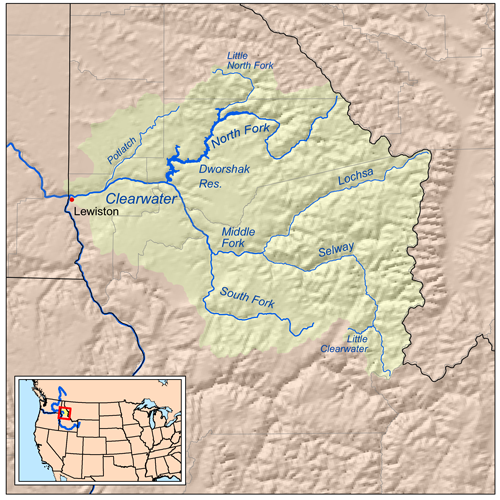
US-12 then continues east along the south bank of the Clearwater River past historical markers commemorating Indian houses and the ghost town of Slaterville, and, in a rest area at Lenore, a historical marker for the Lenore Tram.
Entering Clearwater County, US-12 continues east along the south bank of the Clearwater River through Orofino. Just after leaving Orofino, it briefly overlaps SH-7, then continues southeast along the south bank of the Clearwater River, past a historical marker for the point where Lewis and Clark first found a western-flowing river.
In Lewis County, US-12 continues southeast along the south bank of the Clearwater River, intersecting SH-11 at Greer and passing a historical marker for a ferry operated in the original 1860 goldrush. It then continues southeast into Kamiah, where it intersects SH-162. It then crosses the Clearwater River again and leaves Kamiah.
It then enters Idaho County and continues south along the north bank of the Clearwater River, crossing the Nez Perce National Historical Park. In the park, it passes a historical marker for two sites located about 2 mi away, commemorating the Lewis and Clark Long Camp of 1806 and the Asa Smith mission of 1839 to 1841. It then continues south along the north bank of the Clearwater River, intersecting SH-13 across the river from Kooskia. The highway then turns east along the north bank of the Clearwater River, passing a historical marker commemorating the camp of Nez Perce led by Looking Glass, and the 1877 attack by the U.S. Army on July 1 that provoked Looking Glass to join the Nez Perce retreat with Chief Joseph. It continues east along the north bank of the Clearwater River, leaving the Nez Perce reservation. US-12 then continues to Lowell, where it turns northeast along the north bank of the Lochsa River through the Bitterroot Mountains.
US-12 passes historical markers for Whitehouse Pond, Lewis and Clark's crossing of the Lolo Trail in 1806, and their crossing of the Lolo Pass summit in 1805, before crossing Lolo Pass at 5233 ft to enter Montana. From there it descends past Lolo Hot Springs to Lolo, the junction with US-93, near the site of Lewis and Clark's Traveler's Rest.
History

US-12 was created in 1925 as part of the original system of U.S. Highways, and its original western terminus was in Miles City, Montana. In 1962, the highway was extended west to Lewiston, ending at the former US-410. In 1967, it was extended to its current western terminus in Aberdeen, Washington, with the Idaho section taking its current route.
The Lewis and Clark Highway, from Lewiston eastward to Lolo Pass, was designated SH-9 in 1916 and construction began in 1920. Federal prison labor was used in the late 1930s to early 1940s, and Japanese internment labor was used during the last two years of World War II, working out of the Kooskia Internment Camp, 6 mi upstream of Lowell, just below milepost 104.
By late 1955, 27 mi remained unfinished, and, upon its completion in 1962, it was redesignated US 12. At the dedication ceremony at Lolo Pass attended by thousands on August 19, the states' governors, Robert E. Smylie of Idaho and Tim Babcock of Montana, cut through a ceremonial western redcedar log at Packers Meadow with a two-man crosscut saw.
The bridge crossing the Clearwater River near Arrow opened for traffic in early 1973. it was dismantled shortly after the Arrow bridge opened.
The current SH-9 is entirely in Latah County and runs for less than 14 mi; it starts near Deary at SH-8 and runs northwest, connecting with SH-6 near Harvard.
Equipment shipments
US-12 through Idaho has been proposed as a route for shipment of huge equipment from Lewiston, an inland port, to oil sands facilities near Fort McMurray, Alberta and to a refinery in Billings, Montana. On two-lane portions of the road, the equipment, weighing as much as 300 ST and as much as 30 ft high and 24 ft wide, would occupy the entire roadway. The route is preferable to other routes due to the lack of underpasses and the great distances involved. The alternative is transport across the Great Plains from Texas or New Orleans. On US-12, the major obstacles were powerlines, which had to be raised or buried. That and other alterations to the highway such as turnouts would be paid for by the companies. The trucks would transport only at night, moving short distances between places where they would pull off and let traffic pass. A permit granted by the Idaho Transportation Department to ConocoPhillips in August 2010 is the subject of litigation initiated by householders along the route. On January 19, 2011, it was announced that the Idaho government would issue permits for four loads of refinery equipment to be transported from Lewiston to Billings.
The Port of Lewiston is the furthest inland seaport in the Western U.S. It ships wheat, barley, and legumes to Asia and the South Pacific as well as the Middle East and Africa. There are also inland seaports in Washington at the port of Clarkston and Port of Wilma in Whitman County.
Major intersections
Continuation into Washington
References
References
- Idaho Transportation Department. "Milepost Log, US 12".
- "Northwest Passage Scenic Byway".
- "US-12: Clearwater Memorial Bridge".
- National Park Service. (November 12, 1999). "Ant and Yellowjacket".
- Idaho Transportation Department. (May 26, 2005). "Idaho Highway Historical Marker Guide Index".
- National Park Service. (November 20, 1999). "Spalding Site".
- (September 23, 1972). "Traffic may be moving across new Arrow bridge by November". Lewiston Morning Tribune.
- (November 20, 1972). "New route". Lewiston Morning Tribune.
- (February 21, 1973). "Bridge opens". Spokane Daily Chronicle.
- (February 21, 1973). "New bridge will open today". Lewiston Morning Tribune.
- Harrell, Sylvia. (February 22, 1973). "First cars move across highway bridge at Arrow". Lewiston Morning Tribune.
- North Central Idaho Travel Association. (August 2012). "Asa Smith Mission and Lewis and Clark Long Camp".
- Federal Highway Administration. (May 7, 2005). "U.S. 12: Michigan to Washington".
- (September 24, 1950). "Lewis & Clark Highway link-up is urged for national defense". Lewiston Morning Tribune.
- Forbes, Bob. (November 29, 1953). "Hiking the Wash-ho-tana in Lochsa wilds". The Spokesman-Review.
- (December 6, 1942). "Highway project may be stopped". Lewiston Morning Tribune.
- Wegars, Priscilla. "Asian American Comparative Collection: The Kooskia Internment Camp Project". University of Idaho.
- "Kooskia Internment Camp Scrapbook". University of Idaho.
- Geranios, Nicholas K.. (July 27, 2013). "Researchers uncover little-known internment camp". Yahoo! News.
- Banse, Tom. (August 5, 2010). "Archaeologists Resurrect Nearly Forgotten WWII Internment Camp". Oregon Public Broadcasting.
- Johnson, Johnny. (October 6, 1955). "L-C Highway has entrancing history". Lewiston Morning Tribune.
- (December 21, 1956). "Completion of Lewis-Clark road in 1959 instead of '60 is CC aim". Lewiston Morning Tribune.
- (August 19, 1962). "Leaders arrive for L-C Highway dedication". Lewiston Morning Tribune.
- (August 20, 1962). "Thousands witness L-C Highway dedication". Lewiston Morning Tribune.
- (June 26, 1962). "Highway 12 label approved by Idaho highway board". Lewiston Morning Tribune.
- (August 20, 1962). "Dedication festivity opens Idaho-Montana road link". The Spokesman-Review.
- Wakeley, Daniel A.. (August 20, 1962). "New route opens rugged land". Spokane Daily Chronicle.
- (February 5, 1963). "Idaho bridge shifts". Spokane Daily Chronicle.
- Watkins, Clint G.. (March 12, 1973). "Idaho bridge comes down". Spokane Daily Chronicle.
- Lyons, Shirley. (March 23, 1973). "Poof and it comes down". Spokane Daily Chronicle.
- [http://www.portoflewiston.com/SColumbia.html "Columbia-Snake Corridor: The West Coast Alternative"] {{Webarchive. link. (October 14, 2010 website Port of Lewiston, accessed October 22, 2010)
- On the Great Plains, there are also inland ports on the [[Mississippi River]] and its tributaries as far north as [[Sioux City, Iowa]], on the Missouri River.
- Tom Zeller, Jr.. (October 21, 2010). "Oil Sands Effort Turns on a Fight Over a Road". [[The New York Times]].
- (January 19, 2011). "Idaho: Giant Trucks Win Permit". The New York Times.
This article was imported from Wikipedia and is available under the Creative Commons Attribution-ShareAlike 4.0 License. Content has been adapted to SurfDoc format. Original contributors can be found on the article history page.
Ask Mako anything about U.S. Route 12 in Idaho — get instant answers, deeper analysis, and related topics.
Research with MakoFree with your Surf account
Create a free account to save articles, ask Mako questions, and organize your research.
Sign up freeThis content may have been generated or modified by AI. CloudSurf Software LLC is not responsible for the accuracy, completeness, or reliability of AI-generated content. Always verify important information from primary sources.
Report