From Surf Wiki (app.surf) — the open knowledge base
Tyne Bridge
Bridge in north east England
Bridge in north east England
| Field | Value |
|---|---|
| image | Tyne Bridge.jpg |
| name | Tyne Bridge |
| caption | Tyne Bridge looking towards The Glasshouse, Gateshead with the since-scrapped Tuxedo Princess moored below. The banner is advertising the 2006 Great North Run |
| coordinates | |
| os_grid_reference | NZ253637 |
| other_name | New Tyne Bridge |
| locale | Tyneside |
| carries | |
| crosses | River Tyne |
| owner | |
| maint | NewcastleGateshead Bridges Joint Committee |
| preceded | Swing Bridge |
| followed | Gateshead Millennium Bridge |
| begin | August 1925 |
| complete | 25 February 1928 |
| open | |
| inaugurated | 10 October 1928 by King George V |
| below | 26 m |
| traffic | approx. 70,000 vehicles |
| design | Through arch bridge |
| material | Steel |
| material2 | Cornish granite |
| mainspan | 161.8 m |
| lanes | 4 |
| designer | Mott, Hay and Anderson |
| builder | Dorman Long and Co. |
| length | 389 m |
| width | 17 m |
| mapframe-length_km | 0.4 |
| extra | {{Infobox designation list |
| embed | yes |
| designation1 | NHLE |
| designation1_type | Grade II* listed building |
| designation1_date | 13 January 1983 |
| designation1_number | 1248569}} |
| mapframe-length_km = 0.4
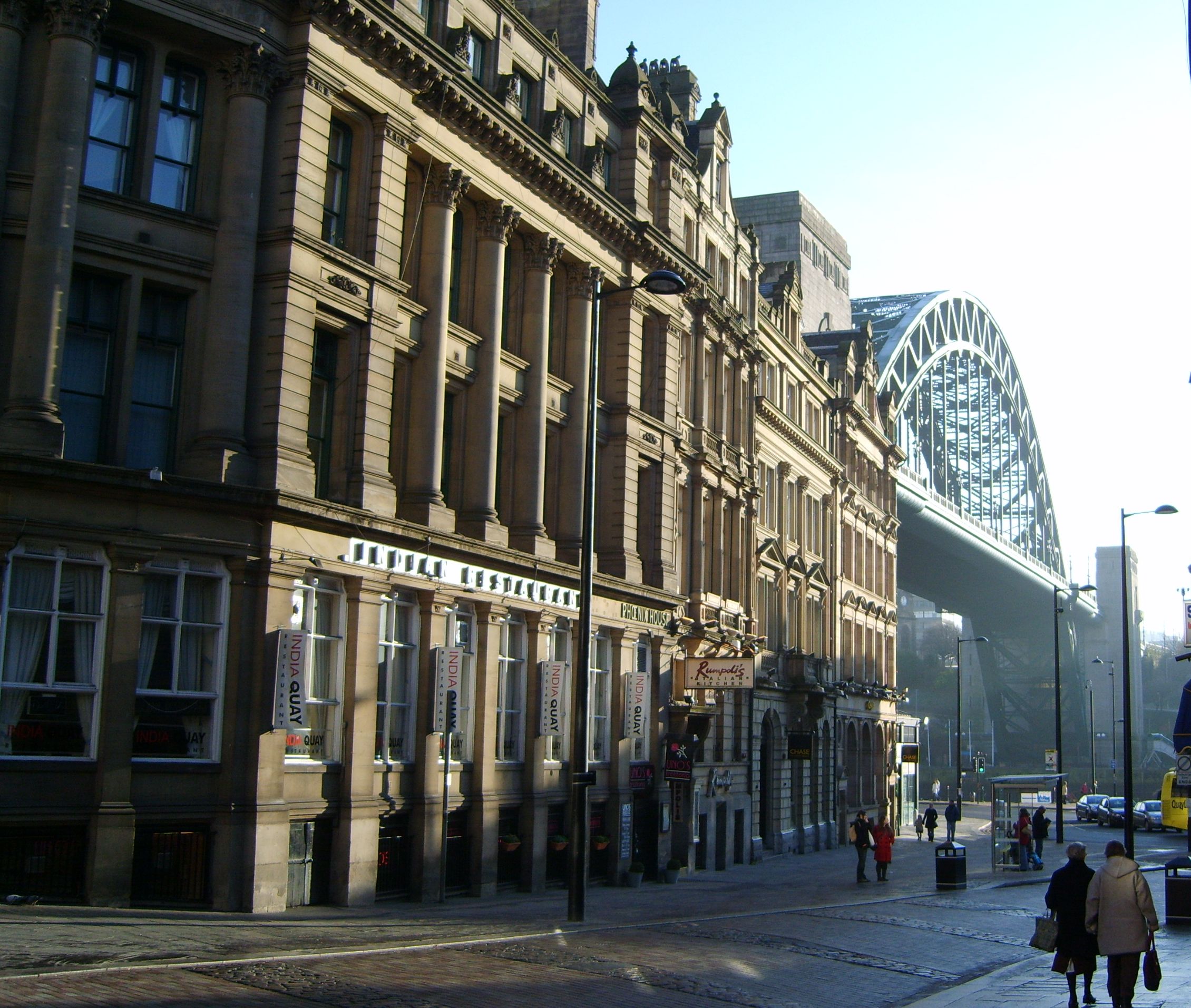
The Tyne Bridge is a through arch bridge over the River Tyne in North East England, linking Newcastle upon Tyne and Gateshead. The bridge was designed by the engineering firm Mott, Hay and Anderson, who later designed the Forth Road Bridge, and was built by Dorman Long and Co. of Middlesbrough. The bridge was officially opened on 10 October 1928 by King George V and has since become a defining symbol of Tyneside. It is ranked as the tenth tallest structure in Newcastle.
History of construction
The earliest bridge across the Tyne, Pons Aelius, was built by the Romans on the site of the present Swing Bridge around 122.
A series of wooden bridges were lost to fire or flood, and plans for a stone bridge were begun in about 1250 with support from local landowners, and the Bishops of Durham, York and Caithness. The stone bridge was constructed but then damaged by flood in 1339. Repairs proved costly and took place in sections: it was not fully repaired, as a part stone and part wooden bridge, until the 16th century and was part destroyed by a great flood in November 1771.
Tyne Bridge Act 1772 Following this, a new stone bridge was begun after the city council petitioned Parliament. The foundation stone on the north side was laid by Sir Matthew White Ridley on 25 April 1775, with the south side foundation stone laid in 1776. Works were completed by 13 September 1779, at an estimated cost of between £30,000 and £60,000.
Work on a modern bridge started in August 1925, with Dorman Long acting as the building contractors. Despite the dangers of the building work, only one worker, Nathaniel Collins, a father of four and a local scaffolder from South Shields, died in the building of this structure.
The Tyne Bridge was designed by Mott, Hay and Anderson, comparable to their Sydney Harbour Bridge version.

The bridge was completed on 25 February 1928, and officially opened on 10 October that year by King George V and Queen Mary, who were the first to use the roadway, travelling in their Ascot Landau. The opening ceremony was attended by 20,000 schoolchildren who had been given the day off. Movietone News recorded the speech given by the King.
The Tyne Bridge's towers were built of Cornish granite and were designed by local architect Robert Burns Dick as warehouses with five storeys. Although a lift shaft was also included in the South tower no lift was ever installed.
The bridge's design uses a parabolic arch.
The bridge was originally painted green with special paint made by J. Dampney, Tonbridge, Tingate Co. of Gateshead. The same colours were used to paint the bridge in 2000.
Technical information
| Total number of rivets | url = https://books.google.com/books?id=C-WGCgAAQBAJ&pg=PA1928 | title = Gateshead from Old Photographs | date = 15 September 2015 | publisher = Amberley Publishing | isbn = 9781445646817 | access-date = 14 Nov 2018 }} |
|---|
History
In 2012, the largest Olympic rings in the UK were erected on the bridge. The rings were manufactured by commercial signage specialists Signmaster ED Ltd of Kelso. The rings were over 25 by and weighed in excess of four tonnes. This was in preparation for Newcastle hosting the Olympic football tournament, and the Olympic torch relay, in which Bear Grylls zipwired from the top of the arch, to Gateshead quayside.
| access-date =}}}}
On 28 June 2012, a large lightning bolt struck the Tyne Bridge. It lit up the roads as the sky was very dark. The bolt, part of a super-cell thunderstorm, came with heavy rain – a month's worth of rainfall in just two hours – causing flash flooding on Tyneside.
In 2015, Newcastle upon Tyne was a host city for the Rugby World Cup. Three matches were played at St James's Park, the home of Newcastle United Football Club. In recognition, a large illuminated sign was erected on Tyne Bridge. Similarly, the bridge was depicted in an official BBC trailer for the 2021 Rugby League World Cup (in reference to Newcastle being one of the host cities).
On 13 November 2017, the Tyne Bridge was the venue for the Freedom on the Tyne finale, the finale of the 2017 Freedom City festival. The festival commemorated Newcastle's civil rights history and the 50 years since Dr Martin Luther King's visit to Newcastle, where King received his honorary degree from Newcastle University.
Newcastle University and Freedom City 2017 wanted to use the Tyne Bridge to symbolically hark back in history to Edmund Pettus Bridge in Selma, Alabama where King was involved in one of the key moments for the struggle for civil rights in 1965. 24 roads around the Tyne Bridge were closed for the day long event. The Freedom of the Tyne event featured the many civil right stories from history. The final event, revolved around the Jarrow Crusade which was described as a memorable closing to the finale.
File:Tyne Bridge - Newcastle Upon Tyne - England - 2004-08-14.jpg|The Tyne Bridge, in green, seen from the Gateshead Millennium Bridge File:Tyne Bridge Olympics.jpg|The Olympic rings on the bridge File:PZarobkiewiczTyneNewcastle 01.jpg|A night view of the Tyne Bridge taken from the northern embankment, looking west
Maintenance
The bridge had a major refurbishment in 2001.
In June 2022, the Department for Transport and the local government funded the cycled refurbishment of the bridge. The costs increased from £12 million to £32 million during the negotiation period. On 11 September 2023, work began, and estimations calculated the work would take four years. The agreement involved a full repaint of the rusted steelwork. The local governments from Newcastle and Gateshead also contracted work for critical structural repairs, including steel and concrete fixes, bridge joint replacements, drainage improvements, waterproofing and resurfacing, and parapet protection. Work on the main bridge deck started in April 2024, with completion expected in time for the bridge's centenary in 2028.
Grade II* listed by Historic England
On 23 August 2018, the bridge was Grade II* listed by Historic England. The rating means the bridge is a particular important structure of more than special interest. The bridge was upgraded by the Department for Digital, Culture, Media and Sport on the advice of Historic England.
The bridge was upgraded to Grade II* for architectural and historical interest, as outlined here:
Architectural interest:
A striking steel arch design, at its construction, notable as the largest single-span steel arch bridge on the British Isles; It is a similar prototype design as to that prepared for Sydney Harbour, Australia; the main arch was designed by the eminent civil engineer (Sir) Ralph Freeman; the prototype of a method of construction involving progressive cantilevering, using cables, cradles and cranes, which was also developed for Sydney Harbour, but first tested in Newcastle; its neoclassical and Art Deco towers that are well-detailed and defined; a potent symbol of the character and industrial pride of Tyneside; recognised worldwide for its dramatic design.}}
Historic interest:
it is associated with some of the most distinguished 20th-century civil engineers. One of its engineers being Sir Ralph Freeman, the architect of some of the most impressive bridges in the world. Freeman was a founder of Freeman Fox & Partners, renowned bridge designers worldwide.}}
Kittiwake colony
The bridge and nearby structures are used as a nesting site by a colony of around 700 pairs of black-legged kittiwakes, the furthest inland in the world. The colony featured in the BBC's Springwatch programme in 2010. Several groups, including the Natural History Society of Northumbria and local Wildlife Trusts, formed a "Tyne Kittiwake Partnership" to safeguard the colony. A proposal for a tower to be built as an alternative nesting site was made in 2011, and in November 2015 a neighbouring hotel submitted a planning application for measures to discourage the birds.
References
References
- Elwall, Robert. "Tyne Bridge". British Architectural Library.
- "Dorman Long Historical Information".
- "Pons Aelius - 'The Aelian Bridge'". roman-britain.co.uk.
- "Public buildings: The Tyne Bridge | British History Online".
- (1827). "Public buildings: The Tyne Bridge". Mackenzie and Dent.
- (1771-11-23). "Newcastle". Newcastle Courant.
- Butcher, Joanne. (1 March 2013). "85 years of the Tyne Bridge". [[Trinity Mirror]].
- Chapman, Tegan. (10 October 2018). "Female engineers gather to celebrate the Tyne Bridge turning 90". [[Institution of Civil Engineers]].
- Butcher, Joanne. (26 February 2013). "Bridge spans the generations". [[Trinity Mirror]].
- "Tyne Bridge (Also known as New Tyne Bridge), non Civil Parish - 1248569 | Historic England".
- (24 September 2014). "Tyne Bridge".
- Butcher, Joanne. (1 March 2013). "85 years of the Tyne Bridge: Crossing of the great divide". [[Trinity Mirror]].
- "Tyne Bridge - Technical Information". International Database for Civil and Structural Engineering.
- (15 September 2015). "Gateshead from Old Photographs". Amberley Publishing.
- (13 June 2012). "Olympic rings launched on Tyne Bridge". [[BBC]].
- Hough, Andrew. (29 June 2012). "Weather: record 110,000 lightning bolts strike during 'superstorms'". [[Daily Telegraph]].
- (2015). "Host Cities: Newcastle". Rugby World Cup.
- (2015). "St James' Park". Rugby World Cup.
- Davies, Katie. (18 February 2015). "Rugby World Cup 2015: Tyne Bridge sign to be replaced with Great North Run advert". [[Trinity Mirror]].
- (9 October 2022). "Rugby League World Cup 2022 Trailer BBC Trailers". [[BBC]].
- Whetstone, David. (4 October 2017). "Newcastle's iconic Tyne Bridge is to host the spectacular Freedom on the Tyne finale". [[Trinity Mirror]].
- Whetstone, David. (13 November 2017). "Statue of Dr Martin Luther King has been unveiled in Newcastle by his great friend". [[Trinity Mirror]].
- (3 June 2022). "Tyne Bridge gets government cash for repainting and repairs".
- Holland, Daniel. (12 September 2023). "Tyne Bridge restoration starts as scaffolding erected". The Chronicle.
- (27 February 2024). "Esh gets start date for Tyne Bridge restoration". The Construction Index.
- (23 August 2018). "Tyne Bridge upgraded to Grade II* by Historic England". [[BBC]].
- Henderson, Tony. (23 August 2018). "We all know the Tyne Bridge symbolises greatness - but there's now proof". [[Trinity Mirror]].
- {{NHLE
- (23 August 2018). "Tyne Bridge listed status upgraded during Great Exhibition Of The North to celebrate its importance". [[Newcastle City Council]].
- (27 April 2020). "Newcastle-Gateshead kittiwakes arrive back on Tyneside". BBC News.
- (19 May 2010). "Tynesiders". [[BBC]].
- (2016). "Tyne Kittiwakes Partnership". Natural History Society of Northumbria.
- Wainwright, Martin. (17 May 2011). "Newcastle in a flap over urban kittiwake colony". [[The Guardian]].
- (9 November 2015). "Installation of bird netting, angled sill plates and avishock system to tower – Tyne Bridge Tower Lombard Street Newcastle upon Tyne".
This article was imported from Wikipedia and is available under the Creative Commons Attribution-ShareAlike 4.0 License. Content has been adapted to SurfDoc format. Original contributors can be found on the article history page.
Ask Mako anything about Tyne Bridge — get instant answers, deeper analysis, and related topics.
Research with MakoFree with your Surf account
Create a free account to save articles, ask Mako questions, and organize your research.
Sign up freeThis content may have been generated or modified by AI. CloudSurf Software LLC is not responsible for the accuracy, completeness, or reliability of AI-generated content. Always verify important information from primary sources.
Report