From Surf Wiki (app.surf) — the open knowledge base
Twentieth Dynasty of Egypt
Period from 1189 to 1077 BCE
Period from 1189 to 1077 BCE
| Field | Value |
|---|---|
| conventional_long_name | Twentieth Dynasty of Egypt |
| era | New Kingdom of Egypt |
| government_type | Absolute monarchy |
| image_map | Ramesses9.jpg |
| image_map_caption | Portrait of Ramesses IX from his tomb KV6. |
| year_start | 1189 BC |
| year_end | 1077 BC |
| p1 | Nineteenth Dynasty of Egypt |
| s1 | Twenty-first Dynasty of Egypt |
| capital | Pi-Ramesses |
| common_languages | Egyptian language |
| religion | Ancient Egyptian Religion |
History
After the death of the last pharaoh of the 19th Dynasty, Queen Twosret, Egypt entered into a period of civil war. Because of lost historical records, the cause of the civil war is unknown. The war was ended with the accession to the throne by Setnakhte, who founded the 20th Dynasty of Egypt.
From the reign of Setnakhte and his son Ramesses III, Egypt faced the crisis caused by the invading of the Sea Peoples. These invasions formed part of a series of linked crises in numerous Mediterranean civilizations. Together, these crises are often referred to as the Late Bronze Age collapse.
The Sea Peoples caused considerable damage to the people of Egypt, visible in the historical record. One inscription reads:
text="All at once the lands were removed and scattered in the fray. No land could resist their arms, from Hatti, Kode, Carchemish, Arzawa, and Alashiya on – being cut off at one time. A camp was set up in Amurru. They desolated its people and its land was like that which had never existed. They were coming forward toward Egypt, while the flame was prepared for them."
Not only Egypt was affected by the Sea People invasions. The empire of the Hittites, a long-standing rival to Egypt, collapsed, never to rise again. (In the inscription quoted above, the Hittites are called "Hatti".)
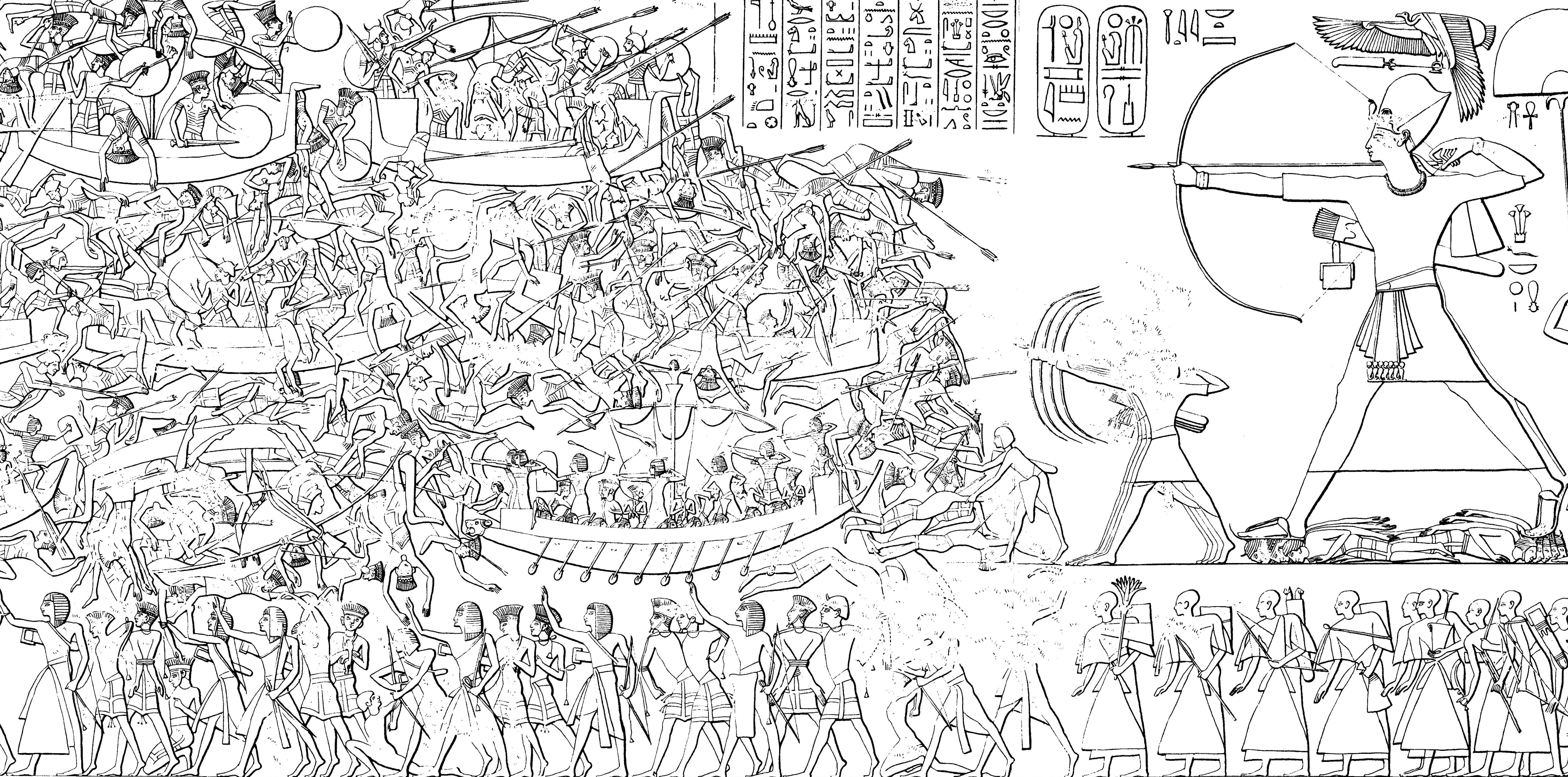
With the victory in the Battle of Djahy and the Battle of the Delta during Year 8 of Ramesses III's reign, Egypt successfully repelled the invading Sea Peoples, protecting Egypt from ruin like other Bronze Age civilizations. During the Twentieth Dynasty, many of the temples were built to display the power of Egypt. However, they also indicate the political ascendancy of the priesthood over the pharaoh.
The Twentieth Dynasty declined because of drastic climate change, infighting in the royal family, and growing power of the priesthood and nobility. Following the death of Ramesses XI, the last pharaoh of the Twentieth Dynasty, a period of chaos ensued. This was ended by Smendes, a member of the Egyptian nobility, who became the first Pharaoh of the 21st Dynasty.
Background
Main article: End of the 19th Dynasty
Upon the death of the last pharaoh of the 19th Dynasty, Queen Twosret, Egypt descended into a period of civil war, as attested by the Elephantine stela built by Setnakhte. The circumstances of Twosret's demise are uncertain, as she may have died peacefully during her reign or been overthrown by Setnakhte, who was likely already middle aged at the time.
20th Dynasty
A consistent theme of this dynasty was the loss of pharaonic power to the High Priests of Amun. Horemheb, a pharaoh of the 18th Dynasty, had restored the traditional Ancient Egyptian religion and the priesthood of Amun after their abandonment by Akhenaten. With the High Priests now acting as intermediaries between the gods and the people, rather than the pharaoh, the position of pharaoh no longer commanded the same kind of power as it had in the past.
Setnakhte
Main article: Setnakhte
Ramesses III
Ramesses III is most famous for decisively defeating a confederacy of the Sea Peoples, including the Denyen, Tjekker, Peleset, Shardana and Weshesh in the Battle of Djahy and the Battle of the Delta during Year 8 of his reign. Within the Papyrus Harris I, which attests these events in detail, Ramesses is said to have settled the defeated Sea Peoples in "strongholds", most likely located in Canaan, as his subjects.
In Year 11 of Ramesses' reign, another coalition of Libyan invaders was defeated in Egypt.
Between regnal Year 12 and Year 29, a systematic program of reorganization of the varied cults of the Ancient Egyptian religion was undertaken, by creating and funding new cults and restoring temples.
In Year 29 of Ramesses' reign, the first recorded labor strike in human history took place, after food rations for the favored and elite royal tomb builders and artisans in the village of Set Maat (now known as Deir el-Medina), could not be provisioned.
The reign of Ramesses III is also known for a harem conspiracy in which Queen Tiye, one of his lesser wives, was implicated in an assassination attempt against the king, with the goal of putting her son Pentawer on the throne. The coup was unsuccessful. The king died from the attempt on his life; however, it was his legitimate heir and son Ramesses IV who succeeded him to the throne, who thereafter arrested and put approximately 30 conspirators to death.
Ramesses IV
Main article: Ramesses IV
Ramesses IV saw issues with the provision of food rations to his workmen, similar to the situation under his father. Ramessesnakht, the High Priest of Amun at the time, began to accompany state officials as they went to pay the workmen their rations, suggesting that, at least in part, it was the Temple of Amun and not the Egyptian state that was responsible for their wages.
He also produced the Papyrus Harris I, the longest known papyrus from Ancient Egypt, measuring in at 41 meters long with 1,500 lines of text to celebrate the achievements of his father.
Ramesses V
Main article: Ramesses V
The Wilbour Papyrus is thought to date from Ramesses V's reign. The document reveals that most of the land in Egypt by that point was controlled by the Temple of Amun, and that the Temple had complete control over Egypt's finances.
Ramesses VI
Main article: Ramesses VI
Ramesses VII
Main article: Ramesses VII}}Ramesses VII's only monument is his tomb, [[KV1]].{{citation needed
Ramesses VIII
Main article: Ramesses VIII}}Almost nothing is known about Ramesses VIII's reign, which lasted for a single year. He is only attested at Medinet Habu and through a few plaques. The only monument from his reign is his modest tomb, which was used for [Mentuherkhepeshef (son of Ramesses IX), [Mentuherkhepeshef]], son of Ramesses IX, rather than Ramesses VIII himself.{{citation needed
Ramesses IX
Main article: Ramesses IX
Ramesses IX's cartouche has been found at Gezer in Canaan, suggesting that Egypt at this time still had some degree of influence in the region.
Most of the building projects during Ramesses IX's reign were at Heliopolis.
Ramesses X
Main article: Ramesses X
Ramesses XI
Main article: Ramesses XI
Decline
As happened under the earlier Nineteenth Dynasty, this dynasty struggled under the effects of the bickering between the heirs of Ramesses III. For instance, three different sons of Ramesses III are known to have assumed power as Ramesses IV, Ramesses VI and Ramesses VIII respectively. However, at this time Egypt was also increasingly beset by a series of droughts, below-normal flooding levels of the Nile, famine, civil unrest and official corruption – all of which would limit the managerial abilities of any king.
Sea Peoples in Egypt
Main article: Sea Peoples
The late 13th century BC was a time of uncertainty and conflict for peoples and polities of the Aegean and Eastern Mediterranean due to the invasion by Sea Peoples, which was a contributing factor in the Late Bronze Age collapse. While there is not much information left to show us why the Sea Peoples began the large scale invasion, the written evidence shows the weakening of central administrations, erosion of political powers, and food shortage might be the reasons.
From Ramses III's mortuary temple at Medinet Habou depicting a chaotic scene of boats and warriors entwined in battle in the Nile delta, it showing that Sea Peoples were seaborne foes from different origins. They launched a combined land-sea invasion that destabilized the already weakened power base of empires and kingdoms of the old world, and attempted to enter or control the Egyptian territory.
While with the victory in the Battle of Djahy and the Battle of the Delta during Year 8 of Ramesses III's reign, Egypt successfully repelled the invading forces of Sea Peoples, the damage that caused the collapse of the Eastern Mediterranean world also damaged the trade routes of Egypt, as most of their trading partners had been destroyed by Sea Peoples.
Pharaohs of the 20th Dynasty
Main article: List of pharaohs
| Pharaoh | Image | Prenomen (Throne Name) | Horus-name | Reign | Burial | Consort(s) | Comments | ||
|---|---|---|---|---|---|---|---|---|---|
| Setnakhte | [[File:Sethnakht_closeup_Lepsius.png | 103x103px]] | Userkhaure-setepenre | Kanakhtwerpehty | 1188 – 1185 BC | KV14 | Tiy-merenese | Usurped the throne from his predecessor, Tausret. | |
| Ramesses III | [[File:Ramesses III Hedjet (cropped).JPG | 133x133px]] | Usermaatre-Meryamun | Kanakhtaanesyt | 1185 – 1154 BC | KV11 | Iset Ta-Hemdjert | ||
| Tyti | |||||||||
| Tiye | |||||||||
| Ramesses IV | [[File:Rameses IV cropped.jpg | 135x135px]] | Usermaatre Setepenamun, later Heqamaatre Setepenamun | Kanakhtankhemmaat | 1154 – 1148 BC | KV2 | Duatentopet | ||
| Ramesses V / Amenhirkhepeshef I | [[File:Ramesses V cropped.jpg | 125x125px]] | Usermaatre Sekheperenre | Kanakhtmenmaat | 1148 – 1144 BC | KV9 | Henutwati | ||
| Tawerettenru | |||||||||
| Ramesses VI / Amenhirkhepeshef II | [[File:Luxor Museum Statue Ramses VI. 01 (Pschent) (crop2).jpg | frameless | 119x119px]] | Nebmaatre Meryamun | Kanakhtaanakhtu | 1144 – 1136 BC | KV9 | Nubkhesbed | |
| Ramesses VII / Itamun | [[File:Tomb_KV1_Ramesses_VII_Lepsius.jpg | frameless | 150x150px]] | Usermaatre Setepenre Meryamun | Kanakhtanemnesu | 1136 – 1129 BC | KV1 | ||
| Ramesses VIII / Sethhirkhepeshef | [[File:SFEC-MEDINETHABU-Sethiherkhepeshef_II.jpg | 129x129px]] | Usermaatre-Akhenamun | (unknown) | 1129 – 1128 BC | ||||
| Ramesses IX / Khaemwaset I | [[File:Ramses IX Karnak.jpg | frameless | 120x120px]] | Neferkare Setepenre | Kanakhtkhaemwaset | 1128 – 1110 BC | KV6 | Baketwernel | |
| Ramesses X / Amenhirkhepeshef III | [[File:RamsesXCrop.jpg | frameless | 100x100px]] | Khepermaatre Setepenre | Kanakhtsekhaenre | 1110 – 1106 BC | KV18 | ||
| Ramesses XI / Khaemwaset II | [[File:Temple_Khonsu_Ramesses_XI_Lepsius.jpg | 150x150px]] | Menmaatre Setpenptah | Kanakhtmeryre | 1106 – 1077 BC | KV4 | Tentamun |
Timeline
ImageSize = width:800 height:auto barincrement:12 PlotArea = top:10 bottom:30 right:130 left:20 AlignBars = justify
DateFormat = yyyy Period = from:-1190 till:-1065 TimeAxis = orientation:horizontal ScaleMajor = unit:year increment:10 start:-1186 ScaleMinor = unit:year increment:5 start:-1186
Colors = id:canvas value:rgb(0.97,0.97,0.97) id:PA value:green id:GP value:red id:eon value:rgb(1,0.7,1) # light purple
Backgroundcolors = canvas:canvas
BarData = barset:Rulers
PlotData= width:5 align:left fontsize:S shift:(5,-4) anchor:till barset:Rulers
from: -1188 till: -1185 color:PA text:"Setnakhte (1188 BC – 1185 BC)" from: -1185 till: -1154 color:PA text:"Ramesses III (1185 BC – 1154 BC)" from: -1154 till: -1148 color:PA text:"Ramesses IV (1154 BC – 1189 BC)" from: -1148 till: -1144 color:PA text:"Ramesses V (1148 BC – 1144 BC)" from: -1144 till: -1136 color:PA text:"Ramesses VI (1144 BC – 1136 BC)" from: -1136 till: -1129 color:PA text:"Ramesses VII (1136 BC – 1129 BC)" from: -1129 till: -1128 color:PA text:"Ramesses VIII (1129 BC – 1128 BC)" from: -1128 till: -1110 color:PA text:"Ramesses IX (1128 BC – 1110 BC)" from: -1110 till: -1106 color:PA text:"Ramesses X (1110 BC – 1106 BC)" from: -1106 till: -1076 color:PA text:"Ramesses XI (1106 BC – 1076 BC)"
barset:skip
Family tree
The Twentieth Dynasty of Egypt was the last of the New Kingdom of Egypt. The familial relationships are unclear, especially towards the end of the dynasty.
Gallery
File:Weihrauchopfer RamsesIII aus KV11.jpg|Ramesses III was the son of Sethnakht. During his reign, he fought off the invasions of the Sea Peoples in Egypt and tolerated their settlement in Canaan. A conspiracy was hatched to kill him, but it failed. He was later murdered. His mummy, long an inspiration for the scary Hollywood films, showed his throat was slit. File:RamessesIV-SmitingHisEnemiesOnAnOstracon MuseumOfFineArtsBoston.jpg|Ramesses IV was the fifth son of Ramesses III. He assumed the throne after his four older brothers had died. File:Ramesses V obelisk Bologna.JPG|Ramesses V was the son of Ramesses IV and Queen Duatentopet. During his reign Libyan raiders attacked the country and attempted to conquer Thebes, forcing the workers of Deir el-Medina to halt work in the Valley of the Kings. He died of smallpox. File:RamassesVIFragmentarySarcophagusHead-BritishMuseum-August19-08.jpg|Ramesses VI was an uncle of Ramesses V. He usurped his predecessor's throne and later his tomb, KV9. File:Satirical papyrus with the god Thoth and some baboons on the verso and religious text with the cartouches of Ramesses VII on the recto - Museo Egizio Turin C 2059 65 2059 64 p02 (Ramesses VII) (cropped).jpg|Ramesses VII was the son of Ramesses VI. During his reign, prices of grain soared to the highest levels. His mummy has never been found but cups bearing his name were found in the royal cache at Deir el-Bahri. He was buried in KV1. File:Ostracon of Prince Sethherkhepshef or the Future king Ramesses VIII.jpg|Ramesses VIII, born Sethherkhepeshef, was a brother of Ramesses VI and a surviving son of Ramesses III. He may have ruled for a year or two. His tomb has never been identified. File:Ramesses9.jpg|Ramesses IX was the grandson of Ramesses III, nephew of Ramesses IV and VI, and a son of Mentuherkhepeshef, who never became a pharaoh. File:Ramesse10ScarabBologna.png|Ramesses X, born Amunherkhepeshef, took the throne after Ramesses IX. He is a poorly documented king, with few monuments to his name. His tomb, KV18, was left unfinished. File:Temple Khonsu Ramesses XI Lepsius.jpg|Ramesses XI was the last pharaoh of the Twentieth Dynasty. As Egypt weakened, Ramesses XI was forced to share power in a triumvirate with Herihor, the high priest of Amun, and Smendes, governor of Lower Egypt. Ramesses XI was buried in Lower Egypt by Smendes, who later took the throne himself.
References
References
- (30 November 2021). "The Mystery of the Sea Peoples {{!}} Classical Wisdom Weekly".
- Hartwig Altenmüller, "The Tomb of Tausert and Setnakht," in Valley of the Kings, ed. Kent R. Weeks (New York: Friedman/Fairfax Publishers, 2001), pp.222-31
- Grandet, Pierre. (2014-10-30). "Early–mid 20th dynasty". UCLA Encyclopedia of Egyptology.
- "New Kingdom of Egypt". [[World History Encyclopedia]].
- Lorenz, Megaera. "The Papyrus Harris".
- William F. Edgerton, The Strikes in Ramses III's Twenty-Ninth Year, JNES 10, No. 3 (July 1951), pp. 137-145
- Dodson and Hilton, pg 184
- Grandet, Pierre. (2014-10-30). "Early–mid 20th dynasty". UCLA Encyclopedia of Egyptology.
- Jacobus Van Dijk, 'The Amarna Period and the later New Kingdom' in The Oxford History of Ancient Egypt, ed. Ian Shaw, Oxford University Press paperback, (2002), pp.306-307
- A.J. Peden, The Reign of Ramesses IV, (Aris & Phillips Ltd: 1994), p.21 Peden's source on these recorded disturbances is KRI, VI, 340-343
- [[Alan H. Gardiner]], R. O. Faulkner: ''The Wilbour Papyrus.'' 4 Bände, Oxford University Press, Oxford 1941-52.
- Une enquête judiciaire à Thèbes au temps de la XXe dynastie : ...Maspero, G. (Gaston), 1846-1916.
- Finkelstein, Israel. (January 2007). "Is the Philistine Paradigm Still Viable?".
- Nicolas Grimal, A History of Ancient Egypt, Blackwell Books, 1992. p.289
- E.F. Wente & C.C. Van Siclen, "A Chronology of the New Kingdom" in ''Studies in Honor of George R. Hughes'', (SAOC 39) 1976, p.261
- Dodson and Hilton, pg 185-186
- (8 June 2011). "The Sea Peoples, from Cuneiform Tablets to Carbon Dating". PLOS ONE.
- Ward WA, Sharp Joukowsky M.. "The Crisis years: the 12th century BC: from beyond the Danube to the Tigris.".
- Kaniewski D.. (2010). "Late Second-Early First Millennium BC abrupt climate changes in coastal Syria and their possible significance for the history of the Eastern Mediterranean.". Quaternary Research.
- Roberts RG.. "Identity, choice, and the Year 8 reliefs of Ramesses III at Medinet Habou.".
- [http://www.thebanmappingproject.com/sites/ Sites in the Valley of the Kings]
This article was imported from Wikipedia and is available under the Creative Commons Attribution-ShareAlike 4.0 License. Content has been adapted to SurfDoc format. Original contributors can be found on the article history page.
Ask Mako anything about Twentieth Dynasty of Egypt — get instant answers, deeper analysis, and related topics.
Research with MakoFree with your Surf account
Create a free account to save articles, ask Mako questions, and organize your research.
Sign up freeThis content may have been generated or modified by AI. CloudSurf Software LLC is not responsible for the accuracy, completeness, or reliability of AI-generated content. Always verify important information from primary sources.
Report