From Surf Wiki (app.surf) — the open knowledge base
Turkish State Railways
Turkish government-owned national railway company

Turkish government-owned national railway company
| Field | Value |
|---|---|
| railroad_name | State Railways of the Republic of Türkiye |
| Türkiye Cumhuriyeti Devlet Demiryolları | |
| logo_filename | Tcdd logo.png |
| logo_size | 150 |
| system_map | TCDD Network Map 2023.svg |
| map_caption | Map of the TCDD railway network as of 2023. TCDD owns and maintains all railway infrastructure in Turkey, while TCDD Transport owns and runs the trains. |
| map_size | 300 |
| marks | TCDD |
| locale | Turkey |
| start_year | 1929 |
| end_year | present |
| predecessor_line | State Railways and Seaports Administration |
| successor_line | TCDD Transport (Railway operations only) |
| gauge | |
| old_gauge | Broad gauge (Sarıkamış-Gyumri) |
| Narrow gauge (Sarıkamış-Erzurum) | |
| electrification | 25 kV, 50 Hz AC |
| length | 12532 km |
| hq_city | Ankara, Turkey |
| website | www.tcdd.gov.tr |
Türkiye Cumhuriyeti Devlet Demiryolları Narrow gauge (Sarıkamış-Erzurum) Overhead line The Turkish State Railways (Turkish:Türk Devlet Demiryolları), abbreviated as TCDD, is a government-owned national railway company responsible for the ownership and maintenance of railways in Turkey, as well as the planning and construction of new lines. TCDD was formed on 4 June 1929 as part of the nationalisation of railways in Turkey.
The Turkish State Railways owns and maintains all public railways in Turkey. This includes railway stations, ports, bridges and tunnels, yards and maintenance facilities. In 2016, TCDD controlled an active network of 12532 km of railways, making it the 22nd-largest railway system in the world. Apart from railway infrastructure, TCDD also owns several rail transport companies within Turkey as well as a 50% share of the İzmir-area commuter rail system, İZBAN.
Prior to 2017, TCDD also operated all railways in Turkey. However, with the government taking steps to privatise some of the Turkish railway network, rolling stock and operations were handed over to TCDD Transport and TCDD formally ceased all railway operations on 31 December 2016.
History
Formerly planned railways
In 1948, the State Railways released a plan of railway lines that were to be constructed to "ensure national progression and safety". The plan included 5,538 km of new railway lines of which only 96 km were actually completed; the Gaziantep-Karkamış section of the Narlı-Nusaybin railway was completed in 1960.
Operations
- İzmir Banliyö Anonim Şirketi Turkish State Railways operated most trains in the country until the end of 2016. Intercity, regional, suburban, freight and most industrial lines are owned and operated by the State Railways. The only other railways in Turkey include İZBAN (TCDD holds 50% of the company's shares) which operates commuter rail service around İzmir and a few other industrial railways. In addition to rail services, TCDD has been responsible since 1927 for operating several major ports, which handle 30% of Turkish port activities.
Passenger operations
The Turkish State Railways operated passenger services on 90% of their system. These are intercity, regional, commuter and international services. In the railway's first year 52% of passenger travel in Turkey was by rail, despite the system lacking connections to many parts of the country. Rail transport was the main mode of transport for passengers in the following two decades, reaching an all-time high of 57% of passenger transport in 1947, but then started to decline after 1950, due to the mass construction of roads. Today, the passenger ratio is slowly increasing with the opening of high-speed rail lines in Turkey.
In 2019, almost 150 million people traveled by train in Turkey. 17.5 million on main lines, 8.3 million on high-speed lines (2% increase compared to 2018) and 124 million used the Marmaray commuter railway. The share of railway in domestic travels in 2013 is about 2.2%.
The types of passenger service are:
- High-speed (Hızlı Tren): High-speed rail services and TCDD's premier service.
- Mainline (Anahat): Intercity trains operating between major cities.
- International (Uluslararası): Trains operating on international routes, toward Europe or the Middle East.
- Regional (Bölgesel): Trains operating within their respective districts.
- Commuter (Banliyö): Commuter trains, currently operating in Ankara and Istanbul.
High-speed services
Main article: High-speed rail in Turkey
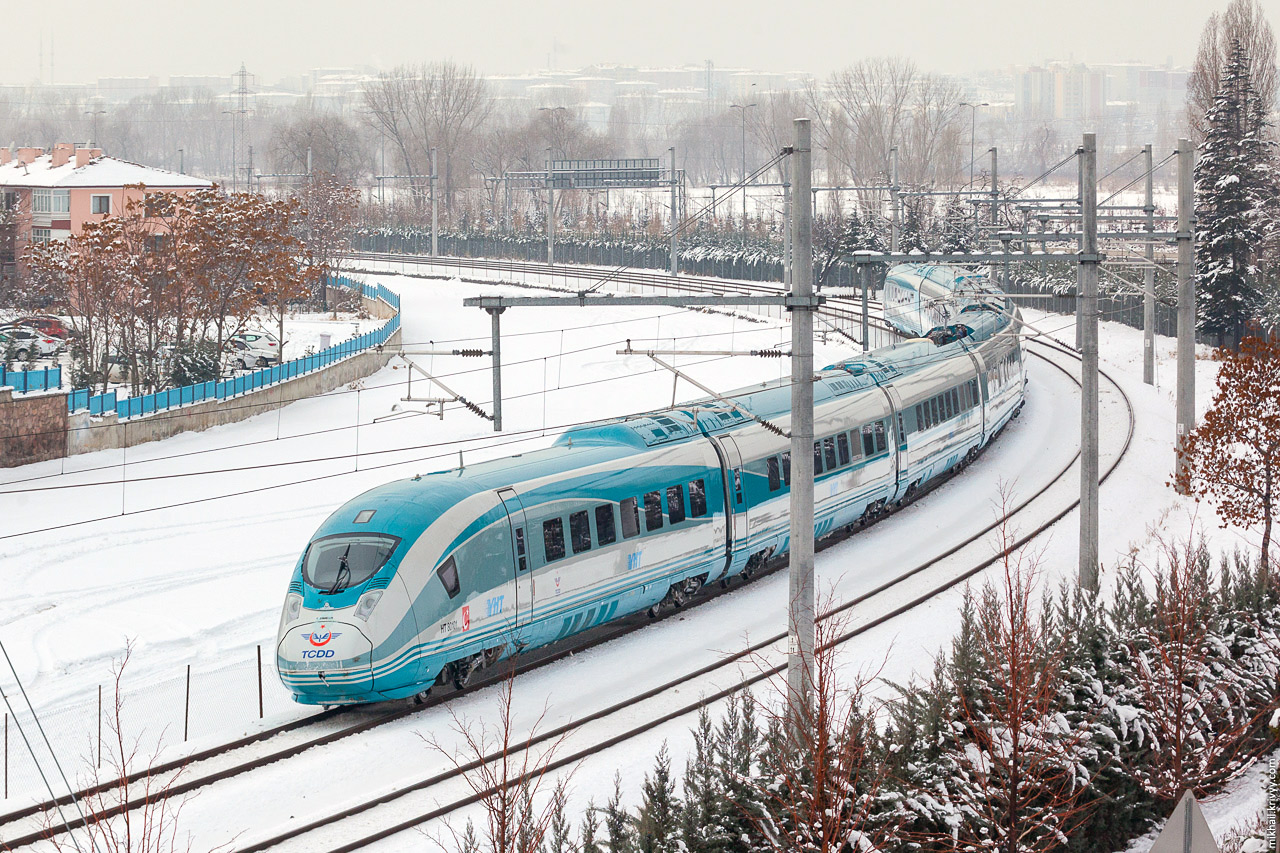
High-speed rail in Turkey began service in 2009. TCDD has branded its high-speed service as Yüksek Hızlı Tren or YHT, directly translating to High-Speed Train, dubbed after the trains' capacity to reach 250 km/h (and in some advanced sections of the Ankara-Konya railroad up to 300 km/h). There had been previously tried but failed accelerated train projects, i.e. higher speed rail without the necessary upgrades on the railroad tracks, causing a number of accidents and ending up with losses incurred by TCDD in the early 2000s. YHT, in stark contrast, became a commercially successful, safe and cheap alternative to Flights and Roads, cutting the travel time between the city centers of two largest cities of the country up to 4 hours. Currently, YHT trains operate 22 daily trips based from its central hub in Ankara, in addition to more trips on the Istanbul–Konya high-speed railway that bypass Ankara.
YHT currently operates on two main lines: the Ankara–Istanbul high-speed railway, and Ankara–Konya high-speed railway. In total, these lines connect 8 provincial capitals out of 81 Provinces in Turkey, namely Adapazarı (via Arifli), Ankara, Bilecik, Eskişehir, Istanbul, İzmit, Karaman and Konya. There are currently ongoing construction projects aiming to link up at least 6 more provincial capitals, including third and fourth largest cities of the country İzmir and Bursa, besides Afyonkarahisar, Edirne, Kayseri, Sivas and other potential cities. Further ambitions at the planning stage eventually aim to link up East and West points of the country through high-speed railways and act as an international High-speed railway bridge across Europe and Asia

On 13 March 2009, the first phase of the Ankara–Istanbul high-speed railway entered service between Ankara and Eskişehir. On 25 July 2014, the Ankara-Istanbul high-speed line services began to reach the Pendik railway station on the Asian side of Istanbul, and on 13 March 2019 the services began to reach the Halkalı railway station on the European side of Istanbul, passing through the Marmaray railway tunnel under the Bosphorus strait. There were initially 6 daily departures in both directions.

On 23 August 2011, the YHT service on the Ankara–Konya high-speed railway was inaugurated. The Konya-Ankara line was later connected with the Istanbul–Ankara line at the Polatlı district of Ankara Province on 23 March 2013, essentially bypassing the city of Ankara and shortening the distance from Istanbul to Konya to 5 hours. Most recently on 8 January 2022, the Konya line was extended into another provincial capital, Karaman.
High-speed rail in Turkey is still developing, with new lines currently under construction or in the planning phase. By 2023, the Ministry of Transport and Infrastructure expects Turkey's high-speed rail system to increase to 10,000 kilometers.
Mainline services

Mainline service () is the railway's main service. In 2010 mainline services made up for 24% of the railway's passenger traffic. Mainline service includes 2 types of trains: Express and Blue Train.
Express service is between major cities and are fast, comfortable and equipped with modern air-conditioned TVS2000 railcars and only stop at important stations. Express trains have an average operating speed of 100 km/h to 120 km/h. Express service has both day (e.g. İzmir-Bandırma) and overnight trains between major cities far apart (e.g. Ankara-Kars). These trains have coaches, a dining car and a sleeping car or a couchette car, or sometimes both.
The TVS2000 railcars used on mainline service are the most comfortable cars in TCDD's entire fleet. TVS2000 railcars may also be used on international services because international services are considered mainline services within Turkey.
International services
Former international services

The Haydarpaşa Terminal was the terminus for a weekly train, to Tehran in Iran, another train to Iran used to travel between Van, Turkey and Tebriz in Iran.
Additionally, trains from Iran to Syria (and vice versa) used to pass through Turkey.
-
Trans-Asia Express, to Tehran, Iran via İzmit, Bilecik, Eskişehir, Ankara, Kayseri, Sivas, Elazığ, Tatvan (train-ferry), Van and Tabriz.
-
Van-Tebriz Treni (Van – Tabriz train) Route: Van, Özalp, Kapıköy, Razi, border crossing to Iran, Salmas, Tabriz (and back.)
-
Tehran – Damascus Train, route: Tehran, Tabriz, Razi, Kapıköy, border crossing to Turkey, Van, (train-ferry), Tatvan, Muş, Elazığ, Malatya, Fevzipaşa, Islahiye, Meydanekbez, Turkey – border crossing to Syria, (via Chemins de Fer Syriens) – Meidan Ekbis, Aleppo, Damascus (and back.) This service was interrupted when the border between Syria and Turkey was closed due to the Syrian civil war.
-
Taurus Express (Toros Ekspresi), route: Istanbul: Haydarpaşa Terminal, Eskişehir (Enveriye), Kütahya, Afyon, Konya, Adana, Fevzipaşa, Islahiye, Meydanekbez, border crossing to Syria (via Chemins de Fer Syriens) – Aleppo, Damascus (and back.)
-
Gaziantep – Baghdad: This service was indefinitely suspended since 13 March 2003 with the invasion of Iraq and the ongoing insurgency. Route: Turkey: Gaziantep, Karkamış, Akçakale, Ceylanpınar, Şenyurt, Nusaybin, border crossing to Syria, Al Qamishli, (via Chemins de Fer Syriens), border crossing to Iraq, El-Yaribieh, Rabia, Mosul, Baghdad. It was also running from Istanbul to Gaziantep as mainline until 2003. It is begun again on 16 August 2012 between Eskişehir-Adana but due to renovations, it's shortened to Konya-Adana route on 15 March 2013.
-
Dostluk/Fillia Express (IC 90/91), to Thessaloniki, Greece via Uzunköprü, Pythion and Alexandroupolis.The line however was eventually terminated in February 2011.
Regional services
Commuter services
As of 2011, the Turkish State Railways operated commuter rail in Istanbul and Ankara, with previous commuter service in İzmir from up to 2006, which is now operated by İZBAN. The railways use the E14000 and the E23000 EMUs on their commuter services. Previously, the newly retired E8000 EMUs and the E4000 electric locomotives were used as well. The first commuter rail service in Turkey was the Istanbul-Halkalı Line on the European side of Istanbul, operating from Sirkeci Terminal to Halkalı in 1955.
Freight operations
Rail freight transport
From 1980 onwards, rail freight tonne-kilometers transported by the TCDD rose slightly from ≈5000million tonne-km in 1980 to ≈7000million tonne-km in 1990 and to ≈9000million tonne-km in 2000. Approximately 50% of freight moved is minerals or ores, with construction materials increasing to ≈10% in 2000 from less than 5% in 1980, food/agricultural products, chemicals/petroleum, and metal sectors each account for between 5 and 10%. International freight accounted for approximately 5% of totals in 2000.
As of 2012, 25.7 million tons are transported by rail in Turkey. Two steel companies, Erdemir and Kardemir, top 2 customers of TCDD, had transported 4.5 million tons in 2012, mainly iron ore and coal. 2.1 million tons of rail freight belong to international traffic. Most of international traffic is between Turkey and Europe, done via Kapikule. Several container trains are running in this route as well as conventional wagons.
As of 2014, 26.6 million tons are transported on rail in Turkey. 7.1 million of it is done by private wagons. International transport went down to 1.7 million.
Containers are widely used both in international and domestic transportation. 7.6 million tons are carried in containers. TCDD supports transportation by containers. Thus, almost all of the private railway companies invested in container wagons, and carrying 20% of all rail freight by their own wagons.
TCDD has plans to strengthen freight traffic by adding 4000 km of conventional lines until 2023. That includes new international rail connections to Georgia, Iraq and Iran. TCDD is also constructing 18 logistic centers to enable transportation of more loads by rail.
TCDD is planning to increase its transit traffic (11000 to in 2011) by constructing "iron silk road" to connect Europe to Asia. Marmaray is the most important part of this project which was completed in 2015 and now in service. Another project is Kars–Tbilisi–Baku railway which is planned to be completed in 2016 and start functioning in 2017. Also, plans for another supplying project to Kars-Tbilisi-Baku railway, the Kars-Igdir-Nakhcivan high-speed railway has been completed. TCDD wants to have share from the freight traffic between Europe and China through this line.
Ports

The State Railways own and operated seven ports throughout the country and has connections to two more ports. The ports TCDD owns are the Port of Haydarpaşa in Istanbul on the southern mouth of the Bosphorus, the Port of İzmir on the Aegean Sea, the Port of Mersin and the Port of İskenderun on the Mediterranean Sea, the Port of Bandırma on the Sea of Marmara, the Port of Derince on the Gulf of İzmit, and the Port of Samsun on the Black Sea. The railways have connections to the Port of Zonguldak, owned by Türkiye Taşkömürü Kurumu (Turkish Coal Company), the Port of Tekkeköy and the Port of Tekirdağ, owned by AKPORT AŞ. In 2004, the privatization of all ports except Haydarpaşa began.
By 2014 Mersin, Iskenderun, Bandirma, Samsun ports had been privatized. Tender for privatization of Derince Port has also completed and waiting for takeover.
The state railways are planning on building rail connections to the Port of Güllük (via Çine) and to the Port of Ereğli, which TCDD serviced until 2004.
The ports TCDD owns are the most important in Turkey. The country's five largest ports are owned by the state railways. The Port of Haydarpaşa will soon be decommissioned, when the Marmaray project is complete.
Performance, market share, assets and financial results

Since 1950, the railway system's market share of freight transportation dropped from 70% to ≈55% (1960), ≈25% (1970), ≈10% (1980, 1990) and to less than 10% in 2000. A similar trend was observed in the percentage of passenger transport performed by rail – dropping from a share of greater than 40% in 1950 to ≈25% in 1960; less than 10% in 1970; ≈5% by 1980; and reaching an all-time low of 2% by 2000. This was partly due to major investment and expansion in the road network.
The TCDD receives subsidies from the government for socially necessary operations, but has registered increasing losses in all its areas of business except for port operations; which have high port tariffs (higher than 36%). By 2000, the cost to the Turkish government had exceeded $500 million per year in addition to a subsidy of over $100 million. In addition to the problems caused by the lack of investment from 1950 onwards, the TCDD organisation has been characterised as suffering from the common problems associated with state-owned enterprises; i.e. emphasis on production rather than customer needs; subject to government reliance and interference; and an inward-looking corporate culture.
As of 2008, the amount of freight transported was the highest ever (18.343 million tonne-kilometers); though actual growth was small over the previous 10 years, and passenger figures had risen slightly overall over the past decade.
As of 2008, the TCDD administers the Ankara Railway Factory, Sivas Concrete Sleeper factory, Afyon Concrete Sleeper factory, Behiçbey rail welding and track machinery repair factory and Çankırı Switch factory. Additionally, the state owned companies TÜLOMSAŞ, TÜDEMSAŞ and TÜVASAŞ are affiliates. The TCDD has a 50% share in the İzmir Banliyö Taşımacılığı Sistemi A.Ş. (İZBAN A.Ş.) which operates the metro in İzmir, and a 15% share in EUROTEM.
Rolling stock
Currently rolling stock is the responsibility of TCDD Transport.
Retired fleet
Locomotives
| Model | Picture | Numbers | Built | Acquired | Type | Power | Builder (Designer) | Notes | Road power | Switchers | |
|---|---|---|---|---|---|---|---|---|---|---|---|
| E4000 | [[File:E4000s at Halkali.jpg | 125px]] | 4001–4003 | 1955 | 1955 | Electric | 2170 hp (1620 kW) | Alsthom | Ordered for use on TCDD's first electrified line. | ||
| DE20000 | [[File:DE20002 Ankara.jpg | 125px]] | 20001-20005 | 1957–58 | 1957–58 | Diesel Electric | 1800 hp (1320 kW) | General Electric | |||
| E2000 | [[File:SNCF BBB 20003.jpg | 125px]] | 2000 | 1955 | 1961 | Electric | 2346 hp (1750 kW) | MTE | Ex SNCF BBB 20003 | ||
| DH27000 | [[File:DH27003.jpg | 125px]] | 27001-27003 | 1961 | 1961 | Diesel Hydraulic | ???? | Krauss-Maffei | |||
| DE21500 | [[File:DE21506 Karabük.jpg | 125px]] | 21501-21540 | 1964–65 | 1965 | Diesel Electric | 1580 hp (2150 kW) | General Electric | |||
| E40000 | [[File:E40013 at Adapazari.jpg | 125px]] | 40001-40015 | 1969 | 1971–1973 | Electric | ???? hp (2945 kW) | Alsthom and TÜVASAŞ (Groupement 50 Hz) | |||
| E52500 | [[File:TCDD E52522 at Hyderpasa.jpg | 125px]] | 52501-52520 | 1967 | 1998–2005 | Electric | 5180 hp (3860 kW) | Končar (ASEA) | Originally built in 1967 as class 441, acquired and overhauled by TCDD in 1998. Returned after loan contract end. | ||
| DH33100 | [[File:TCDD DH33121.jpg | 125px]] | 33101-33105 | 1953 | 1953 | Diesel Hydraulic | 350 hp (260 kW) | MaK | TCDD's first diesel locomotive. | ||
| DH44100 | [[File:DH44106.jpg | 125px]] | 44101-44106 | 1955 | 1955 | Diesel Hydraulic | 800 hp (590 kW) | MaK | |||
| DH6000 | 6001 | 1959 | 1959 | Diesel Hydraulic | 610 hp (445 kW) | Jenbacher | Type DH600C | ||||
| DH4100 | 4101 | 1960 | 1960 | Diesel Hydraulic | 410 hp (300 kW) | Jenbacher | Type DH400C | ||||
| DH6500 | [[File:DH6500 August 2002.jpg | 125px]] | 6501–6540 | 1960 | 1960 | Diesel Hydraulic | 650 hp (480 kW) | Krupp | |||
| DH3600 | [[File:DE3612.jpg | 125px]] | 3601–3624 | 1968 | 1968 | Diesel Hydraulic | 350 hp (260 kW) | MaK | Based on the DE22000. | ||
| DH11500 | [[File:DH11510.jpg | 125px]] | 11501-11511 | 1960 | 1982 | Diesel Hydraulic | 1100 hp (810 kW) | MaK | Acquired from Deutsche Bahn in 1982. |
Trainsets
| Model | Picture | Numbers | Built | Type | Power | Builder (Designer) | Notes | |
|---|---|---|---|---|---|---|---|---|
| MT5200 | [[File:MT5200.jpg | 125px]] | 5201–5202 | 1944 | DMU | 840 hp | MAN | |
| MT5300 | [[File:MT5300 at Haydarpasa.jpg | 125px]] | 5301–5516 | 1951 | DMU | 1100 hp | MAN | |
| E8000 | [[File:TCDD_E8030.JPG | 125px]] | 8001–8030 | 1955 | EMU | 1020 kW | Alsthom | |
| MT5500 | [[File:MT55097 at Basmane.JPG | 125px]] | 5501–5511 | 1968 | DMU | 580 hp | Fiat | |
| E14000 | [[File:E14000s at Goztepe-1.JPG | 125px]] | 14001-14075 | 1979 | EMU | 1040 kW | TÜVASAŞ (Groupement 50 Hz) |
Railcars
| Model | Picture | Numbers | Built | Type | Power | Builder (Designer) | Notes | |
|---|---|---|---|---|---|---|---|---|
| 1-6 | [[File:TCDD Class 1-6 railcar.jpg | 125px]] | 5401–5420 | 1934 | Railcar | 85 hp | Škoda | |
| 21-25 | [[File:TCDD Class 21-25 railcar.jpg | 125px]] | 5401–5420 | 1935 | Railcar | 130 hp | MAN | |
| MV5100 | [[File:MV5100.jpg | 125px]] | 5401–5420 | 1942 | Railcar | 210 hp | Uerdingen | |
| MT5400 | [[File:MT5400 Yedikule.jpg | 125px]] | 5401–5420 | 1954 | Railcar | 300 hp | SCCF | |
| RM3000 | 5401–5420 | 1960 | Railcar | 340 hp | Uerdingen/Germany | |||
| MT5600 | 1990 | Railcar | 550 hp | TÜVASAŞ | Used for regional services |
Network
TCDD directly owns and operated 8697 km of common carrier lines, of which 1920 km are electrified, throughout 57 provinces. Along with this, the railways own and operated over 240 km of industrial lines and 206 km of high-speed lines, with 574 km of lines under construction. As of 2010, the railways consist of 763 tunnels, 25,441 bridges, 17 wyes and 7 loops. The railway's fleet consists of 467 main line Diesel locomotives, 67 Electric locomotives, 860 passenger coaches, 135 MUs, 33 High-speed rail sets and 15,384 freight cars.
Electrification
Electrified lines comprised less than half of the network in 2020, but the aim is for over three-quarters by 2023. Along with these several Turkish cities operate rapid transit and tram system electrified with either overhead wire or third rail.
By 2013, the electrified lines reached to 2416 km. There is also 888 km of electrified high speed train network, which makes 3304 km in total.
History
Turkish State Railways started an electrification plan in 1953. The plan was to first electrify important suburban lines in Istanbul and Ankara. The main reason for this was the many complaints of citizens living in the city about the pollution of the steam locomotives. The railways chose the standard 25 kV 50 Hz AC system to electrify with. The first line to be electrified was the Sirkeci-Halkalı line on the İstanbul commuter railway. Three electric locomotives were ordered from Alsthom and Jeumont from France as well as several sets of multiple units. Electrification was complete and electric train started to run on December 4, 1955. The electrification got many positive reactions. In 1969, TCDD electrified the Haydarpaşa–Gebze part of the commuter railway in İstanbul. Several more sets of E8000 emus were ordered as well as 15 E40000 electric locomotives to meet the demands of the railway. The Ankara Suburban Railway was electrified in 1972 and brand new E14000 multiple units were ordered.

With the success of electrifying suburban lines, the State Railways turned to electrify important main lines. The main reason for this is that tough gradients would be easier to climb with electric traction than steam or diesel traction. On February 6, 1977, TCDD finished the electrification as well as major earthworks of the Gebze-Adapazarı part of the İstanbul–Adapazarı main line. The State Railway then turned to electrify the entire İstanbul-Ankara main line, to try to save its diminishing reputation. Construction started in 1987. Forty-five E43000 electric locomotives were ordered from Toshiba and built in Eskişehir by Tülomsaş, to be used on the line. Electrification was completed between Arifye and Eskişehir and electric trains began to run in 1989. Electrification was connected to Ankara in 1993. The major ore route between Divriği and İskenderun was electrified in 1994 to make it easier for heavy trains to go up steep gradients. İstanbul to Edirne and Kapıkule was electrified in 1997 and 15 new E52500 electric locomotives were delivered from ASEA in 1998. In an attempt to revive İzmir's suburban network, Alsancak-Cumaovası and Basmane-Aliağa lines were electrified in 2001 and 2002 respectively. However these were not used at all. In 2006 the wires were taken down and the line was re-electrified completely between 2006 and 2010. This line opened on August 30, 2010, between Alsancak-Cumaovası and October 29, 2010, between Alsancak and Aliağa.
High speed rail
Main article: High-speed rail in Turkey
The United Kingdom through Export Finance, a credit agency gave a Turkish multinational a €781m loan to finish the High speed rail. The railway is between Gaziantep and Mersin through Adana and Osmaniye. Rönesans Holding, the Dutch Turkish company in charge of the project is required by the UK to be supplied by British suppliers. Mehmet Şimşek, Turkish finance minister said the project is meant to improve the connectivity of Turkey and upgrades Turkey's historic south trade route. The high speed rail is supposed to reach 225km/h, to reach this Railway Supply said Turkey will have to indtroduce modern modifications of its transport system and update train engines. The Turkish transportation ministry said eight carriages are supposed to commence passenger transportation in 2025.
Future plans
Almost 1500 km of track was planned to be completely electrified in 2020.
Sources
- {{Cite report

Turkey has chosen to electrify at the conventional 25 kV 50 Hz AC. The first electrified lines were the Istanbul suburban lines on the European side, from Sirkeci to Soğuksu, on 4 December 1955, and in the same period the E8000 electrical multiple units were taken into use. The suburban lines on the Asian side of Istanbul, from Haydarpaşa to Gebze, were electrified in 1969; while the Ankara suburban trains were electrified in 1972, on the line from Sincan to Kayaş.
On 6 February 1977 the tracks from Gebze to Adapazarı were made double track and electrified, allowing the first main line operation of electric trains in Turkey. The line from Arifiye outside Adapazarı to Eskişehir were further electrified in 1989 and in 1993 to Sincan, allowing electric train passages from Istanbul to Ankara. In 1994 the European lines from Istanbul to Edirne, Kapıkule and the Bulgarian border were also electrified. The same year the line from Divriği to İskenderun in eastern Turkey was also electrified, though this line is not connected to the rest of the electrified network. In 2006 the İzmir suburban system was also electrified.
Regions
Railway links with adjacent countries
The following is a list of railway border crossings of Turkey.
| # | Name | In province | Open/closed since | To country | Counterpart | Status | Break-of-gauge |
|---|---|---|---|---|---|---|---|
| 1 | Uzunköprü | Edirne | 4 September 1953 | Greece | Pythion | date=September 2023}}) | No |
| 2 | Kapıkule | Edirne | 1 April 1988 | Bulgaria | Svilengrad | Open | No |
| 3 | İslahiye | Gaziantep | 4 September 1953 | Syria | Ekbez | Closed | No |
| 4 | Al-Rai | Kilis | 4 September 1953 | Syria | Akhtarin | Closed | No |
| 5 | Akyaka | Kars | 4 September 1953-11 July 1993 | Armenia | - | Closed | Yes |
| 6 | Nusaybin | Mardin | 4 September 1953 | Syria | Qamishli | Closed | No |
| 7 | Kapıköy | Van | 7 October 1971 | Iran | Razi | Open | No |
| 8 | Çıldır | Ardahan | 30 October 2017 | Georgia | Kartsakhi | Open for freight only]] | Yes |
References and notes
Notes
References
References
- Tanıl Bora. (2012). "Tren Bir Hayattır". Iletişim yayınları.
- "Railway Turkey".
- Annual Statistics of the Turkish State Railways, T.C.D.D., available at http://www.tcdd.gov.tr/files/istatistik/20102014yillik.pdf
- Annual Sector Report of the Turkish State Railways, T.C.D.D., available at http://www.tcdd.gov.tr/files/istatistik/2014sektorrapor.pdf
- "Land transport/Rail – Republic of Turkey".
- TCDD ratios 1922–2005
- Anadolu Agency. [https://www.aa.com.tr/en/economy/turkish-railways-posts-record-figures-for-2019/1744316/ "Turkish railways posts record figures for 2019"], 12 June 2020
- Uysal, Onur. [http://railturkey.org/2014/07/24/railway-industry-report-2013-passanger/ "Turkish Railway Industry Report 2013 – Passenger"], ''Rail Turkey'', 24 July 2014
- Uysal, Onur. [http://railturkey.org/2014/07/26/istanbul-ankara-high-speed-train-opened/ "First High Speed Train Set on Ankara Istanbul Line Arrived Istanbul"], ''Rail Turkey'', 26 July 2014
- Uysal, Onur. [http://railturkey.org/2014/08/09/istanbul-ankara-high-speed-train-new-schedule/ "New Schedule for Istanbul-Ankara High Speed Train"], ''Rail Turkey'', 9 August 2014
- [http://www.rayturk.net/?p=29156 Turkey's high-speed rail system will be complete by 2023] – ''rayturk.net''
- [http://www.tcdd.gov.tr/Upload/Files/ContentFiles/2010/istatistik/20062010yillik.pdf 2010 TCDD Statistics] – ''tcdd.gov.tr''
- "TCDD: Destinations in the Middle East".
- (25 July 2012). "Turkey Closes Syria Border Crossings". [[The Wall Street Journal]].
- Brosnahan, Tom. "Toros Ekspresi Adana – Konya".
- (15 August 2012). "Vagonları yenilenen "Toros Ekspresi" 16 Ağustos'da seferlerine başlıyor". www.rayhaber.com.
- (13 March 2013). "Toros Ekspresi seferleri iptal edildi". www.rayhaber.com.
- [http://www.istanbul-ulasim.com.tr/en/default.asp?menu_id=1&sayfa_id=1 İstanbul Ulaşım: Istanbul Metropolitan Municipality Transportation Services]
- "EGO Genel Müdürlüğü: Ankara Metropolitan Municipality Transportation Services".
- "İzmir Metropolitan Municipality: İzmir Metro".
- [http://hwtsk.com/images/HWTSK_World_Bank_Restructuring_Presentation_for_TCDD_27_May_03.pdf Restructuring options for reform of TCDD], World Bank report 2003, ''hwtsk.com''
- Uysal, Onur. [http://railturkey.org/2013/12/16/leading-railway-clients-2012/ "Leading Railway Clients 2012"], ''Rail Turkey'', 16 December 2013
- Uysal, Onur. [http://railturkey.org/2013/06/14/railway-companies-europe/ "Leading Railway Companies In Turkey 2012 – European Traffic"], ''Rail Turkey'', 14 June 2014
- Uysal, Onur. [http://railturkey.org/2014/10/23/tcdd-annual-statistics-2013/ "TCDD Annual Statistics 2013"], ''Rail Turkey'', 23 October 2014
- Uysal, Onur. [http://railturkey.org/2013/07/15/railway-companies-railcar-owners/ "Leading Railway Companies In Turkey 2012 – Railcar Owners"], ''Rail Turkey'', 15 July 2013
- Uysal, Onur. [http://railturkey.org/2013/07/11/railway-targets-2023/ "2023 Targets in Rail Freight – Network"], ''Rail Turkey'', 11 July 2013
- Uysal, Onur. [http://railturkey.org/2013/12/05/2023-targets-logistic-centers/ "2023 Targets in Rail Freight – Logistic Centers"], ''Rail Turkey'', 5 December 2013
- Uysal, Onur. [http://railturkey.org/2013/12/10/when-asia-europe-connected/ "When Asia and Europe Will Be Connected?"], ''Rail Turkey'', 10 December 2013
- Uysal, Onur. [http://railturkey.org/2014/10/20/baku-tblisi-kars-railway/ "10 Things to Know About Baku-Tbilisi-Kars Railway Project"], ''Rail Turkey'', 20 October 2014
- [http://www.rayhaber.com/2016/kars-milletvekilleri-demiryollarini-ziyaret-etti/ Kars-Iğdır-Nahçivan Hızlı Tren Projesi (KIN)]
- Uysal, Onur. [http://railturkey.org/2013/11/12/marmaray-connects-asia-europe/ "Is Marmaray Key for Europe-Asia Rail Connection?"], ''Rail Turkey'', 12 November 2013
- [http://www.tcdd.gov.tr/tcdding/haydarpasa_ing.html Port of Haydapaşa], ''tcdd.gov.tr''
- [http://www.tcdd.gov.tr/tcdding/izmir_ing.html Port of İzmir], ''tcdd.gov.tr''
- [http://www.tcdd.gov.tr/tcdding/mersin_ing.html Port of Mersin], ''tcdd.gov.tr''
- [http://www.tcdd.gov.tr/tcdding/iskenderun_ing.html Port of İskenderun], ''tcdd.gov.tr''
- [http://www.tcdd.gov.tr/tcdding/bandirma_ing.html Port of Bandırma], ''tcdd.gov.tr''
- [http://www.tcdd.gov.tr/tcdding/derince_ing.html Port of Derince], ''tcdd.gov.tr''
- [http://www.istanbuldenizcilik.gov.tr/index.php?option=com_content&view=article&id=48&Itemid=68 Port of Zongulak], Port statistics
- [http://www.akport.com.tr/?part=Communication&key=ulasim_trenyolu AKPORT transport], ''akport.com.tr''
- Uysal, Onur. [http://railturkey.org/2014/02/12/railway-connected-ports-turkey/ "Railway Connected Ports of Turkey"], ''Rail Turkey'', 12 February 2014
- Uysal, Onur. [http://railturkey.org/2014/06/09/derince-port-privatized/ "Safi Kati Yakit is the New Operator of Derince Port"], ''Rail Turkey'', 9 June 2014
- [http://www.kugm.gov.tr/BLSM_WIYS/DLH/tr/DOKUMAN_SOL_MENU/Demiryollari/Demiryolu_Etud/20100421_113633_10288_1_64.html AYDIN-ÇİNE-YATAĞAN-GÜLLÜK RAIL PROJECT] – ''dlh.gov.tr''
- [http://www.tgaassoc.com/documents/ankara-may-2002.pdf TCDD Challenges] Author: Lou Thompson, 3 May 2002 ''www.tgassoc.com''
- [http://www.tcdd.gov.tr/kurumsal/TCDDANNUALREPORT2008.pdf TCDD annual report 2008] ''www.tcdd.gov.tr''
- [http://www.trainsofturkey.com/w/pmwiki.php/History/TCDD TCDD Statistics] – Trains of Turkey
- Hızlı Tren Hakkında Herşey (A Complete Reference to Turkish High Speed Rail) – by T.C. Devlet Demiryolları İşletmesi Genel Müdürlüğü
- 2010 TCDD Annual Report – www.tcdd.gov.tr
- 2007 TCDD Annual Report – www.tcdd.gov.tr
- Uysal, Onur. (October 23, 2014). "TCDD Annual Statistics 2013".
- "TCDD History, Electrification of the railways".
- Atack, Patrick Rhys. (2023-07-24). "UK Government backs high-speed electrified rail in Turkey".
- BATRAK, OLEKSANDR. (2023-08-28). "Operation of Turkey's High-Speed Electric Trains".
- . (2019-11-12). ["Turkey publishes 2020 rail plan"](https://www.railwaygazette.com/infrastructure/turkey-publishes-2020-rail-plan/55085.article).
- (26 March 2013). "Sınır Kapıları Listesi HUDUT KAPILARI NEVİLERİN GÖRE-AÇIKLAMALI SINIR ÜLKELERİ". Interior Ministry of Turkey.
- [[Railway Gazette International]] – January 2008 p51
- Uysal, Onur. [http://railturkey.org/2013/11/11/tekirdag-derince-ferry-departed/ "Wagons On Board: Tekirdag Derince Ferry Departed"], ''Rail Turkey'', 11 November 2013
- "Trains of Turkey {{!}} Network / Train Ferries".
- Uysal, Onur. [http://railturkey.org/2014/01/21/2014-railway-investment-budget/ "Railway Investments of Turkey in 2014"], ''Rail Turkey'', 21 January 2014
- [http://www.invest.gov.tr/en-US/sectors/Pages/TransportationAndLogistics.aspx Invest in Turkey: Transportation and logistics]
- [http://www.trainsofturkey.com/w/pmwiki.php/History/TCDD TCDD History] – Trains and Railways of Turkey
- "Hakkında".
This article was imported from Wikipedia and is available under the Creative Commons Attribution-ShareAlike 4.0 License. Content has been adapted to SurfDoc format. Original contributors can be found on the article history page.
Ask Mako anything about Turkish State Railways — get instant answers, deeper analysis, and related topics.
Research with MakoFree with your Surf account
Create a free account to save articles, ask Mako questions, and organize your research.
Sign up freeThis content may have been generated or modified by AI. CloudSurf Software LLC is not responsible for the accuracy, completeness, or reliability of AI-generated content. Always verify important information from primary sources.
Report